Category Focus/categories/analytics
Analytics AI Tools
Discover and compare the best analytics AI tools and software. Browse 131+ curated tools with reviews and rankings.
Projects tracked
131
Sort mode
RECENT
Page
1
Discover and compare the best analytics AI tools and software. Browse 131+ curated tools with reviews and rankings.
Projects tracked
131
Sort mode
RECENT
Page
1
Navige is a cost-control layer for AI agents that sits between your agents and everything they pay for. On one side are the agents themselves and the tools and frameworks they run on; on the other side are the models and metered services those agents call. Navige plugs into both and routes every call through one governed layer so that, in the company's words, every run gets cheaper and faster, with the same result. The product is built for teams that run AI agents in production and want to manage programmatic AI spend — the money spent on models, agent traffic and metered AI tools — rather than only reviewing it after the fact. Most cost tooling for AI agents works backwards. As Navige puts it, everyone else shows you what the run cost after it has run; Navige changes the step before it runs. The company frames the underlying problem as a set of familiar failure patterns: runs that never finish, where agents keep running without producing an output; big model, small task, where a step is answered by a larger model than its outcome required; chasing, not remembering, where the same work is redone instead of reused; one budget, many agents, where spend is not governed centrally; and misread, then paid for, where an error is only discovered after the call has been billed. The stated consequence is that the bill is decided before the dashboard sees it — by the time cost reporting catches up, the money has already been spent. Navige lightens every run in four stated ways. The first is cache and reuse, described as never pay twice: when a verified answer is still valid, Navige reuses it instead of paying for another model or tool call. The second is context trimming and tool payload capping, described as only pay for what's used: oversized tool results are limited and accumulated history is trimmed before the next request is sent to the model. Together these two controls target both halves of token spend — the context a model is asked to read and the output it is asked to produce — by removing repeated work and excess context rather than by degrading the answer. The third control is a loop and failure guard, described as stopping runaway jobs: repeated failures are blocked before another call adds to the bill, which addresses the 'runs that never finish' pattern directly. The fourth is smart routing, described as the right model, once it's earned: Navige chooses the model based on the task complexity. Routing is deliberately conservative — if Navige is unsure, it keeps your chosen model — so the substitution only happens where the system is confident the outcome will hold. Governance is built into the same layer. Users can set budgets, catch runaway loops and approve sensitive actions. Tool calls are checked against your rules before they run, not flagged afterwards, which means the guardrail acts at the moment of decision rather than in a post-hoc report. Costs and savings are visible by job, with estimates clearly labelled so that projected figures are never confused with measured ones. Changes can be previewed before the controls are switched on, so teams can see what a policy would do before it takes effect. The Watchtower tier is described as free forever. Architecturally, Navige is a middle layer rather than a replacement. Your agents, frameworks, keys and providers stay exactly as they are; you change one line of config and both ends are plugged in once. On the tools and frameworks side this covers LangChain, LangGraph, CrewAI, OpenAI Agents, MCP and Agentforce. On the models side it covers Anthropic, OpenAI, Google, AWS Bedrock, Mistral and Meta Llama, with the site summarising it as 'Claude, GPT, Gemini or Bedrock. One line of config, any framework.' Because the layer sits in the path of every call, the bill is influenced as work runs rather than reconstructed afterwards. Navige calls this approach Sufficiency Intelligence: 'Sufficiency isn't about using less AI. It's about using exactly enough.' That framing matters because the product is explicitly not a discount: it does not propose a cheaper answer to the same question, it proposes the same answer reached at the level it needed, and where a step needs a frontier model, sufficiency keeps it there. The promised outcome is straightforward: the same result with smaller bills, plus faster runs. Because the four controls act before a call is made, savings arrive during the run instead of appearing as a retrospective insight. Because routing defers to your chosen model when it is unsure, and because measurement checks results as well as cost, the spend-versus-quality trade-off is handled explicitly: a step that got cheaper and started being wrong is reported as a failure, never as an opportunity taken. Users also gain visibility — cost and savings broken out by job, with estimates labelled — and control, through budgets, approvals and rules that are enforced before execution. The most direct use case is repetitive agent work: the same conclusion reached the same way many times, where a verified answer can be reused rather than recomputed. Navige's own calculator treats repetitive work as carrying the most opportunity and complex work the least. A second scenario is the multi-agent environment, where several agents touch the same work and share one budget; a governed layer makes that budget observable and enforceable. A third is agents that use premium models by default or send large prompts and context, where smart routing and context trimming apply. A fourth is agents that make paid tool, search or data API calls, where a still-valid held answer can replace another paid call. Before committing, teams can run the sufficiency calculator, which asks for monthly programmatic AI spend and the kind of work involved and returns an estimated opportunity range broken into overspecified intelligence, repeated or unnecessary execution, excess context and output, and tools and APIs. Once connected, Navige leaves a slice of your jobs running untouched and compares the two so the difference is observed rather than assumed. The documented workflow is 'Plug in your agents. Switch on when you trust.' Navige's stated audience is teams running AI agents at scale: the site reports 51+ agents connected and $9K+ in AI spend managed, priced to the millionth of a dollar and updated live, with tool calls governed against rules before they run. The supported integration surface spans agent frameworks and orchestration tools — LangChain, LangGraph, CrewAI, OpenAI Agents, MCP and Agentforce — and model providers — Anthropic, OpenAI, Google, AWS Bedrock, Mistral and Meta Llama. Teams that do not see their platform are invited to say so. On pricing, the Watchtower tier is described as free forever, with dedicated pricing and enterprise pages for the other options; the site also notes that the spend figure entered into the calculator covers models, agent traffic and metered AI tools while excluding employee seat licences. The takeaway is that Navige treats AI agent cost as something to be governed during execution rather than audited afterwards. By sitting between agents and the models and tools they pay for, and by applying caching, context trimming, loop guards and smart routing under user-defined budgets and approvals, it aims to deliver the same output at a lower bill — using exactly enough intelligence for each step.
MentionBird is an AI visibility platform that tracks what AI assistants say when buyers ask them what to buy. It monitors the prompts that matter to a business across ChatGPT, Perplexity, Gemini, and Claude, as well as Google AI Overviews, Grok, Microsoft Copilot, and DeepSeek, and shows which sources each model cites when it answers. From there, MentionBird produces a per-prompt plan to get a brand into those sources. The product is aimed at marketing and SEO teams, founders, e-commerce stores, SaaS companies, and agencies that want their brand to be named in AI answers rather than only ranked in Google. The problem MentionBird addresses is that the shortlist for a purchase now forms inside the AI answer. Buyers no longer start with ten blue links; they ask AI, get two or three brand names, and shop from that list. If AI does not say your name, you were never in the running, and you would never know it. MentionBird's own launch story makes the point bluntly: the team took the top three Product Hunt launches and asked ChatGPT, Gemini and Claude the exact questions their buyers ask, such as 'Best browser for Claude Code?' and 'How do I track agent run costs?'. The result was nine answers and zero mentions, which means AI sent those buyers elsewhere. AI search pulls from pages it trusts, including listicles, Reddit threads, comparisons and YouTube videos, and if a brand is not there, it is not in the answer. Tracking the right prompts is the starting point. Users add the questions buyers actually ask, such as 'Best running shoes for daily use', 'Best marathon shoes for men', 'Best running shoes for flat feet' and 'Most comfortable shoes for long runs', and MentionBird keeps them in one workspace as prompts ready to track. The product guidance is to start with the prompts customers might use when searching for products or services like yours, which for most brands means tracking 20 to 50 real questions. A focused set of pre-purchase questions is described as more valuable than hundreds of broad prompts, and users can add, label or regroup prompts at any time as they learn what matters. Once prompts are tracked, MentionBird shows exactly which sources AI cites for each one. For a tracked prompt, the interface lists the sources AI checks and marks each as cited or not cited, covering domains such as runnersworld.com, runrepeat.com, YouTube shoe reviews and zappos.com listings, or verywellfit.com, rei.com expert advice, YouTube channels and fleetfeet.com. This matters because every prompt has its own set of sources: AI answers are built from a small set of pages, reviews and videos that the model trusts for that specific question. Sources decide the shortlist, so getting into them means getting recommended, while staying out means your competitor takes the customer. Seeing per-prompt citation status turns an opaque AI answer into a concrete list of places where a brand must earn a mention. AI Ranking Advice converts that list into work. Choose any tracked prompt, or customer question, and MentionBird reviews the answers, the named brands and the cited sources, then recommends practical steps while showing the effort required for each one. Advice is rated by impact and effort, for example 'Get featured in trusted running shoe roundups' marked medium effort and high impact because it targets the most-cited sources, 'Publish a guide to daily running shoes' marked medium effort to answer the questions buyers ask before choosing, and 'Add fit and durability details to product pages' marked low effort to give AI clearer product facts to quote. Recommendations may include better product pages, clearer product details, comparison guides, videos, or mentions from trusted websites. MentionBird also proves whether the plan is working. Every plan a team executes shows up in the numbers through daily checks across the supported AI platforms, with AI visibility data checked and updated once every 24 hours. Tracking is prompt by prompt: cited, not cited, or no brand named yet, and that gap is yours to take. It reports share of AI recommendations against each competitor week over week, and every score change is traced back to the exact prompt, model or citation that caused it. Example reporting shows brands such as Nike at 31 percent visibility share and up four points, Adidas at 27 percent and unchanged, Puma at 19 percent and down three points, and New Balance at 12 percent and up one point. The methodology is deliberately action-oriented. Other tools chart AI mentions and tell you when you dropped, leaving the 'now what?' to you; MentionBird is built around the question of what to do to get mentioned for a specific prompt. Its three steps are: pick the prompts that bring you customers, track exactly which sources AI cites for each one, and get ranking advice to win those sources. Setup requires no code, plugins or tracking tags: users add their brand, prompts and competitors, and MentionBird then checks AI answers without making any changes to the website, with setup taking only a few minutes. Unlike SEO rank trackers that report a webpage's position in Google search results for keywords, MentionBird tracks brand mentions across AI answers and the sources behind them. The payoff is visibility that turns into consideration. Because AI answers influence sales by shaping which brands buyers consider, and a buyer may visit only the brands included in the answer, appearing in those answers is directly relevant to revenue. If a brand is missing, a competitor may reach that buyer first. MentionBird's customers report discovering that they win category questions but lose comparison questions, that they were invisible on the exact questions engineering buyers ask about automating environment provisioning, and that AI was recommending an ATS to every buyer who asked while never naming theirs. One customer reports being in 83 percent of 'alternatives to the category leader' answers after MentionBird found the gap and told them exactly what to fix first. Another notes that having 3,300+ reviews was not enough while AI still failed to recommend them. Concrete use cases include e-commerce and retail brands competing on product-category prompts, such as running shoes or apparel, where being cited in trusted roundups, review sites and YouTube reviews determines whether AI names the brand. Software companies use it to find the questions where they are invisible among engineering or business buyers and then publish content that answers them. Agencies manage several clients in one workspace, while marketing and SEO teams track their brands and products and compare their visibility with competitors. Mentions of AI ranking advice also point to comparison guides and clearer product pages as fixes. Beyond those, MentionBird states it supports e-commerce stores, software companies, healthcare providers, law firms, financial services, real estate, travel and education, as well as home services, automotive companies and local businesses, meaning any business whose customers research online. MentionBird is designed for teams whose buyers ask AI what to buy, including marketing and SEO teams, founders, and agencies. Competitors can be added so a brand's AI mentions can be compared with theirs, and businesses managing several brands or product lines can keep them in one workspace, using tags to organize prompts by brand, product or project. Subscription plans can be changed at any time, with upgrades applying immediately and downgrades beginning with the next billing period, while saved prompts, labels and past data remain available. During the Product Hunt launch, code PH19 gives Starter at $19/mo for three months, and a free AI visibility report is available to start. MentionBird's core proposition is simple: AI search is the new shortlist. MentionBird shows which sources AI trusts for the prompts that drive sales, why competitors get recommended, and what to fix to win the mention, then proves the plan worked with daily tracking. For brands that suspect AI is sending their buyers elsewhere, it replaces guesswork with a prompt-by-prompt picture of the gap and a ranked set of actions to close it.
Kudos is a free financial companion that streamlines your purchases and returns the value back to you. It is built around a simple promise: set up once and earn forever. The product pairs the Kudos app with a free browser extension so that, wherever you shop, Kudos automatically maximizes your card offers and benefits, lowers your bills, and keeps finding new ways to save. According to the website, Kudos works at more than 2 million stores and supports more than 3,000 credit cards. It is used by 500,000+ members who want to take control of their finances today, and it holds a 4.8 star rating across 10,000+ reviews. Most money apps show you charts. Kudos does the work instead. The problem the product targets is that value embedded in your wallet routinely goes unclaimed: most people don't know their cards come with personalized offers they have to turn on by hand, benefits expire before they are used, bills quietly creep upward, and forgotten subscriptions keep charging month after month. Kudos states that its AI finds money you're missing and gets it back — activating card offers that are worth roughly $800 a year in early testing, calling providers to lower your bills at about $216 a year per negotiation, and cancelling subscriptions you forgot at around $247 a year each. You keep 100% of the savings. One testimonial describes the AI calling a cellphone company within 12 hours of subscribing and reducing a bill from $420 to $315 a month with no plan changes. The first feature group centers on card-linked offers and earning at checkout. Visit your issuer portal — Amex, Chase, BofA, Wells Fargo, Citi — with Kudos installed, and it automatically activates hundreds of offers across all your cards with no manual clicking required. Kudos auto-activates every offer worth $750+ a year and reminds you when to use them. The free browser extension then stacks rewards, benefits, and offers automatically: it picks the best card, autofills card details, applies offers, and stacks cash back at checkout. Because the offers are activated in the background and surfaced when you shop, members report that they actually use them instead of forgetting, earning cash back on purchases they were already making. The second group is benefits tracking and card guidance. Kudos tracks every benefit across all your cards and makes sure you use them before they expire, which the site frames as taking back +$3,000 in missed benefits every year. For in-store shopping, the Cheatsheet shows the best card to use based on your location, so you never miss a reward. Personalized card discovery tools include Dream Wallet, Card Explore, Test Drive, and Approval Odds, and a Test Drive feature helps members select the right card for their setup. Kudos also analyzes your transaction history and proactively finds personalized ways to earn more rewards and save money, so you understand your spending and get more from every purchase. The third group is the AI concierge and conversational layer. Kudos AI connects the dots across your cards, bills, and spending to answer questions, uncover hidden opportunities, and take action to save you money — you can ask your wallet anything. On the bills side, Kudos AI cancels unused subscriptions, negotiates your bills, and handles the calls to save you money in minutes. For recurring subscriptions, Kudos automatically detects them across all your connected cards and helps you decide what is worth keeping; Premium members can tap "Cancel for Me" and Kudos handles the entire cancellation process — phone calls, live chat, emails — while you get real-time status updates until it is done. By comparison, the site notes that Rocket Money takes up to 10 days and up to 50% of savings, while Kudos takes no cut. Kudos follows a four-step flow the website lays out as Activate, Connect, Automate, and Earn & Save. First you download Kudos and securely connect your cards. Next, Kudos learns how you spend in order to find ways for you to earn and save. Then it automates the work — activating offers, negotiating bills, and using the best card. Finally, you watch your savings pile up and keep more of what you earn. The learning step is what makes the automation personal: because Kudos understands your card mix and your transaction history, the recommendations it surfaces at checkout and the actions it takes on your behalf are tailored to your spending rather than generic advice. The outcomes the site reports are concrete. The average member earns over $3,000 per year with Kudos Premium, and on average Premium members earn an additional $754/year and save $324/year. A member dashboard shows one number for everything Kudos has earned or saved you, along with your wins and your next best money move. Members describe the product as surfacing useful actions instead of just charts, saving them time and helping them earn and save without constant checking — a personal finance experience without the busywork. Concrete workflows include online checkout, where the extension picks the best card, autofills details, applies activated offers, and stacks cash back; in-store shopping, where the Cheatsheet tells you which card to use based on your location; a benefits review, where Kudos tracks credits across your cards and reminds you before they expire; subscription cleanup, where Kudos detects recurring charges and cancels the ones you don't want; bill negotiation, where the AI calls providers such as a cellphone company on your behalf; and card selection, where Test Drive and Approval Odds help you decide whether a particular card fits your setup. Kudos is aimed at people who have multiple credit cards, or who aren't sure which card fits their setup, and at anyone who wants to stop leaving money on the table without doing manual work. The product integrates with Plaid for secure account connections and supports offers from Amex, Chase, BofA, Wells Fargo, and Citi, plus Boost Cash Back at 15,000 partner stores. Security is presented prominently: Plaid connection with user control over what is shared, Zero-Knowledge Architecture so sensitive data is encrypted on your device and invisible to anyone, SOC 2 (Type 1) compliance from independent audits, and 256-bit bank-level encryption. Pricing includes a free tier plus Premium options — a VIP Lifetime access plan at $190 total ($240 total list, with a $50 limited-time promotion) and a yearly subscription at $141.99 yearly. Premium includes an Automated Benefits Tracker, AI negotiations to lower bills, auto-activate card-linked offers, 2 years of transaction history and dashboards, a 500 Boost welcome bonus (lifetime only), earning 1.25x more Boost at 15,000 partner stores, welcome bonus tracking with smart reminders, and early access to new autopilot features. Lifetime access covers one account for the lifetime of the product. The takeaway is simple: Kudos turns a passive wallet into an active one. Instead of asking you to study charts, it activates your card offers automatically, keeps your benefits from expiring, negotiates your bills, cancels what you no longer want, and tells you the best card to use — set up once, put your wallet to work forever, and keep 100% of what it saves you.
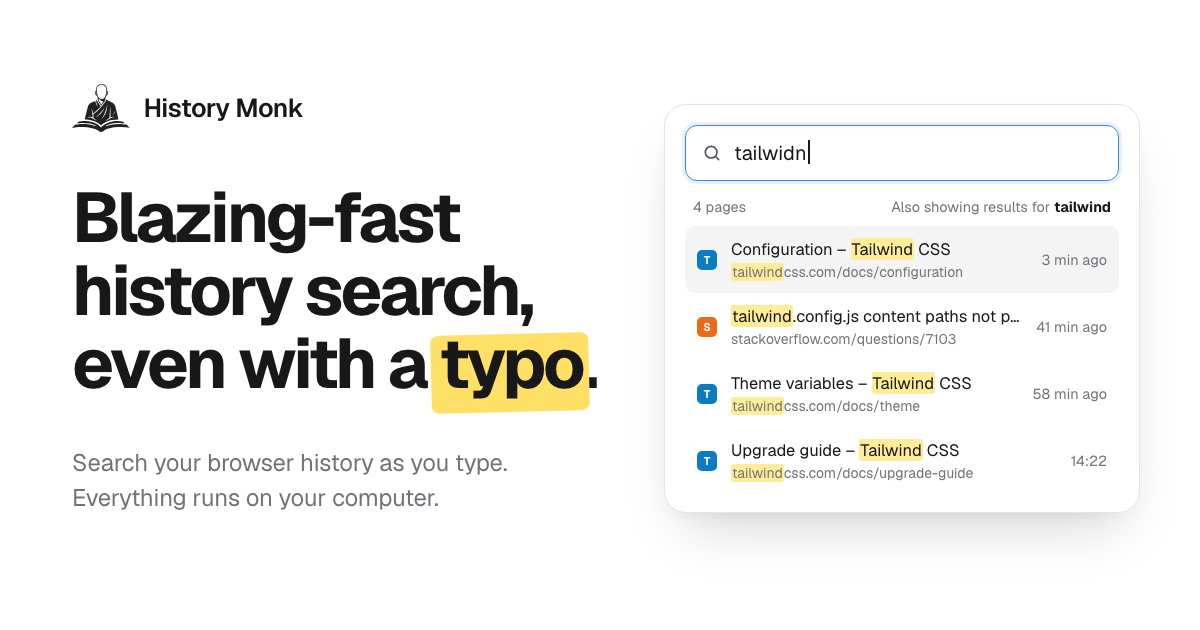
History Monk is a browser extension that replaces your browser's built-in history page with a fully searchable one. Instead of scrolling through days of visits, you type a few letters and the page you want shows up as you type — even with a typo. It works in Chrome, Edge and Opera, where it takes over the built-in history page so the History menu and its shortcut open History Monk, and in Firefox 140 and later, where you open your browsing history from the toolbar button or with Alt+Shift+H. It is made for anyone who spends the day in a browser and needs to find, reopen, export or clear out pages they have visited, and the whole thing runs on your own computer. Browser history pages were designed to record visits, not to help you find them again. They show a long chronological list with a single search box that only matches exact strings, so a half-remembered title or a misspelled word returns nothing useful. At the same time, the history fills up with search result pages, sign-in screens, duplicate URLs and links you clicked once and never needed again. History Monk addresses both sides of that problem: fast, forgiving search across everything you have visited, and a set of cleanup tools that sort the junk into groups you can review and remove. Because everything happens locally, tidying up your history does not mean handing your browsing data to a third party. Search is the centre of the product. History Monk is ready to search 80 milliseconds after it opens, and results update with every letter you press — no Enter key, no waiting for a page to load. It is built to stay fast on large archives, with the page citing 100,000 pages searched with no lag. Typo correction works against the words in your own browsing history, so typing “plannig” still finds the planning doc. When a word is not enough, 11+ power filters let you narrow things down: require two words in any order (“tailwind config”), match an exact phrase in quotes (“release notes”), restrict to one site with site:github.com, exclude one with -site:youtube.com, match the page title with title:invoice or the address with url:/pull/, and combine several of them in a single query. Date and time filters such as after:yesterday, a specific date like 2026-08-01 and before:17:30 limit results to a window, visits:>10 finds pages you opened more than ten times, a regular expression such as /issues\/\d+/ can be mixed with anything above, and sort:new orders results by best match, newest or most visited. A selected: filter can show only the rows you have ticked. Recently closed keeps every tab and window you close, newest first, so the last tab you closed sits on top and can be reopened with one click. The same list is searchable: type a word and only matching closed tabs stay. In Chrome, the Devices view lists the tabs open on your other signed-in computers and phones, grouped by device with the time each tab was last used, and you can search across all of them and open a page on the machine you are using. It uses the Chrome sync account you already have, with no extra account, and the product notes that Firefox does not share other devices' tabs with extensions. A third view, By group, keeps a search together with the pages you opened from it, one card per search — Google, Bing, DuckDuckGo, YouTube and dozens more are recognised with no setup. From a card you can reopen every page in a new tab group or delete the search and its pages in two clicks, while pages you also visited at other times stay. Sites turns cleanup into a bulk operation. You tick the sites you want gone — shift-click to select a range, Ctrl+A to tick every site — and delete every page from them, including older visits that are not visible on screen. You can also right-click any page or link and choose “Delete all history of this site”. Deleting a site always asks first, and sites on your protected list can never be removed. Export takes what you filtered and writes it out: search or filter first, then export just those results or a whole Cleanup group as CSV for Excel and Google Sheets, JSON ready for your own scripts, or an HTML page you can search and sort offline. Every file uses the same five columns — title, URL, site, last visited and visit count — and is created in your browser and saved to Downloads, with nothing uploaded. Cleanup itself sorts your history into 24 groups of likely junk, covering search result pages, duplicate pages that differ only by tracking parameters or a fragment, sign-in and OAuth callback pages, shortened links, links with tracking parameters, pages visited once and never again, untitled or failed pages, social feeds and video, AI chat conversations, meeting and call links, preview and staging sites, cart and checkout pages and more. You see every page in a group before anything is deleted, every delete waits for a second click to confirm, protected sites are never touched, and there are one-click deletes for the last hour, day or week. Timeline lays your browsing history out one day at a time, newest first, with a new session starting after 30 minutes of quiet and the gap showing how long you were away. Analytics shows how you really browse: a weekday-by-hour heatmap of your history, a focus score, streaks, rising and fading sites, and the terms you search for most — and clicking any cell opens those pages. The weekly digest condenses the last seven days into one card with pages, top sites, your busiest hour and late-night share, which you can copy as an image or text. Keyboard users can open History Monk from any tab with Alt+Shift+H, jump to search with /, move with the arrow keys, open with Enter and open in the background with Ctrl+Enter. The interface can be made your own with 28 themes taken from official palettes — Nord, Dracula, Catppuccin, Solarized, Rosé Pine and 23 more — plus 8 languages (English, Español, Français, Deutsch, Português, 日本語, 简体中文 and हिन्दी), a 12- or 24-hour clock, date order, row density and text size. Under the hood, History Monk reads your browsing history through the browser's history API and searches it inside the extension page, so search, Analytics and Cleanup all run locally. There is no account to sign up for and no third-party trackers or analytics. In Chrome and Edge, site icons come from the browser's icon cache, so showing results makes no web requests, and the only network requests the extension makes are to verify a license key and to look up the current price. It has no content scripts, so it never runs inside the pages you visit and only does work while its history page is open. Two settings-like features give you control over what appears: hidden sites stay out of search, Sites, Analytics and Cleanup without the underlying history being touched, while protected sites stay in your browsing history and cannot be deleted from any view. The practical payoff is time. A page you half-remember turns into a few keystrokes instead of a scroll through days of visits, and a typo no longer costs you a second attempt. Closing a tab by mistake becomes one click rather than a hunt. Research that started on a phone can be picked up on a laptop through the Devices view. Instead of manually picking through thousands of entries, you review a cleanup group, confirm, and remove hundreds of junk pages at once — and you can still export exactly the pages you filtered before you clear anything. Because everything stays on your machine, tidying up does not trade privacy for convenience. Typical workflows come straight from the product's own examples. You remember the Lisbon flight you looked at yesterday, type a few letters and it appears. You searched for cheap flights to Lisbon and opened three results; the By group card lets you open those pages again in a new tab group or delete the search and its pages together. You are shopping for a surprise and want a single site's history gone, so you tick it in Sites or right-click and choose to delete all history of that site. You have been researching Tailwind grid gap and want to see where the time went, so you open Timeline or the Analytics heatmap and click a cell to reopen those pages. You want a record of the GitHub pull requests you read this week, so you filter with site:github.com and export CSV, JSON or HTML. Or you simply want the junk gone: you open Cleanup, look through the search result, duplicate and sign-in groups, and clear them out. History Monk is aimed at people who treat the browser as their workspace: developers and designers moving between documentation, repositories and design files, researchers running many searches in a sitting, and anyone who wants a private, searchable record of where they have been. It is available for Chrome, Edge and Opera — where it replaces the built-in history page — and for Firefox 140 and later, and in Chrome it can also show tabs from other devices signed in to the same sync account. It is free for 7 days with no account; when the trial ends it keeps working for 3 opens a day, and a license removes that limit and enables deleting from Cleanup. The extension's only outbound requests are to verify a license key and to look up the current price. History Monk takes the browser's weakest tool — the history page — and rebuilds it around search you can trust, filters that narrow fast, one-click recovery of closed tabs, bulk deletion by site, exports in three formats, and a cleanup system that never deletes without showing you what is going. All of it runs on your computer, which is the point: the wise search once, and History Monk remembers the rest.
Proofsource is an AI intelligence platform that shows whether ChatGPT, Perplexity, Claude and Google AI Overviews name your brand when buyers ask category questions, who those engines name instead, which sources they cite, and what to fix. It is built for the teams that own the shortlist: growth and brand leaders, writers and search teams, agencies running many brands, and founders or small businesses. Its stated purpose is simple and direct — be the brand AI recommends. Rather than measuring blue links or ranking positions on a search results page, Proofsource measures the answer itself: whether your brand appears inside it, where it appears, and which other brands appear alongside it. Buyers now ask AI for a shortlist. An answer engine names three to five brands and moves on. If your brand is not one of them, there is no second page to rank on and no click to measure, so the loss is invisible in conventional reporting. Proofsource says most brands never see this shortlist. Its own measurement illustrates how contested the space is: across 947 citations, four engines and a scan dated 4 October 2026, 43.5% of the sources AI cited for category questions were comparison pages — listicles, alternatives and versus pages. In the same research, 387 different websites were cited across just 80 answers, meaning a brand's own site is one voice among hundreds. A separate finding reported on the site states that only 1 of 4 engines described a brand-new company correctly, with the other three answering from what they already believed. New research highlighted on the homepage notes that 0.8% of AI citations point to the brand's own website. The first feature group is visibility measurement. Proofsource asks each engine the questions your buyers ask and records whether you are named, in what position, and next to whom. It reports mention rate, share of voice and average position per engine, and every number carries a 95% confidence range, described in the product as a 95% Wilson interval, so a bad day never looks like a trend. Answers are kept in full, both as text and as a screenshot, so the evidence behind a number can be revisited. In the Tesla example shown on the site, 53 of 100 answers named Tesla overall, split as 16 of 25 on ChatGPT, 16 of 25 on Google AI Overviews, 11 of 25 on Claude and 10 of 25 on Perplexity. Second, Proofsource shows who AI names instead of you. Every brand the engines name for your questions lands on one leaderboard, ranked by answers per engine, including brands you never thought of as competitors. You can add any of them to tracking with one click, and the platform highlights the questions where each competitor beats you. The Tesla example lists Rivian at 13 answers, SunPower at 13, Ford at 10 and Enphase Energy at 9, alongside Tesla at 53. This matters because a shortlist loss is usually a competitive loss, and the leaderboard makes the set of rivals that answer engines actually consider — not the set you assume — explicit and trackable. Third, Proofsource shows the pages AI trusts in your category. Because answers are built from sources, the platform lists every page the engines cite for your questions, which of those pages mention you, and which are open to a pitch, a listing or a correction. It surfaces cited domains alongside the exact pages, the listicles that leave you out, and the pages on your own site that engines read versus the ones they skip. In the Tesla example, youtube.com was cited in 29 answers, en.wikipedia.org in 24, reddit.com in 20 and tesla.com in 17, with the platform noting whether each source names the brand, partly names it, or is the brand's own site. Fourth, Proofsource catches what AI gets wrong about you. Engines answer from what they already believe, so the platform asks about your brand by name, reads the answers, and flags wrong prices, old features and mixed-up identities, along with the source behind each claim. It reports wrong claims together with the page that caused them, runs profile checks on the sites engines lean on, and checks crawler access — whether GPTBot, ClaudeBot and PerplexityBot can read you at all. One illustrative claim check on the site shows an engine stating that plans start at a price the brand retired last year and that the free tier includes unlimited seats, flagging it as wrong on both counts, pointing to a 2024 review page as the likely source, and suggesting an update to the pricing page plus a request for the reviewer to refresh. Fifth, and central to the product, Proofsource does not stop at a score. It keeps going through a loop it describes as Know, Act, Prove, Repeat: what the engines say, why they say it, what to change, and whether the change worked. It ranks the gaps behind each lost answer by likely lift against effort, names the page or source to change, and drafts the fix from your own content for you to approve. After approval, its agents publish the change, verify that the answers have changed, and learn from every change. The workflow starts from your website and reaches first answers in minutes. You tell Proofsource your site; it reads it, works out your category and your competitors, and drafts the buyer questions worth tracking, with you approving every one. It then asks 25 questions on ChatGPT, Perplexity, Claude and Google AI Overviews, and keeps every answer with its sources and a screenshot. You receive the shortlist and the fixes: where you are named, who is named instead, which sources decided it, and the gaps worth closing first. On paid plans answers are checked every day, because AI answers shift from day to day and a weekly snapshot can miss the day a competitor enters your shortlist. The free trial runs two scans, today and tomorrow. The site links to a published methodology page describing how it measures AI answers. Proofsource is positioned for every team that owns the shortlist. Growth and brand leaders get one number for AI visibility they can defend in a board meeting, with the questions, engines and confidence range behind it. Writers and search teams get the questions they lose, the pages the engines cite instead, and drafts grounded in their own site — the site frames the shift as "search taught you to rank; this shows you how to be quoted." Agencies running many brands get unlimited brands on one account, a weekly report per client, and a roll-up of who is winning and losing across their book. Founders and small businesses use the free trial to see in minutes whether ChatGPT recommends them and then fix the one page that matters most. Engines tracked on every plan are ChatGPT, Perplexity, Claude and Google AI Overviews; the site also displays Google AI Mode, Gemini, Microsoft Copilot, Grok, DeepSeek and Meta AI logos, and the FAQ states that Grok and DeepSeek are available as add-ons on Custom plans. Pricing is free to start: 200 answers, 25 questions on every engine, top AI engines, two days, no card. After that, you choose how many questions each brand tracks, and custom plans start at $64 per brand per month, with the final price discussed on a demo call. Proofsource also publishes side-by-side comparison pages against Profound, Otterly.AI, Peec AI, Semrush, Ahrefs, Scrunch, SE Ranking, Rankscale and AthenaHQ, covering engines covered, sampling cadence, statistics, fixes and price, with sources for every claim about another product. The FAQ clarifies that Proofsource is not ProveSource, the social-proof popup tool, and explains how it differs from SEO rank tracking: rank trackers measure blue links, while answer engines write one answer and name a few brands. The takeaway Proofsource reinforces throughout its site is that the shortlist is being written right now — answer engines are deciding, question by question, which brands get named. By measuring those answers across the major engines, showing who is named instead and which sources decided it, and then drafting, publishing and verifying the fixes, Proofsource turns AI visibility from an invisible loss into a measurable, actionable loop.
Pheebs is an open-source AI telemetry tool created by Eversynced that measures how engineers and teams actually work with AI coding agents. It sits quietly inside Claude Code, Cursor, and Codex via hooks, capturing lightweight interaction signals: the shape of the session, not its contents. The people it is built for are the ones who need an honest proficiency read rather than a guess — engineering leaders, platform teams, and the developers themselves. Its purpose is measurement: turning the ordinary activity of agent sessions into signals about model choice, verification habits, context management, orchestration, and the dollars that model choices are costing. The problem Pheebs addresses is a visibility gap that opens up precisely when a team starts moving fast. AI coding agents arrive, adoption climbs, and nobody can say what changed. Six observations illustrate the questions the tool was built to answer: model spend that buys nothing, such as a bigger model than the work needed; where AI code ships unchallenged; whether AI output gets verified at all; rework hiding inside the speedup, where follow-up prompts are fixing something the AI broke; and whether the enablement investment landed — for example, a review skill used weekly by 78% of engineers while a migration skill never caught on. The final observation frames the stakes: nobody on the team runs tests inside the agent loop, which is a missing harness rather than a skills gap. Distinguishing a structural gap from a coaching gap is the core problem Pheebs exists to solve. Pheebs captures data by hooking into the agents themselves. It works with three coding agents — Claude Code, Cursor, and Codex — and records seventeen event types that run from session_started through to artifact_found. Hooks fire on session starts and ends, prompt submissions, skill and slash-command expansions, sub-agent spawns, tool calls and failures, compaction, and background tasks. Typical recorded fields are deliberately small: a session_started event carries a codebase such as acme/checkout and a model such as opus; a prompt_submitted event carries a character count and, when the prompt intent classifier is enabled, an intent label such as task or debug; a tool_use_completed event carries the tool name and its duration, with recognized commands summarized as a tool_intent such as test_run. Claude Code and Codex additionally export native OpenTelemetry metrics and logs through the Pheebs proxy, while Cursor is covered by hooks alone. The design constraint behind all of this is that Pheebs captures interaction patterns, not content. It never records source code or file contents. It never records file paths or directory structures — a repo is reduced to org/repo from the git remote. It never records prompt text; a prompt becomes a character count. It never records raw command strings, since a command like npm test is read in process and recorded as tool_intent: test_run. It never stores your name or your email: the developer is the id behind your Pheebs token, stamped by the backend, or a truncated hash of your git email when no token is set, and your GitHub handle is never looked up. The only route in the backend contract that receives raw text at all is POST /classify-prompt, which takes one prompt in and returns one label out. The backend contract also includes POST /ingest for one event envelope per request, POST /validate-token to resolve a token to an identity and its consent flags, POST /otel/v1/{signal} as an OTLP passthrough so no observability credential ever ships in the client, and an optional GET /insights for what one developer can see about their own work. On top of those signals sits a documented proficiency model. It assesses six competencies: Models, covering model choice, effort settings, plan mode, and autonomy modes; Artifacts, the reusable configuration that shapes the agent, such as skills, sub-agents, slash commands, and context files; MCP, live connections to external systems like tickets, databases, browsers, and documentation; Evals, verification wired into the agent loop through tests, typecheck, lint, build, and review passes; Context management, deliberate use of the context window including compaction and the save, resume, clear lifecycle; and Orchestration, running more than one agent at a time via sub-agents, parallel work, worktrees, hooks, and plugins. Each practice is classified as Unobserved, Adopted, or Recurring — Recurring meaning it showed up in at least 3 of the last 4 active weeks — and the coverage index summarizes, per engineer, the share of applicable practices at Recurring. Five judgement signals sit alongside the competency model. On the output side, verification coverage measures the share of AI edits followed by a verification action such as a test run, typecheck, lint, build, or a check against a spec; pushback rate measures how often the engineer challenges AI output instead of accepting it; the refinement-to-repair ratio separates follow-up prompts that refine intent from those that repair breakage; and wholesale-accept rate captures sessions with no pushback, no repair, and no verification, weighted by lines changed — described as the composite red flag of polished output with no questions asked. On the input side, model-fit rate measures the share of sessions whose model class matched the size of the work. Pheebs follows three stated principles here: tasks are sized, so every task prompt gets a scope from a one-file change to open-ended design and a session is judged on its hardest prompt; misses count both ways, because an over-provisioned session burns budget silently while an under-powered one shows up as repair prompts; and Pheebs is an audit, not a router — it never intercepts a prompt or switches a model on anyone's behalf, it reads the gap and prices it, and the decision stays yours. The overall pipeline has five steps. A hook fires. Lightweight fields are extracted — event type, durations, counts, models, trigger types — with prompt text reduced to a character count and an optional intent label. Identity and repo are resolved from the Pheebs token or a truncated git email hash, and from org/repo on the git remote. Every event is logged locally in a JSONL log, and with a token set it is also sent to the backend. OpenTelemetry rides along for Claude Code and Codex. Sending requires both settings to be present: pheebs config set base-url and pheebs config set token. Both need to be set or nothing is posted, and unsetting either one stops sending — the local JSONL stays the durable copy either way. Pheebs also states there are four routes to any backend: self-hosted, or managed by Eversynced. Two deployment shapes are described. In the self-hosted model you run the backend and hold the data: telemetry goes from developers' machines to your infrastructure and Eversynced never sees it. That option includes the full client for all three agents under Apache-2.0, a documented contract and a reference backend in the repo, raw JSONL you can query with whatever you already use, and no account, no key, and no requests. In the managed model, the same open-source client points at a backend Eversynced operates, with the proficiency model rendered as reports and dashboards — the AI Enablement Assessment, a 30-day telemetry sprint ending in an executive debrief and a plan for the gaps. The benefits the content states are visibility rather than surveillance: knowing which models are in play, whether AI output gets verified, whether enablement investments landed, and what the model-fit gap costs. The reporting built on top includes a practice adoption funnel, with one bar per competency split by how many engineers have not acted on it, acted on it once, or acted on it week after week; a practice heatmap putting every engineer against every competency, where a cold column means the team is missing the setup and practice for it and a cold row calls for coaching; a per-engineer view showing how much of each competency has become habit; and a signals table showing the five judgement signals per engineer against a team median. The dollar view prices the gap: in the illustrative example, a savings opportunity of $9,960 against $32,400 of list-price spend, described as 31% and an API list-price equivalent estimated upper bound, with models used and work as sized split across Frontier, Large, Medium, and Small classes. Decisions and figures come from complete sessions only, with coverage reported as complete, incomplete, no telemetry, and unpriced. The quickstart is three commands: npm install -g pheebs, pheebs init for interactive setup across all three agents, and pheebs doctor to check the wiring. Eversynced states that every Eversynced engineer is instrumented with Pheebs; it powers the measurement layer of their AI delivery framework, and the reporting built on top of it ships with the AI Enablement Assessment run for client teams. The product is therefore aimed at teams adopting AI coding agents who want evidence about how those agents are actually being used in their codebase. In short, Pheebs turns the day-to-day shape of AI coding sessions — model choices, prompts reduced to counts, tool calls, verification, compaction, and orchestration — into an honest, legible read on proficiency, adoption, and cost, while keeping the code, the prompts, and the identity of the developer out of the dataset.
AUDR (Agent Usage Detail Record) is an open standard for recording who initiated your agent runs and how much each cost, across every system a run passes through. It defines a common JSON schema that any harness, router, or billing system can emit and ingest. The goal is to help businesses make sense of the economics at the run level, giving every team building or monetizing agents a reliable record of what an agent run consumed and who or what it was associated with. It was drafted at Chargebee and is being improved with collaboration across the ecosystem, stewarded by Chargebee under the Apache 2.0 license. The problem AUDR addresses is that a run can be fully observable at every individual layer and still leave you without a single end-to-end record of who ran it and what it cost. A single agent run touches multiple systems: the application knows the customer and the feature, the router knows the tokens and the cost, and the tools know what they executed. Without a shared way to join these, usage data is orphaned from the business context that gives it meaning. The telecom industry solved a similar problem with the Call Detail Record, an open standard carriers converged on so a call's attributes could be captured and exchanged in a common format, independent of any single carrier's systems. AUDR is built on the same principle: a common record for agent runs that any harness, router, or billing system can emit and ingest. AUDR adds three core rules that let reports from different layers come together into one record. The first is a shared run ID, minted by the harness, passed to the router in request metadata, and echoed back, so every system that touches the run carries the same ID. The second is clear authority per field: the harness owns attribution such as customer, environment, and initiator, while the router owns usage such as tokens and provider. Each fact has exactly one source. This ensures that a record can carry raw counts that drive cost—tokens, tool calls, seconds of compute—alongside the business context that says whose cost it is. The record structure includes a run block with run ID and span ID, an attribution block sourced from the harness, a usage block sourced from the router, and an emitter block that identifies the component that produced the record. The third rule is strict merge rules. The sink assembles records sharing a run and span ID, and no component rewrites another's block. Conflicts are rejected, and a correction is a new record, never a mutation. This makes the record durable and reliable, and ensures that retries remain idempotent. The example in the spec shows a run with a run ID minted by the harness, attribution sourced from the harness, usage sourced from the router, and the emitter identified as the router. Because each field has exactly one authoritative source, the merged record is consistent and auditable, and any correction is preserved as a new record rather than silently overwriting history. AUDR provides adapters for runtimes you already use, so you can register an adapter and get a usage record for every model and tool call, including the customer it belongs to. Available adapters include NVIDIA NeMo Relay, LiteLLM, Merge Gateway, Vercel AI SDK, and Mastra. The core SDK builds, validates, and delivers records straight from your own code, with Python and TypeScript packages. Sinks deliver records to destinations you already use: Chargebee and Lago for usage-based billing. Adapters read identifiers, usage, and timings, never prompts or outputs. Every package is Apache 2.0 and published to PyPI or npm. The architecture is runtime → adapter → core client → sink → destination. Support for OpenRouter is in development. You can write records to a local file to start, with no account, hosted backend, or pricing configuration needed. AUDR is designed to sit on top of OpenTelemetry, not compete with it. OTel's GenAI semantic conventions provide the foundation for describing model calls and usage, and AUDR reuses them. An AUDR record can be emitted as an OTel span, and the OTel collector is a first-class sink. What OTel does not define is the set of rules needed when usage becomes a durable record: which attributes are required, how attribution is handled when it's missing, how retries remain idempotent, or how corrections are made. Observability can tolerate a dropped span, but a usage record cannot. AUDR adds those requirements and delivery semantics on top of OTel. It also complements standards like FOCUS, which standardizes billing data received from providers; AUDR standardizes the usage emitted when an agent run happens, before that usage is priced. The benefits are practical. With AUDR, you can answer questions like: How much does this agentic feature cost? What does this customer's agent usage look like, and how much does it cost? What are the unit economics and margins per customer for my agentic features? Which workflows or models are driving our costs? Which power users are driving our costs? Because records are emitted asynchronously and out of band, recording usage adds no synchronous work to inference in the normal request path. The only exception is optional pre-flight budget gating, which makes a single check before a run starts. You can store records locally, send them to a warehouse, feed them into an observability system, or use them for internal cost analysis or future projections. Use cases include usage-based billing, where records are delivered to a Chargebee site's usage-ingest batch endpoint or Lago's batch event endpoint. Teams can also use AUDR for internal cost analysis, to understand unit economics and margins, to identify which workflows or models drive costs, and to track power users. It supports cost governance by providing a common record that any system can emit and ingest. You can write records to a local file to start, with no account, hosted backend, or pricing configuration needed. For observability, the OTel collector acts as a first-class sink, and records can be used for future projections. AUDR is aimed at teams building or monetizing agents, developers, platform engineers, and billing teams. It does not assume what you do with the data after it is emitted; a billing system is just one possible consumer. It carries no prices or rating logic, and the SDK has no concept of plans, invoices, or how a customer should be charged. It records what happened and who it happened for. You can point the records at Chargebee, a competing rating engine, your own, or a warehouse for analytics. The spec is Apache 2.0, stewarded by Chargebee, and the goal is to move cost governance to an independent foundation as adoption grows. Contact is audr@chargebee.com. The three core rules are stable and will not change without a major version, while the field set will continue to grow as providers introduce new things to measure. In summary, AUDR is an open standard that provides a common language for recording agent run usage and cost across every system a run passes through. By combining a shared run ID, clear field ownership, and strict merge rules, it turns orphaned usage data into a durable, end-to-end record that supports cost analysis, usage-based billing, and agent unit economics. It is open, neutral, and community-owned, with packages published under Apache 2.0.
DailyHelm is an agentic AI business reviewer that monitors your analytics, ads, SEO, and store data overnight and then tells you what to fix today, ranked by revenue impact. Its promise is simple: your business, reviewed by AI, every morning. Rather than leaving you to interpret charts or open dashboard after dashboard, DailyHelm produces a daily brief that works as a prioritized punch list of the issues and opportunities worth acting on. It is built for founders, operators, and growth teams who run the whole business themselves — people who wear the marketing hat, the engineering hat, and the finance hat — and who need a clear answer to the question of what to do next. The problem DailyHelm addresses is the gap between data and action. Traditional dashboards show you charts and leave you to interpret them, which means hours of tab-switching and a lingering sense that you are still guessing. Real problems hide in that gap: conversion tracking silently breaks, ad spend keeps optimizing against zero conversion data, a top product disappears from the sitemap, a lead form stops firing, or failed payments quietly churn subscribers. DailyHelm was built to catch those issues and turn them into a ranked, evidence-backed list of things to fix, so days of wasted spend and lost orders do not go unnoticed. The review is produced by six specialists led by Aria. Each agent owns a domain. Iris covers analytics and growth — funnels, pipeline health, and churn signals. Pitch covers ads — spend, keywords, search terms, and CPA. Echo covers SEO — rankings, indexation, and on-page signals. Ada covers code, investigating your repository when business data smells off. Penny covers cost — cloud spend by SKU, cost forecasts, and egress leaks. Sage covers site UX — crawl-driven performance and conversion blockers. Aria correlates their findings, ranks them by expected impact, and writes the morning brief. Together they handle AI for business operations, monitoring ads, SEO, analytics, and code while you sleep. Each finding is delivered with the detail needed to act on it. Every finding cites its evidence and a recommended next step, along with an impact score, a confidence level, and an effort rating. In the product's example, Iris flags a conversion tracking blackout with 96% confidence, showing that GA4 recorded zero conversions while Stripe recorded 47 purchases in the same window, and pointing to the commit that removed the tracking include. The finding carries a recommended action, and you can accept it, snooze it, dismiss it, or chat with Aria to dig deeper into what broke and how to fix it. That structure means the digest does not just surface a symptom — it explains the cause and proposes the fix. Setup is designed to be fast and non-technical. DailyHelm handles the OAuth; you click approve. First you tell the system about your business — what you sell, who buys it, and what success looks like — which anchors every recommendation. Then you connect your platforms one click at a time: GA4, Google Ads, Search Console, Shopify, GitHub, GCP billing, and your site. DailyHelm opens the approval page and you confirm. From there you get a daily AI business review, a prioritized punch list every morning, with the option to chat with Aria any time. The company states average setup time is under five minutes and that findings start arriving within the hour, with first findings reachable within 24 hours. DailyHelm's overall approach is overnight monitoring plus correlation, delivered as a morning brief. It pulls a daily snapshot from each connected platform and stores nothing it does not need. The agents work in parallel across their domains, and Aria cross-references their individual findings to produce one ranked list. Because the system is built to be read-only on every connector, it never writes back to your accounts. OAuth scopes are read-only across GA4, Search Console, Ads, GitHub, and your store, so DailyHelm cannot write, post, or modify anything. Integrations use each platform's own consent screen rather than API keys, and onboarding happens through those approval flows. Users describe the outcome in terms of time saved and money recovered. One founder reported that Aria caught a $340 per day wasted-spend issue on day one, with a Shopping campaign running against 47 zero-conversion search terms for nine days; negatives were added before lunch and the bleed stopped the same morning. Another reported that a Friday deploy broke the GA4 purchase event, leading to $2,200 spent over a weekend with no conversion data to optimize against, and said that kind of thing will not happen again after setting up DailyHelm. A solo founder described replacing 90 minutes every morning across five dashboards with an eight-minute brief and one clear priority. DailyHelm reports early user ratings of 4.9 out of 5 and describes itself as a part-time COO that reads every dashboard so you do not have to, answering questions about your business in plain English. The product documents concrete categories of findings for different business types. For DTC and e-commerce, Pitch surfaces wasted ad spend — specific keywords or search terms burning budget with zero conversions — plus negative-keyword and bid recommendations to cap the bleed. For SaaS and app businesses, Iris and Ada detect a conversion tracking blackout where Stripe charges fire but GA4 shows zero, identifying the deploy that broke the tag and the line of code to restore. For local and service businesses, Echo surfaces a local-search ranking collapse in which "near me" and city-name queries fall out of the local pack. For dropshippers, Echo and Ada catch a top product disappearing from the sitemap or returning a 404 after a deploy. For B2B and lead gen, Iris, Ada, and Sage cross-reference a lead form that silently regressed after a deploy broke validation or the success-event fire. For subscription businesses, Penny flags a failed payment surge, including the dunning gap and recoverable MRR. DailyHelm is aimed at operators who run the whole business: DTC and Shopify founders, dropshippers, B2B SaaS operators, solo founders, agencies, and anyone short on time. It connects to Google Analytics 4, Google Ads, Google Search Console, Shopify, GitHub, Stripe, a Site Crawler, and Meta Ads, with GCP billing referenced during setup. The company offers a seven-day free trial, requires no credit card, and says setup takes about five minutes. On security, it states that all traffic to DailyHelm is TLS 1.2+ encrypted, data is encrypted at rest, and OAuth refresh tokens and webhook secrets are encrypted at the field level. It states that AI never trains on your data, that processing happens through providers contractually prohibited from training on it, and that the service is GDPR and CCPA compliant with rights to access, correct, export, and delete data. One click deletes your account, revoking every connected token and purging findings within 30 days. DailyHelm's value proposition is straightforward: stop opening eight dashboards every morning, get the punch list, pick the top three, and move on with your day — with every recommendation anchored to evidence from your own connected tools. It turns overnight data into a prioritized set of revenue-oriented fixes so founders and growth teams always know what to fix today.
Sellio is an AI customer support platform that puts every customer conversation into one shared inbox. Website chat, WhatsApp, Instagram, Telegram, and email all land in the same place, so a support team works from a single thread rather than switching between tools. On top of the inbox, Sellio adds tickets for work that continues after a chat, an AI agent that can be switched on when a team is ready, and analytics that show how each conversation ended and how it felt. It is aimed at the kinds of teams that answer customers all day: stores and ecommerce businesses, hotels, SaaS companies, local businesses, help desk teams, and agencies. The website describes the product simply as AI customer support in one inbox, with one line added to your site to get started. Support conversations rarely stay in one place. A customer asks something through a website chat widget, follows up on Instagram, sends a complaint by email, and messages on WhatsApp, and each of those threads normally lives in a different tool with its own history. When a conversation is split like that, handoffs lose context, customers repeat themselves, and replies get missed. Sellio frames this as a problem that looks the same in every industry: missed replies look the same whether you run a store, a hotel, or a SaaS product. The shared inbox is the response, one place where every channel lands, every reply and note stays with the thread, and the next step is always clear to whoever picks it up. The core of Sellio is the shared inbox. It is built around clear threads with next steps: every reply, internal note, and handoff stays attached to the same conversation, so anyone on the team can see what was said and what should happen next. Teams work the inbox together rather than forwarding messages around, and because every channel is in one place, an agent does not have to remember which app a customer used. When a conversation turns into work that continues beyond the chat, Sellio lets the team raise a ticket from the thread, assign it, and keep the full history attached, so context survives the move from chat to task. The AI agent is optional and separate from the free chat and inbox. Sellio emphasises that you add it when you decide you are ready: you point the agent at your site, docs, and FAQs so its answers stay grounded in what you actually ship, rather than in whatever a general model happens to know. The agent's first job is the first reply on website chat, which is where many conversations begin. Where the AI cannot finish, it hands off to a person without losing context, so the human sees the same thread the AI saw. The website also highlights staying in control of cost as part of how the agent is positioned, and its FAQ addresses both how the AI learns about your product and whether a person can take over from the AI. Analytics in Sellio are meant to show what to fix next. The product follows every conversation through to how it ended and how it felt, and places automation, resolution, and CX rates beside each other in one funnel, so a team can see performance and customer experience together instead of in separate reports. Topics are drawn from real chats, which surfaces what customers actually ask about rather than what a team assumes they ask about. Sellio also presents response time that improves and CSAT that explains itself as part of the same picture, connecting speed, satisfaction, and outcomes in one view. Getting started is deliberately light. Sellio is installed by adding one line or one script tag to a site, which produces an on-brand chat widget; the site notes that website chat and the shared inbox are free, and that no credit card is required to start. AI is only switched on when a team chooses to switch it on, so a business can run a human support inbox first and layer automation on later. New conversations can be mirrored into Slack, Discord, and Microsoft Teams, so teammates who do not sit in the inbox still see what is happening. The overall approach is staged: inbox and chat first, other channels and AI as the team needs them. The stated benefit is fewer missed replies. Because every channel lands in one inbox and every thread keeps its history, handoffs happen without losing context and customers do not have to repeat themselves. Teams get a clear next step on each conversation, an AI agent that answers from their own documentation, and a funnel that shows how conversations ended and how customers felt. Cost stays controllable: the free plan covers web chat and the shared inbox with no trial clock and no credit card, and paid plans are only needed for more seats, channels, AI agents, and AI credits. Sellio lists the industries and situations it fits. Ecommerce teams can run live chat on Shopify in the same inbox as WhatsApp, Instagram, and email. Hospitality businesses such as hotels can put WhatsApp, Instagram, and website chat in one inbox for front desk and operations. SaaS companies can start with website chat and place every other channel beside it for the whole team. Local businesses can add a live chat bubble to their site along with the channels their neighbourhood already uses. Help desk teams can raise work from a conversation, assign it, and keep the full history, and agencies can run a shared inbox that several people assign, note, and resolve together. On channels and integrations, the website says website chat, WhatsApp, Instagram, Telegram, and email land in one inbox, while Slack, Discord, and Microsoft Teams can mirror new conversations for the team. Logos shown on the page include Stripe, ClickUp, Zoom, Salesforce, Discord, Telegram, Trello, GitLab, WhatsApp, Messenger, Jira, Linear, Shopify, Notion, Microsoft Teams, Zapier, Instagram, Asana, Slack, HubSpot, and GitHub, with the note that six integrations are available now and the rest are on the way. Pricing is straightforward: website chat and the shared inbox are free, while email and messaging channels start on Mini. The Free plan includes two seats, one channel, and one API key, with one AI agent and five AI conversations, and nothing expires; more seats, channels, AI agents, and AI credits come from the paid plans. Sellio's proposition is that support does not have to be scattered or complicated to set up. One inbox holds the conversations, one script tag puts chat on the site, tickets carry work forward, an optional AI agent answers from your own docs and hands off when a person is needed, and analytics show what happened and how it felt. Teams can start on the free plan without a credit card and stay there, adding channels, agents, and AI credits only when the workload grows.
Phare C1® is a smart smoke alarm built by Phare Labs to detect fire and carbon monoxide early and accurately. Rather than simply reacting once smoke reaches a threshold, it pairs research-grade sensors with advanced AI, described by the company as "AI-powered early fire and CO detection, backed by our peace and quiet guarantee." It installs in place of an existing smoke alarm, so the hardware swap is a familiar one even though the behaviour is not. The product is aimed at homeowners who want dependable protection without the constant interruption of nuisance alarms, and it keeps much-loved features from the discontinued Nest Protect — such as early warnings, a night light and in-app alerts — while adding new ones including air quality monitoring and intruder detection. Phare C1 is live in the UK, US pre-orders are open, and pricing starts from $149. The product is framed around three everyday failures of conventional alarms. First, false alarms: Phare states that up to 89% of the time, smoke alarms go off for something other than a fire. Second, missed fires: according to data from the NFPA cited on the site, smoke alarms miss 28% of fatal fires. Third, the beeps: the site asks whether you actually know what the different sounds mean, adding that "we don't speak morse code either." These problems matter because an alarm that cries wolf, misses real emergencies, or communicates in unclear signals is one people learn to ignore, silence or disconnect. Phare C1 is positioned as the answer to all three, with the blunt framing that "it's time to fire your smoke alarm." The core capability is detection. Phare's AI algorithm is designed to detect more fires, earlier, while reducing false alarms, so the device alarms for fires and nothing else. A multi-sensor array spots fire and carbon monoxide early and accurately, and the product description notes that detection algorithms learn and improve to make your home even safer over time. Carbon monoxide is handled with particular precision: Phare measures CO with 0.1 ppm precision and sends exposure alerts before other devices do, so occupants can catch carbon monoxide sooner. Because both fire and CO are covered by the same unit, the alarm replaces a narrow single-purpose sensor with a broader safety net that is meant to stay responsive to genuine events rather than to cooking, steam or dust. Beyond sounding an alarm, Phare C1 is designed to inform. The site promises that Phare tells you what's going on and what you can do about it, removing the mystery beeps that leave people guessing. This early-warning approach means you can respond before it gets loud — reacting before an alarm actually sounds in order to keep the home safe and quiet. Phare C1 and C1 Pro also sense motion in the dark and softly light your path, so you are not fumbling for switches on the way to the bathroom or down a hallway. That pathlight behaviour is one of the features Phare deliberately carried over from the Nest Protect, alongside early warnings and in-app alerts. The C1 line extends into areas a traditional smoke alarm never touches. Phare C1 and C1 Pro monitor air quality, which the company frames as helping protect your health and longevity. Phare C1 Pro adds a radar array that spots intruders and sounds the alarm to drive them away, turning the same ceiling device into a basic home security layer. Maintenance is intentionally minimal: Phare tests itself and never needs batteries, so once it is set up the system handles the rest. Alerts and information are delivered through the companion app — customers who came from Nest Predict describe the devices as producing lots of useful home data, and the app is where CO exposure alerts and other notifications surface. Overall the approach is to analyse a large volume of environmental data continuously rather than to wait for a single threshold to be crossed. Phare states that it analyses thousands of data points every minute to keep you safe, doing all of the worrying so that you don't have to. Combined with detection algorithms that learn and improve, that continuous analysis is what underpins both the earlier detection of real fires and the reduction of false alarms. Installation follows the familiar pattern of an existing alarm — Phare installs in place of your old smoke alarm, though as the site puts it, that's where the similarity ends — and setup is described as plug and play peace of mind, with a companion app for review and alerts. The promised outcome is quieter, better-informed safety. Users get early fire and carbon monoxide warnings rather than a device that only reacts at the last moment, fewer nuisance alarms interrupting cooking and daily life, and clear explanations instead of confusing tone patterns. The pathlight adds practical night-time usefulness, and the air quality monitoring adds a health dimension that a standard alarm does not provide. Customers quoted on the site describe the units as problem free in their basic alarm function, simple to install and use, and producing far more detail than their previous Nest alarms ever did. Phare backs the experience with a Peace & Quiet Guarantee: no false alarms in the first 30 nights, or a full refund. Concrete scenarios follow directly from those capabilities. Households replacing expired mains-powered Nest Protect devices use Phare C1 as a drop-in successor while gaining additional data and features. At night, the pathlight illuminates hallways and rooms when motion is sensed in the dark, and the unit continues to test itself and requires no battery swaps. In the kitchen, the AI-driven detection is intended to distinguish real events from everyday cooking so that dinner does not set off the alarm. Where carbon monoxide is a concern, the 0.1 ppm precision and exposure alerts aim to surface risk earlier than other alarms. Users who want a security element can add Phare C1 Pro's radar-based intruder detection, and anyone interested in indoor environment quality can follow air quality readings alongside their safety status. Phare C1 is sold to homeowners in the UK and the US, with UK availability live and US pre-orders open at the time of publication. Pricing starts from $149, with a promotional code offering $35 off any order of two Phares or more, and orders billed in USD or GBP. The company provides free returns from anywhere in the US and UK, an extended warranty of up to five years with Phare+ Pro, and the Peace & Quiet Guarantee covering the first 30 nights. US orders are noted as shipping once UL certification is complete, estimated for summer 2027, and pre-orders can be cancelled at any time for a full refund. A web login at app.pharelabs.com and published API documentation indicate app and API access alongside the physical device. Phare C1's value proposition is straightforward: a smoke alarm that treats false alarms, missed fires and unclear beeps as problems worth solving. By combining research-grade sensors, AI-based detection, carbon monoxide precision, night-time pathlighting, air quality monitoring and app alerts in one ceiling-mounted unit, it aims to make a home both safer and calmer — the smoke alarm, minus the drama.