Farmer Information System Overview
Uploaded by
anjahchelsybuan02Farmer Information System Overview
Uploaded by
anjahchelsybuan02- Introduction
- Purpose and Description
- Objectives
- Scopes and Limitations
- Definition of Terms
Common questions
Powered by AIThe Farmer Information System aligns with modern advancements in agricultural technology by incorporating digital tools that facilitate data management, real-time communication, and accessibility via mobile devices. This alignment is important for sustainable farming as it supports efficient resource planning, enhances decision-making capabilities, and promotes resilience through timely access to information. By modernizing traditional farming practices, the system enables farmers to adapt to changing environmental and market conditions, ensuring long-term sustainability and productivity .
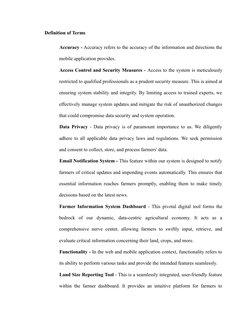
The Farmer Information System assists in land size reporting by providing a user-friendly tool within the farmer dashboard that allows easy submission of land size information using various units of measurement, such as acres or hectares. This system improves upon traditional methods by simplifying the process for farmers, enabling accurate record-keeping, and facilitating better planning and resource management. It helps in overcoming discrepancies and challenges associated with manual land measurement and reporting .
The Farmer Information System implements several measures to ensure data privacy and security, including access control, which restricts system access to qualified professionals to maintain stability and integrity. Additionally, compliance with data privacy laws is upheld, requiring permission and consent to collect, store, and process farmers' data. These measures contribute to trust by ensuring that farmers’ sensitive information is protected against unauthorized access and misuse, thus reinforcing the reliability and credibility of the system .
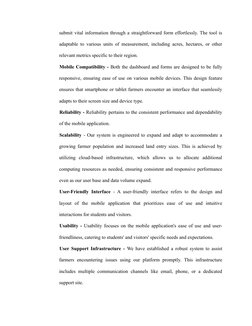
The system enhances user experience for mobile users through its fully responsive design that ensures the dashboard and forms are easily accessible and seamlessly adapt to various mobile devices. This mobile compatibility allows farmers to conveniently access the system on their smartphones or tablets, providing the same functionalities as a PC. This ease of use is crucial for adoption since mobile devices are often more accessible to farmers in remote areas, thereby increasing the system's reach and usage .
The email notification system enhances decision-making among farmers by providing timely updates on critical agricultural information such as policy changes, market trends, and weather forecasts. This proactive communication enables farmers to plan and adjust their activities based on the latest developments, ensuring their farming strategies are aligned with current conditions. This can lead to improved crop yields and reduced risks associated with unforeseen events, ultimately supporting better decision-making and increased productivity .
The Farmer Information System facilitates communication between the MAO and farmers by providing a platform that links both entities through a centralized web-based system. This system allows for direct messaging and email notifications about government programs, subsidies, and critical updates related to agriculture. The advantages include enhanced dissemination of vital agricultural information, improved farmer engagement with government initiatives, and the ability to rapidly exchange data that can aid in more informed decision-making to boost agricultural productivity .
User-friendly interfaces play a critical role in the efficiency of the Farmer Information System by ensuring that users can navigate the platform with ease, reducing the learning curve and potential usability issues. Intuitive interactions foster a more seamless experience for farmers, technicians, and administrators, allowing them to perform tasks efficiently without technical difficulties. The appeal lies in the system's accessibility, encouraging more frequent and effective use, which is essential for achieving better data collection and communication .
The scalability feature of the Farmer Information System benefits the agricultural sector by utilizing cloud-based infrastructure that allows for the allocation of additional computing resources as necessary. This ensures the system can accommodate a growing number of users and larger data volumes without sacrificing performance. It supports expansion by facilitating the incorporation of more farmers as the user base grows, thus helping to streamline agricultural operations and improve data management efficiency across regions .
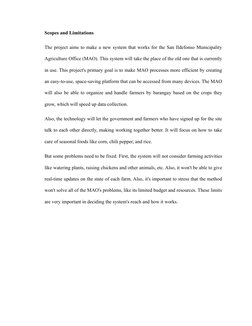
The current Farmer Information System has limitations such as not accounting for certain farming activities like irrigation and livestock management, and it lacks real-time updates on farm conditions. These limitations could affect overall effectiveness by not providing a complete solution for farming needs, thus requiring additional platforms or tools to manage these aspects. Furthermore, the system does not address issues related to the MAO’s limited budget and resources, which can hinder its capacity to support farmers fully .
The Farmer Information System can significantly influence the standard of living for farmers in San Ildefonso, Bulacan, by providing critical data and tools necessary for improving agricultural output and sustainability. By easing communication with MAO and gaining access to a library of information on crops and pests, farmers can make informed decisions that enhance their farming techniques. The system facilitates better resource planning and allows for more effective interaction with government programs and subsidies, ultimately leading to increased income and improved quality of life for local farmers .