Blog
Confidence. Before the launch.
Research, product updates, and the thinking behind Nexus. Written by the team building it.
Search...

·
Galaxies
Galaxies Is Nominated for the Open Innovation Awards 2026
The nomination recognizes an open innovation case between Galaxies and a corporation. The 100 Open Startups Ranking 2026 list was released on October 19. The awards ceremony takes place on November 23, with a live broadcast.
In brief: Galaxies is nominated for the Open Innovation Awards 2026, the awards ceremony for the 11th edition of the 100 Open Startups Ranking, organized by 100 Open Startups. The nomination stems from an open innovation case between Galaxies and a corporation. The ranking list was released on October 19. The ceremony will take place on November 23, 2026, starting at 5:40 p.m. Brasília time (UTC−3), with a live broadcast. Being nominated does not mean having won: the results will only be announced on the night of the ceremony.
This article brings together what we know about the nomination, explains what the ranking measures and shows how to follow the awards ceremony.
What are the Open Innovation Awards and the 100 Open Startups Ranking?
The 100 Open Startups Ranking is a ranking of open innovation with startups, published since 2016, that annually recognizes corporations that stand out in this practice and the startups most attractive to the corporate market. The Open Innovation Awards is the gala evening celebrating the ranking’s highlights. In 2026, the event marks the awards ceremony for the 11th edition, with the theme “The Decade of Results.”
According to the organizer, the ranking’s database includes more than 180,000 registered contracts and relationships between startups and corporations, and the platform connects 50,000 startups and 10,000 corporations. These figures come from 100 Open Startups itself, which has also organized Open Innovation Week since 2008.
How does a startup enter the 100 Open Startups Ranking?
Scores come from formalized open innovation relationships that a startup registers on the platform, such as contracts, projects and proofs of concept. According to the ranking page for startups and scaleups, only the best relationship per corporation is counted. Each relationship must be validated by the corporation on the other side. To appear in the official publication, the startup must also undergo an audit and have at least one case with an abstract approved at the Latin American Congress of Open Innovation Cases. According to the organizer, only those that complete these steps are eligible to receive an award.
In other words, the ranking is based on registered, validated relationships, not self-reported claims.
What changes in the ranking in 2026?
The 11th edition opens a new decade for the ranking with an evolution in its methodology. In addition to the intensity and diversity of relationships between corporations and startups, demonstrating results now carries greater weight. The organizer states that, beginning with the 2026–2035 decade, it is expanding its focus on evidence of results, impact and learning. Cases are evaluated by industry peers and researchers, in conjunction with the Latin American Congress of Open Innovation Cases.
What does the nomination mean for Galaxies?
The nomination stems from an open innovation case between Galaxies and a corporation, registered on the ranking platform and validated by the corporate partner.
This recognition has particular significance for us. In 2026, the ranking began placing greater value on evidence of results, and that is what we aim to deliver to marketing leaders: decisions based on signals before budgets are spent in the market.
A nomination is not yet an award. The results will be announced on the night of the ceremony, November 23, and this article will be updated with them at the same address.
Who is Galaxies?
Galaxies is a Marketing Decision Intelligence company. It helps marketing leaders at consumer-facing companies make decisions about creatives, claims, audiences and messaging before committing their budgets. To do this, it develops Nexus: Galaxies Lab, a platform for investigation and decision support before spending, with synthetic personas built from real research and human review. Galaxies is ISO/IEC 27001 certified and operates in compliance with the LGPD and GDPR.
To understand the method, read what synthetic personas are or explore Nexus.
How can you watch the awards ceremony?
The Open Innovation Awards 2026 live broadcast takes place on November 23, 2026, starting at 5:40 p.m. Brasília time (UTC−3), at 100os.net/Gala2026AoVivo. The organizer reports that the 2025 edition’s broadcast surpassed 350,000 views. To receive a notification when it begins, enable notifications on the broadcast channel.
In closing: what happens after November 23
After the ceremony, this page will be updated with the results and next steps. In the meantime, anyone who would like to discuss Nexus can book a demo.
Frequently asked questions
What is the Open Innovation Awards 2026?
It is the gala evening celebrating the highlights of the 100 Open Startups Ranking. In 2026, the event marks the awards ceremony for the ranking’s 11th edition, organized by 100 Open Startups.
What is the 100 Open Startups Ranking?
It is a ranking of open innovation with startups, published since 2016. It annually recognizes corporations that stand out in this practice and the startups most attractive to the corporate market, based on registered relationships and contracts.
Has Galaxies already won the award?
No. Galaxies is nominated for the Open Innovation Awards 2026. The results will be announced on the night of the ceremony, November 23, and this article will be updated afterward.
When was the 100 Open Startups Ranking 2026 list released?
On October 19, 2026. The awards ceremony celebrating the highlights takes place on November 23 at the Open Innovation Awards.
When is the Open Innovation Awards 2026 ceremony?
On November 23, 2026, starting at 5:40 p.m. Brasília time (UTC−3), via the live broadcast at 100os.net/Gala2026AoVivo. The organizer recommends enabling channel notifications to receive an alert when it begins.
How does a startup enter the ranking?
By registering its contracts and formalized open innovation relationships with corporations on the platform. Scores come from these relationships, and only the best relationship per corporation is counted, according to the organizer. To appear in the official publication, a startup must also undergo an audit and have a case with an abstract approved at the Congress of Open Innovation Cases.
What does Galaxies do?
Galaxies is a Marketing Decision Intelligence company. It helps marketing leaders at consumer-facing companies make decisions about creatives, claims, audiences and messaging before committing their budgets. To do this, it develops Nexus: Galaxies Lab, with synthetic personas built from real research and human review.
Sources cited
100 Open Startups. Open Innovation Awards, About page.
100 Open Startups. 100 Open Startups Ranking 2026, for startups and scaleups.
100 Open Startups. Open Innovation Awards 2026 live broadcast.
Galaxies
Read more

·
Daniel Victorino
Brand Positioning: How to Test Territories and Messaging Before a Reposition
In brief: Brand positioning is the place a brand chooses to occupy in an audience’s mind relative to alternatives. Repositioning is among marketing’s most expensive and least reversible decisions. Yet it is often approved on the strength of a few interviews and a committee’s conviction. Comparing brand territories and messages across audiences before launch can reduce that risk by measuring both the appeal of a new position and how unfamiliar it feels to existing customers. At Galaxies, Nexus tests those options before spending, using synthetic personas built from a client’s own real research.
In some repositioning projects, the preferred territory is chosen before testing begins. An agency presents three options, the committee selects the boldest, and the research that follows is used to confirm the choice. Ambition is not the problem. The problem is that nobody knows its cost until the campaign is live.
Positioning deserves different treatment from a campaign message because it is harder to undo. A line of copy can change next week. A repositioning that alienates existing customers can take years to repair. The right time to test it is while changing direction is still inexpensive, before creative assets reach the market.
What is brand positioning?
Brand positioning is the deliberate choice of what association people should make when they think about a brand in its category. It answers: for whom are we the best choice, in what situation, and for what reason that competitors do not own?
Three ideas are often conflated. A brand territory is the thematic and emotional space the brand occupies, such as convenience or trust. Positioning defines its relative place among competitors for a particular audience. Messaging is how that position is expressed in a campaign. Territory is the most structural decision; messaging is the most tactical; positioning connects them. A strong territory can be undermined by weak messaging, and brilliant copy cannot rescue a territory the audience does not recognize as credible for the brand.
Why test positioning before a reposition?
Repositioning carries two kinds of risk, but common methods often measure only one. The first is attraction: will the new position win the audience the brand wants to reach? The second is loss: will existing customers, who sustain current revenue, still recognize the brand or feel left behind?
Testing only the new target audience may approve a position that pushes current customers away. Testing only the existing base can veto any meaningful change. A responsible decision reads both responses side by side.
Evidence matters at the board level, too. In a 2026 Makers and Uncover study of 113 marketing leaders, only 9% said they fully trusted what they measured, while 41% said their boards primarily evaluated marketing by revenue growth or market share [1]. The survey ran from May to June and included CMOs, VPs, directors, and managers; 70% worked at companies with revenue above R$500 million. These teams are not short on creativity or brand experience. Many need stronger evidence for defending a new territory before launching it.
How do you build a positioning test matrix?
The matrix we use crosses four dimensions: territory, message, audience, and barriers. It turns an abstract argument about “the best territory” into a comparison with stated criteria. Test two to four candidate territories alongside the current position. Give each territory a representative message with a defined tone and promise. Compare responses from current customers, the audience the brand hopes to win, and any group at particular risk. Record objections, unfamiliarity, and credibility concerns.
Each cell in the resulting grid shows how one audience responds to one territory. Consider an illustrative food brand considering a move away from tradition. Its loyal customer base strongly identifies with tradition, while younger urban consumers may dismiss it as “my grandmother’s brand.” Convenience may be moderately acceptable to both, but insufficiently distinctive. An origin-and-ingredients territory might feel like a natural continuation to current customers and interest new buyers, provided the brand can prove its sourcing claims. An irreverent territory might attract new buyers while making loyal customers feel the brand has changed beyond recognition.
Those reactions are fictional examples, not client test results. In a real test, each cell would capture preference, reasons, and barriers by profile. The territory most appealing to newcomers is not necessarily the best choice. A stronger option may attract them while still feeling like a credible continuation to the existing base.
What signals indicate risk in a repositioning?
Watch for four patterns before approval. Estrangement: current customers describe the brand in the new territory as “a different company.” Lack of permission: people understand the territory but do not believe this brand can credibly occupy it. An occupied territory: audiences already associate the idea with a particular competitor, so your spending might reinforce that competitor instead. And attraction without a reason: people like the territory but cannot explain why it would make them choose the brand. That often signals an aesthetic idea rather than a strategic one.
None of these automatically rules out a repositioning. They show what must be resolved before launch: proof, a gradual transition, revised messaging, or another territory.
Where do synthetic personas fit in a positioning test?
They support the comparison between the agency or brand team’s creation of possible territories and the committee’s decision. Personas built from a brand’s own research can respond to territories and messages across audience groups, revealing preferences, reasons, and barriers. A study runs in minutes, and a structured verdict with human review is ready within 48 hours.
That changes the project’s rhythm. Instead of one final validation round, teams can test territories, revise messages in response to existing-customer discomfort, and test again. The committee then sees evidence about both risks: failing to attract new customers and losing the current base.
This step does not replace brand tracking, which measures a brand’s current strength in the market, or the statistical evidence a major repositioning may require. It works earlier, narrowing four territories to one or two worth the larger field-validation investment. At Galaxies, reliability is assessed by comparing persona answers with those of real people in the same segment on questions not used to build the profiles. Conversations also undergo ongoing DeepEval assessment for relevance, bias, hallucination, profile fidelity, and toxicity.
How long does it take to test brand territories?
Repositioning projects often test only the favorite territory, or none at all, because research does not fit the agency and committee’s timetable. In Nexus, each study runs in minutes and a structured, human-reviewed verdict is ready within 48 hours. That makes multiple rounds possible before the choice is final.
For positioning, open-ended answers can be more valuable than scores. This is where unfamiliarity and lack of permission emerge in language a numerical scale might miss.
A useful sequence is: first, test every candidate territory plus the current one with both existing and prospective audiences. Next, revise the messages for the two strongest options using the barriers people cited. Then retest those two options with the same groups to see whether the barriers have eased. Finally, choose a territory and decide what still needs field validation given the scale of the repositioning.
An executive checklist before approving a new position
Was the current positioning included as a baseline? Were existing customers and the new target audience evaluated separately? Did every territory have a representative message, not just an abstract concept? Were unfamiliarity, lack of permission, and competitor ownership checked?
Is there evidence to support the new territory? Is it clear which claims require field validation and which decisions rely on the preliminary test? If the chosen direction causes moderate concern among existing customers, is there a transition plan?
Reposition with both risks in view
Repositioning rarely fails for lack of creativity. It fails when a brand learns too late that a new audience did not believe the promise or existing customers no longer saw themselves in it. Both risks can be explored before launch, while a change of mind still costs relatively little. A committee should receive a comparison, not just a favorite territory: what each option gains and what it puts at risk.
This article is part of our decision-intelligence series. Before positioning comes the value proposition: see how to test which benefit really matters to each audience.
Compare positioning territories before deciding
Show territories and messages to different audiences in Nexus and see who moves closer, who moves away, and why. Explore how Nexus works.
Frequently asked questions about brand positioning
What is brand positioning?
It is the choice of what association a brand wants people to make in its category: for whom it is the best choice, in what situation, and for what reason that sets it apart from competitors.
How can you test brand positioning before launch?
Compare two to four candidate territories plus the current position with existing customers and the audience you want to win. Read preference, reasons, and barriers for each. In Nexus, a study runs in minutes and a structured verdict is ready within 48 hours, before campaign production.
What is the difference between brand territory and positioning?
Territory is the thematic and emotional space a brand occupies, such as convenience or trust. Positioning is its relative place among competitors for a particular audience within that territory.
Does testing with synthetic personas replace brand tracking?
No. Brand tracking measures current brand strength over time. Synthetic-persona testing comes earlier, comparing potential positions that have not yet reached the market.
About the author
Daniel Victorino is CEO and co-founder of Galaxies, a consumer decision layer for marketing leaders at consumer businesses. Galaxies develops Nexus: Galaxies Lab, a platform for investigating and supporting decisions before spending, using synthetic personas built from real research with Brazilian consumers.
Sources
[1] Makers and Uncover, O Futuro da Mensuração em Marketing, survey of 113 marketing leaders conducted May–June 2026: https://meet.uncover.co/o-futuro-da-mensuração-em-marketing-lkd
[2] Galaxies, client cases: https://www.galaxies.com.br/pt/clientes
Daniel Victorino
Read more

·
Carol Yoshida
Nexus MCP: Nexus inside the conversation your team already has open
The decision that used to hold up your week now happens in the conversation you already have open. With Nexus MCP, your team uses Nexus capabilities inside the AI assistant it already uses, with your company’s synthetic personas and a person’s approval before anything is executed.
In brief: Nexus MCP is the connector that links the Nexus platform, from Galaxies, to AI assistants such as Claude. Once connected through a Nexus account, the team uses natural language to ask to talk to personas, test creatives or build questionnaires, and the assistant operates Nexus behind the scenes. Looking up personas and drafting studies is unrestricted; running a study requires a person’s approval inside Nexus. Nexus MCP is available to accounts enabled by the Galaxies team. Marketing Decision Intelligence is what we call the work Galaxies does: helping marketing leaders make decisions about creatives, claims, audiences and messaging before committing their budget, using synthetic personas built from real research and human review.
Anyone who works in marketing knows the pattern: the deadline is tight, media has already been purchased and the creative goes live without any indication of how consumers will react. This article explains what Nexus MCP is, what it enables, how approval works, what it does not do and how your team can get started.
What is Nexus MCP?
Nexus MCP is the connector that links the Nexus platform to AI assistants such as Claude. Instead of opening Nexus and building a study screen by screen, a person describes the business question in the assistant they already have open. The assistant finds the personas, talks to them, builds and runs the studies, and delivers the results as a PDF or presentation.
MCP stands for Model Context Protocol, an open standard for connecting AI applications to external systems. Anthropic introduced the protocol in November 2024 as an open standard for connecting AI assistants to the systems where data lives. In practice, it allows an assistant to operate a product as a tool. The Galaxies connector is called Nexus MCP.
Requests can be made in Portuguese or English. For example: “list my personas,” “test this creative with younger audiences” or “build a questionnaire about switching banks.” The connection walkthrough uses Claude Desktop. Cursor, Claude Code and other compatible assistants use the same address and login.
Why do campaign decisions get stuck today?
Three situations keep recurring in marketing teams and explain why testing gets left out of the process.
The campaign is approved before there is any evidence. The deadline is tight, media has already been purchased and the creative goes live without any indication of how consumers will react.
Testing does not fit the schedule. Validating creatives and messaging takes weeks, the campaign cannot wait and the final decision comes down to intuition or a committee.
Every new tool becomes another forgotten tab. Each requires its own login, training and routine, and the data ends up far from the conversation where the decision happens.
Nexus MCP tackles the third situation head-on: the team does not learn a new tool; it requests the test in the assistant it already uses. In doing so, it helps ease the first two, because testing is no longer a separate step.
What can your team do with Nexus MCP?
There are 22 Nexus actions available in the assistant, organized into six families. Most only retrieve information; eight create or execute studies, and those eight go through a person’s approval. The table shows what each family does and what a request sounds like in practice.
Family
What it does
Example request
Personas
Lists the company’s synthetic audiences and opens each complete profile: who they are, how they think, their habits and motivations.
“List the available personas and tell me which one is closest to a young person who bets occasionally.”
Persona conversations
Asks a persona questions and follows up while maintaining context. Runs the same interview guide with multiple personas in parallel and compares them. Resumes previous conversations.
“Ask these five questions to personas A, B and C in parallel and build a comparison table.”
Stimuli
Lists and details the assets in the company’s Stimulus Library (images, videos and PDFs), adds new assets and removes assets from the collection.
“List the company’s stimuli and show the details of the Órbita, Zero Fee creative.”
Creative analysis
Builds an analysis of a creative from the library or a YouTube video, using the selected personas. Delivers results by audience: what they understood, what they valued, objections and recommendations.
“Create a creative analysis of asset X with the Strategic and Occasional Bettor personas.”
Quantitative questionnaire
Builds the questionnaire with its objective, questions (multiple choice, scale, open-ended and matrix), sample and audiences. Validates the draft, executes it and retrieves the results.
“Build a questionnaire to validate an offer message, with 3 questions, 30 respondents and personas A and B.”
Deliverables
Generates the PDF report for a completed study and a presentation based on the results.
“Generate a 10-slide presentation and give me the link when it is ready.”
In internal tests, the use case that stood out most was interviewing multiple personas at the same time with the same interview guide.
How does it work in practice, from request to result?
Testing a creative follows a five-step flow, and nothing runs before a person approves it.
Build. The team describes the creative and the personas, for example: “Create a creative analysis of asset X with personas A and B. Objective: understand reactions to the new price positioning.” A draft is created.
Prepare. The assistant returns a summary of what will run and requests approval.
Approve. A team member approves it inside Nexus through the link provided by the assistant.
Confirm. With approval recorded, the assistant triggers execution and the study enters the queue.
Use the results. The assistant tracks progress and, when the study is complete, delivers each persona’s reaction, along with a PDF or presentation.
The same path applies to questionnaires: build, validate the draft, prepare, approve, confirm and retrieve the results with an executive summary.
Explore a client’s audiences
In about five minutes, the team lists the personas with a one-line summary, opens one profile to see what the persona values and what puts them off, and asks: “What would make you try brand Y?”
Interview multiple personas with the same guide
This is the use case that draws the most attention in demonstrations. The team asks: “Run these four questions with personas A, B and C in parallel,” then “Build a table comparing the answers and highlight where they differ,” and follows up: “Why did persona B mention price first?”
Nexus through the platform or through the assistant?
Through the Nexus platform
Through Nexus MCP
How the study is built
Screen-by-screen work
The team describes the business question and the assistant handles the operation
Where the team works
Inside Nexus
In the AI assistant it already uses
Account and data
The company’s account and personas
Same account, same personas, same studies
Nexus MCP changes how you operate, not the underlying foundation. The assistant sees what the person sees in Nexus: their company’s personas, stimuli and studies.
Is Nexus MCP safe for company data?
The most common security questions are addressed directly in the connector’s design.
Can the assistant see other companies’ data? No. The connector can only see the active company associated with the account that logged in. A persona or file from another company receives the same “not found” response as an item that does not exist.
Can someone run a study without my knowledge? No. Running a study requires a person’s approval inside Nexus, and each approval is valid for a single study.
Who decides what each person can do? The Galaxies team, through groups: those who only retrieve information, those who build studies and those who can execute them. The default is read-only.
Is there a record of what was done? Yes. Every action is audited with the actor, action, time and company, and studies created by the assistant appear in Nexus with MCP identified as their source.
What if someone leaves the company? When the Nexus account is deactivated, the connector immediately stops responding to it, even if the assistant remains connected.
This approach follows what the MCP security documentation recommends for access scopes: start with the minimum necessary and expand only when needed. In Nexus, the starting point is read access.
Do synthetic personas replace research with real people?
No. Nexus personas and responses are simulated, and Nexus MCP does not change that. The personas are built from real data, and the results help accelerate decisions based on clear hypotheses, not replace research with people. This is the same approach we explain in what synthetic personas are.
In practice, Nexus MCP shortens the path between the question and the first evidence, so the team reaches the decision, and the field study, with a better-formulated question. The team still decides which campaign goes live: the personas show how consumers react.
How do you connect Nexus MCP to Claude?
Before you begin, connecting requires three things: an active, approved Nexus account with the correct company set as active; personas enabled for the company and, if testing a creative, at least one registered stimulus; and permission to create and execute studies, granted by the Galaxies team. Without that permission, the connection works in read-only mode: it retrieves information but does not create or execute studies.
In Claude Desktop, there are five steps:
Open Claude Settings, Connectors and Add Custom Connector.
Name it Nexus and enter the connector address provided to the client by the Galaxies team. No additional key or password is required.
Click Connect to open the Nexus login screen.
Sign in with your Nexus account and accept the consent screen, which shows what Claude will be able to do on your behalf.
In a new conversation, ask “list my personas.” If the company’s list appears, you are ready.
Two habits prevent rework: start a new conversation when switching clients or topics, so the assistant queries Nexus instead of answering from memory, and only ask it to “prepare” when someone is ready to approve.
What does Nexus MCP not do?
It does not create companies, switch companies, invite users or enable personas. Those tasks remain with the Galaxies team.
It does not generate stimulus images or videos. It uses assets in the Stimulus Library or a YouTube link.
It does not run any study without human approval recorded in Nexus.
It does not replace research with real people.
What results has Nexus already delivered for a client?
The result below comes from using Nexus, not the connector itself. At Mahta Bio, validating the creative in Nexus before launching the campaign reduced CAC by 35%.
What Nexus MCP adds is a new way to reach that kind of decision: inside the conversation, in the assistant the team already uses, without another tool to learn. See more client examples.
How can your team get started?
The path we propose is simple: book a demo and run your first test with a real campaign from your brand, supported by the Galaxies team from start to finish. Access is granted across three levels, with read access for everyone and creation and execution permissions only for those who will run studies.
Book a demo or speak with your account executive. To learn more about the platform, you can explore Nexus and the ROI calculator.
In closing: the decision returns to the conversation
Much of the delay in a campaign comes from the distance between where the decision happens, a conversation, and where the evidence lives, another tool. This distance is part of what we call the Signal-to-Decision Gap: the interval between the consumer signal and the brand’s decision. Nexus MCP narrows the part of that gap where evidence is far from the conversation. The question is asked in natural language, no study runs without a person’s approval, and the decision remains with the team.
Frequently asked questions
What is Nexus MCP?
It is the connector that links the Nexus platform, from Galaxies, to AI assistants such as Claude. With it, the team uses natural language to ask to talk to personas, test creatives and build questionnaires, and the assistant operates Nexus behind the scenes.
What does MCP stand for?
MCP stands for Model Context Protocol, an open standard for connecting AI applications to external systems, introduced by Anthropic in November 2024. It enables an AI assistant to operate a product as a tool.
Is there an MCP for synthetic personas or consumer research?
Yes. Nexus MCP connects Nexus, the Marketing Decision Intelligence platform from Galaxies, to AI assistants such as Claude. With it, the team talks to synthetic personas built from real research, tests creatives and builds questionnaires within the assistant itself, with human approval before any execution.
Which AI assistants work with Nexus MCP?
The walkthrough uses Claude Desktop. Cursor, Claude Code and other MCP-compatible assistants use the same address and login. The Galaxies team provides guidance on the specific command when needed.
Can the assistant execute a study without approval?
No. Running a questionnaire or creative analysis requires a person’s approval inside Nexus, and each approval is valid for a single study. Looking up personas, talking to them and building drafts do not require approval.
Can the assistant see other companies’ data?
No. The connector can only see the active company associated with the account that logged in, and items from other companies receive the same “not found” response as an item that does not exist. Every action is recorded with the actor, time and company.
Do Nexus personas replace research with real people?
No. The personas are built from real data and their responses are simulated. They accelerate decisions based on clear hypotheses, and research with people is still necessary to validate decisions.
Do I need a Nexus account to use Nexus MCP?
Yes. Access uses your Nexus account, with the correct company set as active. Permission to create and execute studies is granted by the Galaxies team; without it, the connection works in read-only mode. Nexus MCP is enabled on an account-by-account basis through the Galaxies team.
About the author
Carol Yoshida is Head of Product at Galaxies, a Marketing Decision Intelligence company. She leads the development of Nexus: Galaxies Lab, a platform that helps marketing leaders make decisions about creatives, claims, audiences and messaging before committing their budget, using synthetic personas built from real research and human review.
Sources cited
Model Context Protocol. What is the Model Context Protocol (MCP)?
Anthropic. Introducing the Model Context Protocol, November 25, 2024.
Model Context Protocol. Security Best Practices.
Carol Yoshida
Read more

·
Carol Yoshida
Value Proposition: How to Test Which Benefit Matters to Each Audience
In brief: A value proposition is the central promise that explains why an audience should choose your product over its alternatives. It is often written in a workshop and, if it is tested at all, validated after launch. Testing beforehand takes four steps: name the customer’s problem, write competing propositions, present them to different audiences, and look for signals of connection and resistance. At Galaxies, Nexus runs that test before spending with synthetic personas built from a client’s own real research. A study runs in minutes, with a structured verdict ready within 48 hours.
A familiar product-team pattern begins in a workshop: a wall of sticky notes, a sentence everyone in the room likes, and then that sentence goes straight onto the website, into the sales pitch, and into a campaign. The problem is that the people in that room are the only ones who do not need convincing.
At Galaxies, product and communication hypotheses are tested with Nexus. The value-proposition question comes up often: of all the benefits a product delivers, which ones does the audience actually value? This article sets out a way to answer that before the market answers it for you.
What is a value proposition?
A value proposition states what problem a product solves, for whom, and why it solves that problem better than the available alternatives. It is not a slogan. A slogan is one way to communicate the proposition; the proposition is the strategic choice behind it.
A well-formed proposition answers three questions. What customer problem or desire are we addressing? What is the main benefit we deliver? And why is that benefit more compelling than what the customer already uses, including doing nothing? The third question is the easiest to overlook. A benefit may be real and still irrelevant to the purchase decision because customers can find it elsewhere or do not consider it important.
Why do workshop-approved value propositions often fail?
Because they are chosen by people who know the product rather than those who will buy it. Three biases are common. The team may overvalue the feature that took the most work to build instead of the benefit customers notice most. It may try to please every segment and end up sounding generic to each one. Or it may describe the benefit in internal language, such as “integrated platform” or “omnichannel journey,” instead of the words customers use for their problem.
More internal discussion will not resolve those biases. They become visible when the proposition meets the people on the other side of the purchase.
How do you test a value proposition in four steps?
The framework below takes a team from the customer problem to a decision. It works with traditional research, interviews, or synthetic personas. The difference lies in timing and how many rounds can fit before launch.
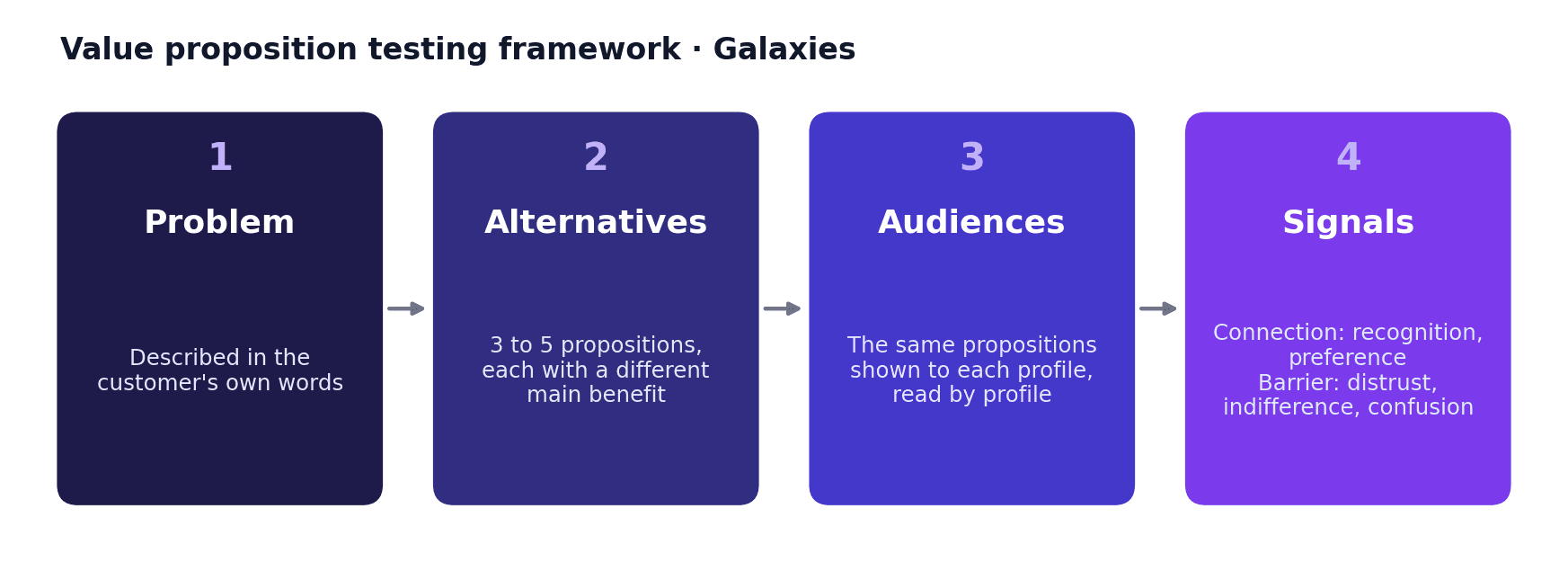
Figure 1. Galaxies’ framework for testing a value proposition: problem, alternatives, audiences, and signals of connection or resistance.
Step 1: name the problem in the customer’s words
Before writing a proposition, describe the problem the way a customer would. If your research includes open-ended responses, start there. A useful check is whether a customer would read the sentence and say, “That is exactly what happens to me.”
Step 2: write three to five different propositions
Each option should bet on a different core benefit. Five versions of the same idea with different adjectives do not count. For an illustrative facial sunscreen, option A might promise “High protection without an oily finish” (texture); B, “One application protects all day” (convenience); C, “Tested for sensitive skin” (safety); and D, “Lower cost per application than your current sunscreen” (savings). Any real product claim must, of course, be substantiated.
Step 3: show the options to different audiences
The same proposition rarely wins across every group. Results need to be read by profile. In Nexus Stimulus Analysis, a team can compare up to ten stimuli with up to ten personas at once; each persona scores, ranks, and explains the options. Because the personas are built from the client’s research, the test stays connected to the brand’s actual audience.
Step 4: read both connection and resistance
Preference is only half the result. The other half is resistance: what makes each audience distrust, misunderstand, or dismiss the promise? A proposition can lead on preference and still raise serious doubts among a strategically important group. That may call for a revision before launch.
What signals show that a value proposition connects?
Look for recognition of the problem: people describe the situation in their own words and offer examples. Consistent preference across profiles suggests a candidate for the main proposition; strong preference in just one profile suggests a segment-specific proposition.
Negative signals matter as much. “Sounds too good to be true” points to a need for proof or a change in tone. Indifference means a benefit may be real but does not affect choice. Confusion, when people explain the promise differently from what the team intended, may be a language problem rather than a product problem.
How can a value proposition vary across audiences?
Consider the same fictional facial sunscreen. These profiles and reactions are illustrative, not client results. A 25- to 34-year-old who uses sunscreen daily and has oily skin might prefer the texture-led promise, but object that every sunscreen claims a non-greasy finish. A tactile demonstration or before-and-after evidence could make it credible.
A busy parent who applies sunscreen once in the morning might prefer convenience, while questioning whether “all day” includes heat and sweat. The promise needs clear conditions. Someone with sensitive skin might favor the safety-led proposition but want evidence about the formula, such as appropriate dermatological testing. A price-conscious shopper might appreciate a lower cost per use yet object to a higher shelf price; a transparent calculation could help.
The most important result is not which option won. It is that there may be no single winner. A company can prioritize its most strategic audience and accept a weaker fit elsewhere, or keep one overarching proposition while adapting the main argument by segment. Both choices are valid. Testing makes the trade-off visible.
Checklist: is your value proposition ready for market?
Before approving the final proposition, ask: Is the problem described in words customers would use? Have at least three options based on distinct benefits been tested? Were results reviewed by audience instead of only as an average? Are each group’s barriers mapped, with answers in the communication?
Does the proposition beat what customers already use, including doing nothing? Is there evidence for the main promise, such as a result, guarantee, case, or demonstration? Have you documented the final choice, its rationale, and the KPI that will measure it after launch, such as click-through rate, customer acquisition cost, or creative approval rate?
How long does it take to test a value proposition with synthetic personas?
A Nexus Stimulus Analysis study runs in minutes. A structured verdict with human review is ready within 48 hours, in time for a launch approval meeting. At Mahta Bio, testing creative before a campaign reduced customer acquisition cost by 35%.
That speed changes the method. Instead of relying on one large prelaunch study, teams can run short iterations: test, refine the wording based on barriers, and test again. The proposition reaching the market has already been through several versions.
There is a limit worth repeating. Synthetic personas suggest direction and reasons before spending. At Galaxies, reliability is assessed by comparing their answers with those of a real control group from the same segment on questions not used in profile construction. Conversations are continuously evaluated with the open DeepEval framework for relevance, bias, hallucination, profile fidelity, and toxicity. If a decision demands formal statistical evidence, as a major repositioning might, simulation serves as a first filter and reduces the number of options needing field validation.
The promise customers would choose
A strong value proposition is not the most polished sentence. It is the one customers recognize as an answer to their own problem. Finding it means comparing options, distinguishing audiences, and paying as much attention to barriers as to preference. Today teams can do that before launch, through short rounds grounded in data they already have. Waiting for the market to validate a proposition has become more expensive than testing it.
This article is part of our decision-intelligence series. A next step is to explore how a product proposition becomes a broader brand position; a dedicated article on testing brand territories and messages can be linked when available.
Compare value propositions across audiences
Bring three to five propositions into Nexus and see which benefit connects with each profile, and what keeps the others from connecting. Explore how Nexus works.
Frequently asked questions about value propositions
What is a value proposition?
It states what problem a product solves, for whom, and why it solves it better than the available alternatives, including doing nothing. It is a strategic choice, not a slogan.
How do you test a value proposition?
Describe the problem in customers’ words, write three to five options with different core benefits, show them to distinct audiences, and analyze preferences and barriers by profile. In Nexus, a study runs in minutes and a structured verdict is ready within 48 hours.
What is the difference between a value proposition and positioning?
A value proposition defines the benefit a product provides and to whom. Positioning defines the place the brand wants to occupy in its audience’s mind relative to competitors. The proposition usually comes first and supports the positioning.
Can a company use different value propositions for different audiences?
Yes. When different benefits resonate with different groups, a company may keep an overarching proposition while tailoring its main argument by segment, provided the promises do not contradict one another.
About the author
Carol Yoshida is head of product at Galaxies, a consumer decision layer for marketing leaders at consumer businesses. Galaxies develops Nexus: Galaxies Lab, a platform for investigating and supporting decisions before spending, using synthetic personas built from real research with Brazilian consumers.
Sources
[1] Galaxies, client cases: https://www.galaxies.com.br/pt/clientes
[2] Galaxies, Nexus: Galaxies Lab User Guide, revised September 14, 2026: Stimulus Analysis supports up to ten stimuli and ten personas.
Carol Yoshida
Read more

·
Pietro Lancieri
Consumer Behavior: How to Test Hypotheses Before Turning Them Into Campaigns
In brief: Consumer behavior is the study of how people choose, buy, use, and stop using products, and of the forces behind those choices. At a large consumer brand, that knowledge becomes a campaign through hypotheses: “This audience buys for convenience” or “This claim will reduce an objection.” Too often, those beliefs receive budget before anyone tests them. Turn each one into a question that could be disproved, then test it before execution. At Galaxies, Nexus does this before spending with synthetic personas built from the client’s own real research.
Every campaign starts with a sentence nobody writes down: “Our audience is tired of promotions.” “They want to see real people, not models.” “Free shipping matters more than a discount.” These are claims about consumer behavior, stated with confidence in briefing meetings and used to steer substantial budgets without being checked.
Working with Galaxies clients and partners has shown me that the problem is rarely a lack of consumer knowledge. Teams know their audiences well. What they need is a way to separate what they know from what they assume, and test those assumptions before they become creative assets, media plans, and sales targets.
What is consumer behavior?
Consumer behavior encompasses the decisions and actions people take as they search for, choose, buy, use, and dispose of products and services, along with the psychological, social, cultural, and situational factors shaping those choices.
For marketers, the practical point matters more than the academic definition: behavior is the context into which a marketing decision lands. The same message can succeed or fail depending on how people research a category, how much they trust it, what objections they already hold, and the situation in which they encounter it.
Why has consumer behavior become harder to keep up with?
Consumer habits can shift faster than the methods used to observe them. In January 2026, Clutch reported that 65% of consumers used AI to research products before buying [1]. PYMNTS reported that 53% of Brazilians used AI in their most recent online purchase [2]. In the United States, SparkToro reported that 68% of Google searches ended without a click, based on Similarweb data from January to April 2026 [3].
The purchasing figures change how we think about assumptions. If more than half of Brazilian shoppers have consulted AI in a recent online purchase, part of the decision may now happen in a conversation the brand cannot see. Meanwhile, a long research and campaign-approval cycle leaves time for preferences, category language, and objections to shift.
In a talk called “The Consumer Your Data Lost,” our CEO Daniel Victorino described the difference this way: marketing still draws journeys, but consumers move in loops. They discover, understand, consume, learn, and return, sometimes with different decision criteria on the next pass. That is the Signal-to-Decision Gap in practice: an assumption supported by the last study may be stale by the next campaign. Our decision-intelligence guide explores that gap.
How do you turn behavior into a testable hypothesis?
A statement about behavior becomes a hypothesis only when evidence could prove it wrong. “Our audience values sustainability” is too broad to test as written. “Given two packages at the same price, audience X will choose the recycled-material option and cite that material as the reason” is testable.
We use four questions to make that shift. Who exactly is the audience or segment, rather than “consumers” in general? What concrete stimulus will they see: a message, benefit, offer, or creative asset? What will it be compared with? And what result would support or overturn the hypothesis?
The last question is the most important. When a team defines in advance what would disprove its belief, it becomes harder to treat every outcome as confirmation.
Which consumer-behavior hypotheses should you test before a campaign?
The most expensive assumptions support the main message, the benefit being highlighted, the objection the campaign aims to resolve, and the value proposition. The following are illustrative examples, not claims about specific client projects.
Message: humor or a rational argument?
Hypothesis: younger audiences respond better to humor than to rational copy. Compare two versions of the same asset, one humorous and one rational. The hypothesis gains support if the humorous version leads and respondents cite identification; it loses support if the rational version wins or the humor causes rejection.
Benefit: light texture or higher protection?
Hypothesis: for skincare, light texture matters more than a high protection factor. Present the same offer with each benefit highlighted. A preference for texture, with that reason cited, supports the idea. A stronger response to protection, or no meaningful difference in reasons, challenges it.
Objection: is trust the real barrier?
Hypothesis: people avoid switching pain-relief brands because they doubt a newcomer’s effectiveness. Compare compliant assets with and without appropriate quality evidence. If that evidence reduces the objection, the hypothesis is supported; if price or another concern dominates, it needs revisiting.
Value proposition: convenience or price?
Hypothesis: the audience chooses for convenience, not price. Compare propositions led by each benefit. Convenience must win among the target segments to support the claim; a price-led result or a split audience would argue for a more nuanced strategy.
Channel and context: does AI inform the purchase?
Hypothesis: the audience consults AI before buying. Ask about information sources and trust in recommendations. Relevant AI use supports the hypothesis; traditional channels dominating responses would challenge it. These tests do not replace what a team has learned about its audience. They put that knowledge to work at the moment it matters, before execution.
How can you anticipate consumer reactions without guessing?
The short answer is real data, competing options, and stated limits. At Galaxies, synthetic personas for these tests come from research with real respondents conducted by clients or partners, not generic web data. Each persona represents a group present in the research. Present a hypothesis and it can surface the group’s likely preferences, reasons, and objections.
We assess reliability by comparing persona answers with a control group of real people from the same segment, using questions that were not used to construct the profiles. Conversations are continuously evaluated with the open DeepEval framework for relevance, bias, hallucination, profile fidelity, and toxicity.
Simulation indicates direction and reasons, not the statistical proof some decisions require. In those cases, it filters options before fieldwork. A persona can only represent behavior present in its source data, so a new audience requires new research. Questions about future events that have not happened call for more caution than questions about current preferences and objections. Small differences between runs are normal; the order of alternatives and consistency of reasons matter more than decimal points.
What does this look like from brief to campaign?
A practical workflow has four moments. At the brief, list the three or four behavioral assumptions behind the campaign and mark which are supported by evidence and which are still guesses. Before creative development, test the costliest assumptions, especially the main message and benefit, with personas reflecting the target audiences.
Before buying media, test the finished assets to check whether execution preserved what the earlier test supported. After launch, compare actual outcomes with the test’s indications and update the list of supported or disproved hypotheses. Over time, the team builds a living record about its own audience, more valuable than any study read only once.
This can fit into a campaign calendar: a Nexus study runs in minutes, and a structured verdict with human review is ready within 48 hours. At Mahta Bio, validating creative before a campaign reduced customer acquisition cost by 35%.
Know your consumers, and verify what you think you know
No marketing team starts from zero with its audience. The risk lies in treating knowledge and assumptions as if they were the same, or carrying a two-year-old belief into a market that changes daily. Testing the most consequential hypotheses before a campaign is a less costly way to learn which still hold.
This article is part of our decision-intelligence series. For another perspective on how audience reactions vary by group, explore our article on AI audience segmentation.
Test your assumptions about consumers
Use Nexus Persona Conversation to check the hypotheses behind your next campaign before spending. Explore how Nexus works.
Frequently asked questions about consumer behavior
What is consumer behavior?
It covers the decisions and actions people take when searching for, choosing, buying, using, and disposing of products, and the psychological, social, cultural, and situational factors shaping those decisions.
How can you predict consumer behavior?
Turn each assumption into a testable hypothesis with a defined audience, stimulus, alternative, and criterion for support or rejection. Then test it against real audience data, through research or synthetic personas built from that research, before investing in a campaign.
What factors influence consumer behavior?
Psychological factors such as motivation and perception; social factors such as family and reference groups; cultural factors such as values and habits; and situational factors such as the moment and channel of purchase. Product research through AI is also an increasingly relevant part of the context.
Do synthetic personas replace consumer-behavior research?
No. They are built from studies with real people and help test hypotheses quickly. Research remains essential for building and refreshing that foundation and for decisions that require formal evidence.
About the author
Pietro Lancieri is co-founder and head of channels and partnerships at Galaxies, a consumer decision layer for marketing leaders at consumer businesses. Galaxies develops Nexus: Galaxies Lab, a platform for exploring and supporting decisions before spending, using synthetic personas built from real research with Brazilian consumers.
Sources
[1] Clutch, “65% of Consumers Use AI to Research Products Before Making a Purchase,” January 22, 2026: https://www.businesswire.com/news/home/20260122526477/en/Clutch-Report-65-of-Consumers-Use-AI-to-Research-Products-Before-Making-a-Purchase
[2] PYMNTS Intelligence, Global Digital Shopping Index: Brazil Playbook, 2,273 respondents: https://www.pymnts.com/study/global-digital-shopping-index-new-brazilian-shopper/
[3] SparkToro, “When Google Stops Sending Clicks, What Still Works?,” June 9, 2026: https://sparktoro.com/blog/zero-click-search-what-still-works/
[4] Galaxies, client cases: https://www.galaxies.com.br/pt/clientes
Pietro Lancieri
Read more

·
Rafael Tortella
Predictive Analytics in Marketing: Seven Decisions to Test Before Launch
In brief: To use predictive analytics in marketing, start with a decision, not a model. Define the choice, write down the alternatives, and use real audience data to estimate how each might be received. Statistical models work for decisions with historical data, such as churn and repeat purchases. New decisions, such as an untested message or product, call for audience simulation. At Galaxies, Nexus runs that test before spending, using synthetic personas built from a client’s own real research.
As an engineer, the question I hear most often from marketing teams is “Which model do you use?” I understand the curiosity, but it comes too early. The model should be the last choice in a predictive-analytics project. The first is the decision it needs to support. A technically sound model is not useful if it answers a question nobody is trying to decide.
This article reverses the order. Rather than explaining algorithms, it presents seven marketing decisions that can be tested before execution and, for each one, sets out the problem, hypothesis, alternatives, and answer the test can provide.
What is predictive analytics?
Predictive analytics uses data, statistics, and machine learning to estimate the likelihood of an outcome. In marketing, it helps anticipate customer behavior and audience reactions to a company’s decisions.
Two situations need different methods. When there is historical data, such as many previous subscription cancellations, propensity models can estimate which customers are likely to churn next quarter. When the decision is new, such as a product that does not yet exist, there is no history of the action. Research into the audience’s attitudes, values, and habits can instead underpin a simulation of how different profiles might react.
A churn model works because “canceling” has happened many times in the database. An untested message has no track record. The question changes from “What will this customer do?” to “How might this type of person respond to this alternative?” Galaxies’ synthetic personas were designed to help answer that second question.
Which marketing decisions can predictive analytics help test?
The following seven decisions recur in the work we see. Each can be framed in the same way: define the problem, state a hypothesis, compare alternatives, and specify what the test should answer. The industry scenarios are illustrative unless a client result is explicitly cited.
1. Product launch
Problem: a beauty brand is launching a skincare line and must decide which concept to take to market. Hypothesis: a simple-routine concept will be better received than a high-performance concept. Alternatives: two or three concepts, each with a name, main benefit, and short description. The test shows which concept each audience prefers and the barriers to adoption before production and launch.
2. Creative
Problem: several assets are ready, but the budget can support only a few. Hypothesis: a creative featuring real people will feel more relatable than a product-focused one. Alternatives: candidate images, videos, or copy. The test ranks the assets by audience and explains what attracts attention or causes rejection before media is purchased.
3. Messaging
Problem: an over-the-counter health brand needs a main claim for its winter campaign. Hypothesis: a rapid-relief argument will outperform a brand-trust argument. Alternatives: two or three versions of the claim, all within applicable category regulations. The test shows which argument connects with each audience and what objections each version raises.
4. Positioning
Problem: a brand is considering a new territory. Hypothesis: existing customers will accept a younger positioning. Alternatives: the current positioning and two candidates. The test shows who moves closer to or further from the brand under each option, including the risk of alienating its current base.
5. Pricing and offer
Problem: a company must choose how to present a price, package, or commercial terms. Hypothesis: interest-free installments matter more than an upfront discount. Alternatives: different ways of presenting the price and offer. The test examines perceived value and the reasoning behind each format by audience. It does not replace a price-elasticity study based on sales data.
6. Priority segment
Problem: the budget cannot support every audience equally. Hypothesis: segment B is more aligned with the proposition than segment A, which currently receives more spend. Alternative: show the same strategy to each segment. The test reveals where the strategy resonates most and where it needs adjustment.
7. Packaging and in-store experience
Problem: a food and beverage brand plans to change the packaging of a high-volume product. Hypothesis: highlighting a natural ingredient on the front will increase purchase intent. Alternatives: two or three visual packaging concepts. The test shows what each audience notices first, what raises doubts, and which version best communicates the benefit before large-scale production.
How do you choose which decision to test first?
You do not need to test all seven at once. Consider three factors: the budget at stake, how difficult it would be to reverse a mistake, and how much evidence the team already has. Product launches and packaging changes carry high spending and low reversibility, so test before production. Positioning is even harder to reverse and should be tested before campaign development.
Messaging usually merits testing before creative production; creative can be tested in shorter cycles before media buying. Test pricing and offers before communicating them to the market, and audience priorities before allocating budget. High-spend, hard-to-reverse decisions may also need field validation after simulation. More reversible choices can be tested repeatedly while tracking click-through rates and creative approval rates.
What makes predictive analytics trustworthy?
From an engineering perspective, trust depends less on the algorithm than on the quality and origin of the data, validation against real people, and continuous evaluation. At Galaxies, personas are built from the client’s or its partners’ real research, not generic internet data. Client data is prepared and anonymized, and access to analyses is isolated by client.
We assess reliability by comparing persona answers with those of real people in the same segment, using questions that were not part of profile construction. Conversations are also evaluated continuously with the open DeepEval framework across relevance, bias, hallucination, profile fidelity, and toxicity.
Limits are part of trustworthiness, too. A persona can represent only what exists in its source research. Results can vary slightly between runs, so interpretation should focus on the ranking of alternatives and the reasons behind it, not tiny percentage differences.
A useful public benchmark shows how simulation can be validated against people. A Stanford study published in 2025 used two-hour interviews with 1,052 Americans to build generative agents. Those agents reproduced participants’ answers to the General Social Survey at 85% of the consistency participants themselves showed when answering again two weeks later [2]. This was a separate study, not a performance claim for Nexus; it illustrates the importance of measuring simulations against real responses.
For a comparison between simulation based on a brand’s own audience and simulation of broader populations, see the Nexus or Simile discussion in our decision-intelligence guide.
Where do predictive-analytics projects tend to fail?
Three failures come up often, and none is primarily about the algorithm. First, a question without a decision: the model answers something interesting but does not change a choice, so its output becomes a slide no one uses again.
Second, data that does not represent the relevant audience: a model trained on existing customers is used to predict the reactions of people the company does not yet serve. The prediction may look precise and still be wrong. Third, a result without a deadline: the analysis arrives after the campaign has already been approved.
All three can be avoided with the same discipline: define the decision, audience, and deadline before choosing the method.
How long do these tests take?
A Nexus study, whether a Persona Conversation, Questionnaire, or Stimulus Analysis, runs in minutes. A structured verdict including human review is ready within 48 hours. That allows several of these decisions to be tested during one campaign cycle before spending.
At Mahta Bio, testing creative before the campaign, as in decision two above, reduced customer acquisition cost by 35%. Galaxies’ ROI calculator can help estimate the potential effect with your own numbers.
Prediction in service of a choice
Predictive analytics earns its place by changing decisions, not by showing off a sophisticated model. All seven decisions have something in common: teams can make them with stronger evidence when they compare alternatives using real audience data before execution. Pick one, write down the options, and test them. The right model is the one that answers that decision.
This article belongs to our decision-intelligence series. For a clearer distinction between forecasting from historical behavior and simulating reactions to something new, read our predictive-marketing article.
Choose one of seven decisions and test it in Nexus
Bring a product launch, creative, messaging, positioning, pricing, audience, or packaging decision to Nexus and compare options with your audiences before spending. Explore how Nexus works.
Frequently asked questions about predictive analytics in marketing
How do you use predictive analytics in marketing?
Start with a specific decision, write down the alternatives, and use real audience data to estimate how each might be received. Historical models suit churn and repeat purchases. New decisions are better suited to simulation with synthetic personas.
What is the difference between predictive and descriptive analytics?
Descriptive analytics explains what has already happened using historical data. Predictive analytics estimates what may happen, either by projecting historical patterns or simulating how an audience might respond to new options.
What data do you need for predictive analytics in marketing?
Propensity models need historical customer behavior. Simulating reactions needs audience research into attitudes, habits, and values. Galaxies builds personas from real research that has been prepared and anonymized.
Does predictive analytics replace A/B testing?
No. An A/B test measures actual audience outcomes after exposure. Predictive analytics operates beforehand, helping teams decide which alternatives are worth putting into an A/B test or paid media.
About the author
Rafael Tortella is co-founder and principal engineer at Galaxies, a consumer decision layer for marketing leaders at consumer businesses. Galaxies develops Nexus: Galaxies Lab, a platform for investigating and supporting decisions before spending, using synthetic personas built from real research with Brazilian consumers.
Sources
[1] Galaxies, client cases: https://www.galaxies.com.br/pt/clientes
[2] Stanford HAI, “Simulating Human Behavior with AI Agents,” May 2025: https://hai.stanford.edu/policy/simulating-human-behavior-with-ai-agents
Rafael Tortella
Read more
·
Galaxies
Galaxies Is Nominated for the Open Innovation Awards 2026
The nomination recognizes an open innovation case between Galaxies and a corporation. The 100 Open Startups Ranking 2026 list was released on October 19. The awards ceremony takes place on November 23, with a live broadcast.
In brief: Galaxies is nominated for the Open Innovation Awards 2026, the awards ceremony for the 11th edition of the 100 Open Startups Ranking, organized by 100 Open Startups. The nomination stems from an open innovation case between Galaxies and a corporation. The ranking list was released on October 19. The ceremony will take place on November 23, 2026, starting at 5:40 p.m. Brasília time (UTC−3), with a live broadcast. Being nominated does not mean having won: the results will only be announced on the night of the ceremony.
This article brings together what we know about the nomination, explains what the ranking measures and shows how to follow the awards ceremony.
What are the Open Innovation Awards and the 100 Open Startups Ranking?
The 100 Open Startups Ranking is a ranking of open innovation with startups, published since 2016, that annually recognizes corporations that stand out in this practice and the startups most attractive to the corporate market. The Open Innovation Awards is the gala evening celebrating the ranking’s highlights. In 2026, the event marks the awards ceremony for the 11th edition, with the theme “The Decade of Results.”
According to the organizer, the ranking’s database includes more than 180,000 registered contracts and relationships between startups and corporations, and the platform connects 50,000 startups and 10,000 corporations. These figures come from 100 Open Startups itself, which has also organized Open Innovation Week since 2008.
How does a startup enter the 100 Open Startups Ranking?
Scores come from formalized open innovation relationships that a startup registers on the platform, such as contracts, projects and proofs of concept. According to the ranking page for startups and scaleups, only the best relationship per corporation is counted. Each relationship must be validated by the corporation on the other side. To appear in the official publication, the startup must also undergo an audit and have at least one case with an abstract approved at the Latin American Congress of Open Innovation Cases. According to the organizer, only those that complete these steps are eligible to receive an award.
In other words, the ranking is based on registered, validated relationships, not self-reported claims.
What changes in the ranking in 2026?
The 11th edition opens a new decade for the ranking with an evolution in its methodology. In addition to the intensity and diversity of relationships between corporations and startups, demonstrating results now carries greater weight. The organizer states that, beginning with the 2026–2035 decade, it is expanding its focus on evidence of results, impact and learning. Cases are evaluated by industry peers and researchers, in conjunction with the Latin American Congress of Open Innovation Cases.
What does the nomination mean for Galaxies?
The nomination stems from an open innovation case between Galaxies and a corporation, registered on the ranking platform and validated by the corporate partner.
This recognition has particular significance for us. In 2026, the ranking began placing greater value on evidence of results, and that is what we aim to deliver to marketing leaders: decisions based on signals before budgets are spent in the market.
A nomination is not yet an award. The results will be announced on the night of the ceremony, November 23, and this article will be updated with them at the same address.
Who is Galaxies?
Galaxies is a Marketing Decision Intelligence company. It helps marketing leaders at consumer-facing companies make decisions about creatives, claims, audiences and messaging before committing their budgets. To do this, it develops Nexus: Galaxies Lab, a platform for investigation and decision support before spending, with synthetic personas built from real research and human review. Galaxies is ISO/IEC 27001 certified and operates in compliance with the LGPD and GDPR.
To understand the method, read what synthetic personas are or explore Nexus.
How can you watch the awards ceremony?
The Open Innovation Awards 2026 live broadcast takes place on November 23, 2026, starting at 5:40 p.m. Brasília time (UTC−3), at 100os.net/Gala2026AoVivo. The organizer reports that the 2025 edition’s broadcast surpassed 350,000 views. To receive a notification when it begins, enable notifications on the broadcast channel.
In closing: what happens after November 23
After the ceremony, this page will be updated with the results and next steps. In the meantime, anyone who would like to discuss Nexus can book a demo.
Frequently asked questions
What is the Open Innovation Awards 2026?
It is the gala evening celebrating the highlights of the 100 Open Startups Ranking. In 2026, the event marks the awards ceremony for the ranking’s 11th edition, organized by 100 Open Startups.
What is the 100 Open Startups Ranking?
It is a ranking of open innovation with startups, published since 2016. It annually recognizes corporations that stand out in this practice and the startups most attractive to the corporate market, based on registered relationships and contracts.
Has Galaxies already won the award?
No. Galaxies is nominated for the Open Innovation Awards 2026. The results will be announced on the night of the ceremony, November 23, and this article will be updated afterward.
When was the 100 Open Startups Ranking 2026 list released?
On October 19, 2026. The awards ceremony celebrating the highlights takes place on November 23 at the Open Innovation Awards.
When is the Open Innovation Awards 2026 ceremony?
On November 23, 2026, starting at 5:40 p.m. Brasília time (UTC−3), via the live broadcast at 100os.net/Gala2026AoVivo. The organizer recommends enabling channel notifications to receive an alert when it begins.
How does a startup enter the ranking?
By registering its contracts and formalized open innovation relationships with corporations on the platform. Scores come from these relationships, and only the best relationship per corporation is counted, according to the organizer. To appear in the official publication, a startup must also undergo an audit and have a case with an abstract approved at the Congress of Open Innovation Cases.
What does Galaxies do?
Galaxies is a Marketing Decision Intelligence company. It helps marketing leaders at consumer-facing companies make decisions about creatives, claims, audiences and messaging before committing their budgets. To do this, it develops Nexus: Galaxies Lab, with synthetic personas built from real research and human review.
Sources cited
100 Open Startups. Open Innovation Awards, About page.
100 Open Startups. 100 Open Startups Ranking 2026, for startups and scaleups.
100 Open Startups. Open Innovation Awards 2026 live broadcast.
Galaxies
Read more
·
Daniel Victorino
Brand Positioning: How to Test Territories and Messaging Before a Reposition
In brief: Brand positioning is the place a brand chooses to occupy in an audience’s mind relative to alternatives. Repositioning is among marketing’s most expensive and least reversible decisions. Yet it is often approved on the strength of a few interviews and a committee’s conviction. Comparing brand territories and messages across audiences before launch can reduce that risk by measuring both the appeal of a new position and how unfamiliar it feels to existing customers. At Galaxies, Nexus tests those options before spending, using synthetic personas built from a client’s own real research.
In some repositioning projects, the preferred territory is chosen before testing begins. An agency presents three options, the committee selects the boldest, and the research that follows is used to confirm the choice. Ambition is not the problem. The problem is that nobody knows its cost until the campaign is live.
Positioning deserves different treatment from a campaign message because it is harder to undo. A line of copy can change next week. A repositioning that alienates existing customers can take years to repair. The right time to test it is while changing direction is still inexpensive, before creative assets reach the market.
What is brand positioning?
Brand positioning is the deliberate choice of what association people should make when they think about a brand in its category. It answers: for whom are we the best choice, in what situation, and for what reason that competitors do not own?
Three ideas are often conflated. A brand territory is the thematic and emotional space the brand occupies, such as convenience or trust. Positioning defines its relative place among competitors for a particular audience. Messaging is how that position is expressed in a campaign. Territory is the most structural decision; messaging is the most tactical; positioning connects them. A strong territory can be undermined by weak messaging, and brilliant copy cannot rescue a territory the audience does not recognize as credible for the brand.
Why test positioning before a reposition?
Repositioning carries two kinds of risk, but common methods often measure only one. The first is attraction: will the new position win the audience the brand wants to reach? The second is loss: will existing customers, who sustain current revenue, still recognize the brand or feel left behind?
Testing only the new target audience may approve a position that pushes current customers away. Testing only the existing base can veto any meaningful change. A responsible decision reads both responses side by side.
Evidence matters at the board level, too. In a 2026 Makers and Uncover study of 113 marketing leaders, only 9% said they fully trusted what they measured, while 41% said their boards primarily evaluated marketing by revenue growth or market share [1]. The survey ran from May to June and included CMOs, VPs, directors, and managers; 70% worked at companies with revenue above R$500 million. These teams are not short on creativity or brand experience. Many need stronger evidence for defending a new territory before launching it.
How do you build a positioning test matrix?
The matrix we use crosses four dimensions: territory, message, audience, and barriers. It turns an abstract argument about “the best territory” into a comparison with stated criteria. Test two to four candidate territories alongside the current position. Give each territory a representative message with a defined tone and promise. Compare responses from current customers, the audience the brand hopes to win, and any group at particular risk. Record objections, unfamiliarity, and credibility concerns.
Each cell in the resulting grid shows how one audience responds to one territory. Consider an illustrative food brand considering a move away from tradition. Its loyal customer base strongly identifies with tradition, while younger urban consumers may dismiss it as “my grandmother’s brand.” Convenience may be moderately acceptable to both, but insufficiently distinctive. An origin-and-ingredients territory might feel like a natural continuation to current customers and interest new buyers, provided the brand can prove its sourcing claims. An irreverent territory might attract new buyers while making loyal customers feel the brand has changed beyond recognition.
Those reactions are fictional examples, not client test results. In a real test, each cell would capture preference, reasons, and barriers by profile. The territory most appealing to newcomers is not necessarily the best choice. A stronger option may attract them while still feeling like a credible continuation to the existing base.
What signals indicate risk in a repositioning?
Watch for four patterns before approval. Estrangement: current customers describe the brand in the new territory as “a different company.” Lack of permission: people understand the territory but do not believe this brand can credibly occupy it. An occupied territory: audiences already associate the idea with a particular competitor, so your spending might reinforce that competitor instead. And attraction without a reason: people like the territory but cannot explain why it would make them choose the brand. That often signals an aesthetic idea rather than a strategic one.
None of these automatically rules out a repositioning. They show what must be resolved before launch: proof, a gradual transition, revised messaging, or another territory.
Where do synthetic personas fit in a positioning test?
They support the comparison between the agency or brand team’s creation of possible territories and the committee’s decision. Personas built from a brand’s own research can respond to territories and messages across audience groups, revealing preferences, reasons, and barriers. A study runs in minutes, and a structured verdict with human review is ready within 48 hours.
That changes the project’s rhythm. Instead of one final validation round, teams can test territories, revise messages in response to existing-customer discomfort, and test again. The committee then sees evidence about both risks: failing to attract new customers and losing the current base.
This step does not replace brand tracking, which measures a brand’s current strength in the market, or the statistical evidence a major repositioning may require. It works earlier, narrowing four territories to one or two worth the larger field-validation investment. At Galaxies, reliability is assessed by comparing persona answers with those of real people in the same segment on questions not used to build the profiles. Conversations also undergo ongoing DeepEval assessment for relevance, bias, hallucination, profile fidelity, and toxicity.
How long does it take to test brand territories?
Repositioning projects often test only the favorite territory, or none at all, because research does not fit the agency and committee’s timetable. In Nexus, each study runs in minutes and a structured, human-reviewed verdict is ready within 48 hours. That makes multiple rounds possible before the choice is final.
For positioning, open-ended answers can be more valuable than scores. This is where unfamiliarity and lack of permission emerge in language a numerical scale might miss.
A useful sequence is: first, test every candidate territory plus the current one with both existing and prospective audiences. Next, revise the messages for the two strongest options using the barriers people cited. Then retest those two options with the same groups to see whether the barriers have eased. Finally, choose a territory and decide what still needs field validation given the scale of the repositioning.
An executive checklist before approving a new position
Was the current positioning included as a baseline? Were existing customers and the new target audience evaluated separately? Did every territory have a representative message, not just an abstract concept? Were unfamiliarity, lack of permission, and competitor ownership checked?
Is there evidence to support the new territory? Is it clear which claims require field validation and which decisions rely on the preliminary test? If the chosen direction causes moderate concern among existing customers, is there a transition plan?
Reposition with both risks in view
Repositioning rarely fails for lack of creativity. It fails when a brand learns too late that a new audience did not believe the promise or existing customers no longer saw themselves in it. Both risks can be explored before launch, while a change of mind still costs relatively little. A committee should receive a comparison, not just a favorite territory: what each option gains and what it puts at risk.
This article is part of our decision-intelligence series. Before positioning comes the value proposition: see how to test which benefit really matters to each audience.
Compare positioning territories before deciding
Show territories and messages to different audiences in Nexus and see who moves closer, who moves away, and why. Explore how Nexus works.
Frequently asked questions about brand positioning
What is brand positioning?
It is the choice of what association a brand wants people to make in its category: for whom it is the best choice, in what situation, and for what reason that sets it apart from competitors.
How can you test brand positioning before launch?
Compare two to four candidate territories plus the current position with existing customers and the audience you want to win. Read preference, reasons, and barriers for each. In Nexus, a study runs in minutes and a structured verdict is ready within 48 hours, before campaign production.
What is the difference between brand territory and positioning?
Territory is the thematic and emotional space a brand occupies, such as convenience or trust. Positioning is its relative place among competitors for a particular audience within that territory.
Does testing with synthetic personas replace brand tracking?
No. Brand tracking measures current brand strength over time. Synthetic-persona testing comes earlier, comparing potential positions that have not yet reached the market.
About the author
Daniel Victorino is CEO and co-founder of Galaxies, a consumer decision layer for marketing leaders at consumer businesses. Galaxies develops Nexus: Galaxies Lab, a platform for investigating and supporting decisions before spending, using synthetic personas built from real research with Brazilian consumers.
Sources
[1] Makers and Uncover, O Futuro da Mensuração em Marketing, survey of 113 marketing leaders conducted May–June 2026: https://meet.uncover.co/o-futuro-da-mensuração-em-marketing-lkd
[2] Galaxies, client cases: https://www.galaxies.com.br/pt/clientes
Daniel Victorino
Read more
·
Carol Yoshida
Nexus MCP: Nexus inside the conversation your team already has open
The decision that used to hold up your week now happens in the conversation you already have open. With Nexus MCP, your team uses Nexus capabilities inside the AI assistant it already uses, with your company’s synthetic personas and a person’s approval before anything is executed.
In brief: Nexus MCP is the connector that links the Nexus platform, from Galaxies, to AI assistants such as Claude. Once connected through a Nexus account, the team uses natural language to ask to talk to personas, test creatives or build questionnaires, and the assistant operates Nexus behind the scenes. Looking up personas and drafting studies is unrestricted; running a study requires a person’s approval inside Nexus. Nexus MCP is available to accounts enabled by the Galaxies team. Marketing Decision Intelligence is what we call the work Galaxies does: helping marketing leaders make decisions about creatives, claims, audiences and messaging before committing their budget, using synthetic personas built from real research and human review.
Anyone who works in marketing knows the pattern: the deadline is tight, media has already been purchased and the creative goes live without any indication of how consumers will react. This article explains what Nexus MCP is, what it enables, how approval works, what it does not do and how your team can get started.
What is Nexus MCP?
Nexus MCP is the connector that links the Nexus platform to AI assistants such as Claude. Instead of opening Nexus and building a study screen by screen, a person describes the business question in the assistant they already have open. The assistant finds the personas, talks to them, builds and runs the studies, and delivers the results as a PDF or presentation.
MCP stands for Model Context Protocol, an open standard for connecting AI applications to external systems. Anthropic introduced the protocol in November 2024 as an open standard for connecting AI assistants to the systems where data lives. In practice, it allows an assistant to operate a product as a tool. The Galaxies connector is called Nexus MCP.
Requests can be made in Portuguese or English. For example: “list my personas,” “test this creative with younger audiences” or “build a questionnaire about switching banks.” The connection walkthrough uses Claude Desktop. Cursor, Claude Code and other compatible assistants use the same address and login.
Why do campaign decisions get stuck today?
Three situations keep recurring in marketing teams and explain why testing gets left out of the process.
The campaign is approved before there is any evidence. The deadline is tight, media has already been purchased and the creative goes live without any indication of how consumers will react.
Testing does not fit the schedule. Validating creatives and messaging takes weeks, the campaign cannot wait and the final decision comes down to intuition or a committee.
Every new tool becomes another forgotten tab. Each requires its own login, training and routine, and the data ends up far from the conversation where the decision happens.
Nexus MCP tackles the third situation head-on: the team does not learn a new tool; it requests the test in the assistant it already uses. In doing so, it helps ease the first two, because testing is no longer a separate step.
What can your team do with Nexus MCP?
There are 22 Nexus actions available in the assistant, organized into six families. Most only retrieve information; eight create or execute studies, and those eight go through a person’s approval. The table shows what each family does and what a request sounds like in practice.
Family
What it does
Example request
Personas
Lists the company’s synthetic audiences and opens each complete profile: who they are, how they think, their habits and motivations.
“List the available personas and tell me which one is closest to a young person who bets occasionally.”
Persona conversations
Asks a persona questions and follows up while maintaining context. Runs the same interview guide with multiple personas in parallel and compares them. Resumes previous conversations.
“Ask these five questions to personas A, B and C in parallel and build a comparison table.”
Stimuli
Lists and details the assets in the company’s Stimulus Library (images, videos and PDFs), adds new assets and removes assets from the collection.
“List the company’s stimuli and show the details of the Órbita, Zero Fee creative.”
Creative analysis
Builds an analysis of a creative from the library or a YouTube video, using the selected personas. Delivers results by audience: what they understood, what they valued, objections and recommendations.
“Create a creative analysis of asset X with the Strategic and Occasional Bettor personas.”
Quantitative questionnaire
Builds the questionnaire with its objective, questions (multiple choice, scale, open-ended and matrix), sample and audiences. Validates the draft, executes it and retrieves the results.
“Build a questionnaire to validate an offer message, with 3 questions, 30 respondents and personas A and B.”
Deliverables
Generates the PDF report for a completed study and a presentation based on the results.
“Generate a 10-slide presentation and give me the link when it is ready.”
In internal tests, the use case that stood out most was interviewing multiple personas at the same time with the same interview guide.
How does it work in practice, from request to result?
Testing a creative follows a five-step flow, and nothing runs before a person approves it.
Build. The team describes the creative and the personas, for example: “Create a creative analysis of asset X with personas A and B. Objective: understand reactions to the new price positioning.” A draft is created.
Prepare. The assistant returns a summary of what will run and requests approval.
Approve. A team member approves it inside Nexus through the link provided by the assistant.
Confirm. With approval recorded, the assistant triggers execution and the study enters the queue.
Use the results. The assistant tracks progress and, when the study is complete, delivers each persona’s reaction, along with a PDF or presentation.
The same path applies to questionnaires: build, validate the draft, prepare, approve, confirm and retrieve the results with an executive summary.
Explore a client’s audiences
In about five minutes, the team lists the personas with a one-line summary, opens one profile to see what the persona values and what puts them off, and asks: “What would make you try brand Y?”
Interview multiple personas with the same guide
This is the use case that draws the most attention in demonstrations. The team asks: “Run these four questions with personas A, B and C in parallel,” then “Build a table comparing the answers and highlight where they differ,” and follows up: “Why did persona B mention price first?”
Nexus through the platform or through the assistant?
Through the Nexus platform
Through Nexus MCP
How the study is built
Screen-by-screen work
The team describes the business question and the assistant handles the operation
Where the team works
Inside Nexus
In the AI assistant it already uses
Account and data
The company’s account and personas
Same account, same personas, same studies
Nexus MCP changes how you operate, not the underlying foundation. The assistant sees what the person sees in Nexus: their company’s personas, stimuli and studies.
Is Nexus MCP safe for company data?
The most common security questions are addressed directly in the connector’s design.
Can the assistant see other companies’ data? No. The connector can only see the active company associated with the account that logged in. A persona or file from another company receives the same “not found” response as an item that does not exist.
Can someone run a study without my knowledge? No. Running a study requires a person’s approval inside Nexus, and each approval is valid for a single study.
Who decides what each person can do? The Galaxies team, through groups: those who only retrieve information, those who build studies and those who can execute them. The default is read-only.
Is there a record of what was done? Yes. Every action is audited with the actor, action, time and company, and studies created by the assistant appear in Nexus with MCP identified as their source.
What if someone leaves the company? When the Nexus account is deactivated, the connector immediately stops responding to it, even if the assistant remains connected.
This approach follows what the MCP security documentation recommends for access scopes: start with the minimum necessary and expand only when needed. In Nexus, the starting point is read access.
Do synthetic personas replace research with real people?
No. Nexus personas and responses are simulated, and Nexus MCP does not change that. The personas are built from real data, and the results help accelerate decisions based on clear hypotheses, not replace research with people. This is the same approach we explain in what synthetic personas are.
In practice, Nexus MCP shortens the path between the question and the first evidence, so the team reaches the decision, and the field study, with a better-formulated question. The team still decides which campaign goes live: the personas show how consumers react.
How do you connect Nexus MCP to Claude?
Before you begin, connecting requires three things: an active, approved Nexus account with the correct company set as active; personas enabled for the company and, if testing a creative, at least one registered stimulus; and permission to create and execute studies, granted by the Galaxies team. Without that permission, the connection works in read-only mode: it retrieves information but does not create or execute studies.
In Claude Desktop, there are five steps:
Open Claude Settings, Connectors and Add Custom Connector.
Name it Nexus and enter the connector address provided to the client by the Galaxies team. No additional key or password is required.
Click Connect to open the Nexus login screen.
Sign in with your Nexus account and accept the consent screen, which shows what Claude will be able to do on your behalf.
In a new conversation, ask “list my personas.” If the company’s list appears, you are ready.
Two habits prevent rework: start a new conversation when switching clients or topics, so the assistant queries Nexus instead of answering from memory, and only ask it to “prepare” when someone is ready to approve.
What does Nexus MCP not do?
It does not create companies, switch companies, invite users or enable personas. Those tasks remain with the Galaxies team.
It does not generate stimulus images or videos. It uses assets in the Stimulus Library or a YouTube link.
It does not run any study without human approval recorded in Nexus.
It does not replace research with real people.
What results has Nexus already delivered for a client?
The result below comes from using Nexus, not the connector itself. At Mahta Bio, validating the creative in Nexus before launching the campaign reduced CAC by 35%.
What Nexus MCP adds is a new way to reach that kind of decision: inside the conversation, in the assistant the team already uses, without another tool to learn. See more client examples.
How can your team get started?
The path we propose is simple: book a demo and run your first test with a real campaign from your brand, supported by the Galaxies team from start to finish. Access is granted across three levels, with read access for everyone and creation and execution permissions only for those who will run studies.
Book a demo or speak with your account executive. To learn more about the platform, you can explore Nexus and the ROI calculator.
In closing: the decision returns to the conversation
Much of the delay in a campaign comes from the distance between where the decision happens, a conversation, and where the evidence lives, another tool. This distance is part of what we call the Signal-to-Decision Gap: the interval between the consumer signal and the brand’s decision. Nexus MCP narrows the part of that gap where evidence is far from the conversation. The question is asked in natural language, no study runs without a person’s approval, and the decision remains with the team.
Frequently asked questions
What is Nexus MCP?
It is the connector that links the Nexus platform, from Galaxies, to AI assistants such as Claude. With it, the team uses natural language to ask to talk to personas, test creatives and build questionnaires, and the assistant operates Nexus behind the scenes.
What does MCP stand for?
MCP stands for Model Context Protocol, an open standard for connecting AI applications to external systems, introduced by Anthropic in November 2024. It enables an AI assistant to operate a product as a tool.
Is there an MCP for synthetic personas or consumer research?
Yes. Nexus MCP connects Nexus, the Marketing Decision Intelligence platform from Galaxies, to AI assistants such as Claude. With it, the team talks to synthetic personas built from real research, tests creatives and builds questionnaires within the assistant itself, with human approval before any execution.
Which AI assistants work with Nexus MCP?
The walkthrough uses Claude Desktop. Cursor, Claude Code and other MCP-compatible assistants use the same address and login. The Galaxies team provides guidance on the specific command when needed.
Can the assistant execute a study without approval?
No. Running a questionnaire or creative analysis requires a person’s approval inside Nexus, and each approval is valid for a single study. Looking up personas, talking to them and building drafts do not require approval.
Can the assistant see other companies’ data?
No. The connector can only see the active company associated with the account that logged in, and items from other companies receive the same “not found” response as an item that does not exist. Every action is recorded with the actor, time and company.
Do Nexus personas replace research with real people?
No. The personas are built from real data and their responses are simulated. They accelerate decisions based on clear hypotheses, and research with people is still necessary to validate decisions.
Do I need a Nexus account to use Nexus MCP?
Yes. Access uses your Nexus account, with the correct company set as active. Permission to create and execute studies is granted by the Galaxies team; without it, the connection works in read-only mode. Nexus MCP is enabled on an account-by-account basis through the Galaxies team.
About the author
Carol Yoshida is Head of Product at Galaxies, a Marketing Decision Intelligence company. She leads the development of Nexus: Galaxies Lab, a platform that helps marketing leaders make decisions about creatives, claims, audiences and messaging before committing their budget, using synthetic personas built from real research and human review.
Sources cited
Model Context Protocol. What is the Model Context Protocol (MCP)?
Anthropic. Introducing the Model Context Protocol, November 25, 2024.
Model Context Protocol. Security Best Practices.
Carol Yoshida
Read more
·
Galaxies
Galaxies Is Nominated for the Open Innovation Awards 2026
The nomination recognizes an open innovation case between Galaxies and a corporation. The 100 Open Startups Ranking 2026 list was released on October 19. The awards ceremony takes place on November 23, with a live broadcast.
In brief: Galaxies is nominated for the Open Innovation Awards 2026, the awards ceremony for the 11th edition of the 100 Open Startups Ranking, organized by 100 Open Startups. The nomination stems from an open innovation case between Galaxies and a corporation. The ranking list was released on October 19. The ceremony will take place on November 23, 2026, starting at 5:40 p.m. Brasília time (UTC−3), with a live broadcast. Being nominated does not mean having won: the results will only be announced on the night of the ceremony.
This article brings together what we know about the nomination, explains what the ranking measures and shows how to follow the awards ceremony.
What are the Open Innovation Awards and the 100 Open Startups Ranking?
The 100 Open Startups Ranking is a ranking of open innovation with startups, published since 2016, that annually recognizes corporations that stand out in this practice and the startups most attractive to the corporate market. The Open Innovation Awards is the gala evening celebrating the ranking’s highlights. In 2026, the event marks the awards ceremony for the 11th edition, with the theme “The Decade of Results.”
According to the organizer, the ranking’s database includes more than 180,000 registered contracts and relationships between startups and corporations, and the platform connects 50,000 startups and 10,000 corporations. These figures come from 100 Open Startups itself, which has also organized Open Innovation Week since 2008.
How does a startup enter the 100 Open Startups Ranking?
Scores come from formalized open innovation relationships that a startup registers on the platform, such as contracts, projects and proofs of concept. According to the ranking page for startups and scaleups, only the best relationship per corporation is counted. Each relationship must be validated by the corporation on the other side. To appear in the official publication, the startup must also undergo an audit and have at least one case with an abstract approved at the Latin American Congress of Open Innovation Cases. According to the organizer, only those that complete these steps are eligible to receive an award.
In other words, the ranking is based on registered, validated relationships, not self-reported claims.
What changes in the ranking in 2026?
The 11th edition opens a new decade for the ranking with an evolution in its methodology. In addition to the intensity and diversity of relationships between corporations and startups, demonstrating results now carries greater weight. The organizer states that, beginning with the 2026–2035 decade, it is expanding its focus on evidence of results, impact and learning. Cases are evaluated by industry peers and researchers, in conjunction with the Latin American Congress of Open Innovation Cases.
What does the nomination mean for Galaxies?
The nomination stems from an open innovation case between Galaxies and a corporation, registered on the ranking platform and validated by the corporate partner.
This recognition has particular significance for us. In 2026, the ranking began placing greater value on evidence of results, and that is what we aim to deliver to marketing leaders: decisions based on signals before budgets are spent in the market.
A nomination is not yet an award. The results will be announced on the night of the ceremony, November 23, and this article will be updated with them at the same address.
Who is Galaxies?
Galaxies is a Marketing Decision Intelligence company. It helps marketing leaders at consumer-facing companies make decisions about creatives, claims, audiences and messaging before committing their budgets. To do this, it develops Nexus: Galaxies Lab, a platform for investigation and decision support before spending, with synthetic personas built from real research and human review. Galaxies is ISO/IEC 27001 certified and operates in compliance with the LGPD and GDPR.
To understand the method, read what synthetic personas are or explore Nexus.
How can you watch the awards ceremony?
The Open Innovation Awards 2026 live broadcast takes place on November 23, 2026, starting at 5:40 p.m. Brasília time (UTC−3), at 100os.net/Gala2026AoVivo. The organizer reports that the 2025 edition’s broadcast surpassed 350,000 views. To receive a notification when it begins, enable notifications on the broadcast channel.
In closing: what happens after November 23
After the ceremony, this page will be updated with the results and next steps. In the meantime, anyone who would like to discuss Nexus can book a demo.
Frequently asked questions
What is the Open Innovation Awards 2026?
It is the gala evening celebrating the highlights of the 100 Open Startups Ranking. In 2026, the event marks the awards ceremony for the ranking’s 11th edition, organized by 100 Open Startups.
What is the 100 Open Startups Ranking?
It is a ranking of open innovation with startups, published since 2016. It annually recognizes corporations that stand out in this practice and the startups most attractive to the corporate market, based on registered relationships and contracts.
Has Galaxies already won the award?
No. Galaxies is nominated for the Open Innovation Awards 2026. The results will be announced on the night of the ceremony, November 23, and this article will be updated afterward.
When was the 100 Open Startups Ranking 2026 list released?
On October 19, 2026. The awards ceremony celebrating the highlights takes place on November 23 at the Open Innovation Awards.
When is the Open Innovation Awards 2026 ceremony?
On November 23, 2026, starting at 5:40 p.m. Brasília time (UTC−3), via the live broadcast at 100os.net/Gala2026AoVivo. The organizer recommends enabling channel notifications to receive an alert when it begins.
How does a startup enter the ranking?
By registering its contracts and formalized open innovation relationships with corporations on the platform. Scores come from these relationships, and only the best relationship per corporation is counted, according to the organizer. To appear in the official publication, a startup must also undergo an audit and have a case with an abstract approved at the Congress of Open Innovation Cases.
What does Galaxies do?
Galaxies is a Marketing Decision Intelligence company. It helps marketing leaders at consumer-facing companies make decisions about creatives, claims, audiences and messaging before committing their budgets. To do this, it develops Nexus: Galaxies Lab, with synthetic personas built from real research and human review.
Sources cited
100 Open Startups. Open Innovation Awards, About page.
100 Open Startups. 100 Open Startups Ranking 2026, for startups and scaleups.
100 Open Startups. Open Innovation Awards 2026 live broadcast.
Galaxies
Read more
·
Daniel Victorino
Brand Positioning: How to Test Territories and Messaging Before a Reposition
In brief: Brand positioning is the place a brand chooses to occupy in an audience’s mind relative to alternatives. Repositioning is among marketing’s most expensive and least reversible decisions. Yet it is often approved on the strength of a few interviews and a committee’s conviction. Comparing brand territories and messages across audiences before launch can reduce that risk by measuring both the appeal of a new position and how unfamiliar it feels to existing customers. At Galaxies, Nexus tests those options before spending, using synthetic personas built from a client’s own real research.
In some repositioning projects, the preferred territory is chosen before testing begins. An agency presents three options, the committee selects the boldest, and the research that follows is used to confirm the choice. Ambition is not the problem. The problem is that nobody knows its cost until the campaign is live.
Positioning deserves different treatment from a campaign message because it is harder to undo. A line of copy can change next week. A repositioning that alienates existing customers can take years to repair. The right time to test it is while changing direction is still inexpensive, before creative assets reach the market.
What is brand positioning?
Brand positioning is the deliberate choice of what association people should make when they think about a brand in its category. It answers: for whom are we the best choice, in what situation, and for what reason that competitors do not own?
Three ideas are often conflated. A brand territory is the thematic and emotional space the brand occupies, such as convenience or trust. Positioning defines its relative place among competitors for a particular audience. Messaging is how that position is expressed in a campaign. Territory is the most structural decision; messaging is the most tactical; positioning connects them. A strong territory can be undermined by weak messaging, and brilliant copy cannot rescue a territory the audience does not recognize as credible for the brand.
Why test positioning before a reposition?
Repositioning carries two kinds of risk, but common methods often measure only one. The first is attraction: will the new position win the audience the brand wants to reach? The second is loss: will existing customers, who sustain current revenue, still recognize the brand or feel left behind?
Testing only the new target audience may approve a position that pushes current customers away. Testing only the existing base can veto any meaningful change. A responsible decision reads both responses side by side.
Evidence matters at the board level, too. In a 2026 Makers and Uncover study of 113 marketing leaders, only 9% said they fully trusted what they measured, while 41% said their boards primarily evaluated marketing by revenue growth or market share [1]. The survey ran from May to June and included CMOs, VPs, directors, and managers; 70% worked at companies with revenue above R$500 million. These teams are not short on creativity or brand experience. Many need stronger evidence for defending a new territory before launching it.
How do you build a positioning test matrix?
The matrix we use crosses four dimensions: territory, message, audience, and barriers. It turns an abstract argument about “the best territory” into a comparison with stated criteria. Test two to four candidate territories alongside the current position. Give each territory a representative message with a defined tone and promise. Compare responses from current customers, the audience the brand hopes to win, and any group at particular risk. Record objections, unfamiliarity, and credibility concerns.
Each cell in the resulting grid shows how one audience responds to one territory. Consider an illustrative food brand considering a move away from tradition. Its loyal customer base strongly identifies with tradition, while younger urban consumers may dismiss it as “my grandmother’s brand.” Convenience may be moderately acceptable to both, but insufficiently distinctive. An origin-and-ingredients territory might feel like a natural continuation to current customers and interest new buyers, provided the brand can prove its sourcing claims. An irreverent territory might attract new buyers while making loyal customers feel the brand has changed beyond recognition.
Those reactions are fictional examples, not client test results. In a real test, each cell would capture preference, reasons, and barriers by profile. The territory most appealing to newcomers is not necessarily the best choice. A stronger option may attract them while still feeling like a credible continuation to the existing base.
What signals indicate risk in a repositioning?
Watch for four patterns before approval. Estrangement: current customers describe the brand in the new territory as “a different company.” Lack of permission: people understand the territory but do not believe this brand can credibly occupy it. An occupied territory: audiences already associate the idea with a particular competitor, so your spending might reinforce that competitor instead. And attraction without a reason: people like the territory but cannot explain why it would make them choose the brand. That often signals an aesthetic idea rather than a strategic one.
None of these automatically rules out a repositioning. They show what must be resolved before launch: proof, a gradual transition, revised messaging, or another territory.
Where do synthetic personas fit in a positioning test?
They support the comparison between the agency or brand team’s creation of possible territories and the committee’s decision. Personas built from a brand’s own research can respond to territories and messages across audience groups, revealing preferences, reasons, and barriers. A study runs in minutes, and a structured verdict with human review is ready within 48 hours.
That changes the project’s rhythm. Instead of one final validation round, teams can test territories, revise messages in response to existing-customer discomfort, and test again. The committee then sees evidence about both risks: failing to attract new customers and losing the current base.
This step does not replace brand tracking, which measures a brand’s current strength in the market, or the statistical evidence a major repositioning may require. It works earlier, narrowing four territories to one or two worth the larger field-validation investment. At Galaxies, reliability is assessed by comparing persona answers with those of real people in the same segment on questions not used to build the profiles. Conversations also undergo ongoing DeepEval assessment for relevance, bias, hallucination, profile fidelity, and toxicity.
How long does it take to test brand territories?
Repositioning projects often test only the favorite territory, or none at all, because research does not fit the agency and committee’s timetable. In Nexus, each study runs in minutes and a structured, human-reviewed verdict is ready within 48 hours. That makes multiple rounds possible before the choice is final.
For positioning, open-ended answers can be more valuable than scores. This is where unfamiliarity and lack of permission emerge in language a numerical scale might miss.
A useful sequence is: first, test every candidate territory plus the current one with both existing and prospective audiences. Next, revise the messages for the two strongest options using the barriers people cited. Then retest those two options with the same groups to see whether the barriers have eased. Finally, choose a territory and decide what still needs field validation given the scale of the repositioning.
An executive checklist before approving a new position
Was the current positioning included as a baseline? Were existing customers and the new target audience evaluated separately? Did every territory have a representative message, not just an abstract concept? Were unfamiliarity, lack of permission, and competitor ownership checked?
Is there evidence to support the new territory? Is it clear which claims require field validation and which decisions rely on the preliminary test? If the chosen direction causes moderate concern among existing customers, is there a transition plan?
Reposition with both risks in view
Repositioning rarely fails for lack of creativity. It fails when a brand learns too late that a new audience did not believe the promise or existing customers no longer saw themselves in it. Both risks can be explored before launch, while a change of mind still costs relatively little. A committee should receive a comparison, not just a favorite territory: what each option gains and what it puts at risk.
This article is part of our decision-intelligence series. Before positioning comes the value proposition: see how to test which benefit really matters to each audience.
Compare positioning territories before deciding
Show territories and messages to different audiences in Nexus and see who moves closer, who moves away, and why. Explore how Nexus works.
Frequently asked questions about brand positioning
What is brand positioning?
It is the choice of what association a brand wants people to make in its category: for whom it is the best choice, in what situation, and for what reason that sets it apart from competitors.
How can you test brand positioning before launch?
Compare two to four candidate territories plus the current position with existing customers and the audience you want to win. Read preference, reasons, and barriers for each. In Nexus, a study runs in minutes and a structured verdict is ready within 48 hours, before campaign production.
What is the difference between brand territory and positioning?
Territory is the thematic and emotional space a brand occupies, such as convenience or trust. Positioning is its relative place among competitors for a particular audience within that territory.
Does testing with synthetic personas replace brand tracking?
No. Brand tracking measures current brand strength over time. Synthetic-persona testing comes earlier, comparing potential positions that have not yet reached the market.
About the author
Daniel Victorino is CEO and co-founder of Galaxies, a consumer decision layer for marketing leaders at consumer businesses. Galaxies develops Nexus: Galaxies Lab, a platform for investigating and supporting decisions before spending, using synthetic personas built from real research with Brazilian consumers.
Sources
[1] Makers and Uncover, O Futuro da Mensuração em Marketing, survey of 113 marketing leaders conducted May–June 2026: https://meet.uncover.co/o-futuro-da-mensuração-em-marketing-lkd
[2] Galaxies, client cases: https://www.galaxies.com.br/pt/clientes
Daniel Victorino
Read more
·
Carol Yoshida
Nexus MCP: Nexus inside the conversation your team already has open
The decision that used to hold up your week now happens in the conversation you already have open. With Nexus MCP, your team uses Nexus capabilities inside the AI assistant it already uses, with your company’s synthetic personas and a person’s approval before anything is executed.
In brief: Nexus MCP is the connector that links the Nexus platform, from Galaxies, to AI assistants such as Claude. Once connected through a Nexus account, the team uses natural language to ask to talk to personas, test creatives or build questionnaires, and the assistant operates Nexus behind the scenes. Looking up personas and drafting studies is unrestricted; running a study requires a person’s approval inside Nexus. Nexus MCP is available to accounts enabled by the Galaxies team. Marketing Decision Intelligence is what we call the work Galaxies does: helping marketing leaders make decisions about creatives, claims, audiences and messaging before committing their budget, using synthetic personas built from real research and human review.
Anyone who works in marketing knows the pattern: the deadline is tight, media has already been purchased and the creative goes live without any indication of how consumers will react. This article explains what Nexus MCP is, what it enables, how approval works, what it does not do and how your team can get started.
What is Nexus MCP?
Nexus MCP is the connector that links the Nexus platform to AI assistants such as Claude. Instead of opening Nexus and building a study screen by screen, a person describes the business question in the assistant they already have open. The assistant finds the personas, talks to them, builds and runs the studies, and delivers the results as a PDF or presentation.
MCP stands for Model Context Protocol, an open standard for connecting AI applications to external systems. Anthropic introduced the protocol in November 2024 as an open standard for connecting AI assistants to the systems where data lives. In practice, it allows an assistant to operate a product as a tool. The Galaxies connector is called Nexus MCP.
Requests can be made in Portuguese or English. For example: “list my personas,” “test this creative with younger audiences” or “build a questionnaire about switching banks.” The connection walkthrough uses Claude Desktop. Cursor, Claude Code and other compatible assistants use the same address and login.
Why do campaign decisions get stuck today?
Three situations keep recurring in marketing teams and explain why testing gets left out of the process.
The campaign is approved before there is any evidence. The deadline is tight, media has already been purchased and the creative goes live without any indication of how consumers will react.
Testing does not fit the schedule. Validating creatives and messaging takes weeks, the campaign cannot wait and the final decision comes down to intuition or a committee.
Every new tool becomes another forgotten tab. Each requires its own login, training and routine, and the data ends up far from the conversation where the decision happens.
Nexus MCP tackles the third situation head-on: the team does not learn a new tool; it requests the test in the assistant it already uses. In doing so, it helps ease the first two, because testing is no longer a separate step.
What can your team do with Nexus MCP?
There are 22 Nexus actions available in the assistant, organized into six families. Most only retrieve information; eight create or execute studies, and those eight go through a person’s approval. The table shows what each family does and what a request sounds like in practice.
Family
What it does
Example request
Personas
Lists the company’s synthetic audiences and opens each complete profile: who they are, how they think, their habits and motivations.
“List the available personas and tell me which one is closest to a young person who bets occasionally.”
Persona conversations
Asks a persona questions and follows up while maintaining context. Runs the same interview guide with multiple personas in parallel and compares them. Resumes previous conversations.
“Ask these five questions to personas A, B and C in parallel and build a comparison table.”
Stimuli
Lists and details the assets in the company’s Stimulus Library (images, videos and PDFs), adds new assets and removes assets from the collection.
“List the company’s stimuli and show the details of the Órbita, Zero Fee creative.”
Creative analysis
Builds an analysis of a creative from the library or a YouTube video, using the selected personas. Delivers results by audience: what they understood, what they valued, objections and recommendations.
“Create a creative analysis of asset X with the Strategic and Occasional Bettor personas.”
Quantitative questionnaire
Builds the questionnaire with its objective, questions (multiple choice, scale, open-ended and matrix), sample and audiences. Validates the draft, executes it and retrieves the results.
“Build a questionnaire to validate an offer message, with 3 questions, 30 respondents and personas A and B.”
Deliverables
Generates the PDF report for a completed study and a presentation based on the results.
“Generate a 10-slide presentation and give me the link when it is ready.”
In internal tests, the use case that stood out most was interviewing multiple personas at the same time with the same interview guide.
How does it work in practice, from request to result?
Testing a creative follows a five-step flow, and nothing runs before a person approves it.
Build. The team describes the creative and the personas, for example: “Create a creative analysis of asset X with personas A and B. Objective: understand reactions to the new price positioning.” A draft is created.
Prepare. The assistant returns a summary of what will run and requests approval.
Approve. A team member approves it inside Nexus through the link provided by the assistant.
Confirm. With approval recorded, the assistant triggers execution and the study enters the queue.
Use the results. The assistant tracks progress and, when the study is complete, delivers each persona’s reaction, along with a PDF or presentation.
The same path applies to questionnaires: build, validate the draft, prepare, approve, confirm and retrieve the results with an executive summary.
Explore a client’s audiences
In about five minutes, the team lists the personas with a one-line summary, opens one profile to see what the persona values and what puts them off, and asks: “What would make you try brand Y?”
Interview multiple personas with the same guide
This is the use case that draws the most attention in demonstrations. The team asks: “Run these four questions with personas A, B and C in parallel,” then “Build a table comparing the answers and highlight where they differ,” and follows up: “Why did persona B mention price first?”
Nexus through the platform or through the assistant?
Through the Nexus platform
Through Nexus MCP
How the study is built
Screen-by-screen work
The team describes the business question and the assistant handles the operation
Where the team works
Inside Nexus
In the AI assistant it already uses
Account and data
The company’s account and personas
Same account, same personas, same studies
Nexus MCP changes how you operate, not the underlying foundation. The assistant sees what the person sees in Nexus: their company’s personas, stimuli and studies.
Is Nexus MCP safe for company data?
The most common security questions are addressed directly in the connector’s design.
Can the assistant see other companies’ data? No. The connector can only see the active company associated with the account that logged in. A persona or file from another company receives the same “not found” response as an item that does not exist.
Can someone run a study without my knowledge? No. Running a study requires a person’s approval inside Nexus, and each approval is valid for a single study.
Who decides what each person can do? The Galaxies team, through groups: those who only retrieve information, those who build studies and those who can execute them. The default is read-only.
Is there a record of what was done? Yes. Every action is audited with the actor, action, time and company, and studies created by the assistant appear in Nexus with MCP identified as their source.
What if someone leaves the company? When the Nexus account is deactivated, the connector immediately stops responding to it, even if the assistant remains connected.
This approach follows what the MCP security documentation recommends for access scopes: start with the minimum necessary and expand only when needed. In Nexus, the starting point is read access.
Do synthetic personas replace research with real people?
No. Nexus personas and responses are simulated, and Nexus MCP does not change that. The personas are built from real data, and the results help accelerate decisions based on clear hypotheses, not replace research with people. This is the same approach we explain in what synthetic personas are.
In practice, Nexus MCP shortens the path between the question and the first evidence, so the team reaches the decision, and the field study, with a better-formulated question. The team still decides which campaign goes live: the personas show how consumers react.
How do you connect Nexus MCP to Claude?
Before you begin, connecting requires three things: an active, approved Nexus account with the correct company set as active; personas enabled for the company and, if testing a creative, at least one registered stimulus; and permission to create and execute studies, granted by the Galaxies team. Without that permission, the connection works in read-only mode: it retrieves information but does not create or execute studies.
In Claude Desktop, there are five steps:
Open Claude Settings, Connectors and Add Custom Connector.
Name it Nexus and enter the connector address provided to the client by the Galaxies team. No additional key or password is required.
Click Connect to open the Nexus login screen.
Sign in with your Nexus account and accept the consent screen, which shows what Claude will be able to do on your behalf.
In a new conversation, ask “list my personas.” If the company’s list appears, you are ready.
Two habits prevent rework: start a new conversation when switching clients or topics, so the assistant queries Nexus instead of answering from memory, and only ask it to “prepare” when someone is ready to approve.
What does Nexus MCP not do?
It does not create companies, switch companies, invite users or enable personas. Those tasks remain with the Galaxies team.
It does not generate stimulus images or videos. It uses assets in the Stimulus Library or a YouTube link.
It does not run any study without human approval recorded in Nexus.
It does not replace research with real people.
What results has Nexus already delivered for a client?
The result below comes from using Nexus, not the connector itself. At Mahta Bio, validating the creative in Nexus before launching the campaign reduced CAC by 35%.
What Nexus MCP adds is a new way to reach that kind of decision: inside the conversation, in the assistant the team already uses, without another tool to learn. See more client examples.
How can your team get started?
The path we propose is simple: book a demo and run your first test with a real campaign from your brand, supported by the Galaxies team from start to finish. Access is granted across three levels, with read access for everyone and creation and execution permissions only for those who will run studies.
Book a demo or speak with your account executive. To learn more about the platform, you can explore Nexus and the ROI calculator.
In closing: the decision returns to the conversation
Much of the delay in a campaign comes from the distance between where the decision happens, a conversation, and where the evidence lives, another tool. This distance is part of what we call the Signal-to-Decision Gap: the interval between the consumer signal and the brand’s decision. Nexus MCP narrows the part of that gap where evidence is far from the conversation. The question is asked in natural language, no study runs without a person’s approval, and the decision remains with the team.
Frequently asked questions
What is Nexus MCP?
It is the connector that links the Nexus platform, from Galaxies, to AI assistants such as Claude. With it, the team uses natural language to ask to talk to personas, test creatives and build questionnaires, and the assistant operates Nexus behind the scenes.
What does MCP stand for?
MCP stands for Model Context Protocol, an open standard for connecting AI applications to external systems, introduced by Anthropic in November 2024. It enables an AI assistant to operate a product as a tool.
Is there an MCP for synthetic personas or consumer research?
Yes. Nexus MCP connects Nexus, the Marketing Decision Intelligence platform from Galaxies, to AI assistants such as Claude. With it, the team talks to synthetic personas built from real research, tests creatives and builds questionnaires within the assistant itself, with human approval before any execution.
Which AI assistants work with Nexus MCP?
The walkthrough uses Claude Desktop. Cursor, Claude Code and other MCP-compatible assistants use the same address and login. The Galaxies team provides guidance on the specific command when needed.
Can the assistant execute a study without approval?
No. Running a questionnaire or creative analysis requires a person’s approval inside Nexus, and each approval is valid for a single study. Looking up personas, talking to them and building drafts do not require approval.
Can the assistant see other companies’ data?
No. The connector can only see the active company associated with the account that logged in, and items from other companies receive the same “not found” response as an item that does not exist. Every action is recorded with the actor, time and company.
Do Nexus personas replace research with real people?
No. The personas are built from real data and their responses are simulated. They accelerate decisions based on clear hypotheses, and research with people is still necessary to validate decisions.
Do I need a Nexus account to use Nexus MCP?
Yes. Access uses your Nexus account, with the correct company set as active. Permission to create and execute studies is granted by the Galaxies team; without it, the connection works in read-only mode. Nexus MCP is enabled on an account-by-account basis through the Galaxies team.
About the author
Carol Yoshida is Head of Product at Galaxies, a Marketing Decision Intelligence company. She leads the development of Nexus: Galaxies Lab, a platform that helps marketing leaders make decisions about creatives, claims, audiences and messaging before committing their budget, using synthetic personas built from real research and human review.
Sources cited
Model Context Protocol. What is the Model Context Protocol (MCP)?
Anthropic. Introducing the Model Context Protocol, November 25, 2024.
Model Context Protocol. Security Best Practices.
Carol Yoshida
Read more
·
Carol Yoshida
Value Proposition: How to Test Which Benefit Matters to Each Audience
In brief: A value proposition is the central promise that explains why an audience should choose your product over its alternatives. It is often written in a workshop and, if it is tested at all, validated after launch. Testing beforehand takes four steps: name the customer’s problem, write competing propositions, present them to different audiences, and look for signals of connection and resistance. At Galaxies, Nexus runs that test before spending with synthetic personas built from a client’s own real research. A study runs in minutes, with a structured verdict ready within 48 hours.
A familiar product-team pattern begins in a workshop: a wall of sticky notes, a sentence everyone in the room likes, and then that sentence goes straight onto the website, into the sales pitch, and into a campaign. The problem is that the people in that room are the only ones who do not need convincing.
At Galaxies, product and communication hypotheses are tested with Nexus. The value-proposition question comes up often: of all the benefits a product delivers, which ones does the audience actually value? This article sets out a way to answer that before the market answers it for you.
What is a value proposition?
A value proposition states what problem a product solves, for whom, and why it solves that problem better than the available alternatives. It is not a slogan. A slogan is one way to communicate the proposition; the proposition is the strategic choice behind it.
A well-formed proposition answers three questions. What customer problem or desire are we addressing? What is the main benefit we deliver? And why is that benefit more compelling than what the customer already uses, including doing nothing? The third question is the easiest to overlook. A benefit may be real and still irrelevant to the purchase decision because customers can find it elsewhere or do not consider it important.
Why do workshop-approved value propositions often fail?
Because they are chosen by people who know the product rather than those who will buy it. Three biases are common. The team may overvalue the feature that took the most work to build instead of the benefit customers notice most. It may try to please every segment and end up sounding generic to each one. Or it may describe the benefit in internal language, such as “integrated platform” or “omnichannel journey,” instead of the words customers use for their problem.
More internal discussion will not resolve those biases. They become visible when the proposition meets the people on the other side of the purchase.
How do you test a value proposition in four steps?
The framework below takes a team from the customer problem to a decision. It works with traditional research, interviews, or synthetic personas. The difference lies in timing and how many rounds can fit before launch.
Figure 1. Galaxies’ framework for testing a value proposition: problem, alternatives, audiences, and signals of connection or resistance.
Step 1: name the problem in the customer’s words
Before writing a proposition, describe the problem the way a customer would. If your research includes open-ended responses, start there. A useful check is whether a customer would read the sentence and say, “That is exactly what happens to me.”
Step 2: write three to five different propositions
Each option should bet on a different core benefit. Five versions of the same idea with different adjectives do not count. For an illustrative facial sunscreen, option A might promise “High protection without an oily finish” (texture); B, “One application protects all day” (convenience); C, “Tested for sensitive skin” (safety); and D, “Lower cost per application than your current sunscreen” (savings). Any real product claim must, of course, be substantiated.
Step 3: show the options to different audiences
The same proposition rarely wins across every group. Results need to be read by profile. In Nexus Stimulus Analysis, a team can compare up to ten stimuli with up to ten personas at once; each persona scores, ranks, and explains the options. Because the personas are built from the client’s research, the test stays connected to the brand’s actual audience.
Step 4: read both connection and resistance
Preference is only half the result. The other half is resistance: what makes each audience distrust, misunderstand, or dismiss the promise? A proposition can lead on preference and still raise serious doubts among a strategically important group. That may call for a revision before launch.
What signals show that a value proposition connects?
Look for recognition of the problem: people describe the situation in their own words and offer examples. Consistent preference across profiles suggests a candidate for the main proposition; strong preference in just one profile suggests a segment-specific proposition.
Negative signals matter as much. “Sounds too good to be true” points to a need for proof or a change in tone. Indifference means a benefit may be real but does not affect choice. Confusion, when people explain the promise differently from what the team intended, may be a language problem rather than a product problem.
How can a value proposition vary across audiences?
Consider the same fictional facial sunscreen. These profiles and reactions are illustrative, not client results. A 25- to 34-year-old who uses sunscreen daily and has oily skin might prefer the texture-led promise, but object that every sunscreen claims a non-greasy finish. A tactile demonstration or before-and-after evidence could make it credible.
A busy parent who applies sunscreen once in the morning might prefer convenience, while questioning whether “all day” includes heat and sweat. The promise needs clear conditions. Someone with sensitive skin might favor the safety-led proposition but want evidence about the formula, such as appropriate dermatological testing. A price-conscious shopper might appreciate a lower cost per use yet object to a higher shelf price; a transparent calculation could help.
The most important result is not which option won. It is that there may be no single winner. A company can prioritize its most strategic audience and accept a weaker fit elsewhere, or keep one overarching proposition while adapting the main argument by segment. Both choices are valid. Testing makes the trade-off visible.
Checklist: is your value proposition ready for market?
Before approving the final proposition, ask: Is the problem described in words customers would use? Have at least three options based on distinct benefits been tested? Were results reviewed by audience instead of only as an average? Are each group’s barriers mapped, with answers in the communication?
Does the proposition beat what customers already use, including doing nothing? Is there evidence for the main promise, such as a result, guarantee, case, or demonstration? Have you documented the final choice, its rationale, and the KPI that will measure it after launch, such as click-through rate, customer acquisition cost, or creative approval rate?
How long does it take to test a value proposition with synthetic personas?
A Nexus Stimulus Analysis study runs in minutes. A structured verdict with human review is ready within 48 hours, in time for a launch approval meeting. At Mahta Bio, testing creative before a campaign reduced customer acquisition cost by 35%.
That speed changes the method. Instead of relying on one large prelaunch study, teams can run short iterations: test, refine the wording based on barriers, and test again. The proposition reaching the market has already been through several versions.
There is a limit worth repeating. Synthetic personas suggest direction and reasons before spending. At Galaxies, reliability is assessed by comparing their answers with those of a real control group from the same segment on questions not used in profile construction. Conversations are continuously evaluated with the open DeepEval framework for relevance, bias, hallucination, profile fidelity, and toxicity. If a decision demands formal statistical evidence, as a major repositioning might, simulation serves as a first filter and reduces the number of options needing field validation.
The promise customers would choose
A strong value proposition is not the most polished sentence. It is the one customers recognize as an answer to their own problem. Finding it means comparing options, distinguishing audiences, and paying as much attention to barriers as to preference. Today teams can do that before launch, through short rounds grounded in data they already have. Waiting for the market to validate a proposition has become more expensive than testing it.
This article is part of our decision-intelligence series. A next step is to explore how a product proposition becomes a broader brand position; a dedicated article on testing brand territories and messages can be linked when available.
Compare value propositions across audiences
Bring three to five propositions into Nexus and see which benefit connects with each profile, and what keeps the others from connecting. Explore how Nexus works.
Frequently asked questions about value propositions
What is a value proposition?
It states what problem a product solves, for whom, and why it solves it better than the available alternatives, including doing nothing. It is a strategic choice, not a slogan.
How do you test a value proposition?
Describe the problem in customers’ words, write three to five options with different core benefits, show them to distinct audiences, and analyze preferences and barriers by profile. In Nexus, a study runs in minutes and a structured verdict is ready within 48 hours.
What is the difference between a value proposition and positioning?
A value proposition defines the benefit a product provides and to whom. Positioning defines the place the brand wants to occupy in its audience’s mind relative to competitors. The proposition usually comes first and supports the positioning.
Can a company use different value propositions for different audiences?
Yes. When different benefits resonate with different groups, a company may keep an overarching proposition while tailoring its main argument by segment, provided the promises do not contradict one another.
About the author
Carol Yoshida is head of product at Galaxies, a consumer decision layer for marketing leaders at consumer businesses. Galaxies develops Nexus: Galaxies Lab, a platform for investigating and supporting decisions before spending, using synthetic personas built from real research with Brazilian consumers.
Sources
[1] Galaxies, client cases: https://www.galaxies.com.br/pt/clientes
[2] Galaxies, Nexus: Galaxies Lab User Guide, revised September 14, 2026: Stimulus Analysis supports up to ten stimuli and ten personas.
Carol Yoshida
Read more