
Sometimes, you might need to query a set of three or more tables that are all related to each other. In that case, you define nested relationships between the tables.
Suppose that in the music streaming app example, you want to query all the users, all the playlists for each user, and all the songs in each playlist for each user. Users have a one-to-many relationship with playlists, and playlists have a many-to-many relationship with songs. The following code example shows the classes that represent these entities as well as the cross-reference table for the many-to-many relationship between playlists and songs:
@Entity data class User( @PrimaryKey val userId: Long, val name: String, val age: Int ) @Entity data class Playlist( @PrimaryKey val playlistId: Long, val userCreatorId: Long, val playlistName: String ) @Entity data class Song( @PrimaryKey val songId: Long, val songName: String, val artist: String ) @Entity(primaryKeys = ["playlistId", "songId"], indices = [Index("playlistId", "songId")]) data class PlaylistSongCrossRef( val playlistId: Long, val songId: Long )
First, model the relationship between two of the tables in your set as you
normally do, using a data class and the @Relation annotation. The
following example shows a PlaylistWithSongs class that models a many-to-many
relationship between the Playlist entity class and the Song entity class:
data class PlaylistWithSongs( @Embedded val playlist: Playlist, @Relation( parentColumns = ["playlistId"], entityColumns = ["songId"], associateBy = Junction(PlaylistSongCrossRef::class) ) val songs: List<Song> )
After you define a data class that represents this relationship, create another
data class that models the relationship between another table from your set and
the first relationship class, "nesting" the existing relationship within the new
one. The following example shows a UserWithPlaylistsAndSongs class that models
a one-to-many relationship between the User entity class and the
PlaylistWithSongs relationship class:
data class UserWithPlaylistsAndSongs( @Embedded val user: User, @Relation( entity = Playlist::class, parentColumns = ["userId"], entityColumns = ["userCreatorId"] ) val playlists: List<PlaylistWithSongs> )
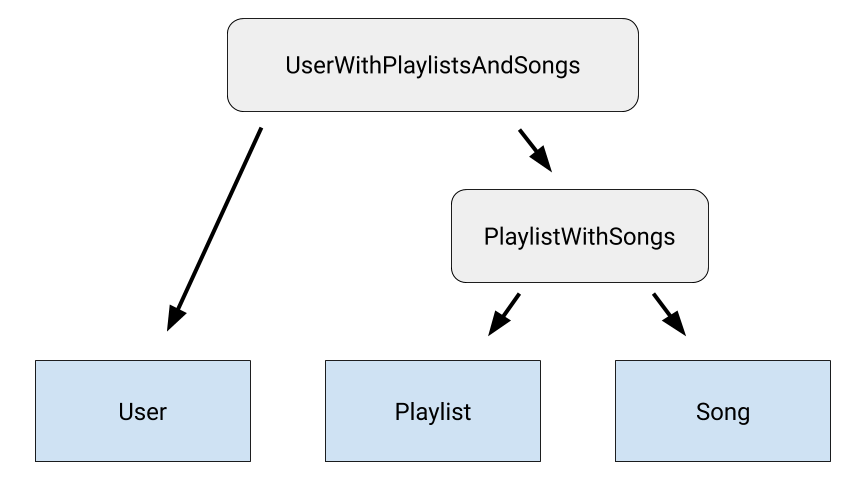
The UserWithPlaylistsAndSongs class indirectly models the relationships
between all three of the entity classes: User, Playlist, and Song. This is
illustrated in figure 1.
If your set has more tables, create a class to model the relationship between each remaining table and the previous relationship class. This process creates a chain of nested relationships among all tables you want to query.
Finally, add a function to the data access object (DAO) class to expose the
query function that your app needs. This function requires Room to run
multiple queries, so add the @Transaction annotation so that the whole
operation runs atomically:
@Transaction @Query("SELECT * FROM User") suspend fun getUsersWithPlaylistsAndSongs(): List<UserWithPlaylistsAndSongs>