
Control systems are used in a wide range of applications; they are the essential parts of many modern devices and systems. In simple terms, Control systems are used to control the behavior of devices or any process.
Control System
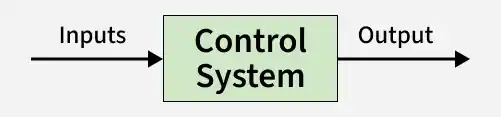
It is a system or a set of devices that manages commands and directs the behavior of other devices or systems. It works on the principle of the input-process-output cycle. since the output is controlled by varying the input. They are widely used in electronics, automation, and engineering.
It is made up of three main components: sensor, controller, and actuator. Here, the sensor senses physical characteristics such as pressure and temperature and converts them into an electrical signal, and it generates an output signal that is used to control the actuator.
Examples of Control Systems
- Elevators - In order to control or to regulate acceleration and braking mechanisms, Control systems are used.
- Smart Coffee Machine - To control water temperature, coffee strength, and brewing rate, control systems are used, and all these properties are balanced to give the desired flavor.
- Home Security and Automation - To control and monitor wide aspects of home security, such as cameras, sensors, and motion detectors.
- Traffic light control systems - When an input is processed through the control system, the output of the three lights is turned ON for a particular duration of time. Here input signal determines the output, and it works on a timely basis.
Classification of Control Systems
Control systems can be classified based on the type of signal we used and operate
- Continuous signal - Signals vary continuously with respect to time.
- Discrete signal - Consists of more discrete signals.
Control System can be classified on the Number of input and Output Present
- SISO - Single Input Single Output which consists of one input and one output.
- MIMO - Multiple Input Multiple Output which consists of two or more inputs to give outputs.
Control System can be classified based on the Feedback Path
- Open loop control system - Here control action is not dependent of desired output and it requires human efforts to operate.
- Closed loop control system - Here control action is dependent of output and input is applied to controller processes it to give signal.
Types of Control Systems
- Open-loop control system
- Closed-loop control system
Open-Loop Control System
In an open-loop controlled system a control signal which is considered input is sent to a system (Source), and the system responds without considering the output. The disadvantage of this system is it doesn't continuously monitor the system's behavior. The block diagram for this system is represented below.

Examples of open-loop controlled system are:
- Washing machine - Here the operations of soaking, drying, rinsing done on a timely basis.
- Bread toaster and Microwave oven - These machine run on the basis of preset time period (specific time) irrespective of an output.
- Electric bulb - when an electric supply is available, by switching ON and OFF electric bulb works without the parameters such as temperature, intensity of the light.
Closed-Loop Control System
In an Closed-loop control system sensors used to provide system performance and then adjust the control input accordingly. This system is also called feedback control system. well comparing to OLCS it continuously monitor the output and make some changes based on the difference between desired output and actual output.

Examples of Closed-loop control system are:
- Thermostat heater - Maintains and control the temperature.
- Voltage stabilizer - Measures the fluctuations in voltage and reduces & maintains the voltage to a desired level.
- Human on any action - When any person looks for any consequences and changes the position based on it. It is also an example of closed-loop control system.
- It also contains home appliances such as AC, Refrigerator, and in industry appliances too.
Open Loop vs Closed Loop Control System
Open Loop Control System | Closed Loop Control System |
|---|---|
It is economical and inaccuracy. | It is expensive and accurate. |
It does not have an feedback path. | It has an feedback path. |
Control action is not dependent on output. | Control action is dependent on output. |
It is designed easily. | It is hard to design. |
It is called Non feedback control system | It is called Feedback control system. |
Also Read: Difference between Open-Loop Control System and Closed-Loop Control System
Features of Control Systems
- Control sources should be easily understandable and manageable for both clients and managers. If not then the complicated devices may not be properly functioned. So main thing is good control system design is needed for ease understandability.
- Control systems should provide organizational needs to give meaningful results.
- Control systems should be adequate and appropriate to achieve the objectives which can suitable used for the enterprises. (Objectives should be smart)
- It should be simple.
- Control systems use efficient control techniques to detect any sudden deviations which helps in achieving the desired results at earlier.
- Control systems should be flexible and forward looking towards future and so on.
Embedded Control Systems
We all aware of Embedded systems, It consists of combination of hardware and software support designed for specific purpose or an task is called Embedded system on the other hand a system which is embedded into a complex system to control the activities, track the status, and monitor the results with hardware and software functionalities is called Embedded control systems.
Examples : Patient monitoring in healthcare administration, To regulate and control vehicles speed in automobile industries and so on.
Applications such as Automotive industries, Defense systems, Medical devices and Industrial processes, etc.
Advantages
- Control systems having the capability to respond something faster than humans and control systems are very reliable.
- It can automate various tasks by reducing the human intervention which leads to increased productivity and decrease labor costs.
- Control systems are adaptable in any conditions and in any requirements and they can be reprogrammed to accommodate different operating functions.
- Many control systems are controlled and monitored remotely which is valuable in applications like space science and remote infrastructure.
- They are used to optimize complex processes and find the best operations to achieve the goal such as increased throughput.
Disadvantages
- Designing and implementation of control systems are more expensive.
- They need regular maintenance and updates for their functions in any operations.
- They highly depend on electricity which means they need continuous power supply and in case of power failure can disrupt any operation.
- They are very sensitive to environmental constraints such as light, temperature, and pressure.
- Control systems need high specialized knowledge which is complex to operate and handle.
Applications
- Medical Equipment: It is used to control various types of medical machines such as dialysis machine, X-ray machines.
- Farming and Agriculture: Control systems are used to automate and optimize various types of tasks in agricultural processes such as crop harvesting, fertilization etc.
- Robotics - Here the control systems mainly used to control and automate the movements of robots for any operations.
- Power and Energy Systems: It optimizes power generation, consumption and distribution improving the operational efficiency of power plants.
- Environmental Control - HVAC systems used to regulate physical or chemical characteristics.
- Transportation - Control systems control various aspects of transportation such as traffic control systems, air-traffic controller, etc.
- Industrial Automation - They optimize production processes in mills, factories, and other manufacturing industries.
- IoT and Home automation - IoT and home automation used to control and automate various systems in home or building such as air conditioning, heating, and security.