
IP addresses uniquely identify devices on a network, enabling reliable communication, traffic routing, and data delivery. Based on their routing scope and accessibility, IP addresses are broadly classified into two types:
Private IP Address
A Private IP Address is used for communication within a local network (LAN). It enables devices such as computers, smartphones, and printers to exchange data internally.
- These addresses are typically assigned by a router or DHCP server, ensuring that each device on the network has a unique local identifier.
- Private IP addresses are not routable on the public internet, meaning they cannot be accessed directly from outside the local network.
- While this provides network isolation, private IP addresses are not inherently secure.
- Security depends on firewalls, NAT, and proper network configuration.
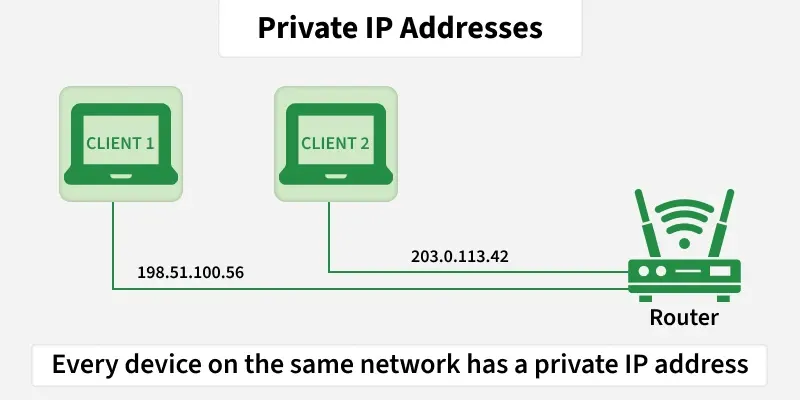
Tracing a Private IP Address
A private IP address can only be identified or traced within the local network where it is assigned. Devices connected to the same LAN can view and communicate using private IP addresses.
- Private IP addresses cannot be traced or accessed from the internet, as they are not visible or routable outside the local network.
- External networks only see the public IP address used by the router through Network Address Translation (NAT).
Key Features
- Private IP addresses are not directly reachable from the public internet, which helps reduce exposure to external attacks and unwanted traffic.
- They provide a large internal address space, allowing networks to scale easily as the number of devices and services increases.
- Organizations can freely use private IP addresses within their networks without purchasing additional public IP address blocks, making internal addressing cost-efficient.
- Integration with external services may require additional configuration, as private IP addresses are not globally routable.
- The use of NAT introduces processing overhead, added latency, and increased network complexity, especially in large-scale or high-traffic environments.
Public IP Address
A Public IP Address is an IP address used to communicate outside a local network over the internet.
- It is globally routable and allows devices or networks to send and receive data from external systems.
- These IP addresses are typically assigned by an Internet Service Provider (ISP).

Types of Public IP Addresses
- Dynamic Public IP Address: These IP address is assigned by the ISP and may change over time, usually when the connection is reset or periodically according to the ISP’s policy. Most home and mobile internet connections use dynamic public IP addresses.
- Static Public IP Address: These IP address remains fixed and does not change and commonly used by servers and services such as web servers, mail servers, and DNS servers that need a consistent and reachable address.
Tracing a Public IP Address
A public IP address can be traced to the ISP that owns and assigns it, along with an approximate geographical location such as city or region. This information does not reveal an exact physical address, but it can be used for network management, content delivery, and basic location-based services.
- Public IP addresses may be visible to websites and online services, which is why privacy tools such as VPNs, proxy servers, or the Tor network are sometimes used to mask the original public IP address.
- A VPN works by routing traffic through another server, thereby hiding the user’s actual public IP from external websites.
Key Features
- A public IP address allows a device or service to be directly reachable over the internet.
- It is commonly used for hosting services such as websites, application servers, game servers, and cloud-based resources.
- Devices with public IP addresses can communicate directly over the internet without requiring NAT or intermediate address translation.
- Public IP addresses are usually allocated by Internet Service Providers (ISPs) or cloud service providers and may involve additional cost.
- Due to IPv4 address exhaustion, public IPv4 addresses are increasingly limited and may be harder to obtain.
Private vs Public IP Addresses
| Private IP Address | Public IP Address |
|---|---|
| Used within a local or private network | Used for communication over the internet |
| Not routable on the public internet | Routable on the public internet |
| Scope is limited to the local network | Scope is global |
| Assigned by router or DHCP server | Assigned by ISP |
| Unique within a local network | Globally unique |
| Requires NAT for internet access | Does not require NAT |
| Hidden from external networks | Visible on the internet |
| Uses reserved private IP ranges | Uses globally assigned IP ranges |
| Freely usable inside networks | May involve additional ISP cost |
| Example: 192.168.1.10 | Example: 203.0.113.10 |