
Bluetooth is a short-range wireless communication technology that allows electronic devices to exchange data over radio waves without physical cables, mainly for simple, low-power, and personal connectivity.
- Used to connect nearby devices such as phones, laptops, and accessories
- Designed to replace short cables with wireless links
- Operates in the 2.4 GHz Industrial, Scientific, and Medical (ISM) frequency band
Bluetooth Versions and Types
Bluetooth exists in two main versions:
1. Bluetooth Classic (BR/EDR)
Bluetooth Classic (BR/EDR) is the original version of Bluetooth designed for continuous, high-reliability data and audio transmission between devices over short distances.
- Supports steady data and audio streaming between devices
- Higher power consumption compared to BLE
- Commonly used in headphones, speakers, keyboards, and computers
- Provides moderate data rates for reliable connections
2. Bluetooth Low Energy (BLE)
Bluetooth Low Energy (BLE) is a power-efficient version of Bluetooth optimized for devices that transmit small amounts of data intermittently, extending battery life.
- Ideal for low-power, battery-operated devices like wearables and sensors
- Supports intermittent or periodic data transfer
- Widely used in IoT, smart home, and health monitoring devices
- Maintains connectivity with minimal energy consumption
Architecture of Bluetooth
The architecture of Bluetooth defines how devices are organized and communicate within a network. It supports two main types of network structures:
1. Piconet
A piconet is the basic Bluetooth network where one device acts as a master controlling communication, while up to seven active devices act as slaves.
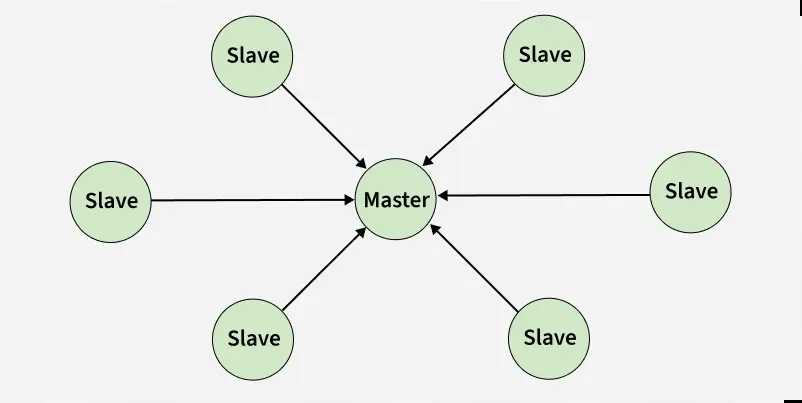
- The master device coordinates data transmission and timing
- Slaves communicate only when allowed by the master
- Uses frequency-hopping to avoid interference
- Supports ad-hoc network formation for nearby devices
2. Scatternet
A scatternet is formed when multiple piconets are connected through devices that participate in more than one piconet, allowing a larger network to function seamlessly.

- Extends network coverage beyond a single piconet
- Devices can act as master in one piconet and slave in another
- Enables communication across multiple groups of devices
- Useful in environments where many Bluetooth devices coexist
Bluetooth Protocol Stack
The Bluetooth protocol stack consists of multiple layers, each responsible for specific functions to enable reliable wireless communication between devices.

Radio (RF) Layer
- Specifies the air interface, including operating frequency, frequency hopping, and transmit power.
- Performs modulation and demodulation of digital data into radio frequency (RF) signals.
- Defines the physical characteristics of Bluetooth transceivers.
- Supports two types of physical links: connection-oriented and connection-less.
Baseband Link Layer
- Acts as the digital core of the Bluetooth system.
- Equivalent to the MAC sublayer in LAN architectures.
- Handles connection establishment within a piconet.
- Manages device addressing, packet formats, timing, and power control.
Link Manager Protocol (LMP) Layer
- Manages the established links between Bluetooth devices.
- Responsible for authentication, encryption, and security management.
- Creates, monitors, and terminates links based on commands or failures.
Logical Link Control and Adaptation Protocol (L2CAP) Layer
- Known as the heart of the Bluetooth protocol stack.
- Provides communication between upper and lower layers.
- Performs segmentation and reassembly of data packets.
- Supports multiplexing of multiple logical connections over a single physical link.
Service Discovery Protocol (SDP) Layer
- Enables a device to discover available services on another Bluetooth-enabled device.
- Allows applications to determine the capabilities and services supported by remote devices.
RFCOMM Layer
- A cable replacement protocol that emulates serial ports.
- Provides serial data communication over L2CAP.
- Supports protocols such as WAP and OBEX.
- Based on the ETSI TS 07.10 standard.
OBEX (Object Exchange)
- Used for exchanging objects such as files, images, and contacts between devices.
- Commonly used in file transfer and data synchronization applications.
WAP (Wireless Application Protocol)
- Enables internet access and web-based services over Bluetooth.
- Used mainly in older mobile and embedded systems.
TCP (Telephony Control Protocol)
- Provides telephony services over Bluetooth.
- Supports call setup, call release, and group management.
- Used primarily for voice gateway and cordless telephony applications.
Types of Bluetooth
Bluetooth technology is used in a wide variety of devices to enable short-range wireless communication. These Bluetooth-enabled devices are designed for different applications such as communication, entertainment, navigation, and data sharing.
Common Types of Bluetooth Devices
- In-Car Headset: Allows users to make and receive phone calls through the car’s speaker system without directly using a mobile phone, enabling hands-free communication.
- Stereo Headset: Used to listen to music wirelessly from smartphones, cars, or home audio systems, providing cable-free audio streaming.
- Webcam: A Bluetooth-enabled webcam can be connected wirelessly to a laptop or smartphone for video calls and conferencing.
- Bluetooth-Enabled Printer: Enables wireless printing by connecting a printer to a mobile phone or laptop through Bluetooth, without requiring cables or a network connection.
- Bluetooth Global Positioning System (GPS): Allows a smartphone to connect with a car’s navigation system via Bluetooth to provide GPS directions and location-based services.
Applications of Bluetooth
Bluetooth is widely used for short-range wireless communication across various personal, commercial, and industrial applications due to its low power consumption and ease of use.
- Used in wireless headsets, speakers, keyboards, and other peripherals for cable-free connectivity.
- Enables Wireless Personal Area Networks (WPANs) for connecting nearby devices; in limited cases, it can support small local networks.
- Allows wireless connectivity between digital cameras and mobile phones for instant photo transfer.
- Supports data transfer such as videos, music, photographs, and documents between smartphones, computers, and other Bluetooth-enabled devices.
- Widely used in medical healthcare for patient monitoring devices and wearable sensors.
- Applied in sports and fitness devices such as smartwatches, fitness trackers, and heart-rate monitors.
- Used in military and defense systems for secure short-range communication and equipment interconnection.
Advantages
- Bluetooth is a low-cost and easy-to-use wireless communication technology.
- It supports wireless connectivity without cables, enabling quick ad-hoc connections between devices.
- Bluetooth signals can penetrate walls and obstacles to a limited extent.
- It supports both voice and data transmission, making it suitable for audio devices and file sharing.
- Bluetooth consumes low power, especially with Bluetooth Low Energy (BLE).
- Widely supported across smartphones, laptops, and IoT devices.
Disadvantages
- Bluetooth can be vulnerable to security threats if proper pairing and encryption are not used.
- It offers lower data transfer speeds compared to Wi-Fi (Bluetooth Classic supports up to ~3 Mbps).
- Bluetooth has a limited communication range compared to other wireless technologies.
- Performance may degrade due to interference in the 2.4 GHz ISM band.
- Traditional Bluetooth piconet communication does not support routing, though Bluetooth Mesh enables multi-hop routing in modern implementations.