Pollination is the biological process by which pollen from the male part of the flower transfers to the female part of the same or on different flowers. Pollination results in fertilization and the production of seeds. Pollination is important for the reproduction of plants. Pollination can occur in different ways, such as through the wind, water, or animals such as bees, butterflies, and many more. However, some plant species are self-pollinating or do not require pollinators to reproduce.
What is Pollination?
Pollination can be defined as the transfer of pollen from an anther the male part of the plant to the stigma, which is the female part of the plant. Pollen can be transmitted through animals such as insects and birds, and also through water, wind, etc., and they are known as pollinating agents. Stamen will interact with the stigma of the same species of flower, so it is important that stamen will reach the stigma of the same family plant for successful pollination.

Process of Pollination
Pollination begins with the transfer of pollen grains to the stigma in a flower of a plant, when pollen grain reaches then a pollen tube will be formed with the style length that basically connects the stigma and ovary. When the pollen tube is completely formed the pollen grain will start transmitting sperms to the ovary.
When the sperm cell (Pollen grains) reaches the ovary the fertilization process will begin and the seed will be released from the parent and allowed to grow into a plant and then continue its reproductive cycle using the pollination method.
Also Read: Androecium
Agents of Pollination
During sexual reproduction, these agents of pollination are the ones who transfer pollen grains from one to flower or plant. It is classified based on Anatomy and on what types of forces are involved.
Classification based on Anatomy
- Syndromic agents: These agents can be insects or animals that feed on nectar. Basically while gathering food, these agents attach pollens with themselves and make themselves pollinating agents in cross-pollination.
- Proboscis agents: These agents are animals that feed through their long tongues called proboscis. They basically collect pollen from one plant while feeding and then transfer it to another plant.
Classification based on what types of forces are involved
- Abiotic factors- agents that use physical forces. For example- wind, water, rain, etc.
- Biotic factors - agents that work with living organisms. For example- insects such as bees, butterflies, etc.
Types of Pollination
Plants having flowers depend on pollination for reproduction. There are two types of pollination:
- Self Pollination
- Cross-Pollination
Self Pollination
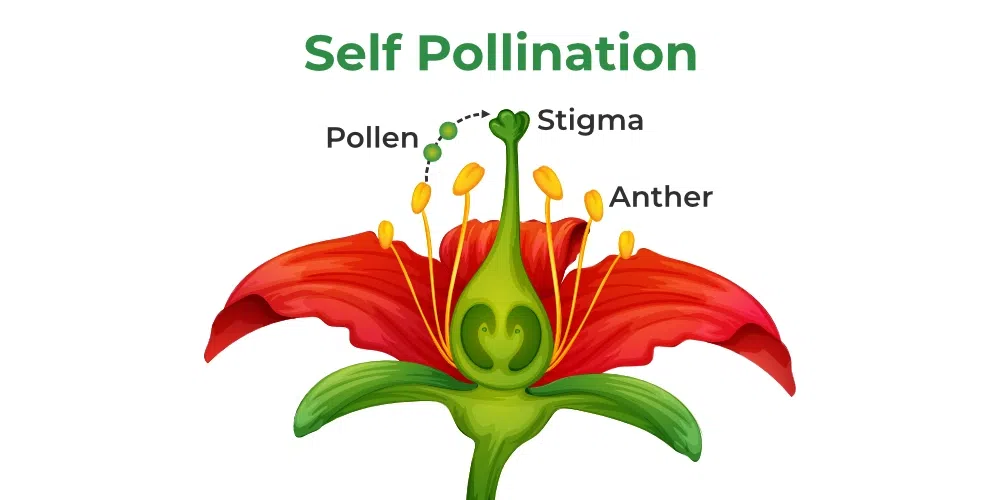
Self-pollination occurs when pollen grains are transferred from the anther of one flower of a plant to the stigma in the same flower of the same plant. It can also occur when pollen grains are transferred from the anther of one flower of one plant to the stigma of another flower but of the same plant. During self-pollination, the eggs and sperm of the same flower share the same genetic information which leads to a reduction in genetic diversity.
Advantages of Self-Pollination
- Less wastage of pollen grains as compared to cross-pollination.
- It ensures a standard harvest quality in vegetable gardening and farming.
- It ensures the elimination of recessive characters.
- It doesn't rely on any pollinators like bees, water, wind, etc.
- They require less effort than plants as they don't need pollinators.
- It ensures that even a small quantity of produced pollens from plants can achieve a good success rate in the population.
Disadvantages of Self-Pollination
The primary disadvantage of self-pollination is that gene mixing not occurred in self-pollination.
- Seeds will be less in number.
- Due to reduced genetic diversity, the offspring will have less immunity to diseases.
Cross-Pollination
Cross-pollination occurs when pollen grains are transferred from the anther of one flower of one plant to the stigma of another flower of another plant. During cross-pollination, the eggs and sperms will share their different genetic information which leads to an increase in genetic diversity. While combining the different genetic information the offspring will become unique.

Types of Cross-pollination
Cross-Pollination occurred via both biotic and abiotic factors. Following are the
Pollination by Animals-Zoophily
Basically, this is the pollination that is done by animals. Animals play an essential role in plant reproduction as they help in seed dispersal. The animals spread the seeds as they eat fruits from one plant and move to another new location.
Pollination by Wind-Anemophily
Basically, this is the pollination that is done by the wind. When pollens are transferred to the female part of the plant that is stigma through the wind.
Artificial Pollination-Anthropophily
Basically, this is artificial pollination which means pollination is done by human beings. This is done by spreading the pollen grains over the female part of the plant. The hybridization technique can be used in this process.
Advantages of Cross-Pollination
The following are the advantages of cross-pollination:
- New varieties of crops and plants can be formed.
- All unisexual plants can involve in cross-pollination.
- Offspring will be healthier as there is an increase in genetic diversity during cross-pollination.
- Produced seeds will be more viable.
Disadvantages of Cross-Pollination
- More wastage of pollen grains as compared to self-pollination.
- During meiosis, genetic recombination will create chances of eliminating the good characters and adding unnecessary characters in offspring.
Mechanism that Prevents Self-pollination
Two noticeable mechanisms that prevent self-pollination are:
- Natural Way
- Chemical Way
The natural way is dichogamy. A situation in which pollen grains are shed either before or after the period during which the stigma of the same plant is receptive.
The chemical way is Chemical self-incompatibility. Basically, this depends upon the chemical substances that are already present in the plant, pollen may not grow on the stigma of the same flower that produced it. Alternatively, the pollen tube may not be able to fertilize by growing the stem normally after germination. Chemical incompatibility is usually not found in plants that have strong temporal or structural barriers to self-pollination. The formation of such a mechanism during evolution was clearly sufficient for most plant species.
Mechanism that Permits Self-pollination
- Perfect flower: This type of flower also called bisexual and hermaphroditic flower, is self-fertilized by being present in a single plant because both male and female reproductive organs are present in the same flower. It will be promoted. When pollen release and stigma receptivity are synchronized and there is no mechanism to facilitate pollen transfer from flower to flower, pollen transfer within the flower is guaranteed.
- Homogamy: Female and male reproductive organs mature at the same time. That is, pollen is released as soon as the stigma is absorbed.
- Cleistogamy: This is a plant mechanism in which pollination and fertilization occur before or just before flowering.
Similar Reads
CBSE Class 12 Biology Syllabus NCERT Class 12 Biology Syllabus: NCERT Class 12 Biology Syllabus covers important topics that provide students with a comprehensive understanding of living organisms, their structure, function, and behavior. These notes introduce fundamental concepts of biology including Sexual reproduction in Flowe
4 min read
CBSE Class 12 Biology Notes CBSE Class 12 Chapter-wise Notes Biology helps students to score well in their board examinations. Class 12 Biology is a subject that comes with a wide range of topics, which include inheritance, evolution, reproduction, human health and disease, biotechnology, Ecosystem, and Biodiversity and Conser
4 min read
Chapter 1: Sexual Reproduction In Flowering Plants
Parts of a Flower and Their FunctionsA flower is the reproductive structure of angiosperm that facilitates sexual reproduction. The 4 main parts of the flower include - sepals, petals, stamens (male parts of the flower), and carpels (female part of the flower). The different parts of the flower have their unique function. The primary f
9 min read
Pollen Grains​Pollen grains are minute structures of varying size and shape that contain the androecium, the male reproductive organ of a flower. Pollen grains are also called microgametophytes. The formation of pollen grains occurs through the process of microsporogenesis and consists of a protective outer laye
5 min read
The Structure and Functions of PistilIn flowering plants, sexual reproduction is a complex process that involves the mating of male and female gametes to create seeds for the following generation. The pistil, which is located in the centre of the flower, is the female reproductive structure in flowering plants. What is Pistil?A pistil
4 min read
PollinationPollination is the biological process by which pollen from the male part of the flower transfers to the female part of the same or on different flowers. Pollination results in fertilization and the production of seeds. Pollination is important for the reproduction of plants. Pollination can occur in
6 min read
Double Fertilization: Process & SignificanceDouble fertilization is a unique reproductive process that occurs in flowering plants (angiosperms). Unlike in most other organisms where a single sperm fertilizes an egg, in double fertilization, one male gamete fertilizes the egg cell to form the embryo, while another male gamete fuses with two po
8 min read
Post FertilizationPost-fertilization events are the processes that occur after the fusion of the male and female gametes during sexual reproduction. These post-fertilization events in flowering plants are crucial for the development of the zygote into a mature seed or fruit. Understanding post-fertilization events in
6 min read
Apomixis and Polyembryony: Differences, Types, SignificanceApomixis and polyembryony are two different but related biological processes that result in the production of offspring without fertilization. Apomixis is a type of asexual reproduction where seeds are produced without gametic fusion. While polyembryony is a process in which multiple embryos are pro
5 min read
Chapter 2: Human Reproduction
NCERT Notes on Human Reproduction Class 12 Chapter 2NCERT Notes of Class 12 Chapter 2 Human Reproduction: Human reproduction is the biological process by which a new individual offspring is produced from one or two parent organisms. The Human Reproduction process involves the fusion of gametes, which are specialized cells that carry genetic informati
15+ min read
Gametogenesis - Spermatogenesis and OogenesisGametogenesis is a process of producing male and female gametes, carried out by all sexually reproducing organisms. The process involves various multiple stages of division and differentiation and is highly regulated under hormonal control. GametogenesisGametogenesis produces male and female gametes
4 min read
Menstrual CycleIn a day-to-day existence cycle, a lady's body is powerless against different changes. The pattern of these progressions happens in ladies consistently, emphatically for pregnancy is known as the feminine cycle. At the point when an ovum is unfertilized, the uterus lining sheds and prompts a dischar
9 min read
Fertilizations And ImplantationFertilization and implantation are the 2 important events in human reproduction, which is the biological process of producing new individuals from a union of male and female gametes. This complex process involves the fusion of gametes, the development of a zygote, and the growth and differentiation
5 min read
Embryo Development - Development Process of FetusBirth gives process to a child is known as reproduction. A species' survival depends on its ability to reproduce. There are two different ways to reproduce: Sexual reproduction is asexual reproduction. Asexual reproduction is a type of reproduction that occurs without the involvement of 2 parents. A
5 min read
Parturition And Lactation - Biology Notes Class 12Parturition And Lactation: Several intricate physiological processes, such as fertilisation, implantation, gestation, and delivery, are involved in human reproduction. The act of giving birth, often referred to as parturition, is a significant occasion that signals the conclusion of pregnancy and th
4 min read
Chapter 3: Reproductive Health
Notes on NCERT for Class 12 Biology Chapter 3 Reproductive HealthNotes on NCERT for Class 12 Biology Chapter 3 Reproductive Health: Reproductive health simply means people in a society living with physically and functionally normal reproductive organs and normal behavioral and emotional responses toward sex-related matters. According to WHO “reproductive health m
10 min read
Population Stabilization And Birth Control - Class 12Population Stabilization And Birth Control: Reproductive Health means total well-being in all aspects of reproduction, i.e., physical, emotional, behavioral, and social. Counseling and raising awareness among people about reproductive organs, adolescence, and associated changes, safe and hygienic se
6 min read
Medical Termination of Pregnancy (MTP)Medical termination of Pregnancy (MTP) is an intentional or voluntary termination of pregnancy before its full term. Before the 1960s, surgical methods like vacuum aspiration or dilatation and curettage were common, but medication has since emerged as an alternative option. Medical Termination of Pr
5 min read
Chapter 4: Principles Of Inheritance And Variation
Principles of Inheritance and Variation CBSE Notes for Chapter 4Inheritance is the term given to the process by which characters are passed from parents to offspring which forms the basis of heredity. Heredity is the process of passing down genetic traits from parents to offspring. The degree of difference in characters between a parent and offspring is called v
15 min read
Mendel's Laws of Inheritance | Mendel's ExperimentsMendel's law of inheritance states that offspring inherited from their parents that results in similar characteristics of parents and offspring. This law of inheritance depends upon three other laws including the law of dominance, the law of segregation, law of independent assortment. Gregor Mendel
8 min read
Inheritance of One Gene NotesWe never wonder why Lion can give birth to Lions only, or why a bird can reproduce in the same species and no other species. Not everything is possible, Isn't it? Also, No human being look exactly identical, even with twins there are differences in every individual. Some siblings look similar while
6 min read
Chromosomal Theory of InheritanceThe essential idea behind the chromosomal theory of inheritance is that genes are located on chromosomes and that the behavior of chromosomes during meiosis and fertilization provides the basis for inheritance patterns. In the early 1900s, pioneering geneticists Walter Sutton and Theodor Boveri form
6 min read
Linkage And Recombination - Principles Of Inheritance And Variation Class 12 NCERTCBSE Class 12- Principles Of Inheritance And Variation- Linkage And Recombination: Linkage and recombination are the phenomena that describe the inheritance of genes. Linkage and Recombination both are related to the genetic information inherited from parents to offspring. Linkage is the tendency of
6 min read
What is Polygenic Inheritance?Polygenic inheritance is a type of inheritance in which multiple genes control the phenotype of an organism. The phenotypes or traits can be height, skin color, the color of the eyes, etc. This type of inheritance is also known as quantitative inheritance or multifactorial inheritance. Such traits a
7 min read
MutationThe human body might be visualized as a simple organism. But it is the combination of different complex processes. From the outside, a human body might resemble a very simple one. A body that has two arms, two legs & one head for monitoring purposes. But from the inside of the body, there are ma
15+ min read
Chromosomal Disorders: Principles of Inheritance And Variation Class12CBSE Class-12 Principles Of Inheritance And Variation - Chromosomal Disorders: The chromosomes are thread-like structures that are mainly present in the nucleus which carries the hereditary information of genes that are passed from the parents to the offspring. Due to some irregularities of cell div
5 min read
Chapter 5: Molecular Basis Of Inheritance
Evolution Notes for Class 12 Chapter 6Evolutionary biology is the study of the evolutionary processes that produced the diversity of life on Earth. Earth came into existence sometime between 4 and 5 billion years ago. Life evolved on planet Earth about 3.5 billion years ago. Since then, approximately 15 million different species of orga
11 min read
Molecular Basis of Inheritance Notes Class 12CBSE Class 12 Molecular Basis of Inheritance: Inheritance is transmitted by certain molecules that Mendel termed as ‘factors’, but their nature was discovered later with the development of various scientific techniques. The molecules which govern the inheritance are called genes and it is of two typ
15+ min read
DNA: Structure, Types, and FunctionsDNA structure is made of nucleotide base pairs (other than RNA). DNA is the hereditary material that is possessed by all the organisms found on the Earth except certain virus species. DNA functions involve the transfer of genetic information from generation to generation. The full form of DNA is Deo
11 min read
Packaging of DNA Helix: Histones & ImportanceDNA packaging refers to the process through which DNA molecules are tightly compacted into a smaller volume so that they can fit into the nucleus of a cell. DNA packaging is important because the length of DNA molecules is much greater than the size of the cell nucleus, and therefore, if the DNA wer
5 min read
Search For Genetic MaterialThe search for genetic material has been important in understanding inheritance and evolution. Scientists have explored various models and experiments to identify the substance responsible for transmitting hereditary traits. From Griffith's transformation experiments to Avery, MacLeod, and McCarty's
5 min read
Difference Between DNA and RNAThe difference Between DNA and RNA lies in their structure, function, and location within cells, with DNA typically double-stranded, storing genetic information in the nucleus, while RNA is generally single-stranded, involved in protein synthesis, and present in various cellular compartments. DNA (D
6 min read
RNA - Definition, Structure, Types and FunctionsRNA is a ribonucleic acid that helps in the synthesis of proteins in our body. This nucleic acid is responsible for the production of new cells in the human body. It is usually obtained from the DNA molecule. RNA resembles the same that of DNA, the only difference being that it has a single strand u
11 min read
DNA ReplicationDNA replication is a fundamental biological process by which a cell duplicates its entire DNA. DNA is a self-replicating structure and the replication is catalyzed by enzymes. Through DNA Replication, genetic information is passed on from one generation of cells to the next during cell division. It
8 min read
The Experimental Proof Of DNA ReplicationThe process by which cells duplicate their genetic material during cell division—the replication of DNA—was still largely a mystery. This sparked a race to understand how DNA replication happens among several well-known experts. The experimental evidence of DNA replication, which showed that DNA rep
5 min read
Transcription of DNATranscription of DNA is a cellular process where the genetic information encoded in DNA is converted into RNA. It initiates with RNA polymerase binding to the DNA at a specific promoter region. Then, the enzyme unwinds the DNA and synthesizes a complementary RNA strand by following the DNA template.
6 min read
Genetic Code - Molecular Basis of InheritanceCBSE Class12- Molecular Basis Of Inheritance- Genetic Code: The sequence of nucleotides in deoxyribonucleic acid and ribonucleic acid which determines the amino acids sequence of proteins is known as Genetic code. DNA consists of information for protein sequences. RNA consists of four nucleotides: a
5 min read
Genetic Code and MutationsGenetic code and mutations are important to understand and explain the central dogma of biology. The set of rules governing how DNA sequences are translated into proteins is the genetic code. The four nucleotide bases adenine (A), thymine (T), guanine (G), and cytosine (C), which are organized in pa
5 min read
tRNA - the Adapter MoleculetRNA is also known as transfer RNA is a subtype of RNA, tRNA help in the protein synthesis process. tRNA carries the amino acid to the ribosome, which is the molecular machine that assembles the protein, and ensures that the amino acid is incorporated into the growing protein chain in the correct or
5 min read
RNA TranslationThe Central Dogma, claims that once "information" has transferred into protein, it cannot be retrieved. In greater detail, information transmission from nucleic acid to the nucleic acid or nucleic acid to protein may be conceivable, but transfer from protein to protein or protein to nucleic acid is
15+ min read
Lac OperonLac operon consists of the genes that are required for the metabolism of lactose in a bacterium E. coli and some other enteric bacteria. The name Lac operon actually stands for lactose operon. Lac operon works only when the nutrient source lacks glucose and has only lactose as it takes more steps to
7 min read
Human Genome ProjectHuman Genome Project was the world’s largest collaborative biological project that gave us the ability to examine the full genetic manual for creating a human being in nature. HGP was international scientific research that mainly aims to determine the base pairs that make human DNA, as well as the i
9 min read
What is DNA Fingerprinting?DNA Fingerprinting is a technique used to identify individuals by analyzing their unique DNA patterns. Studying the DNA Fingerprinting steps and process helps in understanding genetic relationships, solving crimes, and identifying individuals based on their unique DNA profiles. In this article, we w
10 min read
Chapter 6: Evolution
Origin of LifeThe origin of life on earth is one of the mysteries to mankind. According to a common man, life is gifted by god whereas scientists believe that life has originated from non-living matter by natural means. This mystery of whether life originated from non-living matter was solved by scientists Pirie.
4 min read
Evolution Of Life Forms – A TheoryEvolution is a process of gradual changes in the heritable characteristics of a biological population, over successive generations, over a long period. (Population: - It is a group of individuals of the same species who live in the same area and can interbreed) Theories of EvolutionTill now, several
5 min read
Understanding Adaptive Radiation: Evolutionary Diversification ExplainedAdaptive radiation is a phenomenon observed in evolutionary biology, that involves the rapid diversification of species into various forms to exploit new ecological niches. This process leads to the exposure of multiple species with distinct adaptations, enhancing their survival in diverse environme
4 min read
Hardy-Weinberg PrincipleA system of guidelines for genetic inheritance is known as mendelian inheritance. A monk by the name of Gregor Mendel made the initial discoveries of genetics in the 1850s, and his findings were first published in 1866. People have been aware of how qualities are passed on from parents to their offs
13 min read
Evolution Of Humans - History, Stages, Characteristics, FAQsHumans, or Homo sapiens, are a species of upright-walking beings known for their cultural diversity, inhabiting the Earth's surface. Believed to have originated in Africa around 315,000 years ago, human evolution is a complex process involving the development of traits such as bipedalism and languag
6 min read
Chapter 7: Human Health and Disease
NCERT Notes on Class 12 Biology Chapter 7 - Human Health and DiseaseNCERT Chapter 7 of Class 12 Notes on Human Health and Disease: According to the World Health Organisation, health can be defined as a state of complete physical, mental, and social well-being and not merely the absence of disease and infirmity. Good health has many benefits like it helps to keep us
15+ min read
Common Diseases In HumansDisease: - A disease is a physiological condition in which the human body fights against the external or internal causes of infection. On the basis of externally caused diseases, various examples are present, ranging from bacteria, viruses, protozoans, helminths, and many more. Pathogen: - The patho
5 min read
Immunity - Definition, Types and VaccinationImmunity is a defense mechanism of the body that is provided by the immune system and helps in fighting disease-causing organisms. There are two immunity types: innate and acquired immunity. Immunity-enhancing foods help boost the body's immune system Vaccination also enhances immunity by exposing t
11 min read
Innate And Acquired ImmunityThe immune system fights against germs and foreign substances on the skin, in the body's tissues, and in bodily fluids such as blood. The overall ability of the host to fight the disease-causing organisms conferred by the immune system is called Immunity. The immune system can be broadly categorized
5 min read
Importance of Vaccines, Vaccination and ImmunizationVaccination and immunization play a crucial role in protecting individuals and communities from infectious diseases. They help to stimulate the immune system and prepare it to recognize and fight off specific pathogens. Vaccination classes 6 and 12 are important topics frequently asked in examinatio
7 min read
Alcohol and Drug Abuse Prevention ControlAs opposed to the normal thoughts pervasive in general society, substance use is very far-reaching. So is substance misuse. It's anything but a little issue, confined to the domain of the feeble and detestable. The utilization of medications rises above race, orientation, age, or financial status. T
10 min read
Chapter 8: Microbes In Human Welfare
Microbes in Human Welfare NotesCBSE Class 12 Chapter 8 Microbes in Huaman Welfare: Microbes are the smallest living organisms that can only be seen under the microscope. Microbes are found everywhere. Examples- are air, water, soil, inside and outside the bodies of plants and animals, thermal vents (1000 degree Celsius), under th
6 min read
Microbes In Human WelfareMicrobes are microscopic organisms, that can be classified under protozoa, bacteria, fungi, and microscopic plants viruses, viroid, and prions (proteinaceous infectious agents). They are present everywhere– in soil, water, and air, inside our bodies, animals, and plants. Not only in life forms, but
6 min read
BiofertilizersBiofertilizers are biologically active substances that help in enriching the soil's fertility. Biofertilizers are microbes or microbial products. It helps to reduce the use of chemical fertilizers. Reducing the use of chemical fertilizers from the environment biofertilizers helps to protect the ecos
8 min read