Showing posts with label Cleveland. Show all posts

Wednesday, April 29, 2026

Where the Wild Things Are


I'm afraid a mere logo won't do.


That's better.

Spring has proceeded in fits and starts this year in Northeast Ohio. Rain followed by sun followed--I'm not kidding, this was just last week--a freeze alert. I had to scrape the ice off my car window that morning only to drive with the same window down later in the day only to roll it back up again when a thunderstorm passed by. Mother Nature is clearly into mind games. Nevertheless, there's been a few days where spring actually remained for a full 24-hours, and on those  days, when I had the time, I took full advantage of the Cleveland Metroparks system. 


Nicknamed the Emerald Necklace, the Metroparks is a series of nature preserves, some 25,000 acres, found not only or even mostly in the city of Cleveland itself, but throughout the suburbs as well, most of the parks, or reservations, linked by a parkway, allowing for a nice bicycle ride or drive in the country, as long as you stay on the parkway and don't make any lefts or rights onto a main road. I'll show what I mean in one moment, but first a few beads in that aforementioned necklace:


Ah, wilderness! How it does a person good to commune with nature and leave the demands of modernity behind. Though not as far behind as you may think, for just a few minutes' drive from any of these bucolic locations, you'll find sights such as these: 


I'm not showing these pictures with the intent of making developers, investors, and other capitalist types feel guilty (I'm not sure that's even possible) but to demonstrate why the Metropark system is such a treasure. As Cuyahoga Country becomes developed and overdeveloped, it does a soul good knowing that there may be a pastoral getaway just off the main thoroughfare. What I find ironic is to what extent the history of the Metroparks precedes so much of that development. It was a getaway before anything really needed getting away from.


This is what much of Cuyahoga County looked like in the first two decades of the 20th century. None of these pictures are of the city of Cleveland proper, which at the time was nearing its Industrial Revolution apex and looked very different from the scenes depicted here. The city was already a metropolis, but one without, really, "suburbs", just villages and townships with fairly sizable expanses of land between them. So how does the Cleveland Metroparks fit into all this? The system got its start in the 1910s when a self-taught engineer and surveyor for Cleveland named William A. Stinchcomb made this statement to city council:

"The importance of conserving our natural resources is now well recognized. Cannot it be truly said that these natural wild beautiful valleys and glens which lie adjacent to our rapidly growing urban centers are a kind of 'natural resource' of ever increasing value to the public?"

Stinchcomb said much the same thing a few years later to the lawmakers in Columbus, Ohio's capitol city, when objections were raised to the acquisition of land on the county level, but the engineer's reasoning prevailed. I'm just surprised that it did. Those pictures of early 20th century Cuyahoga County look pretty rural to me. It was a de facto Metropark. Nevertheless, that aforementioned...
.


  ...Industrial Revolution wasn't going to stay confined to the city of Cleveland for long. If not the factories themselves...


...then the products that emerged from them.

That's why I'm in awe of Stinchcomb. Just as Teddy Roosevelt did when he placed 230 million acres of land under federal protection, Stinchcomb in his more modest way looked into the future, clearly saw what was coming in the way of development and overdevelopment, and figured future generations would appreciate a respite. As a member of one of those future generations, I sure do. 


William A Stinchcomb
 I


Tuesday, January 27, 2026

Lost in Frost


Almost looks like fog, doesn't it?  

Tuesday, December 9, 2025

Sterling Structures (Deconstruction Function Edition)


Peter S. Lewis Building, Case Western Reserve University, Cleveland, Ohio

I am obsessed with architecture. It is true, I am restless, trying to find myself as an architect, and how best to contribute in this world filled with contradiction, disparity, and inequality, even passion and opportunity.

--Frank Gehry


1929-2025


Friday, July 4, 2025

Speculator Sports


Cleveland loves it sports teams, and there have been times Cleveland sports teams have loved them back.


Just not always.

The above cartoon by the late Plain Dealer sports artist Dick Dugan is from some time in the 1970s, when I grew up. Both the football Browns and the baseball Indians (today the Guardians) were in a long draught, as well were the newly arrived basketball Cavaliers (with the exception of a "miracle" year when the wins exceeded the losses.) Better (albeit not always permanent) days eventually arrived for all three teams, as well as the profits that come from better days. However, this post concerns itself not with profits per se, but with how a professional sports team manages to stay afloat, sometimes audaciously so, no matter if the days are better, worse, or somewhere in between.  


This is the old Cleveland Municipal Stadium, built in 1931 and in service until 1995. When I was growing up it was the home of both the baseball AND the football teams, something I didn't much question. You mean to tell me there are cities that have separate stadiums for baseball and football? That's plain weird


I found out later that not only is it not weird but fairly commonplace. Cleveland's one-size-fits-all approach to professional sports (as well as the occasional rock concert and even more occasional Billy Graham religious revival) was what was unusual, as well as something that could serve as a scapegoat. You see, because football is played only once a week, there's more of a novelty value and thus it becomes easier to fill 80,000 seats. Since less people attend baseball games (because there's more of them), it could seem like you're watching the Great American Pastime in the Grand Canyon. Also, that the Indians were losing many of their games, thus affecting attendance, made the Grand Canyon that much grander (maybe if mules had taken fans to their seats, that would have drummed up interest.) The baseball club was owned by some kind of local consortium, one of its owners also a member of the Cleveland Board of Education, the implication being that keeping the Indians on life support was a another kind of civic duty. The duty got dowdy, and the team was put up for sale. Everyone from City Hall to the local sports radio call-in hosts panicked. Suppose the new owners move the club to a different city?


Before the team changed hands, a plan was approved by voters for a new baseball stadium (and right next door, a venue for basketball, which would free up the Cavs from playing in an arena in the middle of a corn field situated halfway between Cleveland and Akron) that would be paid for by a tax on booze and cigarettes, neither one in short supply in a working-class metropolis. You'll note I have two different pictures of the outside of this then-new (1994) stadium. The first has the last name of the two brothers, shopping mall developers, who bought the baseball club while it was still at the old stadium. Now look at that second picture. While I would like to think changing the club's name from the "Indians" to the "Guardians" is a very "progressive" thing to do, I'm afraid it's just a coincidence. An insurance company bought the naming rights (though not the team itself, which is owned by the Dolan family.) The 31-year-old stadium is now undergoing $200 million in renovations, mostly with taxpayers' dough. After all, it's city- and county-owned. The Guardians just play there.


Now, I momentarily want to go back to when the club was still called the Indians. Whether because they were inspired by their new digs, or, more likely, owner Dick Jacobs hired people who knew how to put a baseball team together, in its second year at Jacobs Field, the club went all of the way to the World Series. In the months leading up to that, the Rock and Roll Hall of Fame opened. The eyes of the nation, perhaps the world itself, were on Cleveland, now justifiably dubbed The Comeback City!


"The Comeback City, eh? Well, I'll burst their bubble. Heh, heh, heh!"
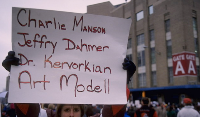

OK, I don't know if Browns owner Art Modell actually said that, but announcing the team's move did clip the wings of a city that saw itself as a rock'n'roll phoenix rising from the ashes of a burning river. Modell was an out-of-towner but had lived in Cleveland since 1962. Surely in those 33 years you might have thought he had some affection for the place and wouldn't think of moving. In fact, he even made a promise not to move, until he declared the promise "null and void." Modell had his reasons, most of them mercenary, a few of them spiteful. As I said earlier the Browns and the Indians shared the old Municipal Stadium, which as the name implies, was owned by the city, a city that couldn't afford to maintain it. Modell agreed to basically lease the stadium, for $1 a year, and become responsible for its upkeep. He also constructed loge boxes that could be rented to anybody who wants whatever a loge box has to offer (I wouldn't know, I've never been in one.) The money earned from the loge boxes went to Modell, even if the person or persons boxed up were there to watch an Indians game. The Indians objected to this and it's one of the issues that led to them demanding the city or county or state build them a separate stadium. Modell was offered a chance to be part of the new stadium, but he declined, only to watch the ballpark net a whole lot of moolah when the team went to the playoffs and World Series. And of course this made Jacobs Field's own loges desirable to rent. City officials, not wanting Modell to feel too left out of Cleveland's renaissance, offered to finance improvements to the old stadium, but Modell issued a "public moratorium" on such talks. He couldn't very well talk to officials from the city of Cleveland while at the same time talking to officials from the city of Baltimore (which a decade earlier had lost the Colts to Indianapolis), now could he?


The whole thing landed in court, the NFL itself also becoming involved. A deal was struck. The physical team could physically move, becoming the Ravens (Edgar Allen Poe was born in Baltimore) while the Browns name and records could stay in Cleveland, as long as Cleveland agreed to build a new football stadium for a new expansion team with the old name and records attached, which it did at jaw-dropping speed. The old stadium, the site of two World Series and six NFL Championship games, was razed, much of its debris turned into an artificial reef on Lake Erie. It cost $270 million, some of it paid for by the NFL, some if paid by new owner Al Lerner (a minority owner of the Modell-era Browns who some say encouraged the move to Baltimore) and a huge chunk of it paid for by further taxes on smokers and drinkers. Another good reason to live the clean life (just as long as not too many people live the clean life, or else risk a budgetary shortfall.) Now, when the baseball team got its new stadium, it almost immediately went to the World Series, and there's been two more since then. The team didn't win any of them, but still, it got there. The Browns? There's been no Super Bowls, I can tell you that. They've been in the playoffs exactly three times. Last year they were 3-14.


The dismal showing hasn't discouraged Jimmy and Dee Haslam, an out-of-town billionaire couple who bought the Browns from the late billionaire Al Lerner's billionaire son in 2012. The Haslams appear to have extraordinary optimism in the franchise's future. The above enclosed stadium has yet to be built, but it looks like it's going to be. The Municipal Stadium was in service for 64 years. The Browns stadium, Cleveland's newest stadium, is 26 years old, and apparently that's 26 years too old for the Haslams (both of whom are in their 70s and really shouldn't be practicing ageism.) Like Modell before them, they're moving the team out of town. Unlike Modell, they're not going all the way to Baltimore, just Brook Park, a Cleveland suburb. The Haslams have just purchased a 175-acre site (which will include restaurants, hotels, and apartments along with the stadium itself), not far from Cleveland Hopkins Airport, for $76 million. Does it mean this it's all going to be privately-owned-and-operated? I'm afraid local officials, or at least their constituents, aren't getting off that easily. This past Monday the Ohio Legislature took time out from demonizing LGBTQ folks to pass a bill that the governor signed giving the Haslam Sports Group $600 million towards the 2.4 billion project (the Haslams were expecting more.) And just what is the source of this $600 million? Unclaimed funds, i.e., usually small sums that Ohioans have yet to collect from old bank accounts, uncashed checks, and security deposits. Why haven't they collected this money? They're probably unaware they're owed it and, unlike owners of sports teams and the politicians that enable them, don't have bookkeepers, accountants, and business managers around to make them aware of it.

Well, that's it. I have nothing else to say on the subject. Unless a legendary hero of medieval lore suddenly were to materialize in front of me. If he did, I'd say this to him:


Just be grateful Sherwood Forest doesn't have a professional sports team. Faster than you could rob from the rich and give to the poor, they'd be doing it in reverse!


Thursday, October 3, 2024

Vital Viewing (That's Enfranchisement Edition)


For those of you who live in Ohio, the deadline to register to vote in the 2024 elections is October 7, this coming Monday. Above are all the things you need to know and do and be in order to register. However, it may not be all that easy to read as at some point the words shrink quite a bit (just what you need in an election where there's bound to be accusations of fraud and voter suppression: small print.) So as a further service I've included the following video provided by the good people at the Cuyahoga County Board of Election themselves in the hope of making things a bit more clear:


Get all that? Good. Now just to make sure you do everything you're supposed to do to fully participate in our democracy, I'd like to add a cautionary tale of what could happen if you DON'T do everything you're supposed to do.


Actually, this cautionary tale takes place in the Queens, New York of the 1970s but I think it applies equally well to Cuyahoga County, Ohio of the 2020s as a man of many, many opinions suddenly finds himself unable to act upon a single one of those opinions. Watch:


Don't end up like Archibald. Register!


Monday, July 1, 2024

Vital Viewing (Comedy 2 Night Edition)


1943-2024

Comedian, actor, musician, and, having spent part of his childhood in the area, Cleveland booster Martin Mull died this past Thursday. Here he is sometime in the 1980s as a guest on David Letterman's NBC late night talk show. As it turns out, Mull was something else other than just a comedian, actor, musician, and Browns fan:


"Representational" doesn't quite describe Mull's retro-photorealistic collage-like paintings. Not that "retro-photorealistic collage-like" describes the artworks all that much better, but I like 'em:


The Ides of August


Sunday Morning


Carpe Diem


Self-Portrait


Band on the Run


Some noted celebrities have taken notice of Mull's artworks, and used them for their own endeavors:


So was painting just Mull's hobby? Actually, it was his main line of work. Or rather, it's what the Rhodes Island School of Design Bachelor of Fine Arts (1965) and Master of Fine Arts (1967) graduate would preferred to have been his main line of work, but fine art doesn't always pay the bills, thus the comedy, acting, music, and boosting. A closer look at how he paid those bills:


Martin Mull first came to public attention in 1977 playing wife-beater Garth Gimble on the late-night black comedy soap opera Mary Hartman, Mary Hartman. Doesn't sound too pleasant, I know, but if it's any consolation his character got his comeuppance when he was fatally impaled on an artificial Christmas tree. Mull's stint on MHMH didn't end, however, as he soon returned as Garth's identical twin show biz brother Barth. This led to the spinoff Fernwood 2 Night, the titled small town's local TV station's misguided attempt at a talk show that had host Barth spending as much time fending off announcer/sidekick/buttinski Jerry Hubbard (Fred Willard) as he did interviewing guests:


Fernwood 2 Night eventually morphed into America 2 Night, which had Barth and Jerry moving to California and interviewing real-life celebrities but with the same disastrous results. That show ended its run in 1978, but it wasn't the end for Mull or Willard, who nearly two decades later would make...


...sitcom history. Martin Mull had for some time been appearing on Roseanne where he played the title character's boss and later business partner Leon Carp, who was eventually revealed to be gay. Fred Willard played Scott, Leon's old flame, and the two eventually decided to get married (some 20 years before the Supreme Court ruled same-sex couples could do so.) Now, Mull and Willard were straight in real-life, but here at Shadow of a Doubt we hold no objection to heterosexuals playing homosexuals as long as it's done with some understanding of what that state of being must be like (or at least as much understanding as you're likely to get on a sitcom.). And they did. Unfortunately, all I could find on YouTube was the following clip in which someone very obviously pointed a video camera at a TV screen and started recording. It's still very watchable, but just not listenable. Turn up the volume all you want. All you'll hear is a mutter. Undaunted, I went to the website IMBd and found out just what  muttering went on between Mull and Willard. It's just below the video. Watch (that's Norm Crosby officiating) and then read:  


  • Scott: I love you in a way that is mystical and eternal and illegal in 20 states.
  • Leon Carp: That's the most beautiful thing I've ever heard.


 Martin Mull did a lot of movies and TV guest shots in his lengthy career, but it was as a stand-up, or rather sit-down, comedian that I found him at his funniest:


That ended kind of abruptly, but who else but God always leaves them wanting more?

Finally, a hometown promo:


That was from the early 1990s. These days we have two downtown stadiums, one for the Browns and one for the Guardians, as well as a casino and a Rock and Roll Hall of Fame, but even if we didn't, Mr. Mull still would have convinced me to stay, just as long as he made me laugh in return for doing so.