Multiplexing Techniques MCQ Guide
Uploaded by
Mohamed AlfarashMultiplexing Techniques MCQ Guide
Uploaded by
Mohamed Alfarash- Questions Section
- Answers Section
Common questions
Powered by AIModulation allows the transfer of information over long distances by altering aspects of a carrier signal. AM systems modify the amplitude of the carrier wave and are simpler and cheaper but are more susceptible to noise . FM, which varies frequency, offers better fidelity and higher noise immunity, making it more suitable for high-quality transmissions . However, FM systems are more complex and require more bandwidth than AM .
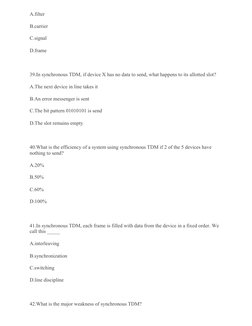
The efficiency of a synchronous TDM system is determined by its ability to utilize time slots effectively. Slots are fixed even if there is no data to send, resulting in efficiency loss due to potential empty slots. Efficiency can be calculated by comparing the number of occupied slots to the total slots available . It can be improved by minimizing empty slots through more dynamic allocation, as done in asynchronous TDM, or by optimizing the assignment based on traffic analysis of input devices .
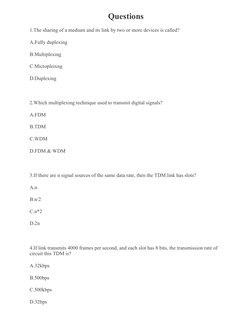
TDM requires a transmission rate of the multiplexed path to be greater than the sum of the individual data rates of the input channels. This means high temporal resolutions are necessary to accommodate the rapid switching between inputs . In contrast, FDM necessitates the total bandwidth of the link being greater than the combined bandwidths of the signals, exploiting the frequency spectrum . The choice between TDM and FDM hinges on the nature of the signals: TDM is ideal for digital signals with distinct time frames, whereas FDM suits analog signals with continuous frequency bands .
A multiplexer serves to combine multiple input signals into a single transmission stream, optimizing the use of available bandwidth by consolidating several communication channels . The demultiplexer complements this function by performing the reverse operation; it separates the combined signal into its original constituent parts at the receiving end . This relationship is important because it enables efficient data management and transmission in communication systems, supporting multiple concurrent communications over a single medium without cross-talk between channels .
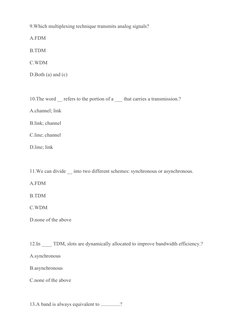
The principle difference between synchronous and asynchronous TDM lies in the allocation of time slots. In synchronous TDM, time slots are pre-assigned and fixed, meaning that each input connection has a dedicated slot even if it has no data to send, which can lead to inefficient bandwidth utilization due to empty slots . Conversely, asynchronous TDM dynamically allocates slots based on input demands, improving bandwidth efficiency by ensuring slots are only used when there is actual data to send .
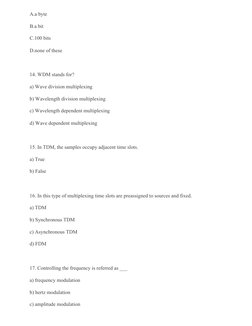
WDM utilizes different wavelengths of light to simultaneously transmit multiple signals through a single optical fiber. Each signal operates on its unique wavelength, allowing for multiple signals to be multiplexed into one data stream without interfering with each other . This capability significantly increases the capacity and efficiency of fiber-optic communications, as each wavelength can theoretically carry independent information, maximizing the utility of the optical transmission medium .
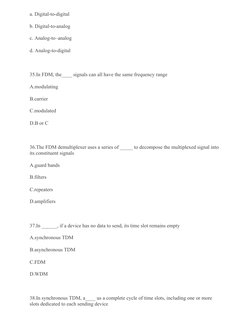
The choice of guard band in FDM is crucial because it prevents possible interference between adjacent frequency channels. When determining its size, factors such as the precision of the frequency separation technology, the stability of frequency generation, and the potential for signal drift due to environmental conditions or component tolerance variations must be considered . Guard bands must be wide enough to prevent overlap but not so wide as to waste valuable bandwidth, balancing between interference prevention and channel capacity maximization .
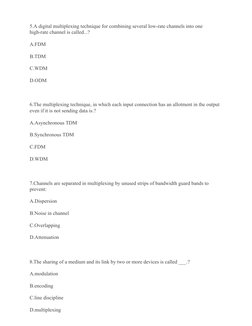
FDM prevents signal overlap by using guard bands, which are unused strips of bandwidth that separate the channels. This ensures that modulated signals do not interfere with each other . Carrier frequencies are essential in this process as they shift each signal to a distinct frequency band, which is crucial for maintaining the separation and integrity of individual signals within the total bandwidth .
TDM has become a preferred method for digital signal transmission due in part to improvements in digital signal processing technologies that allow precise synchronization and allocation of time slots. Enhanced clocking techniques ensure accurate time slot management, while digital compression technologies aid in efficiently encoding data. Additionally, advances in high-speed digital interfaces support increased data rates typical of TDM, maximizing throughput and minimizing latency . These advancements collectively enhance the bandwidth efficiency and flexibility of TDM for a variety of digital signal applications .
Guard bands are unused frequency bands that separate channels in FDM to prevent overlap and interference between adjacent signals . While they effectively mitigate interference by ensuring that the transmission signals do not bleed into one another, they reduce overall channel capacity by occupying portions of the total available bandwidth that could otherwise be used for carrying additional data. Thus, while essential for interference prevention, guard bands represent a trade-off between channel capacity and signal integrity .