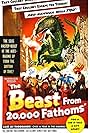
This film was the first to feature a giant creature awakened or mutated by an atomic bomb.
While visiting his friend Ray Harryhausen on the set, Ray Bradbury was given a copy of the script (with the working title "Monster From the Sea") and asked if he could do some rewriting on it. After reading the script, Bradbury remarked about a scene of the monster destroying a lighthouse, which seemed very similar to a short story that he'd had published in "The Saturday Evening Post" several years earlier called "The Beast from 20,000 Fathoms". Bradbury's story was about a dinosaur that destroys a lighthouse. The next day he received a telegram offering to buy the film rights for $2,000. After the sale, the film's title was changed to "The Beast from 20,000 Fathoms". When Bradbury's story was reprinted years later, he changed its title to "The Fog Horn". When the film was released, Bradbury's name was used heavily in promotional advertising.
One of the many characteristics that separated Ray Harryhausen from lesser stop-motion animators was his attention to realism. When the beast steps on a parked car and crushes it, he pauses a moment, then swipes it sideways. As he proceeds onward his other foot crushes it further, and finally his tail catches hold of the car and drags it along with him out of the frame. It's a close-up shot, totally separate from the general action, and does nothing to further the plot. But its subconscious effects on the viewer add significantly to the overall effect of the movie. This time-consuming and expensive attention to realistic physicality was not at all common in B-grade monster-movies.
The elderly couple behind Tom and Lee in the opera sequence are the most prolific "Dress Extras" in the business. Franklyn Farnum had over 700 appearances in movies and TV. Bess Flowers, who was known as "Queen of the Extras" had over 1,000 appearances in movies and TV. They appeared in 136 movies together, but not necessarily in the same scenes.