

High-Level Design (HLD) defines the overall architecture of a software system by identifying its major components, responsibilities, communication patterns, and data flow without focusing on implementation details.
- Provides a clear architectural overview to help developers understand how different components interact and work together.
- Defines major system components such as services, databases, APIs, caches, message queues, and infrastructure to support scalability and reliability.
Example: In an e-commerce system, HLD defines User, Product, Order, Payment, and Notification services, illustrating how they communicate through APIs, databases, caches, and messaging systems.
High-Level Design Architecture
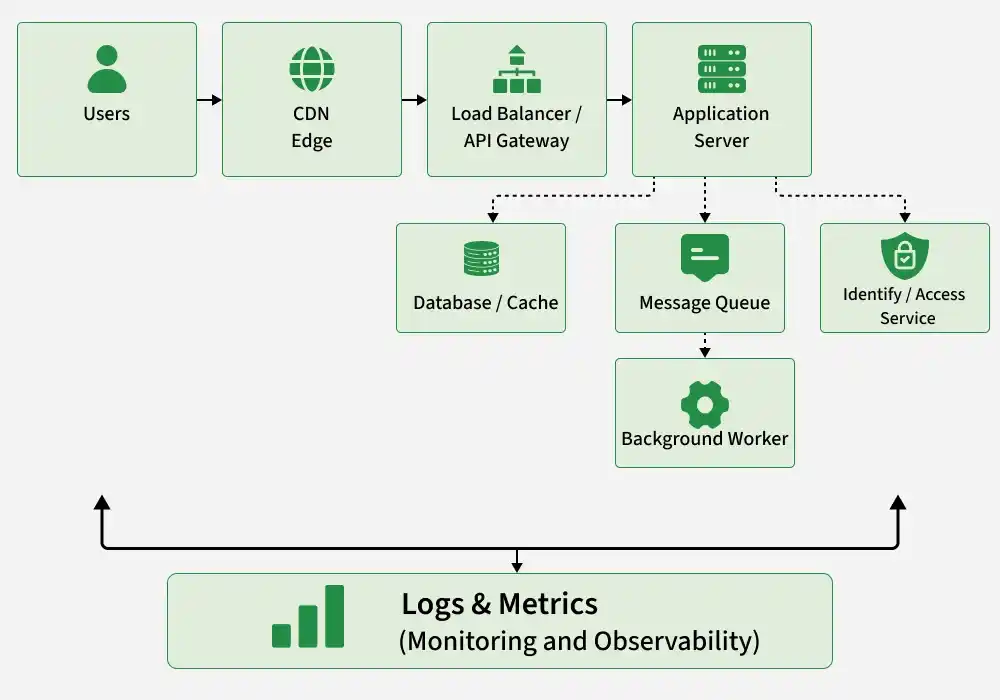
A typical HLD architecture illustrates how clients, application services, data storage, and background processing components interact.
Components
- Users: Access the system through web browsers, mobile applications, or other client interfaces.
- CDN / Edge: Delivers cached content closer to users, reducing latency and origin server load.
- Load Balancer / API Gateway: Distributes incoming traffic and routes requests to appropriate application services.
- Application Services: Execute business logic, process user requests, and communicate with backend components.
- DataStore: Includes databases, caches, object storage, and other systems used to store or retrieve application data.
- Message Queue: Enables asynchronous communication by storing messages for background processing.
- Background Workers: Process asynchronous tasks such as notifications, report generation, and data processing.
- Identity / Access Service: Handles authentication, authorization, and access control for application resources.
- Logs & Metrics: Collects monitoring data to track system performance, errors, resource utilization, and overall health.
Request Flow
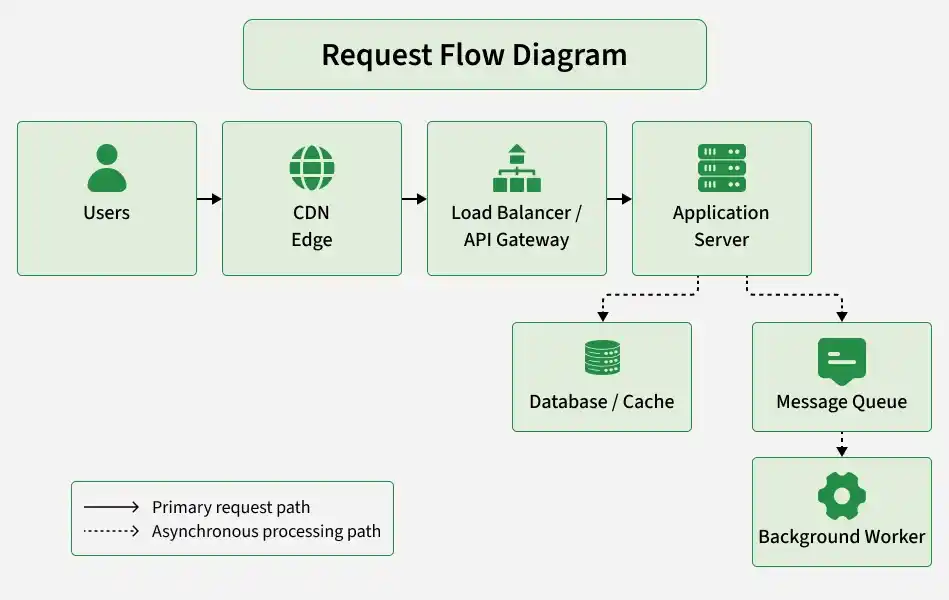
A typical application request follows these steps:
- The user sends a request through a web or mobile application.
- The gateway routes the request to the appropriate application service.
- The service processes the request and accesses the database or cache as required.
- Asynchronous tasks are published to a message queue.
- Background workers process queued tasks independently.
- The application returns a response without necessarily waiting for background tasks to finish.
Steps to Create a High-Level Design
Creating an HLD involves translating requirements into a scalable and reliable architecture.
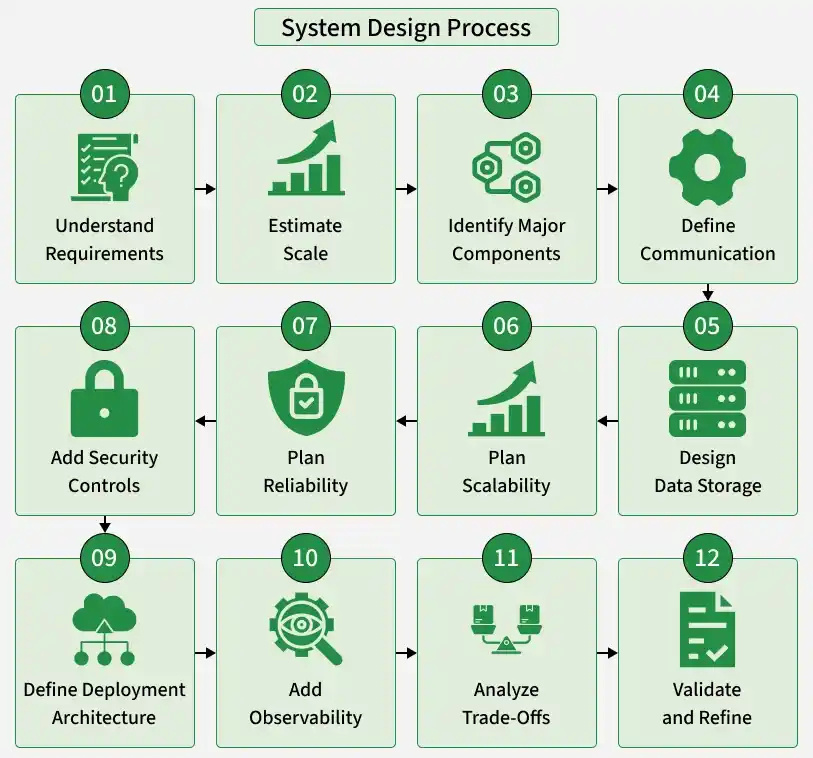
Follow these steps to design a scalable, secure, and reliable system architecture.
- Identify Requirements: Define functional and non-functional requirements, including scalability, security, and availability.
- Estimate Capacity: Calculate expected users, traffic, storage, and bandwidth needs.
- Define Components: Divide the system into major services based on business requirements.
- Design Communication: Choose APIs, messaging, or events for component interactions.
- Plan Data Storage: Select databases and define caching, replication, and data ownership.
- Design Scalability: Use load balancing, caching, partitioning, and horizontal scaling.
- Ensure Reliability: Plan redundancy, failover, retries, timeouts, and circuit breakers.
- Implement Security: Define authentication, authorization, encryption, and rate limiting.
- Plan Deployment: Decide how services will run on servers, containers, or cloud infrastructure.
- Set Up Monitoring: Include logging, metrics, tracing, and alerts.
- Evaluate Trade-offs: Balance performance, consistency, availability, cost, and complexity.
- Review Architecture: Validate the design against requirements, workloads, and failure scenarios.
HLD Deliverables
A High-Level Design usually produces a set of architectural artifacts that help teams understand and review the system before detailed implementation.
- Architecture Diagram: Shows major components and their interactions.
- Component Description: Defines the responsibilities of major services or modules.
- Data Flow: Explains how requests and data move through the system.
- Communication Design: Identifies APIs, messaging, or event-based interactions.
- Data Storage Design: Describes major databases, caches, and storage systems.
- Deployment Overview: Shows how the system is deployed across infrastructure or environments.
- Key Decisions and Trade-Offs: Documents important architectural choices, assumptions, and constraints.
Design Considerations and Trade-Offs
High-Level Design requires balancing scalability, performance, reliability, cost, and complexity. Key trade-offs include:
Trade-Off | Consideration |
|---|---|
Scalability vs. Cost | More resources improve capacity but increase costs. |
Performance vs. Complexity | Caching and partitioning can improve performance but add complexity. |
Consistency vs. Availability | Coordination for stronger consistency can affect availability during network partitions. |
Reliability vs. Cost | Replication and redundancy improve fault tolerance but require additional resources. |
Synchronous vs. Asynchronous | Synchronous communication provides immediate results, while asynchronous communication improves decoupling. |
SQL vs. NoSQL | Selection depends on data structure, query patterns, transactions, and scaling needs. |
Caching vs. Data Freshness | Caching reduces latency but may introduce stale data. |
Monolith vs. Microservices | Monoliths simplify initial operations, while microservices enable independent deployment with additional complexity. |
Benefits of High-Level Design
- Provides a clear architectural overview that helps development teams understand the system structure and overall design.
- Defines major system components and their communication paths to ensure smooth interaction between different services.
- Helps identify dependencies, potential bottlenecks, and architectural challenges early in the software development process.
- Supports scalability, reliability, and security planning by considering system requirements before implementation begins.
- Helps teams evaluate architectural trade-offs and select suitable technologies, design patterns, and infrastructure components.
- Provides a foundation for Low-Level Design (LLD) and guides developers during detailed design and implementation.
Limitations of High-Level Design
- Does not describe detailed implementation logic, making additional design documentation necessary for actual development.
- Does not define individual classes, methods, algorithms, or internal component behavior required during implementation.
- Architecture diagrams and design documents can become outdated when system requirements or components change over time.
- Capacity estimates and performance assumptions may differ from actual production behavior under real-world workloads.
- Cannot eliminate all scalability, reliability, or performance risks because some issues become visible only during system execution.