

White box testing is a software testing technique that focuses on examining the internal structure and working of an application. It ensures that the code logic, flow, and implementation behave correctly as per requirements.
- Provides full visibility of the source code, design, and architecture for detailed testing.
- Verifies internal logic, including conditions, loops, branches, and data flow.
- Ensures better code coverage by testing different execution paths and code statements.
White Box Testing Across Testing Levels
White box testing is applied at different stages of the software testing process to verify the internal logic and code structure at each level. It ensures that the application behaves correctly from individual components to the complete system.
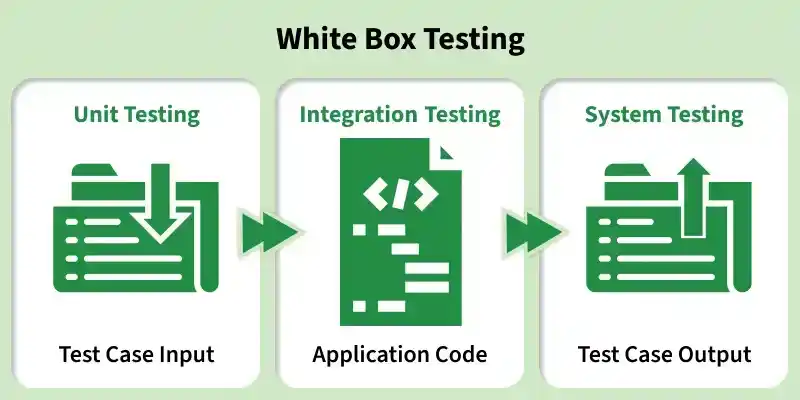
- Unit Testing: Focuses on testing individual functions or components by validating their internal logic and code behavior.
- Integration Testing: Ensures that multiple modules work together correctly by verifying data flow and interactions between integrated components.
- System Testing: Validates the complete application by checking the overall flow, ensuring that all integrated parts function correctly together.
Architecture for White Box Testing
White box testing, also known as structural or glass box testing, focuses on examining the internal structure and code of an application. It ensures that the logic, control flow, and data handling work correctly at the code level.
- Code Analysis: Involves examining the source code to understand logic, detect dead or unreachable code, and measure coverage using techniques like statement, branch, and condition coverage.
- Control Flow & Path Identification: Includes creating control flow graphs (CFG) and using cyclomatic complexity and path testing to identify all important execution paths.
- Test Case Design: Test cases are designed based on internal code structure to achieve maximum path coverage, with well-defined inputs and expected outputs.
- Execution & Reporting: Tests are executed at unit and integration levels, and detailed reports are generated highlighting coverage metrics, defects, and overall code quality.
Types of White Box Testing
White box testing can be performed at different stages of development to validate various aspects of the internal code structure. The following are the main types of white box testing
- Path Testing: Focuses on testing all possible execution paths in a program to ensure each path behaves correctly and all branches are covered.
- Loop Testing: Ensures that loops work correctly by validating initialization, execution, and termination under different conditions.
- Unit Testing: Checks individual functions or components in isolation to ensure each unit performs its intended functionality correctly.
- Mutation Testing: Evaluates test case effectiveness by introducing small changes in the code to verify whether test cases can detect errors.
- Integration Testing: Verifies the interaction between different modules or components to ensure smooth data flow and correct communication.
- Penetration Testing: Simulates cyber-attacks to identify security weaknesses and ensure the application is protected from unauthorized access.
Workflow for White Box Testing
White box testing, also known as structural or glass-box testing, involves testing the internal code, logic, and structure of an application. The workflow focuses on validating code paths, branches, loops, and data flow to achieve high coverage and early defect detection.
- Code Understanding & Analysis: Review source code, design documents, and requirements to understand internal structure, logic, functions, conditions, loops, and data flow.
- Path Identification: Identify all execution paths, decision points, and branches using CFG and basis path testing techniques.
- Test Case Design: Create test cases to cover different paths, conditions, loops, branches, and edge cases for maximum code coverage.
- Test Execution & Coverage Measurement: Execute test cases and measure coverage using statement, branch, and path coverage metrics to find untested areas.
- Result Analysis & Reporting: Analyze results, identify defects, verify fixes through re-testing, and generate reports with coverage and improvement suggestions.
Areas of White Box Testing
White Box Testing focuses on verifying the internal structure, logic, and implementation of an application. It involves examining the source code to ensure that the program functions correctly and efficiently.
- Code Logic and Control Flow: Verifies that program logic, conditions, loops, and execution paths work as intended.
- Code Coverage: Ensures maximum code is executed during testing using techniques such as statement, branch, path, and condition coverage.
- Data Flow and Variables: Verifies that variables are properly initialized, updated, and used throughout the program.
- Functions and Methods: Ensures individual functions and methods produce the expected output for different inputs.
- Boundary Conditions: Validates the application's behavior with minimum, maximum, and edge-case input values.
- Error Handling and Exception Management: Verifies that errors and exceptions are handled correctly without causing application failures.
White Box Testing Techniques
White box testing uses different techniques to achieve maximum code coverage and ensure that all parts of the application are thoroughly tested. These techniques focus on validating logic, conditions, and execution paths.
- Statement Coverage: Ensures every statement in the code is executed at least once during testing.

- Branch Coverage: Ensures all decision points are tested for both true and false outcomes.
In a flowchart all edges must be traversed at least once.

- Condition Coverage: Ensures each individual condition is tested independently for both true and false values.
- Multiple Condition Coverage: Ensures all possible combinations of conditions are tested for complete validation.
- Basis Path Testing: Ensures all independent execution paths are tested using control flow graph and cyclomatic complexity.
- Loop Testing: Ensures loops are tested under different conditions like 0, 1, and maximum iterations to check correctness.
Tools of White Box testing
- JUnit: JUnit is a widely used Java testing framework for unit testing individual methods and classes.
- NUnit: NUnit is a unit testing framework for .NET applications used to test internal code logic.
- PyUnit (unittest): PyUnit is Python’s built-in framework for writing and running unit tests on code modules.
- JaCoCo: JaCoCo is a code coverage tool that measures statement, branch, and path coverage in Java applications.
- Emma: Emma is a Java code coverage tool used to analyze which parts of the code are tested.
- Selenium (for white box support in some cases): Selenium is mainly used for automation testing but can support internal testing when combined with frameworks.
Advantages of White Box Testing
White box testing provides deep insight into the internal structure of an application, improving code quality, reliability, and performance.
- Detects defects early in the software development lifecycle, reducing the cost of fixing bugs.
- Ensures thorough testing of the application's internal code, logic, and execution paths.
- Improves code quality by identifying logical errors, syntax issues, and dead code.
- Provides high code coverage through statement, branch, and path testing.
- Helps identify security vulnerabilities and potential coding weaknesses.
- Supports code optimization and better software maintainability.
Limitations of White Box Testing
- Time-consuming and complex for large applications with extensive code.
- Focuses on internal code and may miss missing or incorrect business requirements.
- Requires frequent updates to test cases when the code changes.
- Cannot identify all user interface (UI) or usability issues.
- May overlook integration problems between different modules.
- Less effective for validating end-to-end functionality from a user's perspective.
Black Box vs White Box vs Gray Box Testing
| Aspect | Black Box Testing | White Box Testing | Gray Box Testing |
|---|---|---|---|
| Definition | Tests functionality without knowing internal code | Tests internal code, logic, and structure | Tests with partial knowledge of internal code |
| Knowledge Required | No programming knowledge | Strong programming knowledge required | Basic understanding of code |
| Focus Area | Inputs and outputs | Internal logic and code paths | Both functionality and internal logic |
| Test Design | Based on requirements/specifications | Based on code structure | Based on both requirements and design |
| Performed By | Testers / QA | Developers / Testers | Testers with some technical knowledge |
| Level of Testing | System, Acceptance | Unit, Integration | Integration, System |
| Techniques | Equivalence Partitioning, BVA | Statement, Branch, Path Coverage | Combination of both techniques |
| Access to Code | No access | Full access | Partial access |
| Main Goal | Validate functionality | Ensure code correctness | Improve coverage with limited access |