

Alpha Testing is a type of acceptance testing performed by internal teams at the developer's site before releasing the software to external users. It helps identify defects, usability issues, and stability problems in a controlled environment.
- Performed by internal teams such as developers, QA engineers, and stakeholders.
- Conducted in a controlled testing environment at the developer’s site.
- Helps identify major defects before releasing the product to external users.
Process of Alpha Testing
The process of Alpha Testing involves the following steps:
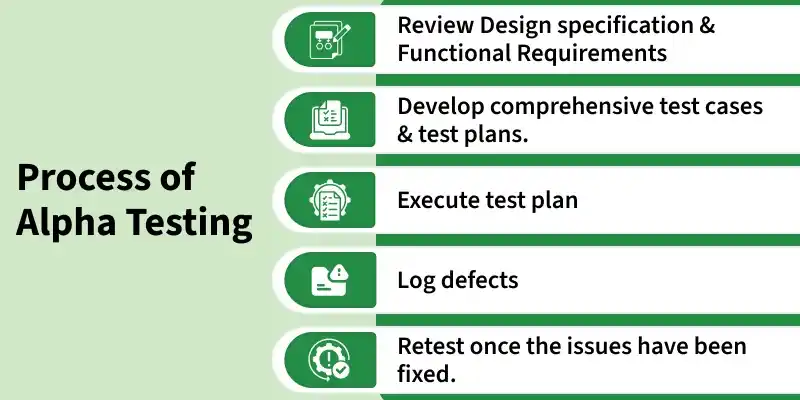
- Requirement Review: Analyze design documents and functional requirements to understand expected behavior.
- Test Planning: Prepare test cases, test plans, and set up the testing environment.
- Test Execution: Execute test cases to identify defects and system issues.
- Defect Logging: Record and report bugs to the development team for correction.
- Retesting and Validation: Re-test the fixed issues and ensure the software meets acceptance criteria before moving to beta testing.
Phases of Alpha Testing
Alpha testing is carried out in two main phases:
Phase 1. Developer Testing
Developers perform initial testing using debugging tools to detect major bugs, crashes, and technical issues at an early stage.
Phase 2. QA Testing
The Quality Assurance (QA) team conducts detailed testing using both white-box and black-box techniques to verify functionality, performance, and stability before beta release.
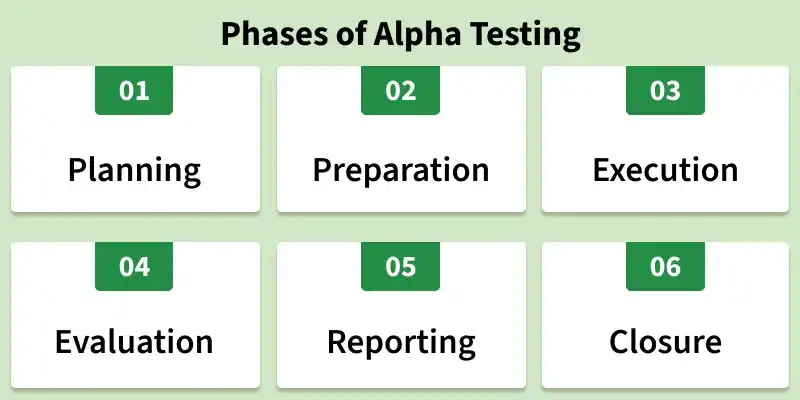
- Planning: This phase defines the scope, objectives, and schedule of alpha testing. It helps in identifying required resources, tools, and the testing strategy. Proper planning ensures the testing process is well-organized.
- Preparation: In this phase, the test environment is set up and all necessary test data is prepared. Test cases and scripts are created based on requirements. It ensures everything is ready before testing begins.
- Execution: Test cases are executed to identify defects in the software. Testers run the application and observe its behavior under different conditions. Bugs are reported and sent to developers for fixing.
- Evaluation: The results of testing are analyzed to check whether the software meets the expected requirements. Testers compare actual results with expected outcomes. Areas for improvement are also identified.
- Reporting: All defects, test results, and observations are documented in this phase. Reports are shared with developers and stakeholders. It helps in tracking progress and making decisions.
- Closure: This is the final phase where all testing activities are completed. It ensures that major defects are resolved and documentation is finalized. The software is then prepared for beta testing or release.
Techniques Used in Alpha Testing
Alpha Testing uses different techniques to identify defects and ensure the software works correctly before release.
- Black Box Testing: Testing functionality without knowing the internal code or structure of the software.
- White Box Testing: Testing is done with knowledge of the internal code and logic of the application. It helps identify coding and logical errors.
- Gray Box Testing: Testing is performed with partial knowledge of the system’s internal workings. It combines both functional and structural testing approaches.
- Boundary Value Analysis: This technique tests values at the boundaries of input ranges. It helps detect defects occurring at extreme values.
- Equivalence Partitioning: Inputs are divided into valid and invalid groups called partitions. Testing one value from each group reduces test cases while maintaining coverage.
- Error Guessing: Testers use experience and intuition to predict defect-prone areas. It helps uncover hidden and unexpected bugs.
- Exploratory Testing: Testing is carried out without predefined test cases while exploring the application. It helps discover unknown defects and usability issues.
Entry and Exit Criteria for Alpha Testing
Defines the conditions that must be met before starting alpha testing and the requirements to be satisfied for its successful completion.
Entry Criteria (Before Alpha Testing Starts)
Entry criteria are the conditions that must be satisfied before starting alpha testing. They ensure the system is ready for testing.
- Requirements and design documents are finalized
- Basic development (build) is completed
- Test environment is set up
- Test cases and test data are prepared
- Smoke/Sanity Testing is passed
Exit Criteria (Before Moving to Beta Testing)
Exit criteria are the conditions that must be met to complete alpha testing. They ensure the product is stable for the next phase.
- All critical and major defects are fixed
- Test cases are executed successfully
- System meets expected requirements
- Test reports are prepared and approved
- Product is ready for beta testing
Advantages of Alpha Testing
Alpha testing offers several advantages:
- Detects critical defects before product release and helps improve software stability.
- Improves software quality, reliability, and overall application performance.
- Reduces the risk of failure during public launch by identifying issues early.
- Provides early feedback from internal users to enhance product quality.
- Ensures the software meets business requirements and expected functionality.
- Reduces maintenance costs by fixing defects before final deployment.
Limitations of Alpha Testing
Alpha testing has some limitations:
- Testing environment may not fully represent real-world user conditions and scenarios.
- Internal testers may fail to identify issues that actual users encounter.
- Requires additional time and resources before the final product release.
- Limited tester availability may reduce overall test coverage.
- Internal knowledge of the application can influence testing results.
- Does not provide direct feedback from external customers.
Applications of Alpha Testing
Used to identify and fix defects early by testing the application internally before releasing it to external users.
- Pre-Release Validation: Ensures the software is ready before beta testing or public launch.
- Enterprise Software Development: Used to verify internal systems and business applications before deployment.
- Product Feature Verification: Confirms new features function correctly before user exposure.
- Performance and Stability Testing: Evaluates system behavior under controlled, simulated real-world conditions.
- User Experience Improvement: Identifies usability issues to enhance overall customer satisfaction.
Alpha Testing Vs Beta Testing
Alpha testing is performed internally by the development team, while beta testing is conducted by real users in a real-world environment.
| Basis | Alpha Testing | Beta Testing |
|---|---|---|
| Performed By | Internal team (developers & QA) | External users or customers |
| Environment | Controlled testing environment | Real-world environment |
| Purpose | Identify and fix major bugs before release | Validate product usability and gather user feedback |
| Stage | Conducted before beta testing | Conducted after alpha testing |
| Focus | Functionality, performance, stability | User experience and real-world issues |