

Fuzz Testing is a software testing technique in which an application is tested by providing random, invalid, unexpected, or malformed inputs. Its main purpose is to check whether the software can handle unusual input safely without crashing, failing, or exposing security vulnerabilities.
- Helps detect input validation issues, crashes, and security weaknesses in the system.
- Commonly used for testing applications, APIs, file parsers, and network protocols.
- Improves the robustness and reliability of software by testing unexpected input conditions.
Fuzz Testing Process
Fuzz testing checks how an application behaves when it receives random, invalid, or unexpected inputs.
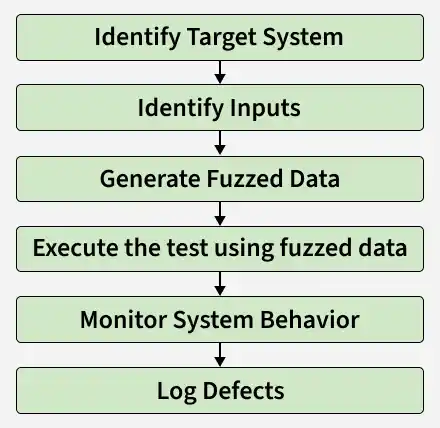
- Identify Target System: Select the application, API, file parser, or protocol that needs to be tested. This defines the component where fuzzing will be applied.
- Identify Inputs: Determine the type of input the target accepts, such as files, form fields, API requests, or network packets. This helps prepare suitable fuzz test data.
- Generate Fuzzed Data: Create random, malformed, unexpected, or mutated input data for testing. These inputs are used to check how the system handles abnormal conditions.
- Execute the Test Using Fuzzed Data: Provide the generated inputs to the application or target component. The goal is to observe whether the system crashes, fails, or behaves unexpectedly.
- Monitor System Behavior: Watch the system for crashes, hangs, exceptions, memory leaks, or abnormal responses. This helps identify vulnerabilities and stability issues.
- Log Defects: Record all crashes, errors, and unexpected behavior found during fuzz testing. These issues are then analyzed and fixed by the development team
Types of Fuzz Testing
Fuzz testing can be classified into different types based on how test inputs are generated, how the fuzzing process is guided, and the type of target being tested.
- Generation-Based Fuzzing: Creates test inputs from scratch using predefined rules or input specifications. It is useful for testing structured formats such as JSON, XML, and protocols.
- Mutation-Based Fuzzing: Starts with valid input data and then modifies it by changing, deleting, or inserting random values. It helps check how the application handles corrupted or unexpected input.
- Dumb Fuzzing: Sends completely random or malformed input without understanding the application’s expected format. It is simple to use but may be less effective for complex systems.
- Smart Fuzzing: Uses knowledge of the input structure, file format, or protocol to create more meaningful test cases. This improves the chances of finding deeper bugs and vulnerabilities.
- Coverage-Guided Fuzzing: Monitors which parts of the code are executed during testing and creates new inputs to explore more code paths. It is effective for detecting hidden crashes and security flaws.
- Protocol Fuzzing: Tests communication protocols by sending malformed or unexpected packets and messages. It helps identify parsing issues, crashes, and protocol-handling vulnerabilities.
- Web Fuzzing: Applies fuzz testing techniques to web applications using manipulated URL parameters, form data, cookies, or HTTP requests. It is useful for finding validation issues and web security weaknesses.
Tools Used for Fuzz Testing
Fuzz testing tools help automate the process of generating random or malformed inputs and monitoring how the application behaves. They are widely used to detect crashes, memory issues, and security vulnerabilities in software systems.
- AFL (American Fuzzy Lop): A popular coverage-guided fuzzing tool used to find crashes and security issues in applications.
- LibFuzzer: A fast in-process fuzzing tool mainly used with C/C++ programs for continuous input testing.
- Peach Fuzzer: A fuzzing platform used to test network protocols, file formats, and APIs with malformed inputs.
- Burp Suite Intruder: Useful for web fuzzing by sending manipulated payloads to web forms, parameters, and requests.
- zzuf: A lightweight fuzzing tool that mutates file or input data to test application robustness.
- Sulley / Boofuzz: Tools commonly used for protocol fuzzing and network service testing.
Applications of Fuzz Testing
Fuzz testing is widely used in different areas of software and security testing to evaluate how systems handle unexpected or malformed input.
- Blockchain: Fuzz testing of smart contracts helps uncover vulnerabilities that could lead to financial loss or security issues.
- API Testing: Fuzz testing helps verify whether APIs can handle invalid, unexpected, or high-volume requests safely.
- Operating Systems: It tests system calls and input handling to identify crashes, memory issues, or privilege-related vulnerabilities.
- Quality Assurance: It checks whether software can handle erroneous or unexpected inputs without crashing under different conditions.
- Cryptography: It helps test cryptographic implementations with unusual inputs to identify weaknesses and improve security.
Advantages of Fuzz Testing
- Helps detect crashes, input-handling errors, and unexpected application behavior.
- Identifies security vulnerabilities caused by invalid or malformed input data.
- Improves the stability, robustness, and reliability of the software.
- Automates testing by generating a large number of unusual input combinations quickly.
- Useful for testing APIs, file parsers, protocols, and web applications under abnormal conditions.
Limitations of Fuzz Testing
- It may generate many random inputs that are not meaningful, which can reduce testing efficiency.
- Fuzz testing mainly focuses on input-related issues and may not detect logical or workflow defects.
- Some crashes can be difficult to analyze without proper debugging tools or code access.
- It may require specialized tools and setup for complex applications, protocols, or file formats.
- Fuzz testing does not guarantee complete coverage of all application paths or vulnerabilities.