

Software Engineering is the discipline of applying engineering principles to the design, development, testing, and maintenance of software systems. Understanding the Software Development Life Cycle (SDLC), Software Design & Code Quality, and Testing & Maintenance is essential for both academic and interview preparation.
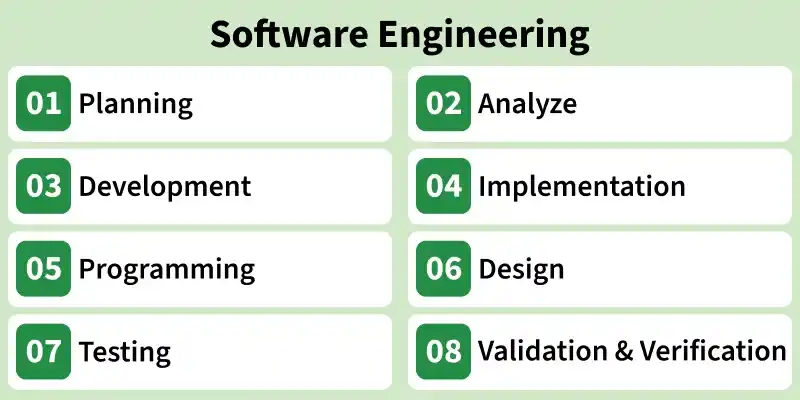
1. What is Software Engineering?
Software Engineering is the systematic application of engineering principles to design, develop, test, deploy, and maintain high-quality software that meets user requirements.
- Applies engineering principles to software development.
- Covers requirement analysis, design, coding, testing, deployment, and maintenance.
- Follows structured SDLC processes and best practices.
- Ensures software quality and meets user requirements.
2. What are the Characteristics of Software?
The main characteristics of software are:
- Functionality: Performs the intended tasks correctly.
- Reliability: Works accurately and consistently over time.
- Usability: Easy to learn and use.
- Efficiency: Uses system resources effectively.
- Maintainability: Easy to modify, update, and fix.
- Portability: Can run on different platforms with minimal changes.
- Integrity: Ensures data accuracy, consistency, and security.
3. What is the Black Hole Concept in DFD?
A Black Hole in a Data Flow Diagram (DFD) is a process that has input data but produces no output. It indicates an error in the DFD because input data disappears without generating any result.
Black Hole = Input present, but no output.
4. Explain SDLC and its Phases?
SDLC (Software Development Life Cycle) is a structured process used to plan, develop, test, deploy, maintain, and improve software. It provides a systematic approach to build high-quality software that meets user requirements.

Phases of SDLC: Following are the phases of SDLC:
- Planning & Requirement Analysis: Gather and analyze requirements.
- Requirement Specification (SRS): Document functional and non-functional requirements.
- Design: Create software architecture and design.
- Development (Coding): Implement the software.
- Testing: Verify and validate the software.
- Deployment & Maintenance: Release, monitor, and update the software.
5. What are different SDLC Models Available?
Here are the models which are available for the SDLC:
- Waterfall Model: Sequential model where each phase is completed before the next begins.
- V-Model: Each development phase has a corresponding testing phase.
- Incremental Model: Software is developed and delivered in small increments.
- Iterative Model: Software is refined through repeated development cycles.
- Spiral Model: Risk-driven model combining iterative development with risk analysis.
- Prototype Model: A prototype is built first to clarify and validate requirements.
- RAD (Rapid Application Development) Model: Focuses on rapid development using prototyping and user feedback.
- Agile Model: Iterative and incremental model emphasizing customer collaboration and frequent releases.
6. What is the Waterfall Method and What are its Use Cases?
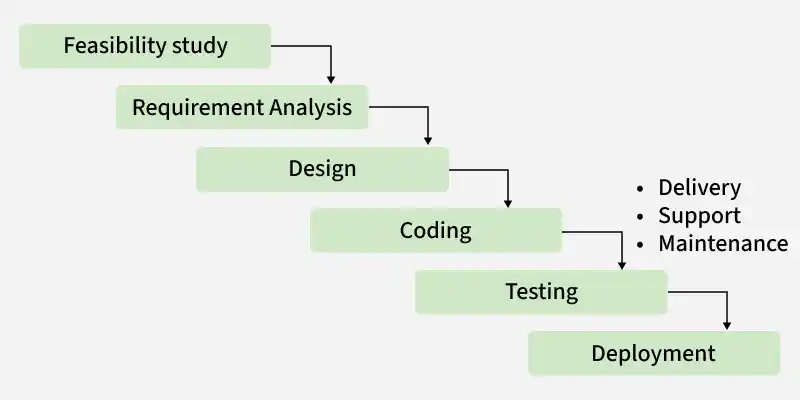
The waterfall model is a software development model used in the context of large, complex projects, typically in the field of information technology. It is characterized by a structured, sequential approach to project management and software development.
Phases of Waterfall Model:
- Requirements Analysis: Gather and analyze user requirements.
- Design Phase: Create the software architecture and system design.
- Implementation (Coding): Develop the software and perform unit testing.
- Integration & System Testing: Integrate modules and test the complete system.
- Deployment: Release the software to users.
- Maintenance: Fix bugs, update features, and improve the software after deployment.
Use Case of Waterfall Model
- Requirements are clear and fixed that may not change.
- There are no ambiguous requirements (no confusion).
- It is good to use this model when the technology is well understood.
- The project is short and cast is low.
- Suitable when project risk is low and requirements are stable.
7. What is Black Box Testing?
The black box test (also known as the conducted test/ closed box test/ opaque box test) is software testing technique. In this technique, tester does not care about the internal knowledge or implementation details but rather focuses on validating the functionality based on the provided specifications or requirements. The name "black box" refers to the idea that the internal workings are hidden from the tester's view.
8. What is White Box Testing?
White Box Testing is a method of analyzing the internal structure, data structures used, internal design, code structure, and behavior of software, as well as functions such as black-box testing. Also called glass-box test or clear box test or structural test.
9. Distinguish between Alpha and Beta Testing?
Alpha Testing | Beta Testing |
|---|---|
| Alpha testing involves both white box and black box testing. | Beta testing commonly uses black-box testing. |
| Alpha testing is performed by testers who are usually internal employees of the organization. | Beta testing is performed by clients who are not part of the organization. |
| Alpha testing is performed at the developer’s site. | Beta testing is performed at the end-user, the of the product. |
Performed in a controlled testing environment. | Performed in a real-world environment. |
| Alpha testing requires a testing environment or a lab. | Beta testing doesn’t require a testing environment or lab. |
| Alpha testing may require a real-time long execution cycle. | Beta testing requires only a few weeks of execution. |
| Developers can immediately address the critical issues or fixes in alpha testing. | Most of the issues or feedback collected from the beta testing will be implemented in future versions of the product |
10. What is Debugging?
Debugging is the process of identifying and resolving errors, or bugs, in a software system. It is an important aspect of software engineering because bugs can cause a software system to malfunction, and can lead to poor performance or incorrect results. Debugging can be a time-consuming and complex task, but it is essential for ensuring that a software system is functioning correctly.
11. What is a Feasibility Study?
The Feasibility Study in Software Engineering is a study that analyze whether a proposed software project is practical or not. It early detects the potential issues, analyzes technological possibilities, and determines the project's financial and operational viability. This decreases the chance of projects failure that also save time and money.
12. What is a Use Case Diagram?
A use case diagram is a behavior diagram and visualizes the observable interactions between actors and the system under development. The diagram consists of the system, the related use cases, and actors and relates these to each other:
- System: What is being described?
- Actor: Who is using the system?
- Use Case: What are the actors doing?
13. What is a Baseline?
A baseline is a measurement that defines the completeness of a phase. It is an approved version of a software work product that serves as a reference for future development and change control.
14. What is SRS?
Software Requirement Specification (SRS) Format is a complete specification and description of requirements of the software that needs to be fulfilled for successful development of software system. These requirements can be functional and non-functional requirements depending upon the type of requirement. The interaction between different customers and contractors is done because it is necessary to fully understand the needs of customers.
15. What is level-0 DFD?
The highest abstraction level is called Level 0 of DFD. It is also called context-level DFD. It portrays the entire information system as one diagram.
16. What is a Function Point?
Function point metrics provide a standardized method for measuring the various functions of a software application. Function point metrics, measure functionality from the user’s point of view, that is, on the basis of what the user requests and receives in return.
17. What is Physical and Logical DFD (Data Flow Diagram) ?
Physical DFD and Logical DFD both are the types of DFD (Data Flow Diagram)used to represent how data flows within a system.
- Physical DFD focuses on how the system is implemented. It includes details like hardware, people, files, and other resources needed to perform the business processes.
- Logical DFD focuses on what happens in the system. It shows processes and data flow at a high level without implementation details. For example, in a banking system, it explains how data moves between entities like customers, accounts, and transactions.
18. What are CASE Tools?
CASE stands for Computer-Aided Software Engineering. CASE tools are a set of automated software application programs, which are used to support, accelerate and smoothen the SDLC activities. It is a software package that helps with the design and deployment of information systems. It can record a database design and be quite useful in ensuring design consistency.
19. What is the Name of Various CASE Tools?
- Requirement Analysis Tool
- Structure Analysis Tool
- Software Design Tool
- Code Generation Tool
- Test Case Generation Tool
- Document Production Tool
- Reverse Engineering Tool
20. Difference between an EXE and DLL?
DLL refers to Dynamic Link Library, and EXE is an executable. An EXE assembly can execute in its own address space, whereas a DLL cannot. It does not have its own address space, therefore it must run within a host and requires a consumer to invoke it.
21. Why is Modularization important in Software Engineering?
Modular programming makes your code easier to read by dividing it into functions that only deal with one part of the overall functionality. When compared to monolithic code, it can make your files significantly smaller and easier to read.
22. What is the difference between Verification and Validation?
| Verification | Validation |
|---|---|
| Checks whether the software is built correctly according to specifications. | Checks whether the right software is built to meet user requirements. |
| Static process (no code execution). | Dynamic process (requires code execution). |
| Done through reviews, inspections, walkthroughs, and desk checking. | Done through testing (black-box, white-box, gray-box, etc.). |
| Detects defects in documents, design, and code before execution. | Detects defects in the running software. |
| Performed mainly by the QA team. | Performed mainly by the testing team. |
| Performed before validation. | Performed after verification. |
23. What is the Difference Between Quality Assurance and Quality Control?
Quality Assurance (QA) | Quality Control (QC) |
|---|---|
| It focuses on providing assurance that the quality requested will be achieved. | It focuses on fulfilling the quality requested. |
| It is the technique of managing quality. | It is the technique to verify quality. |
| It does not include the execution of the program. | QC usually involves testing and execution. |
| It is process-oriented. | It is product-oriented. |
| The aim of quality assurance is to prevent defects. | The aim of quality control is to identify and improve the defects. |
| It is a preventive technique. | It is a corrective technique. |
| It is a proactive measure. | It is a reactive measure. |
| It is responsible for the full software development life cycle. | It is responsible for the software testing life cycle. |
| Example: Verification | Example: Validation |
24. What is Cohesion and Coupling?
Cohesion is the degree to which the elements within a module work together to perform a single, well-defined task. High cohesion means the module is focused and functionally independent, making it easier to maintain and reuse.
Coupling is the degree of dependency between modules. Low coupling means modules interact minimally through simple interfaces, making the software more flexible, maintainable, and easier to modify.
25. What is the Agile software development model?
The Agile model is an iterative and incremental SDLC approach that develops software in small, frequent releases. It emphasizes customer collaboration, adaptability, and rapid delivery of working software.
Advantages:
- Customer satisfaction by rapid, continuous delivery of useful software.
- Customers, developers, and testers constantly interact with each other.
- Close, daily cooperation between business people and developers.
- Continuous attention to technical excellence and good design.
- Regular adaptation to changing circumstances.
- Even late changes in requirements are welcomed.
26. What is the Spiral Model, and its Disadvantages?
The Spiral Model is a risk-driven, iterative SDLC model that combines prototyping with the Waterfall model. Development progresses through repeated spiral loops (phases), with each loop including planning, risk analysis, development, and evaluation.
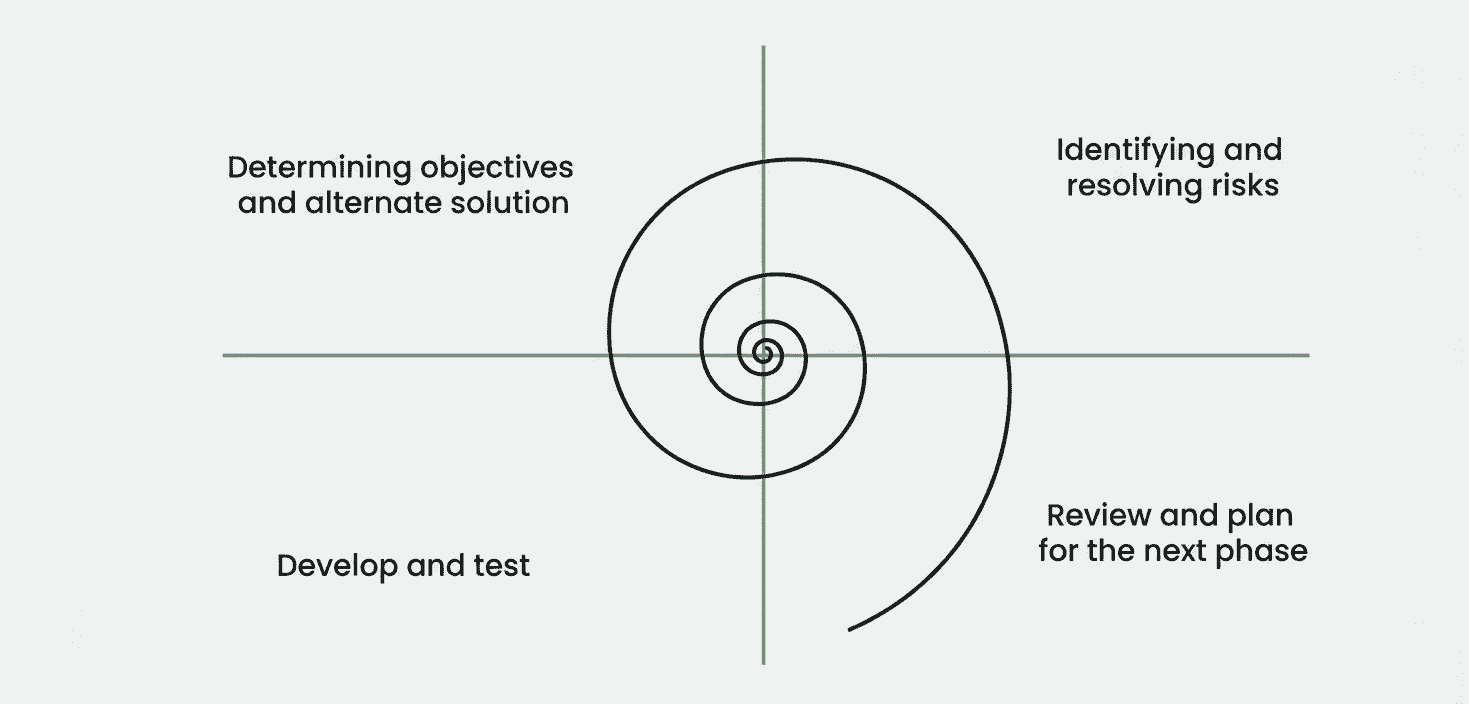
Following are the disadvantages of spiral model:
- Can be a costly model to use.
- Risk analysis requires highly specific expertise.
- The project’s success is highly dependent on the risk analysis phase.
- Doesn’t work well for smaller projects
27. What is the RAD Model, and its limitations?
IBM first proposed the Rapid Application Development or RAD Model in the 1980s. The RAD model is a type of incremental process model in which there is a concise development cycle. The RAD model is used when the requirements are fully understood and the component-based construction approach is adopted.
Limitations of RAD Model:
- For large but scalable projects RAD requires sufficient human resources.
- Projects fail if developers and customers are not committed in a much-shortened time frame.
- Problematic if a system cannot be modularized
28. What is Regression Testing?
Regression testing is a type of software testing performed to ensure that new code changes or bug fixes do not affect existing functionality. It involves re-running previously executed test cases to verify that the software still works correctly.
29. What is Software Re-engineering?
Software re-engineering is the process of scanning, modifying, and reconfiguring a system in a new way. The principle of reengineering applied to the software development process is called software reengineering. It has a positive impact on software cost, quality, customer service, and shipping speed. Software reengineering improves software to create it more efficiently and effectively.
30. What is Reverse Engineering?
Software Reverse Engineering is a process of recovering the design, requirement specifications, and functions of a product from an analysis of its code. It builds a program database and generates information from this. The purpose of reverse engineering is to facilitate maintenance work by improving the understandability of a system and producing the necessary documents for a legacy system.
Reverse Engineering Goals:
- Cope with Complexity.
- Recover lost information.
- Detect side effects.
- Synthesize higher abstraction.
- Facilitate Reuse.
31. What are Software Project Estimation Techniques Available?
There are some software project estimation techniques available:
- PERT
- WBS
- Delphi method
- User case point
32. How to Measure the Complexity of Software?
To measure the complexity of software there are some methods in software engineering:
- Line of codes
- Cyclomatic complexity
- Class coupling
- Depth of inheritance
33. What is the formula to Calculate the Cyclomatic Complexity?
The formula to calculate the cyclomatic complexity of a program is:
c = e - n+2p where,
- e = number of edges
- n = number of vertices
- p = predicates
Example:
A = 10
IF B > C THEN
A = B
ELSE
A = C
ENDIF
Print A
Print B
Print C
Control Flow Graph of the above code:
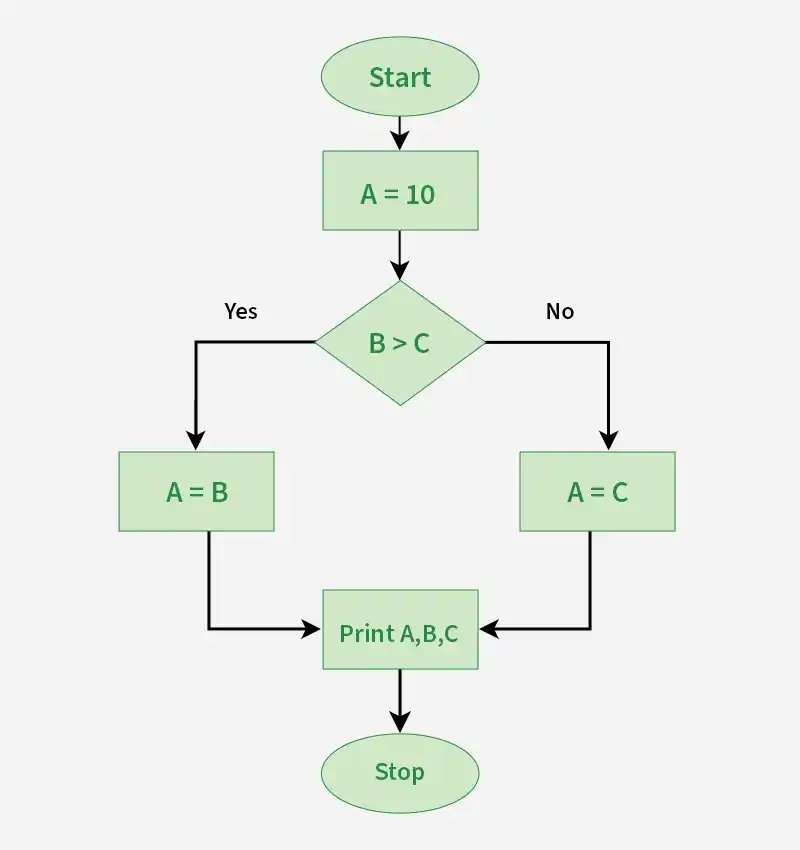
The cyclomatic complexity calculated for the above code will be from the control flow graph. The graph shows seven shapes(nodes), and seven lines(edges), hence cyclomatic complexity is 7-7+2 = 2.
34. What is the Cyclomatic Complexity of a Module that has 17 Edges and 13 Nodes?
The Cyclomatic complexity of a module that has seventeen edges and thirteen nodes = E – N + 2
E = Number of edges, N = Number of nodes
Cyclomatic complexity = 17 – 13 + 2 = 6
35. What is COCOMO Model?
A COCOMO model stands for Constructive Cost Model. As with all estimation models, it requires sizing information and accepts it in three forms:
- Object points
- Function points
- Lines of source code
36. Define an Estimation of Software Development Effort for Organic Software in the basic COCOMO Model?
Estimation of software development effort for organic software in the basic COCOMO model is defined as
Organic: Effort = 2.4(KLOC) 1.05 PM
37. What Activities Come Under the Umbrella Activities?
Umbrella activities are supporting activities performed throughout the entire Software Development Life Cycle (SDLC) to ensure effective project management, quality, and control.
Common Umbrella Activities:
- Project tracking and control
- Risk management
- Software quality assurance (SQA)
- Technical reviews
- Software configuration management (SCM)
38. Which SDLC Model is the Best?
The selection of the best SDLC model is a strategic decision that requires a thorough understanding of the project’s requirements, constraints, and goals. The choice depends on the project requirements, size, complexity, budget, timeline, and risk. The best model is the one that best fits the project's needs and goals.
39. What are the Various Categories of Software?
The software is used extensively in several domains including hospitals, banks, schools, defense, finance, stock markets, and so on. It can be categorized into different types:
1. Based on Application
- System Software: Manages computer hardware and system resources.
- Application Software: Performs specific user tasks.
- Web Applications Software: Runs through a web browser.
- Embedded Software: Controls dedicated hardware devices.
- Reservation Software: Manages booking and reservation systems.
- Business Software: Supports business operations (e.g., CRM, ERP).
- AI Software: Uses artificial intelligence to perform intelligent tasks.
- Scientific Software: Used for scientific research, simulations, and analysis.
2. Based on Copyright
- Commercial Software: Paid software with a licensed usage.
- Shareware Software: Free trial software with limited features or duration.
- FreewareSoftware: Free to use but usually proprietary.
- Public Domain Software: Free to use, modify, and distribute without restrictions.
40. Which of the Testing is Used for Fault Simulation?
With increased expectations for software component quality and the complexity of components, software developers are expected to perform effective testing. In today’s scenario, mutation testing has been used as a fault injection technique to measure test adequacy. Mutation Testing adopts “fault simulation mode”.
41. What is Concurrency, and How to Achieve it ?
Concurrency refers to a system's ability to execute numerous tasks or processes at the same time, ostensibly concurrently. It is a wider concept that includes the idea of completing many jobs in concurrent intervals. In a concurrent system, tasks can begin, run, and finish in overlapping time frames, increasing overall system efficiency and responsiveness. There are many programming languages available that support concurrency using unthreading example Java, C++ etc.
42. Define Adaptive Maintenance?
Adaptive maintenance defines as modifications and updating when the customers need the product to run on new platforms, on new operating systems, or when they need the product to interface with new hardware and software.
43. Define the term WBS?
The full form of WBS is Work Breakdown Structure. Its Work Breakdown Structure includes dividing a large and complex project into simpler, manageable, and independent tasks. For constructing a work breakdown structure, each node is recursively decomposed into smaller sub-activities, until at the leaf level, the activities become undividable and independent. A WBS works on a top-down approach.
44. How to Find the Size of a Software Product?
Estimation of the size of the software is an essential part of Software Project Management. It helps the project manager to further predict the effort and time which will be needed to build the project. Various measures are used in project size estimation. Some of these are:
- Lines of Code
- Number of entities in ER diagram
- Total number of processes in detailed data flow diagram
- Function points
45. Which Model is Used to Check Software Reliability?
A Rayleigh model is used to check software reliability. The Rayleigh model is a parametric model in the sense that it is based on a specific statistical distribution. When the parameters of the statistical distribution are estimated based on the data from a software project, projections about the defect rate of the project can be made based on the model.
46. What is the Difference between Risk and Uncertainty?
- Risk is able to be measured while uncertainty is not able to be measured.
- Risk can be calculated while uncertainty can never be counted.
- You are capable of make earlier plans in order to avoid risk. It is impossible to make prior plans for the uncertainty.
- Certain sorts of empirical observations can help to understand the risk but on the other hand, the uncertainty can never be based on empirical observations.
- After making efforts, the risk is able to be converted into certainty. On the contrary, you can’t convert uncertainty into certainty.
- After making an estimate of the risk factor, a decision can be made but as the calculation of the uncertainty is not possible, hence no decision can be made.
47. What is CMM?
To determine an organization’s current state of process maturity, the SEI uses an assessment that results in a five-point grading scheme. The grading scheme determines compliance with a capability maturity model (CMM) that defines key activities required at different levels of process maturity. The SEI approach provides a measure of the global effectiveness of a company's software engineering practices and establishes five process maturity levels that are defined in the following manner:
- Level 1: Initial
- Level 2: Repeatable
- Level 3: Defined
- Level 4: Managed
- Level 5: Optimizing
48. A software does not wear out in the traditional sense of the term, but the software does tend to deteriorate as it evolves, why?
Software does not wear out physically like hardware. However, it deteriorates over time due to continuous modifications and updates. Each change can introduce new bugs, increase complexity, and create unexpected interactions between components, making the software harder to maintain and reducing its reliability.
- Software does not physically wear out.
- Frequent changes and new features introduce defects.
- Increased complexity makes maintenance difficult.
- Poorly managed changes reduce reliability and performance.
49. What are the elements to be considered in the System Model Construction?
The type and size of the software, the experience of use for reference to predecessors, difficulty level to obtain users’ needs, development techniques and tools, the situation of the development team, development risks, the software development methods should be kept in mind. It is an important prerequisite to ensure the success of software development that designing a reasonable and suitable software development plan.
50. Which Process Model Removes Defects before Software get into trouble?
Clean room software engineering is a software development approach to producing quality software. In clean room software engineering, an efficient and good quality software product is delivered to the client as QA (Quality Assurance) is performed each and every phase of software development.