

Model-Based Testing is a software testing approach where test cases are generated from models that represent system behavior. It helps improve test coverage, consistency, and reduces manual effort.
- Uses models like FSM, UML, and Statecharts.
- Generates test cases automatically or semi-automatically.
- Improves coverage and reduces manual effort.
Example: An online banking fund transfer module can be modeled using login, OTP verification, and transaction states. Test cases are generated to check valid and invalid transactions.
Process of Model-Based Testing
Model-Based Testing (MBT) follows a structured process where a system is modeled, test cases are generated from the model, executed on the system, and results are analyzed to improve quality.
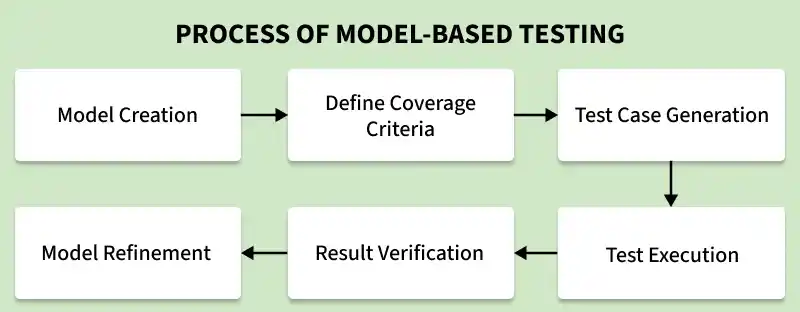
- Model Creation: Requirements, user stories, or system behavior are converted into a formal model such as FSM, EFSM, or UML diagrams. This helps clearly define how the system should behave.
- Define Coverage Criteria: Testing objectives are defined, such as state coverage, transition coverage, or path coverage, to decide how thoroughly the model should be tested.
- Test Case Generation: Test cases are automatically or semi-automatically generated from the model using traversal or algorithm-based techniques.
- Test Execution: Generated test cases are executed on the actual system using tools or test automation frameworks.
- Result Verification: Actual system outputs are compared with expected results derived from the model to identify defects.
- Model Refinement: If defects or mismatches are found, the model is updated to improve accuracy and test coverage in future cycles.
Types of Model-Based Testing
Model-Based Testing uses different types of models to represent system behavior, rules, and interactions. These models help generate test cases systematically and improve test coverage.
- Finite State Machines (FSM) / State Transition Models: Represent the system as states and transitions based on events or inputs. Useful for testing workflows and state-dependent behavior.
- Statecharts: An advanced form of FSM that supports hierarchical, parallel, and complex states. Used for testing reactive and event-driven systems.
- Decision Tables: Represent business rules in tabular form where combinations of conditions lead to actions. Useful for validating complex business logic.
- UML-Based Models: Use diagrams such as use case, sequence, activity, and state diagrams to model system behavior. Test cases are derived from design and requirements.
- Markov Models: Represent the system using probabilistic state transitions. Mainly used for reliability, performance, and usage-based testing.
- Formal Specification Models: Use mathematical notations to define system behavior precisely. Mainly used in safety-critical systems for correctness and reliability.
Tools Used in Model-Based Testing
- Spec Explorer: Microsoft tool for generating test cases from formal models, mainly for .NET applications.
- GraphWalker: Open-source tool for graph-based and state machine testing.
- Conformiq: Commercial tool for automatic test generation from requirements and models.
- Tricentis Tosca: Scriptless test automation tool using model-based approach.
- MaTeLo: Uses Markov chains for statistical and usage-based testing.
- Microsoft MBT Framework: Supports model-based test generation using Visual Studio tools.
Applications of Model-Based Testing
- Web applications are tested to validate workflows like login, registration, and payment processes.
- Banking systems use it to verify transactions, fund transfers, and security operations.
- Embedded systems apply it to test real-time behavior in devices such as cars, ATMs, and IoT systems.
- Telecommunication systems use it to test protocols, call flows, and network behavior.
- Safety-critical systems use it to ensure reliability and correctness in aerospace, medical, and railway systems.
- Business applications use it to validate complex business rules and decision-making processes.
Advantages of Model-Based Testing
Model-Based Testing offers several benefits in terms of coverage, automation, and testing efficiency.
- Improves test coverage by systematically testing states and transitions.
- Detects requirement and design issues early in the development cycle.
- Reduces manual effort through automated test generation.
- Provides consistent and repeatable test design.
- Enables reuse of models across multiple test cycles.
- Integrates effectively with test automation tools.
Limitations of Model-Based Testing
Despite its benefits, Model-Based Testing has some challenges and limitations.
- Building accurate models requires significant time and effort.
- Managing models becomes difficult for large and complex systems.
- Requires expertise in modeling techniques and MBT tools.
- Models must be updated whenever requirements change.
- Success depends heavily on the capabilities of the chosen tools.
- Some testing activities still require manual validation and review.