

Variables in PostgreSQL are used to store and manage data temporarily within a block. They support different data types and make database programs more flexible and efficient.
- Declare and initialize values.
- Store query results for further processing.
- Perform calculations and data manipulation.
- Write cleaner and more maintainable code.
Syntax
DECLARE
    variable_name data_type [:= initial_value];
Where:
- variable_name: The name of the variable.
- data_type: The data type of the variable, such as INTEGER, VARCHAR or NUMERIC.
- initial_value: An optional value assigned when the variable is declared.
Working
Example 1: Declare and Initialize Variables
The following block declares variables and initializes them with values.
Query:
DO $$
DECLARE
    counter INTEGER := 1;
    first_name VARCHAR(50) := 'John';
    last_name VARCHAR(50) := 'Doe';
    salary NUMERIC(10,2) := 50000.00;
BEGIN
    RAISE NOTICE '% % % earns $%',
        counter,
        first_name,
        last_name,
        salary;
END;
$$;
Output:

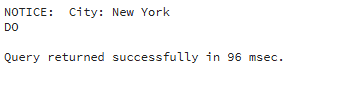
Example 2: Assign a Value to a Variable
The following block assigns a value to a variable after declaration.
Query:
DO $$
DECLARE
    city VARCHAR(30);
BEGIN
    city := 'New York';
    RAISE NOTICE 'City: %', city;
END;
$$;
Output:
Example 3: Copy a Data Type Using %TYPE
The following block declares a variable using the data type of a table column.
Query:
DO $$
DECLARE
    employee_name Employees.EmployeeName%TYPE;
BEGIN
    SELECT EmployeeName
    INTO employee_name
    FROM Employees
    WHERE EmployeeID = 101;

    RAISE NOTICE 'Employee Name: %', employee_name;
END;
$$;
Output:

Example 4: Variables in Nested Blocks
The following block demonstrates variable scope in nested blocks.
Query:
DO $$
<<outer_block>>
DECLARE
    counter INTEGER := 1;
BEGIN
    RAISE NOTICE 'Outer Counter: %', counter;

    DECLARE
        counter INTEGER := 10;
    BEGIN
        RAISE NOTICE 'Inner Counter: %', counter;
        RAISE NOTICE 'Outer Counter: %', outer_block.counter;
    END;
END outer_block;
$$;
Output:
