

Probability rules are basic laws that help us calculate and understand the chances of events happening. These rules are used when solving probability problems in mathematics.
These fundamental principles, including the addition rule, multiplication rule, and complement rule, help determine the likelihood of events and calculate the probabilities of different outcomes in random experiments.
1. Addition Rule
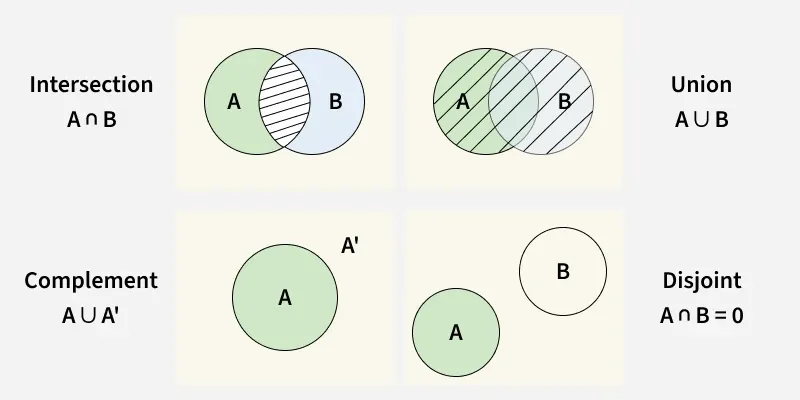
The addition rule of probability deals with the probability of the union of two events. If A and B are two events, then the probability of either event A or event B occurring is given by:
P(A∪B) = P(A) + P(B) - P(A∩B)
where,
- P(A∩B) represents the probability of both events A and B occurring simultaneously.
This rule applies when events A and B are not mutually exclusive.
Example: Suppose we toss a fair coin. Let A be the event of getting a head, and let B be the event of getting a tail. The probability of either getting a head or a tail is given by:
P(AUB) = P(A) + P(B)
= 1/2 + 1/2 = 1
2. Multiplication Rule
The multiplication rule of probability applies when we want to find the probability of the intersection of two independent events. If A and B are independent events, then the probability of both events A and B occurring is given by:
P(A∩B) = P(A) × P(B)
This rule holds when the occurrence of one event does not affect the probability of the other event.
Example: Consider rolling a fair six-sided die. Let A be the event of rolling an even number, and let B be the event of rolling a number less than 4. Since these events are independent, the probability of rolling an even number and a number less than 4 is given by:
P(A∩B) = P(A) × P(B)
P(A) = 3/6 = 1/2
P(B) = 3/6 = 1/2
P(A∩B) = 1/2×1/2 = 1/4
3. Complement Rule
The complement Rule deals with the probability of the complement of an event. If A is an event, then the probability of the complement of A (i.e., the event not occurring) is given by:
P(A′) = 1 - P(A)
Example: Suppose we draw a card from a standard deck of 52 playing cards. Let A be the event of drawing a heart. The probability of not drawing a heart (drawing a card that is not a heart) is given by:
P(A) = 13/52 = 1/4
P(A') = 1 - P(A)
P(A') = 1 - 1/4 = 3/4
4. Conditional Probability
Conditional probability is the probability of an event occurring given that another event has already occurred. If A and B are events, then the conditional probability of A given B is denoted by P(A∣B) and calculated as:
P(A∣B) = P(A∩B)/P(B)
This rule quantifies how the probability of one event changes in light of the occurrence of another event.
Example: Let's continue with the example of drawing a card from a standard deck of 52 playing cards. Suppose B is the event of drawing a face card (jack, queen, or king), and A is the event of drawing a heart. The probability of drawing a heart given that the card drawn is a face card is given by:
P(A) = 13/52 = 1/4
P(B) = 12/52
P(A∩B) = 3/52
P(A∣B) = P(A∩B)/P(B)
P(A∣B) = (3/52)/(12/52) = 1/4
This means that given the card drawn is a face card, there is a 1/4 chance that it is also a heart.