

Surface area is the area covered by the outer surface of an object, while volume is the amount of space contained inside the object.
- Surface area tells us how much material is needed to cover an object.
- Volume tells us how much an object can hold.
Example: Find the volume and surface area of a cube with a side length of 5 cm.

Surface Area
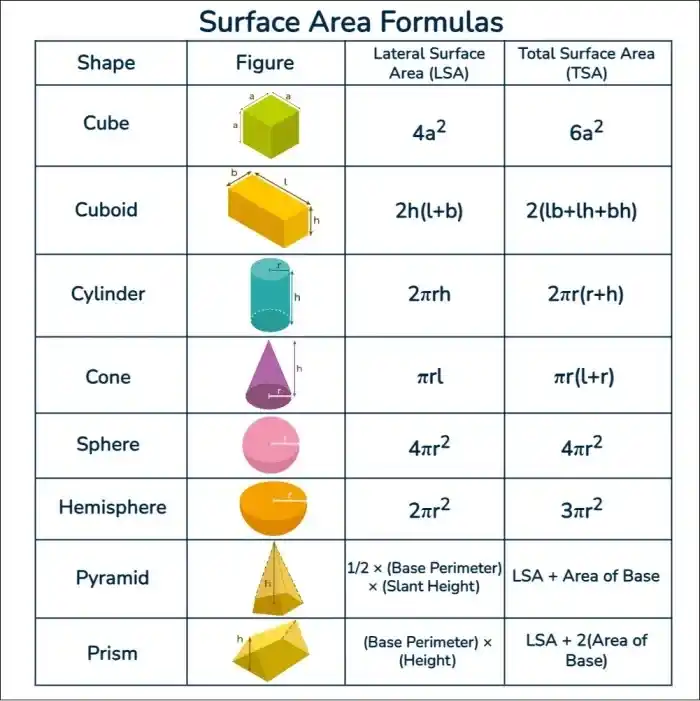
The surface area of a three-dimensional (3D) object is the total area covered by its outer surface. All 3D shapes, such as a cube, cuboid, sphere, cylinder, and hemisphere, have surface area.
Surface area tells us how much space the outside of an object occupies and is measured in square units.
Total Surface Area
The total surface area of a three-dimensional object is the complete area covered by all its outer surfaces.
- It includes every face of the object, whether flat or curved.
- Total surface area helps us understand how much material is needed to cover an object fully from the outside.
Example: A cuboid has six flat faces—top, bottom, front, back, left, and right.
The total surface area of a cuboid is found by adding the areas of all these six faces together.

Example: Two cubes each of edge 8 cm are joined face to face to form a cuboid. Find the total surface area of the cuboid.
Solution:
Given,
Each cube has an edge of 8 cm.
When two cubes are joined face to face, they form a cuboid.Length of the cuboid = 8 + 8 = 16 cm
Breadth of the cuboid = 8 cm
Height of the cuboid = 8 cmTotal surface area of the cuboid = 2(lb + bh + hl)
= 2(16 × 8 + 8 × 8 + 16 × 8)
= 2(128 + 64 + 128)
= 2(320)
= 640 cm²
Curved Surface Area / Lateral Surface Area
The curved surface area, also called the lateral surface area, is the area of only the curved part of a three-dimensional object, excluding its base or bases.
A curved surface is not flat and bends smoothly, like the surface of a ball, cylinder, or cone. Curved surface area helps us measure the outer curved part of solid shapes.

Example: A cylindrical water tank has a radius of 7 cm and a height of 10 cm. Find the curved surface area of the tank.
Solution:
Given,
Radius of the cylinder = 7 cm
Height of the cylinder = 10 cmCurved surface area of a cylinder = 2πrh
= 2 × (22/7) × 7 × 10
= 2 × 22 × 10
= 440 cm²
Volume
Volume is the amount of capacity occupied by a three-dimensional object.
- It tells us how much an object can hold and is measured in cubic units.
- To find volume, a solid shape is considered as being made of equal cubical units, just like area is found using square units.

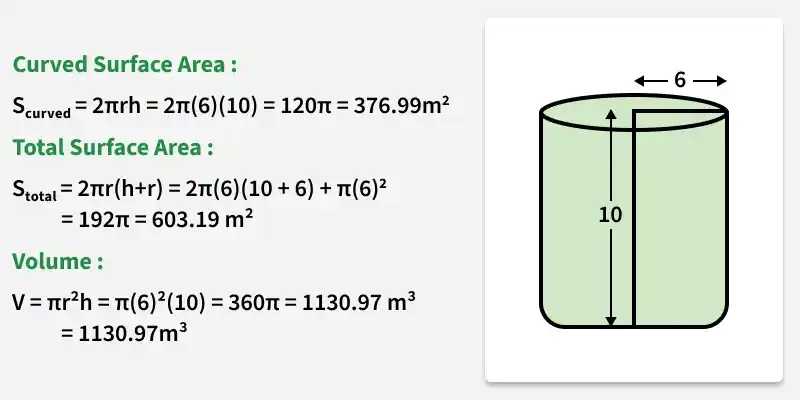
Example: A cylindrical water tank has a radius of 6 m and a height of 10 m. Find the area of the surface that needs to be painted (curved surface area of the tank) and also determine the volume of water the tank can hold.
Application:
- Curved surface area → area to paint the sides of the tank
- Total surface area → area to paint or cover the entire tank
- Volume → water storage capacity of the tank
How to Find Surface Area from Volume?
It is easy to find the surface area of any shape from its volume. Below are the steps to find surface area of sphere and cylinder from their respective volumes:
Surface Area of a Sphere from Volume
To find the surface area of a sphere from its volume, you can use the formula S =
- Start with the formula for the volume of a sphere: V =
\frac{4}{3} \pi r^3 - Solve for r by using r3 =
\frac{3V}{4\pi} or r =\left( \frac{3V}{4\pi} \right)^{1/3} - Substitute the value of r into the surface area formula for the sphere.
Surface Area of a Cylinder from Volume
- Use the formula for the volume of a cylinder: V =
\pi r^2 h - Solve for the radius r by using r =
\sqrt{\frac{V}{\pi h}} - Once r is known, substitute it into the formula for the surface area of a cylinder: S =
2\pi r(r + h)
For a three-dimensional object we can easily calculate its surface area from volume by using these specific formulas depending on the shape of the object.
Shape | Volume (V) | Surface area from Volume |
|---|---|---|
Cylinder | πr2h | Where, h = height of Cylinder |
Sphere | 4/3π r3 | |
Hemisphere | 2/3π r3 | |
Cube | a3 | |
Cuboid | l × b × h | Where, h = height of Cuboid, l = length of cuboid |