

In three-dimensional space (ℝ³), we also consider height or depth. Therefore, a point is represented as (x, y, z), where x, y and z determine the exact position of the point in space. These values are called the coordinates of the point.
In 3D coordinate geometry, we use three coordinate axes to locate a point in space.
Coordinate Axes
Three mutually perpendicular axes intersect at a point called the origin (O). These axes are
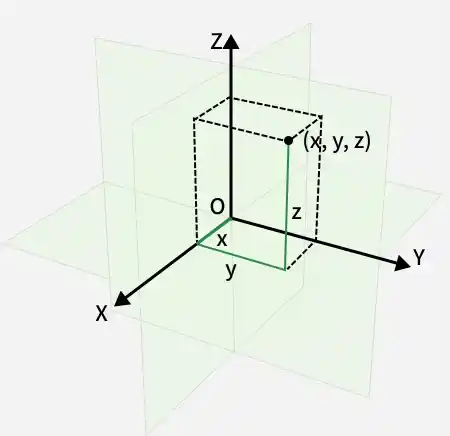
- X-axis: measures left-right direction
- Y-axis: measures front-back direction
- Z-axis: measures up-down direction
A point in 3D space is written as P(x, y, z)
For example, P(2, 3, 4) means:
- Move 2 units along the X-axis,
- 3 units along the Y-axis,
- 4 units along the Z-axis.
Coordinate Planes
In three-dimensional space, the planes formed by the coordinate axes are called coordinate planes: the XY-plane, YZ-plane, and ZX-plane. Each plane is formed by two axes and is perpendicular to the third axis. These three planes divide the space into eight regions called octants.
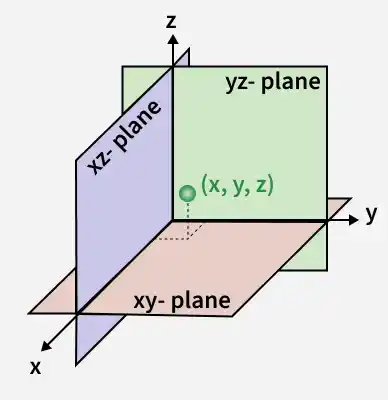
In this system:
- The origin is written as (0, 0, 0).
- Any point on the x-axis is of the form (x, 0, 0).
- Any point on the y-axis is of the form (0, y, 0).
- Any point on the z-axis is of the form (0, 0, z).
- Any point on the XY-plane is of the form (x, y, 0).
- Any point on the YZ-plane is of the form (0, y, z).
- Any point on the ZX-plane is of the form (x, 0, z).
Distance between Two Points
Consider two points (x1, y1, z1) and (x2, y2, z2) in three-dimensional space. The distance between them is found using an extension of the distance formula from two dimensions.
The distance between the two points is given by:
d = \sqrt{(x_2 - x_1)^2 + (y_2 - y_1)^2 + (z_2 - z_1)^2}
Sample Problems
Question 1: Let's say we have a point on the x-axis, what is its y-coordinate and z-coordinate?
Solution: In the figure, the point lies on x-axis. It can be noticed that it's coordinates for y and z are equal to zero.

Question 2: Fill in the blanks:
- X and Y axis together make _____ plane.
- All the coordinate planes divide the 3d space into _______ octants.
Answer:
1. X and Y axis together make XY plane.
2. All the coordinates planes divide the 3-D space into eight octants.
Question 3: Calculate the distance between (0,0,0) and (5,4,3).
Solution:
For the points (x1, y1, z1) and (x2, y2, z2)
\sqrt{(x_1 - y_1)^2 + (x_2 - y_2)^2 + (x_3 - y_3)^2} Here, (x1, y1, z1) = (0, 0, 0) and (x2, y2, z2) = (5, 4, 3). Let the distance be "l"
l =
\sqrt{(x_1 - y_1)^2 + (x_2 - y_2)^2 + (x_3 - y_3)^2} =
\sqrt{(5 - 0)^2 + (4 - 0)^2 + (3 - 0)^2} =
\sqrt{25 + 16 + 9} =
\sqrt{50} = 5√2
Question 4: Calculate the distance between (0,0,0) and (1,2,3).
Solution:
For the points (x1, y1, z1) and (x2, y2, z2)
\sqrt{(x_1 - y_1)^2 + (x_2 - y_2)^2 + (x_3 - y_3)^2} Here, (x1, y1, z1) = (0,0,0) and (x2, y2, z2) = (1,2,3). Let the distance be "l"
l =
\sqrt{(x_1 - y_1)^2 + (x_2 - y_2)^2 + (x_3 - y_3)^2} =
\sqrt{1 + 4 + 9} =
\sqrt{1 + 9 + 4} =
\sqrt{14}
Question 5: Calculate the distance between (1,1,1) and (2,4,3).
Solution:
For the points (x1, y1, z1) and (x2, y2, z2)
\sqrt{(x_1 - y_1)^2 + (x_2 - y_2)^2 + (x_3 - y_3)^2} Here, (x1, y1, z1) = (1,1,1) and (x2, y2, z2) = (2,4,3). Let the distance be "l"
l =
\sqrt{(x_1 - y_1)^2 + (x_2 - y_2)^2 + (x_3 - y_3)^2} =
\sqrt{(2 - 1)^2 + (4 - 1)^2 + (3 - 1)^2} =
\sqrt{1^2 + 3^2 + 2^2} =
\sqrt{14}