

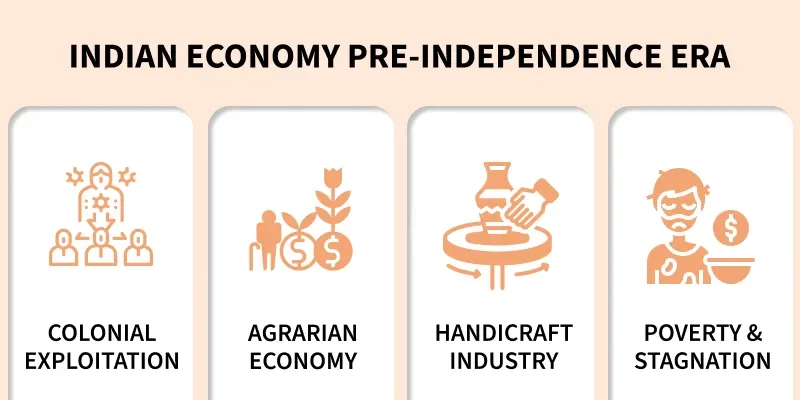
India’s present economy has deep historical roots in the nearly two centuries of British colonial rule that ended with independence on 15 August 1947. The primary objective of British rule was not to promote India’s economic development but to serve Britain’s interests by transforming India into a supplier of raw materials for British industries and a market for British manufactured goods. This colonial economic policy significantly shaped the structure and development of India’s economy, leaving lasting effects that continued even after independence.
Lower Level of Economic Development under Colonial Rule
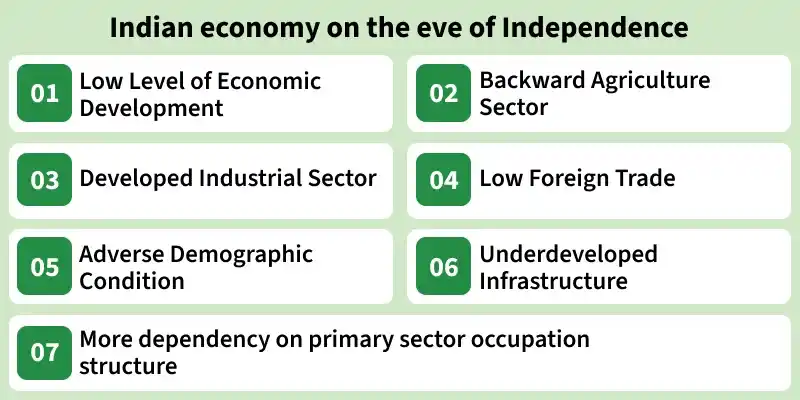
During British rule, India’s economy remained largely stagnant and underdeveloped because colonial policies were designed to serve British commercial interests rather than promote India’s economic growth. As a result, the standard of living remained low, and income and employment levels showed little improvement. The British government made no official attempt to estimate India’s national or per capita income, but Indian economists such as Dadabhai Naoroji, William Digby, Findlay Shirras, V. K. R. V. Rao, and R. C. Desai conducted independent studies which showed that India’s real output grew by less than 2 percent per year, while per capita income increased by only about 0.5 percent annually. These figures highlight the slow economic growth and widespread stagnation that characterized the Indian economy during the colonial period
- The economy remained primarily agricultural, with most people depending on farming for their livelihood.
- Agricultural productivity was extremely low due to outdated techniques and a lack of proper irrigation facilities.
- Industrial development was limited to a few sectors like cotton and jute, and large-scale industries were controlled by the British.
- Investment and capital formation were very low because of widespread poverty and a lack of savings.
- A significant portion of India’s wealth was drained to Britain through salaries, profits, and trade surplus, leaving little for domestic development.
- Infrastructure such as railways, ports, and roads was developed mainly to serve British trade interests, not to support Indian industries.
- Foreign trade was dominated by Britain, making India a supplier of raw materials and an importer of finished goods.
- The majority of the population lived in poverty, with limited access to education, healthcare, and employment opportunities.
In essence, India’s economy under British rule lacked growth, diversification, and self-sufficiency. The colonial structure ensured that the benefits of production and trade were enjoyed by the British, while India was left impoverished and economically dependent.
Agricultural Sector
Before independence, agriculture formed the backbone of the Indian economy. Nearly 70 percent of the national income came from agriculture, and about 85 percent of the population lived in villages depending on farming. Yet, the sector remained stagnant and backward throughout the colonial period. The British used Indian agriculture mainly to serve their industrial and trade interests, focusing on revenue collection rather than rural development. Poor technology, heavy taxation, and a lack of investment kept productivity extremely low.
The main factors that led to the backwardness of Indian agriculture were:
- Exploitative land revenue systems such as Zamindari and Ryotwari prioritized British revenue interests over farmers’ welfare.
- High land taxes were collected in cash, even during years of poor harvest or drought.
- The shift toward cash crops like indigo, cotton, and opium reduced food grain cultivation and made farmers vulnerable to price changes.
- Little effort was made to develop irrigation, modern tools, or scientific farming methods.
- Dependence on monsoon rains often led to crop failures and famines.
- Heavy debts to moneylenders forced many farmers to lose their land and become tenants.
Agriculture under colonial rule became a tool for exploitation rather than growth. Instead of modernization, it brought widespread poverty, inequality, and frequent famines that weakened the rural economy.
Industrial Sector
Before British rule, India was known for its thriving handicraft industries, especially in textiles, metalwork, and artisanal goods that were exported across the world. However, the colonial economic policies destroyed this vibrant industrial base. The British aimed to make India a supplier of raw materials and a consumer of British finished goods. As a result, traditional industries collapsed, and no modern industrial foundation was allowed to develop.
The major impacts on the Indian industrial sector were:
- The influx of cheap machine-made goods from Britain destroyed local handicraft industries.
- Indian artisans lost their livelihoods as handmade products could not compete with industrial imports.
- No significant investment was made in establishing large-scale industries within India.
- India was reduced to exporting raw materials such as cotton, jute, and iron ore to Britain.
- Industrial development was concentrated only in a few regions such as Bengal, Bombay, and Madras.
- The lack of modern technology, infrastructure, and capital restricted industrial progress.
The deindustrialization of India under British rule led to large-scale unemployment and economic decline. The once-flourishing Indian crafts and manufacturing sectors were replaced by dependence on imports, turning India into a colonial market rather than an industrial economy.
Foreign Trade
During the British period, India’s foreign trade structure was entirely shaped to serve British interests. The colonial rulers turned India into a supplier of raw materials and an importer of British manufactured goods. The pattern of trade was one-sided, with India’s economy depending heavily on exports to Britain and imports from it.
The key features of India’s foreign trade under colonial rule were:
- India mainly exported raw materials such as cotton, jute, indigo, sugar, and silk.
- It imported finished goods like clothes, machinery, and iron products from Britain.
- Britain maintained a monopoly over India’s imports and exports, controlling trade policies.
- The export surplus earned by India was not used for its own development but was drained to Britain to meet administrative and military expenses.
- Trade relations with other countries such as China, Ceylon (Sri Lanka), and Persia (Iran) were limited.
- The structure of foreign trade restricted India’s industrialization and deepened its economic dependence on Britain.
Although India had a high volume of exports during this period, it did not benefit from it. The wealth generated through trade was transferred out of the country, leaving behind widespread poverty and stagnation.
Demographic Condition
Reliable demographic data for India became available only after the first census was conducted in 1881. However, this data revealed several signs of backwardness and neglect under colonial administration. The British showed little concern for improving the quality of life or population welfare, focusing instead on administrative convenience.
The main demographic characteristics of India on the eve of independence were:
- The overall population growth was slow and uneven across regions due to recurring famines, epidemics, and wars.
- The death rate was extremely high, and the birth rate was also very high, resulting in a stagnant population pattern.
- The life expectancy was shockingly low, around 32 years, compared to nearly 70 years in modern India.
- Literacy levels were very poor. Overall literacy was below 16 percent, and female literacy was only around 7 percent.
- Public health facilities were almost non-existent, and most rural areas lacked access to doctors or hospitals.
- Diseases like malaria, plague, and cholera were widespread and caused heavy mortality.
These demographic trends reflected the poor standard of living, inadequate healthcare, and lack of education during British rule. The colonial administration made no substantial effort to improve social infrastructure, leaving India socially and economically backward at the time of independence.
Occupational Structure
The occupational structure of a country shows how its working population is distributed among different sectors like agriculture, industry, and services. During the British period, India’s occupational structure reflected the dominance of the primary sector and the underdevelopment of the secondary and tertiary sectors. Most Indians depended on agriculture, while only a small fraction worked in manufacturing or services.
The key features of India’s occupational structure under British rule were:
- A very high proportion of the workforce, about 70–75 percent, was engaged in agriculture and related activities.
- Only around 10 percent of the population worked in manufacturing, handicrafts, or industrial sectors.
- About 15–20 percent were employed in the service sector, mainly in petty trade, transport, and administration.
- There were wide regional variations in employment patterns.
- In regions like Madras, Bombay, and Bengal, a gradual shift from agriculture to manufacturing and services began.
- On the other hand, in regions like Punjab, Rajasthan, and Odisha, dependence on agriculture continued to rise.
This structure shows that the British made no significant effort to promote industrialization or create non-agricultural job opportunities. The Indian economy remained largely rural and stagnant, with little improvement in occupational mobility or diversification.
Infrastructure
Infrastructure refers to the basic physical and organizational structures needed for the operation of an economy, such as transport, communication, and power facilities. During British rule, some infrastructure was developed in India, but it was designed mainly to serve colonial interests rather than to promote the welfare or development of the Indian people.
The major features of infrastructure under the British rule were:
- The British introduced railways in 1853, which became one of the most significant developments of the colonial period.
- Railways helped in expanding the market for British goods and facilitated the movement of raw materials from the interior to ports for export.
- Roads were developed mainly to maintain law and order and to support military movements rather than to connect rural and urban markets.
- The development of ports, inland waterways, and sea routes mainly supported the export of raw materials and the import of finished goods from Britain.
- Postal and telegraph services were introduced but remained limited in reach and accessibility for the common population.
- These developments contributed to the commercialization of agriculture and integration of India into the global market, but not to its industrial or social progress.
Thus, while the British laid the foundation for India’s transport and communication network, their primary goal was to strengthen control and exploit India’s economic resources rather than to modernize the country.
Did you know-
"The first railway line in India, opened in 1853 between Bombay and Thane, was built mainly to transport raw materials from the hinterland to ports for British export."
State of Indian Economy on the Eve of Independence
The Indian economy on the eve of independence was marked by deep poverty, industrial backwardness, and a complete lack of self-reliance. It had been drained of its wealth and resources over nearly two centuries of colonial rule. Its main features can be explained as follows:
Colonial Nature of the Economy: India’s economy functioned to benefit Britain rather than its own people. The British used India as a source of raw materials and a market for finished goods. This resulted in a one-sided economic structure that promoted British industrial growth while suppressing Indian enterprise.
Agricultural Stagnation: The agricultural sector was trapped in poverty and low productivity. Land revenue systems like Zamindari led to the exploitation of peasants, while the commercialization of agriculture prioritized cash crops over food grains. Famines became frequent, and rural distress increased.
Decline of Handicraft Industries: Traditional handicraft industries collapsed due to competition from British machine-made goods. Skilled artisans lost their livelihoods, and industrial growth was restricted to British-controlled sectors. This led to widespread unemployment and economic decline.
Unequal and One-sided Foreign Trade: India’s trade pattern was highly unequal. The country exported primary goods and imported finished products, keeping it dependent on Britain. Despite export surpluses, the profits were drained out through payments for administration and military expenses.
Widespread Poverty and Low Living Standards: Per capita income was very low, literacy was below 16 percent, and average life expectancy was around 32 years. Diseases, malnutrition, and poor sanitation were widespread. The colonial administration did little to improve the people’s living conditions.
Lack of Infrastructure and Industrial Base: Infrastructure development under British rule served colonial purposes. Railways and ports were built mainly to move goods for export, not to promote domestic industry. Industrialization was negligible, leaving India with a weak and dependent economic foundation.
Land Revenue Systems in British India
Land revenue was one of the main sources of income for the British government in India. Before independence, three major land tenure systems existed in the country:
- The Zamindari System
- The Mahalwari System
- The Ryotwari System.
The main difference among these systems was the method of collecting land revenue. In the Zamindari System, revenue was collected through zamindars (landlords); in the Ryotwari System, farmers (roots) paid revenue directly to the government; and in the Mahalwari System, the village community or mahal was responsible for paying the revenue. These systems were mainly designed to increase British revenue and often led to the exploitation of farmers.

1. Zamindari System
The Zamindari System was introduced by the British in Bengal, Bihar, Odisha, and some other regions. Under this system, zamindars (landlords) were recognized as the owners of the land and were responsible for collecting land revenue from farmers and paying it to the government. Farmers had little security and were often exploited through high rents and taxes.
2. Mahalwari System
The Mahalwari System was introduced in parts of North India, such as Punjab, Uttar Pradesh, and Central India. Under this system, the village (mahal) or a group of villages was considered the unit for revenue collection. The responsibility for paying land revenue rested collectively on the village community or its headmen. Although it involved the village community, the tax burden remained high and often caused hardship to farmers.

3. Ryotwari System
The Ryotwari System was introduced mainly in Madras and Bombay Presidencies. Under this system, individual farmers (ryots) were recognized as the owners of the land and paid land revenue directly to the government without any intermediaries. However, the revenue demand was often very high, which led to poverty and indebtedness among farmers