

Greedy algorithms are one of the most frequently tested topics in coding interviews because they help solve optimization problems efficiently. Interviewers often ask conceptual questions to evaluate whether a candidate understands when a greedy approach works and when it fails.
- Covers the most commonly asked theoretical Greedy Algorithm interview questions.
- Explains core concepts with practical examples and interview-oriented answers.
Table of Content
Theoretical Interview Questions
1. What is a Greedy Algorithm?
A greedy algorithm is an algorithmic approach that builds a solution step by step by choosing the best possible option at each stage. It aims to find an optimal solution without reconsidering previous choices.
- Produces optimal results for problems with the greedy-choice property.
- Commonly used in algorithms like Kruskal's, Prim's, and Dijkstra's.
2. What are the characteristics of a Greedy Algorithm?
A greedy algorithm follows a step-by-step approach where the best available choice is selected at each stage. Once a decision is made, it is not changed later.
- Selects the locally optimal choice at every step.
- Does not reconsider or backtrack on previous decisions.
- Builds the solution incrementally until completion.
3. What is the Greedy Choice Property?
The Greedy Choice Property states that making the best local choice at each step leads to an optimal overall solution. It allows a greedy algorithm to produce the correct result without revisiting previous decisions.
- Chooses the best available option at every step.
- Ensures local choices lead to a globally optimal solution.
- Eliminates the need for backtracking or reconsideration.
- Holds only for problems where the greedy approach is valid.
4. What is Optimal Substructure?
Optimal Substructure is a property in which the optimal solution to a problem can be constructed from the optimal solutions of its smaller subproblems. Many greedy and dynamic programming algorithms rely on this property.
- Breaks a problem into smaller independent subproblems.
- Combines optimal subproblem solutions to form the final solution.
- Required for many greedy and dynamic programming algorithms.
- Does not guarantee that a greedy approach will always work.
5. What is the difference between Greedy Algorithms and Dynamic Programming?
Greedy algorithms make the best local choice at each step, while dynamic programming solves and stores solutions to overlapping subproblems to find the global optimum.
| Greedy Algorithm | Dynamic Programming |
|---|---|
| Makes the locally optimal choice at each step. | Solves all required subproblems before building the final solution. |
| Does not revisit previous decisions. | Stores and reuses previously computed results. |
| Usually faster and uses less memory. | May require more time and additional memory. |
| Used in Kruskal's, Prim's, and Dijkstra's algorithms. | Used in Knapsack, Longest Common Subsequence, and Matrix Chain Multiplication. |
6. Why can't every optimization problem be solved using a Greedy Algorithm?
A greedy algorithm cannot solve every optimization problem because making the best local choice at each step does not always produce the globally optimal solution. Some problems require evaluating multiple possibilities before selecting the best overall answer.
- Local optimal choices may not lead to the global optimum.
- Some problems require reconsidering earlier decisions.
- Greedy algorithms work only when the greedy-choice property and optimal substructure hold.
- Problems like 0/1 Knapsack are better solved using dynamic programming.
7. Why does the Greedy Algorithm work for the Fractional Knapsack problem but not for the 0/1 Knapsack problem?
The greedy algorithm works for the Fractional Knapsack problem because items can be divided, allowing the algorithm to always choose the highest value-to-weight ratio. In the 0/1 Knapsack problem, items cannot be divided, so a locally optimal choice may not produce the globally optimal solution.
| Fractional Knapsack | 0/1 Knapsack |
|---|---|
| Items can be divided into fractions. | Items must be taken completely or not at all. |
| Greedy choice always leads to the optimal solution. | Greedy choice may miss the optimal solution. |
| Solved efficiently using a greedy algorithm. | Typically solved using dynamic programming. |
| Time Complexity: O(n log n) (after sorting). | Time Complexity: O(n × W) using dynamic programming, where W is the knapsack capacity. |
8. What are the advantages of Greedy Algorithms?
Greedy algorithms are widely used because they are simple to implement and often provide efficient solutions for problems that satisfy the greedy-choice property.
- Easy to understand and implement compared to many other approaches.
- Usually require less time and memory than dynamic programming.
- Produce optimal solutions for problems where the greedy approach is valid.
- Well suited for real-time and optimization problems with fast decision-making.
9. What are the limitations of Greedy Algorithms?
Greedy algorithms are not suitable for every optimization problem because they make decisions based only on the current best choice without considering future consequences.
- Do not always produce the globally optimal solution.
- Cannot revise or backtrack on previous decisions.
- Work only for problems with the greedy-choice property.
- May fail on problems better solved using dynamic programming or backtracking.
10. How do you determine whether a problem can be solved using a Greedy Algorithm?
A problem can be solved using a greedy algorithm if making the best local choice at each step always leads to the optimal overall solution. This is verified by checking the problem's properties.
- Verify that the problem satisfies the greedy-choice property.
- Ensure the problem has an optimal substructure.
- Check that local decisions do not affect future optimal choices.
- Validate the greedy approach using proofs or known algorithms.
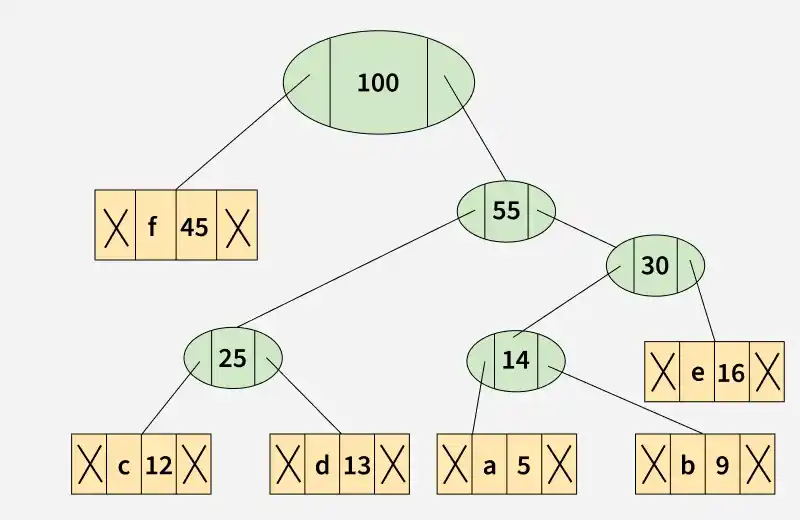
11. Why does Huffman Coding use a Greedy Algorithm?
Huffman Coding uses a greedy algorithm because repeatedly combining the two nodes with the lowest frequencies produces an optimal prefix code with the minimum average code length.
- Always selects the two least frequent nodes at each step.
- Builds the Huffman tree from the bottom up through repeated merging.
- Produces an optimal prefix-free encoding for the given frequencies.
- Reduces the average number of bits required for data compression.
12. Why does the Activity Selection problem use the earliest finishing activity?
The Activity Selection problem chooses the activity that finishes first because it leaves the maximum time available for selecting the remaining compatible activities. This greedy choice ensures the maximum number of activities can be scheduled.
- Leaves the most time available for future activities.
- Maximizes the total number of non-overlapping activities.
- Makes a locally optimal choice that leads to a globally optimal solution.
- Solves the problem efficiently using a greedy approach after sorting by finish time.
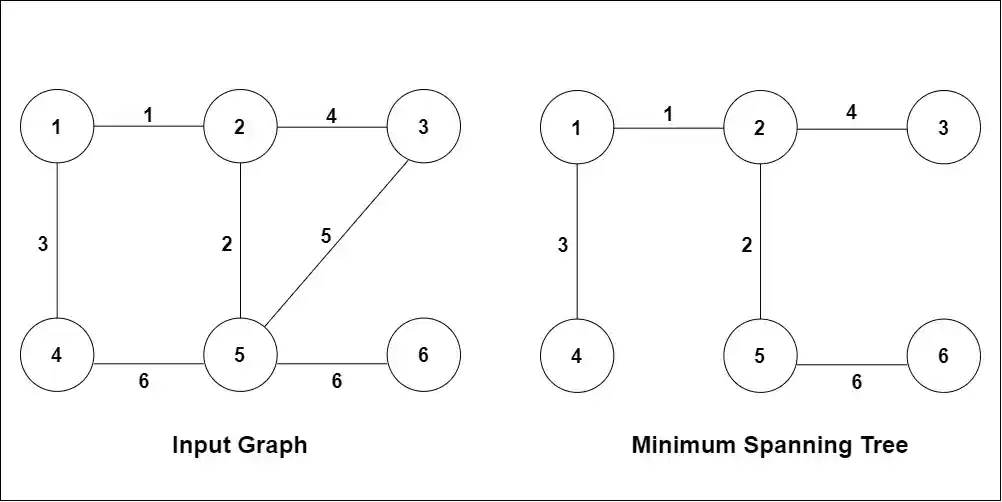
13. Why does Kruskal's Algorithm use a Greedy approach?
Kruskal's Algorithm uses a greedy approach because it repeatedly selects the smallest-weight edge that does not form a cycle. This strategy guarantees the construction of a Minimum Spanning Tree (MST) with the minimum possible total weight.
- Always selects the minimum-weight edge available.
- Adds an edge only if it does not create a cycle.
- Builds the Minimum Spanning Tree incrementally.
- Produces an optimal solution for connected, weighted graphs.
14. Why does Prim's Algorithm use a Greedy approach?
Prim's Algorithm uses a greedy approach because it repeatedly selects the minimum-weight edge that connects a visited vertex to an unvisited vertex. By making the best local choice at each step, it constructs a Minimum Spanning Tree (MST) with the minimum total weight.
- Always selects the smallest edge connecting the current tree to a new vertex.
- Expands the Minimum Spanning Tree one vertex at a time.
- Avoids cycles by adding only unvisited vertices.
- Produces an optimal MST for connected, weighted graphs.
15. Can a Greedy Algorithm produce multiple optimal solutions?
Yes. A greedy algorithm can produce multiple optimal solutions when different choices lead to the same optimal result. Although the selected solution may differ, the overall optimal value remains the same.
- Different greedy choices may produce different valid solutions.
- All resulting solutions have the same optimal value or cost.
- This occurs when multiple choices are equally optimal at some step.
- The final solution depends on the tie-breaking strategy used.
16. What are some common interview problems based on Greedy Algorithms?
Greedy algorithms are frequently used in coding interviews to solve optimization problems where making the best local choice leads to an optimal solution.
- Activity Selection, Fractional Knapsack, and Job Sequencing.
- Huffman Coding, Optimal Merge Pattern, and Connect Ropes.
- Kruskal's and Prim's algorithms for Minimum Spanning Tree.
- Dijkstra's Algorithm and Coin Change (for applicable coin systems).
17. Why does the Greedy approach fail for the Coin Change problem in some cases?
The greedy approach fails for the Coin Change problem because choosing the largest denomination first does not always result in the minimum number of coins. For some coin systems, a combination of smaller denominations gives a better solution.
- Always selects the largest available coin first.
- Works correctly only for canonical coin systems.
- May fail to produce the minimum number of coins.
- Dynamic programming is preferred when greedy is not optimal.
Example:
For Coins = {1, 3, 4} and Amount = 6:
- Greedy: 4 + 1 + 1 = 3 coins
- Optimal: 3 + 3 = 2 coins
18. Is a Greedy Algorithm always faster than Dynamic Programming?
No. Greedy algorithms are usually faster because they make one decision at each step, but they do not always produce the optimal solution. Dynamic programming may be slower, but it solves a wider range of optimization problems correctly.
- Greedy usually uses less time and memory.
- Dynamic programming guarantees optimal solutions for many problems.
- Greedy is faster only when its approach is applicable.
- Choose the algorithm based on the problem requirements.
19. Can a Greedy Algorithm be used for approximation algorithms?
Yes. Greedy algorithms are widely used in approximation algorithms to find near-optimal solutions for problems where finding the exact optimal solution is computationally expensive.
- Produces good solutions in a reasonable amount of time.
- Often used for NP-hard optimization problems.
- Prioritizes efficiency over guaranteed optimality.
- Common examples include Set Cover and Vertex Cover approximation algorithms.
20. What are some real-world applications of Greedy Algorithms?
Greedy algorithms are widely used in real-world applications that require efficient, locally optimal decisions to solve optimization problems.
- Network routing using Dijkstra's and Prim's algorithms.
- Data compression using Huffman Coding.
- Task scheduling and resource allocation problems.
- Minimum Spanning Tree construction in communication networks.
Coding Interview Questions
The following list of Greedy Algorithm coding problems covers a range of difficulty levels, from easy to hard, to help candidates prepare for coding interviews.
Easy Problems
- Activity Selection Problem
- Minimum Coins
- Job Sequencing
- Largest Number by One Swap
- Fractional Knapsack
- Minimum Platforms
Medium Problems
- Kruskal’s Algorithm
- Huffman Coding
- Prim’s Algorithm
- Dijkstra’s Shortest Path Algorithm
- Maximum sum of three stacks
- Policemen catch thieves
- Connect n ropes with minimum cost