

Wireless security encryption is a method used to secure Wi-Fi communication between devices and routers. It protects sensitive data such as passwords, banking information, emails and business communications from attackers. Encryption works by scrambling data into ciphertext using an encryption key.
Modern Windows operating systems provide several wireless security encryption options while creating or connecting to a Wi-Fi network. Each encryption type offers a different level of security, authentication and compatibility.
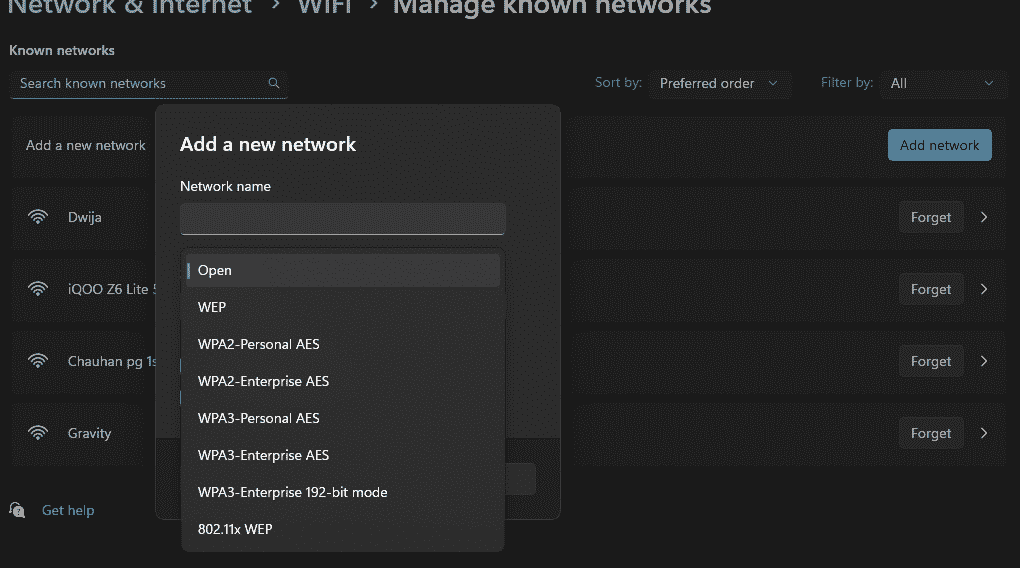
Open Network
An Open network does not use any encryption or password protection. Any nearby device can connect to the network and data transmitted over the connection is not secure.
- Features: No password required, No encryption protection, Easy network access.
- Security Level: Very Low.
- Usage: Commonly used in public places such as cafes, airports and temporary guest networks.
WEP (Wired Equivalent Privacy)
WEP is one of the earliest wireless encryption standards developed for Wi-Fi security. It was designed to provide privacy similar to wired networks but is now considered outdated because of major security weaknesses.
- Features: Uses RC4 encryption, Supports 64-bit and 128-bit keys, Basic wireless protection.
- Security Level: Low.
- Usage: Only used for older legacy devices and outdated routers.
WPA2-Personal AES
WPA2-Personal AES is one of the most widely used wireless security standards for home and small office networks. It uses AES encryption to secure wireless communication.
- Features: Strong AES encryption, Uses a shared Wi-Fi password, Better performance and security.
- Security Level: High
- Usage: Recommended for most home Wi-Fi networks when WPA3 is unavailable.
WPA2-Enterprise AES
WPA2-Enterprise AES is designed for organizations and enterprise environments. Instead of a shared password, it uses centralized authentication servers for user verification.
- Features: AES encryption, Centralized authentication, Improved access management.
- Security Level: High.
- Usage: Used in offices, universities and enterprise environments.
WPA3-Personal AES
WPA3-Personal AES is the latest wireless security standard for home users. It provides stronger protection against password attacks and improves wireless privacy.
- Features: Advanced encryption security, Better password protection, Enhanced wireless privacy.
- Security Level: Very High.
- Usage: Recommended for modern home Wi-Fi networks and smart devices.
WPA3-Enterprise AES
WPA3-Enterprise AES is the enterprise version of WPA3 security. It provides advanced authentication and stronger encryption mechanisms for professional environments.
- Features: Enterprise-grade protection, Enhanced authentication security, Improved encryption standards.
- Security Level: Very High.
- Usage: Suitable for large organizations and secure business environments.
WPA3-Enterprise 192-bit Mode
This is the highest level of wireless encryption available in modern Wi-Fi security standards. It uses 192-bit cryptographic protection for highly sensitive environments.
- Features: 192-bit cryptographic security, Maximum wireless protection, Advanced enterprise security.
- Security Level: Maximum.
- Usage: Used in government, defense and highly secure enterprise networks.
802.1x WEP
802.1x WEP combines enterprise authentication with older WEP encryption technology. Although it improves authentication, the encryption itself remains outdated.
- Features: Enterprise authentication support, Legacy WEP encryption, Limited modern compatibility.
- Security Level: Low.
- Usage: Rarely used today except in older enterprise environments.
Recommended Wireless Encryption Standard
Choosing a strong wireless encryption standard helps protect data, prevent unauthorized access and improve overall network security. For modern wireless networks:
- Use WPA3-Personal AES for home networks.
- Use WPA3-Enterprise AES for organizations.
- Use WPA2-Personal AES only when WPA3 is unsupported.
- Avoid using WEP and Open networks for sensitive communication.