

Block ciphers encrypt data in fixed-size blocks (such as 128 bits). However, real-world data is usually much larger than a single block. To securely encrypt large amounts of data, block ciphers use modes of operation, which define how multiple blocks are processed during encryption and decryption. Different modes provide different levels of security, performance and error handling capabilities.
- Modes of operation allow encryption of messages larger than one block.
- Different modes offer different security and performance characteristics.
- Common block cipher modes include ECB, CBC, CFB, OFB and CTR.
- Modern systems often use advanced modes such as GCM and XTS.
Modes of Operation Needed
A block cipher can encrypt only one fixed-size block at a time. Without modes of operation, encrypting large files, network traffic and storage devices would not be practical. If a message contains multiple blocks, a mode of operation determines:
- How blocks are linked together.
- Whether encryption can be performed in parallel.
- How errors affect encrypted data.
- The overall security of the encryption process.
1. Electronic Codebook (ECB)
ECB is the simplest block cipher mode. Each plaintext block is encrypted independently using the same key. If two plaintext blocks are identical, their ciphertext blocks will also be identical. Working:
Plaintext Block 1 -> Encrypt -> Ciphertext Block 1
Plaintext Block 2 -> Encrypt -> Ciphertext Block 2
Plaintext Block 3 -> Encrypt -> Ciphertext Block 3
Suitable only for encrypting very small and independent data blocks. Generally not recommended for sensitive information. The procedure of ECB is illustrated below:

Advantages
- Simple to implement.
- Supports parallel encryption and decryption.
- Fast processing.
Disadvantages
- Reveals patterns in data.
- Identical plaintext blocks produce identical ciphertext blocks.
- Vulnerable to cryptanalysis.
2. Cipher Block Chaining (CBC)
CBC improves security by combining each plaintext block with the previous ciphertext block before encryption. The first block uses an Initialization Vector (IV) instead of a previous ciphertext block. Working:
Plaintext Block XOR Previous Ciphertext -> Encrypt -> CiphertextUsed in file encryption, database encryption and legacy security systems. The process is illustrated here:

Advantages
- Hides patterns present in plaintext.
- More secure than ECB.
- Widely used in older encryption systems.
Disadvantages
- Encryption cannot be fully parallelized.
- A corrupted ciphertext block affects subsequent blocks.
- Requires a unique IV.
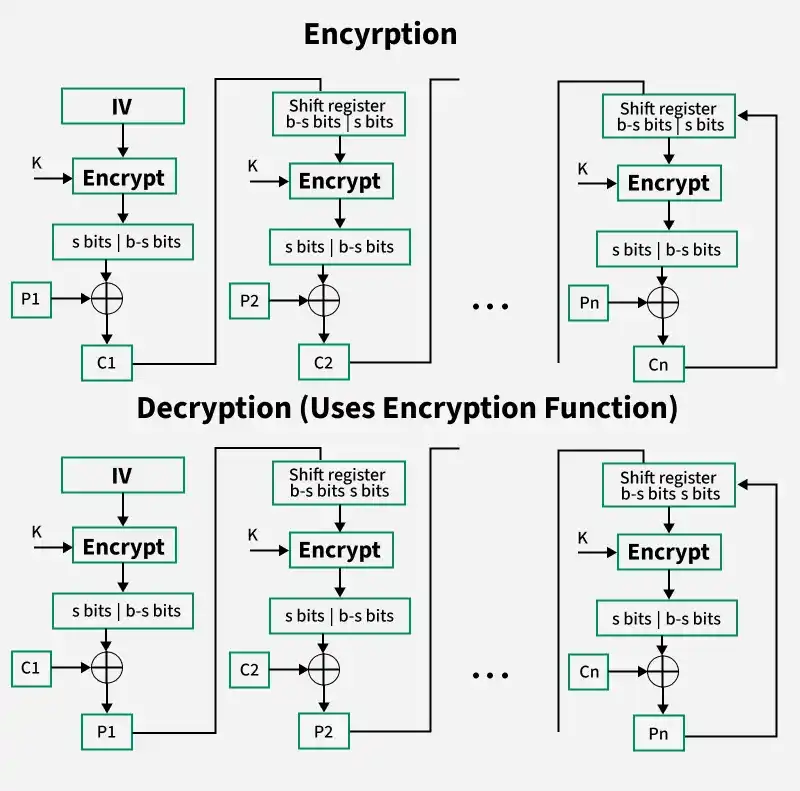
3. Cipher Feedback Mode (CFB)
CFB converts a block cipher into a stream-like cipher by using previously encrypted data to generate the next encryption output. Used in streaming applications and communication systems. Working:
- Encrypt the IV.
- XOR the encrypted output with plaintext.
- Generate ciphertext.
- Feed ciphertext back into the encryption process.
Advantages
- Can encrypt data streams of varying lengths.
- Does not require padding.
- Suitable for real-time communication.
Disadvantages
- Encryption process is sequential.
- Errors may affect multiple decrypted bits.
- Slower than some modern modes.
4. Output Feedback Mode (OFB)
OFB is similar to CFB, but instead of feeding back ciphertext, it feeds back the encrypted output. Useful in communication systems where transmission errors are common. Working:
Encrypt IV -> Output
Output XOR Plaintext -> Ciphertext
Output -> Next Encryption Round

Advantages
- Transmission errors do not propagate.
- Suitable for noisy communication channels.
- Works like a stream cipher.
Disadvantages
- Reusing the same IV and key compromises security.
- Does not provide authentication.
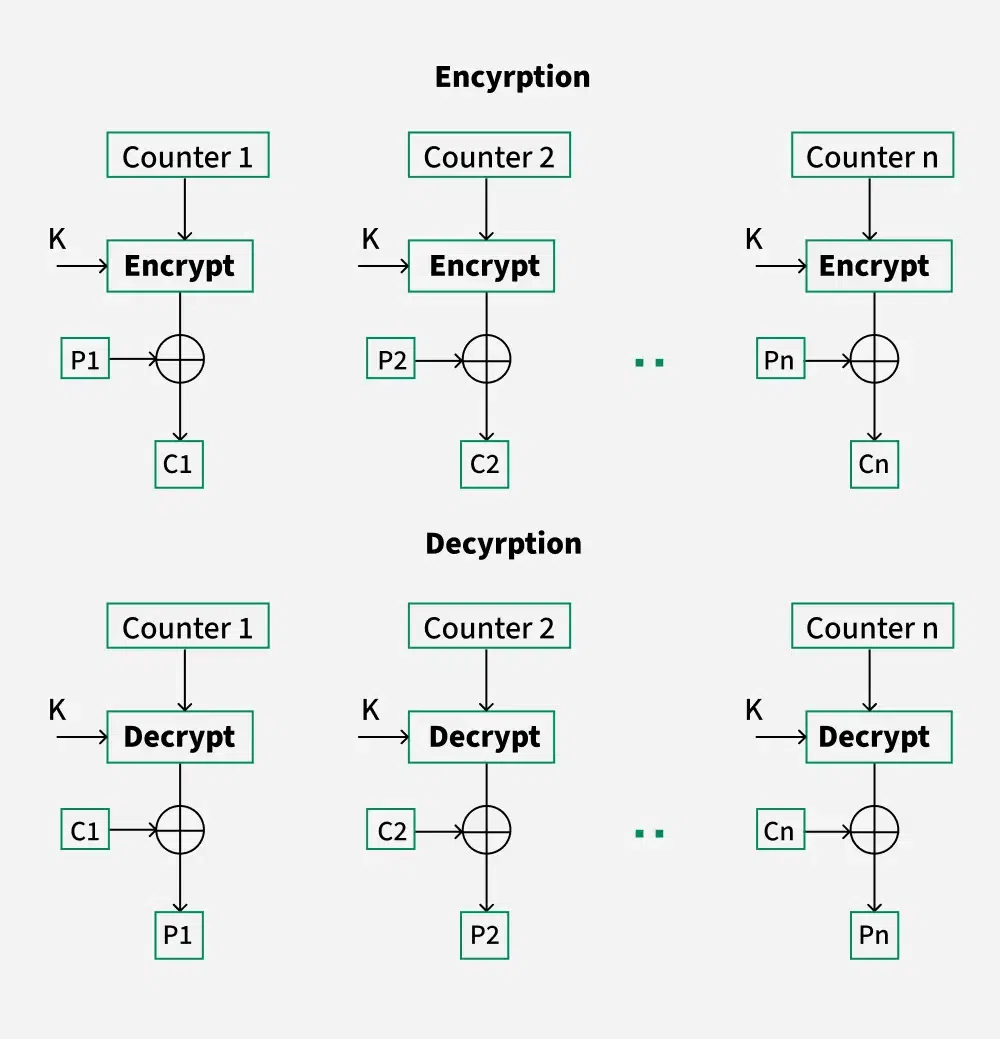
5. Counter Mode (CTR)
CTR mode generates a unique encrypted counter value for each block and XORs it with plaintext. The counter value increases for every block. Working:
Encrypt Counter -> Keystream
Keystream XOR Plaintext → Ciphertext
Widely used in modern secure communication systems and high-performance applications. Its simple implementation is shown below:
Advantages
- Supports parallel encryption and decryption.
- High performance.
- No pattern leakage.
- Suitable for large-scale systems.
Disadvantages
- Counter values must never be reused with the same key.
- Synchronization between sender and receiver is required.
Applications of Block Ciphers
- Data Encryption: Block Ciphers are widely used for the encryption of private and sensitive data such as passwords, credit card details and other information that is transmitted or stored for a communication.
- File and Disk Encryption: Block Ciphers are used for encryption of entire files and disks in order to protect their contents and restrict from unauthorized users.
- Virtual Private Networks (VPN): Virtual Private Networks use block cipher for the encryption of data that is being transmitted between the two communicating devices over the internet.
- Secure Sockets Layer (SSL) and Transport Layer Security (TLS): SSL and TLS protocols use block ciphers for encryption of data that is transmitted between web browsers and servers over the internet.
- Digital Signatures: Block ciphers are used in the digital signature algorithms, to provide authenticity and integrity to the digital documents. .
Initialization Vector (IV)
Initialization Vector (IV) is an important concept in cryptography, especially when using block cipher modes of operation. It is a random or unique value used in combination with a secret key to initialize the encryption process. It ensures that the same plaintext encrypted multiple times will produce different ciphertexts, enhancing security by preventing patterns from emerging.
- Initialization Vector (IV) is a non-secret, unique value used to ensure that encrypting the same plaintext with the same key results in different ciphertexts.
- IVs are essential for maintaining the security and integrity of encryption processes, especially in block cipher modes like CBC, CFB, OFB and CTR.
- Proper generation and management of IVs ensures they are unique and unpredictable and are vital to preventing cryptographic vulnerabilities.
- IVs should be transmitted or stored alongside the ciphertext to enable successful decryption, but they must never be reused with the same key.