

Applied Cryptography is the practical implementation of cryptographic techniques to protect data, communications and digital systems from unauthorized access and cyber threats. It uses encryption, hashing, digital signatures and authentication protocols to ensure confidentiality, integrity, authentication and non-repudiation in real-world applications.
- Secures applications, networks, databases, cloud services and digital transactions against cyber threats.
- Enables secure communication, data protection, user authentication and trusted digital interactions across modern computing systems.
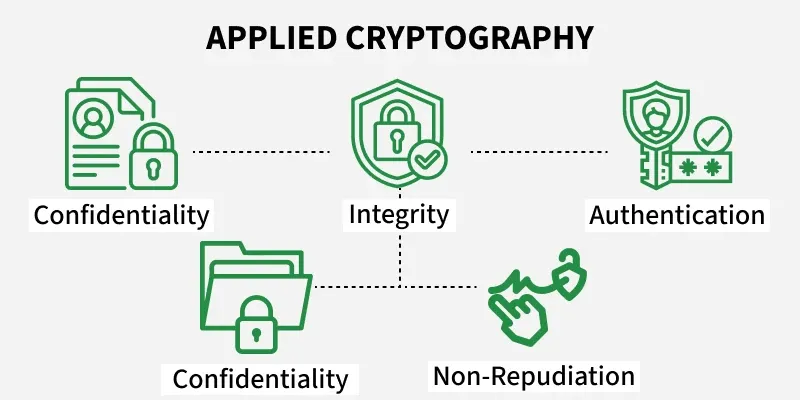
- Confidentiality: Ensures only authorized users can access sensitive information through encryption.
- Integrity: Detects unauthorized modification of data using cryptographic hashes and message authentication.
- Authentication: Verifies the identity of users, devices, or systems before granting access.
- Non-Repudiation: Prevents a sender from denying the creation or transmission of digitally signed data.
- Cryptography.io (PyCA): Supplies Python libraries for implementing modern cryptographic operations securely.
Techniques Used in Applied Cryptography
There are a different number of techniques used to safeguard real-world systems and data.
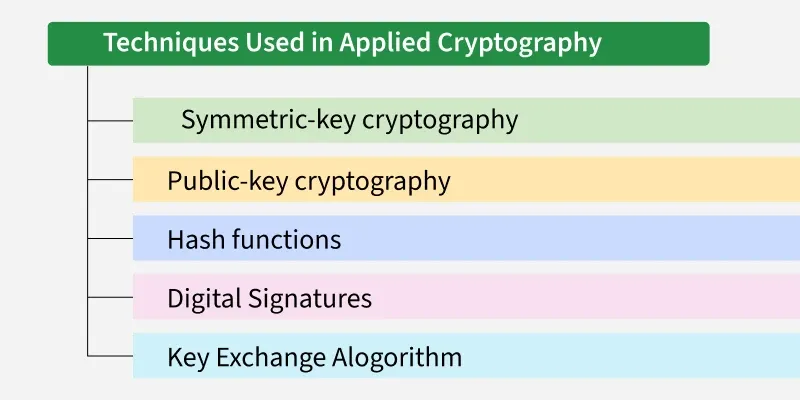
1. Symmetric-Key Cryptography
Uses a single shared secret key for both encryption and decryption.
- Provides high-speed encryption and decryption for bulk data while requiring secure key distribution between communicating parties.
- Commonly implemented in full-disk encryption, VPNs, database encryption and TLS session encryption.
2. Public-Key (Asymmetric) Cryptography
Uses a public–private key pair where one key encrypts and the other decrypts.
- Supports secure key exchange, authentication and encryption using publicly distributed encryption keys and privately held decryption keys.
- Widely used in SSL/TLS, Public Key Infrastructure (PKI), digital certificates and secure email systems.
3. Hash Functions
Convert data into a fixed-length hash value that cannot be reversed.
- Ensures data integrity by generating unique message digests that change significantly with even minor input modifications.
- Used in password hashing, digital signatures, file integrity verification and blockchain technologies.
4. Digital Signatures
Cryptographic method to verify authenticity, integrity and non-repudiation of digital data.
- Authenticates the sender and confirms that transmitted data has not been modified during transmission.
- Commonly implemented in software code signing, electronic documents, secure email and blockchain transactions.
5. Key Exchange Algorithms
Securely establish shared secret keys over an insecure communication channel.
- Enable secure session key generation while preventing key disclosure during transmission.
- Form the foundation of secure communication protocols such as HTTPS, VPNs, SSH and TLS using algorithms like Diffie-Hellman (DH), Elliptic Curve Diffie-Hellman (ECDH) and RSA.
Tools and Libraries used in Applied Cryptography
Here is concise list of commonly used tools and libraries in applied cryptography, along with what they are used for:
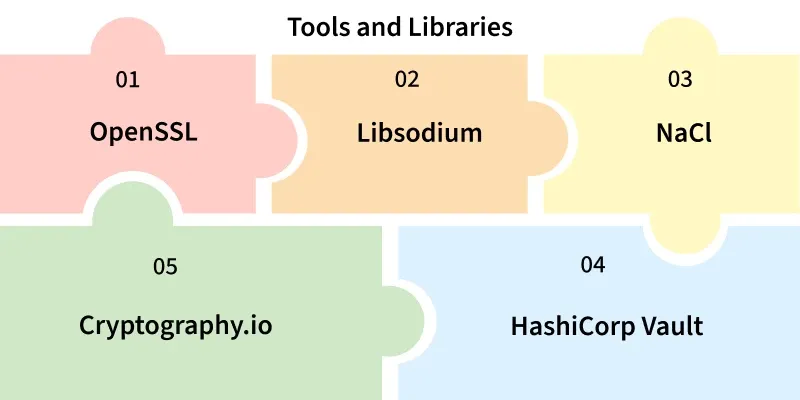
1. OpenSSL
A widely used open-source toolkit for implementing SSL/TLS and performing cryptographic operations.
- Implements encryption, hashing, digital certificates, Public Key Infrastructure (PKI) and SSL/TLS protocols for secure data transmission.
- Widely used in web servers, VPNs, email servers and enterprise applications to enable HTTPS and certificate management.
2. Libsodium
A modern, easy-to-use cryptographic library designed to provide safe, high-level crypto primitives.
- Supports authenticated encryption, digital signatures, password hashing, key exchange and cryptographically secure random number generation.
- Designed for cross-platform applications with strong security defaults and high-performance cryptographic implementations.
3. NaCl (Networking and Cryptography Library)
A high-speed, high-security cryptographic library focused on simplicity and performance.
- Provides public-key encryption, symmetric encryption, digital signatures and secure key exchange mechanisms.
- Emphasizes simplicity, efficiency and resistance to common implementation vulnerabilities.
4. HashiCorp Vault
A secure secrets and key management tool for protecting sensitive data in modern applications.
- Protects secrets such as API keys, passwords, certificates and encryption keys through secure storage and dynamic secret management.
- Supports access control, auditing, key rotation and encryption-as-a-service for cloud-native and enterprise environments.
5. Cryptography.io (pyca/cryptography)
A robust Python library providing high-level and low-level cryptographic functions.
- Offers encryption, decryption, hashing, digital signatures, key derivation and certificate management for secure application development.
- Supports both high-level and low-level cryptographic interfaces while following industry security standards and best practices.
Real-World Applications
Here are some of the most common real-world applications
1. Online Banking and E-Commerce
- Applied cryptography protects financial transactions by encrypting sensitive information exchanged between users and payment servers.
- Example: When a customer purchases a product on an e-commerce website or transfers money through a banking application, SSL/TLS encryption secures payment details and prevents interception by attackers.
2. Cryptocurrencies and Blockchain
- Cryptography ensures the security, integrity and authenticity of blockchain transactions through hashing and digital signatures.
- Example: In Bitcoin and Ethereum, SHA-256 hashing secures blockchain data, while digital signatures verify transaction ownership before adding new blocks to the ledger.
3. Internet of Things (IoT)
- Cryptography protects communication between connected devices and cloud platforms from unauthorized access and data manipulation.
- Example: A smart security camera encrypts video streams and authenticates with the cloud server, preventing attackers from accessing or modifying surveillance data.
4. Digital Signatures
- Digital signatures verify the authenticity of digital documents, software and electronic communications while ensuring data integrity.
- Example: Software vendors digitally sign application updates so users can verify that the software originates from the legitimate publisher and has not been modified.