

Propositional equivalences are logical relationships in which two or more propositions have the same truth value in every possible case.
- Two propositions P and Q are said to be logically equivalent if they have identical truth tables.
- This relationship is denoted as P ≡ Q.
- It helps in simplifying and solving logical expressions.
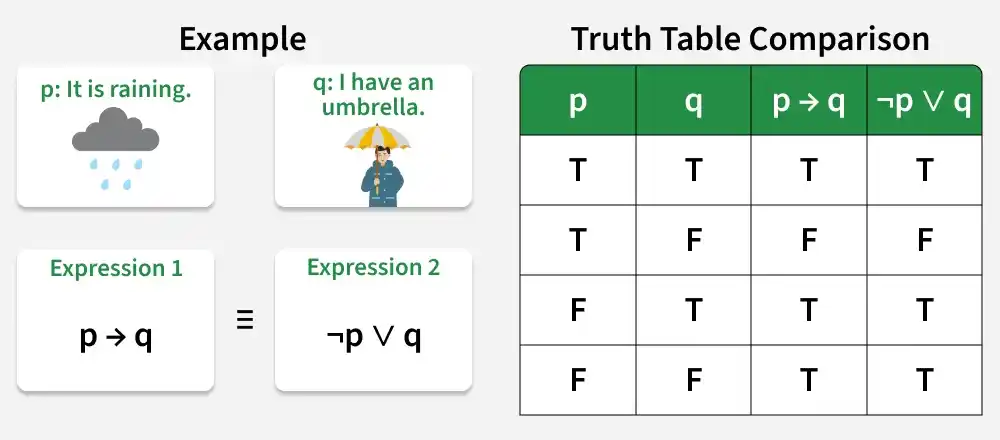
Some of the key propositional equivalences are given below:
1. Identity Laws
- P∧ true ≡ P
- P∨ false ≡ P
2. Domination Laws
- P∨ true ≡ true
- P∧ false ≡ false
3. Idempotent Laws
- P∨ P ≡ P
- P∧ P ≡ P
4. Double Negation Law
- ¬(¬P) ≡ P
5. Commutative Laws
- P∨ Q ≡ Q∨ P
- P∧ Q ≡ Q∧ P
6. Associative Laws
- (P ∨ Q) ∨ R ≡ P ∨ (Q ∨ R )
- (P ∧ Q) ∧ R ≡ P ∧ (Q ∧ R)
7. Distributive Laws
- P ∨ (Q ∧ R) ≡ (P ∨ Q) ∧ (P ∨ R)
- P ∧ (Q∨ R) ≡ (P ∧ Q) ∨ (P ∧ R)
8. De Morgan's Laws
- ¬(P ∧ Q) ≡ ¬P ∨ ¬Q
- ¬(P ∨ Q) ≡ ¬P ∧ ¬Q
9. Absorption Laws
- P∨ (P ∧ Q) ≡P
- P∧ (P ∨ Q) ≡P
10. Negation Laws
- P ∨ ¬P ≡true
- P ∧ ¬P ≡ false
Applications
1. Digital Logic Design: Propositional equivalences are used to simplify Boolean expressions, which helps in designing simpler, faster, and more efficient digital circuits.
2. Software Engineering: They help simplify conditional statements and logical expressions in programs, making the code easier to read, understand, and optimize.
3. Theoretical Computer Science: Propositional equivalences are used to analyze algorithms, prove logical correctness, and improve computational efficiency.
4. Control Systems: They are used to simplify logical conditions in control systems, helping systems work more accurately, efficiently, and reliably.
➢Practice: Solved Examples