

Sorting interview questions are commonly asked to evaluate your understanding of sorting algorithms, their time complexities, stability, and practical use cases. This collection covers the most important sorting concepts to help you prepare for coding and technical interviews.
- Covers the most frequently asked sorting interview questions with concise explanations.
- Suitable for both freshers and experienced professionals preparing for technical interviews.
Table of Content
Theoretical Questions for Interviews
1. What is Sorting in Data Structures?
Sorting is the process of arranging data elements in a specific order, such as ascending or descending. It helps organize data and improves the efficiency of searching and other operations.
- Simplifies searching and data retrieval.
- Helps eliminate duplicate or misplaced records.
- Used in databases, reports, and ranking systems.
#include <iostream>
#include <algorithm>
using namespace std;

int main() {
    int arr[] = {40, 10, 30, 20, 50};
    int n = sizeof(arr) / sizeof(arr[0]);

    sort(arr, arr + n);

    for (int x : arr)
        cout << x << " ";

    return 0;
}
Output
10 20 30 40 50
Explanation: The elements are arranged in ascending order using the sort() function, making the data organized and easier to search or process.
2. What are the Different Types of Sorting Algorithms?
Sorting algorithms are classified based on how they arrange elements and their time complexity. Different algorithms are suitable for different types of datasets and applications.

Common Sorting Algorithms:
- Bubble Sort: Repeatedly swaps adjacent elements until the array is sorted.
- Selection Sort: Selects the smallest element and places it in the correct position.
- Insertion Sort: Inserts each element into its proper position in the sorted part.
- Merge Sort: Uses the divide-and-conquer approach to merge sorted subarrays.
- Quick Sort: Selects a pivot and partitions the array around it.
- Heap Sort: Builds a heap and repeatedly extracts the largest element.
- Counting Sort: Sorts integer values by counting their occurrences.
- Radix Sort: Sorts numbers digit by digit.
3. What is Bubble Sort?
Bubble Sort is a simple comparison-based sorting algorithm that repeatedly compares adjacent elements and swaps them if they are in the wrong order. This process continues until the array becomes sorted.
Working:
- Start from the first element and compare adjacent elements.
- Swap the elements if they are in the wrong order.
- Repeat the process for all elements in the array.
- Continue passes until no swaps are required.
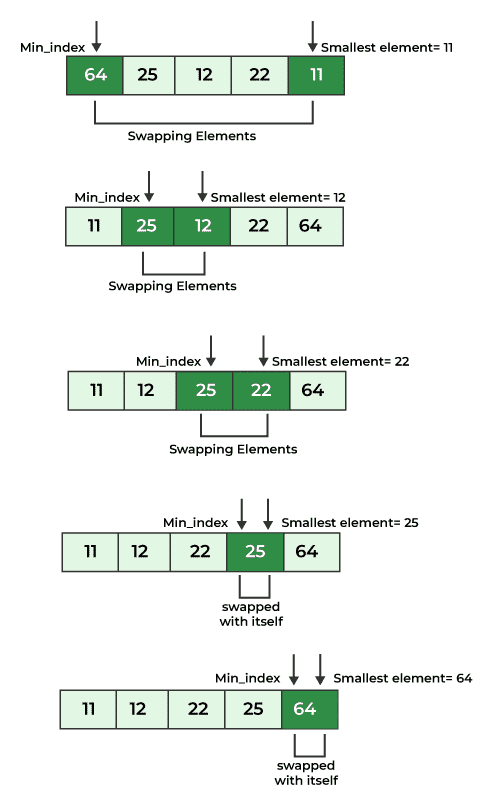
4. What is Selection Sort?
Selection Sort is a comparison-based sorting algorithm that repeatedly selects the smallest element from the unsorted portion of the array and places it at the beginning.
Working:
- Find the smallest element in the unsorted part.
- Swap it with the first unsorted element.
- Move the sorted boundary one position to the right.
- Repeat until all elements are sorted.
5. What is Insertion Sort?
Insertion Sort is a comparison-based sorting algorithm that builds the sorted array one element at a time by inserting each element into its correct position.
Working:
- Assume the first element is already sorted.
- Pick the next element as the key.
- Shift larger elements one position to the right.
- Insert the key into its correct position.
6. What is Merge Sort?
Merge Sort is a divide-and-conquer sorting algorithm that recursively divides an array into smaller halves, sorts each half, and then merges them to produce a sorted array.
Working:
- Divide the array into two equal halves.
- Recursively sort both halves.
- Merge the sorted halves into a single sorted array.
- Repeat until the entire array is sorted.

7. What is Quick Sort?
Quick Sort is a divide-and-conquer sorting algorithm that selects a pivot element, partitions the array around it, and recursively sorts the resulting subarrays.
Working:
- Choose a pivot element.
- Partition the array into elements smaller and larger than the pivot.
- Place the pivot in its correct position.
- Recursively sort the left and right subarrays.
8. What is Heap Sort?
Heap Sort is a comparison-based sorting algorithm that uses a Binary Heap to sort elements. It first builds a max heap and then repeatedly moves the largest element to the end of the array.
Working:
- Build a max heap from the input array.
- Swap the root (largest element) with the last element.
- Reduce the heap size and restore the heap property.
- Repeat until all elements are sorted.
#include <iostream>
using namespace std;

void heapify(int arr[], int n, int i) {
    int largest = i;
    int left = 2 * i + 1;
    int right = 2 * i + 2;

    if (left < n && arr[left] > arr[largest])
        largest = left;

    if (right < n && arr[right] > arr[largest])
        largest = right;

    if (largest != i) {
        swap(arr[i], arr[largest]);
        heapify(arr, n, largest);
    }
}

void heapSort(int arr[], int n) {
    for (int i = n / 2 - 1; i >= 0; i--)
        heapify(arr, n, i);

    for (int i = n - 1; i > 0; i--) {
        swap(arr[0], arr[i]);
        heapify(arr, i, 0);
    }
}

int main() {
    int arr[] = {5, 2, 4, 1, 3};
    int n = sizeof(arr) / sizeof(arr[0]);

    heapSort(arr, n);

    for (int x : arr)
        cout << x << " ";

    return 0;
}
Output
1 2 3 4 5
Explanation: The algorithm first converts the array into a max heap. It then repeatedly places the largest element at the end of the array and rebuilds the heap until the array is completely sorted.
9. What is Counting Sort?
Counting Sort is a non-comparison-based sorting algorithm that sorts elements by counting the frequency of each distinct value. It is efficient when the input values lie within a small range.
Working:
- Count the occurrences of each element.
- Compute the cumulative counts.
- Place each element in its correct sorted position.
- Copy the sorted elements back to the original array.
10. What is Radix Sort?
Radix Sort is a non-comparison-based sorting algorithm that sorts numbers digit by digit, starting from the least significant digit (LSD) or the most significant digit (MSD).
Working:
- Sort the numbers based on the current digit.
- Move to the next higher digit.
- Repeat until all digits are processed.
- The final array becomes completely sorted.
11. What is Bucket Sort?
Bucket Sort is a sorting algorithm that distributes elements into multiple buckets, sorts each bucket individually, and then combines them to produce the final sorted array. It performs well when the input data is uniformly distributed.
Working:
- Divide the input into multiple buckets.
- Place each element into its appropriate bucket.
- Sort the elements within each bucket.
- Merge all buckets to obtain the sorted array.
#include <iostream>
#include <vector>
#include <algorithm>
using namespace std;

void bucketSort(float arr[], int n) {
    vector<float> buckets[n];

    for (int i = 0; i < n; i++) {
        int index = n * arr[i];
        buckets[index].push_back(arr[i]);
    }

    for (int i = 0; i < n; i++)
        sort(buckets[i].begin(), buckets[i].end());

    int k = 0;
    for (int i = 0; i < n; i++) {
        for (float x : buckets[i])
            arr[k++] = x;
    }
}

int main() {
    float arr[] = {0.42, 0.32, 0.23, 0.52, 0.25};
    int n = sizeof(arr) / sizeof(arr[0]);

    bucketSort(arr, n);

    for (float x : arr)
        cout << x << " ";

    return 0;
}
Output
0.23 0.25 0.32 0.42 0.52
Explanation: The elements are first distributed into buckets based on their values. Each bucket is sorted separately, and the sorted buckets are then combined to form the final sorted array.
12. What is the Difference Between Merge Sort and Quick Sort?
Both Merge Sort and Quick Sort are divide-and-conquer sorting algorithms, but they differ in how they divide the array, use memory, and perform in different cases.
| Feature | Merge Sort | Quick Sort |
|---|---|---|
| Strategy | Divides the array into halves and merges them. | Partitions the array around a pivot. |
| Time Complexity (Best) | O(n log n) | O(n log n) |
| Time Complexity (Average) | O(n log n) | O(n log n) |
| Time Complexity (Worst) | O(n log n) | O(n²) |
| Space Complexity | O(n) | O(log n) |
| Stability | Stable | Not Stable |
| Suitable For | Linked lists, external sorting. | Arrays and in-memory sorting. |
13. What is the Difference Between Quick Sort and Heap Sort?
Both Quick Sort and Heap Sort are comparison-based sorting algorithms with an average time complexity of O(n log n), but they differ in their approach and performance characteristics.
| Feature | Quick Sort | Heap Sort |
|---|---|---|
| Strategy | Partitions the array around a pivot. | Builds a max heap and repeatedly extracts the largest element. |
| Time Complexity (Best) | O(n log n) | O(n log n) |
| Time Complexity (Average) | O(n log n) | O(n log n) |
| Time Complexity (Worst) | O(n²) | O(n log n) |
| Space Complexity | O(log n) | O(1) |
| Stability | Not Stable | Not Stable |
| Suitable For | General-purpose in-memory sorting. | When guaranteed worst-case performance is required. |
14. What is a Stable Sorting Algorithm?
A stable sorting algorithm preserves the relative order of equal elements after sorting. If two elements have the same value, they appear in the same order in the sorted output as they did in the original input.
- Maintains the original order of duplicate elements.
- Important when multiple fields are used for sorting.
- Examples include Merge Sort, Insertion Sort, and Bubble Sort.
15. What is the Worst Case of Quick Sort, and How Can It Be Avoided?
The worst case of Quick Sort occurs when the pivot repeatedly divides the array into highly unbalanced parts, causing the algorithm to process almost every element in each recursive call.
How to Avoid It:
- Choose a random pivot instead of a fixed one.
- Use the median-of-three pivot selection technique.
- Shuffle the array before sorting.
- Use Hybrid Sorts (e.g., Introsort) for large datasets.
16. When would you choose Heap Sort over Quick Sort?
Heap Sort is preferrede when guaranteed worst-case performance and constant auxiliary space are more important than average-case speed.
Choose Heap Sort When:
- Worst-case O(n log n) performance is required.
- Memory usage should remain constant.
- Predictable execution time is important.
- Sorting large arrays where worst-case inputs are possible.
17. Can Quick Sort be Used on Linked Lists?
Yes, Quick Sort can be implemented on linked lists, but it is generally not preferred. Since linked lists do not support random access, partitioning around a pivot is less efficient than in arrays.
- Partitioning requires sequential traversal.
- Swapping nodes is more complex than swapping array elements.
- Merge Sort is usually preferred for linked lists.
18. What is the Significance of the Partition Step in Quick Sort?
The partition step is the core operation of Quick Sort. It rearranges the array so that all elements smaller than the pivot are placed on its left, while larger elements are placed on its right.
- Places the pivot in its correct sorted position.
- Divides the array into two smaller subarrays.
- Reduces the search space for recursive sorting.
19. What is K-way Merge Sort, and Where Is It Used?
K-way Merge Sort is an extension of Merge Sort that merges k sorted lists or arrays at the same time instead of merging only two. It is commonly used when dealing with very large datasets.
Applications:
- External sorting for large files.
- Merging multiple sorted database records.
- Search engines and indexing systems.
- Processing distributed or parallel data.
20. How do you choose the best sorting algorithm for a problem?
The choice depends on the input size, memory constraints, and data characteristics.
- Use Quick Sort for fast average-case performance.
- Use Merge Sort when stability is required.
- Use Heap Sort for guaranteed O(n log n).
- Use Counting/Radix/Bucket Sort for suitable integer datasets.
- Use Insertion Sort for small or nearly sorted data.
Coding Problems
Easy Problems
- Maximum Perimeter Triangle
- Maximize sum after K negations
- Sum of minimum absolute difference
- Sort in waveform
- Chocolate Distribution Problem
- Pair with the given difference
Medium Problems
- Triplet Sum (3sum)
- H Index
- Triplet with closest sum
- K most occurring elements
- Merge Overlapping Intervals
- Form the Largest Number
- Sort array of 0s, 1s and 2s
- K’th Smallest/Largest
- Inversion Count
- Minimum Platforms Required
- Maximum meetings in one room
- Case-specific Sorting of Strings
- Sort by Frequency
- Minimum Operations for Distinct
- Maximum intersections lines
- Maximum intervals overlapping
- Minimum Product sum of consecutive pairs
- Position of an element after stable sort
- Merge Sort for Doubly Linked List
- Radix Sort
- Segregate 0s and 1s in an array
- Sort even and odd numbers
- Minimum product of k integers
- Array Permutation with Pair Sums ≥ K
Hard Problems
- Merge sorted arrays with O(1) extra space
- Count smaller elements on Right side
- Smallest Non-Representable Subset Sum
- Count Subarrays with median at least X
- Merge K sorted linked lists
- Smallest Difference Triplet from Three arrays
- Sort n numbers from 0 to n^2 – 1 in linear time
- Sort a 2D vector diagonally
- Print Binary Tree levels in sorted order