

Searching interview questions are commonly asked to evaluate your understanding of searching algorithms, time complexities, and techniques for efficiently locating data. This collection covers the most important searching concepts to help you prepare for coding and technical interviews.
- Covers the most frequently asked searching interview questions with concise explanations.
- Suitable for both freshers and experienced professionals preparing for technical interviews.
Table of Content
Theoretical Questions for Interviews
1. What is Searching in Data Structures?
Searching is the process of locating a specific element in a data structure based on a given key or value. It is one of the most fundamental operations performed on data.
- Determines whether a required element exists in the data structure.
- Returns the position of the element if it is found.
- Different searching algorithms are used depending on the data structure.
2. What are the Different Searching Algorithms?
Searching algorithms are techniques used to locate a specific element in a data structure. The choice of algorithm depends on whether the data is sorted and the type of data structure.
Common Searching Algorithms:
- Linear Search: Checks each element one by one until the target is found.
- Binary Search: Repeatedly divides a sorted array into halves to find the target.
- Jump Search: Skips fixed-size blocks in a sorted array before performing a linear search.
- Interpolation Search: stimates the target's position in a sorted, uniformly distributed array.
- Exponential Search: Finds a search range by doubling the index, then applies binary search.
- Hash-Based Search: Uses a hash table to provide near constant-time lookup.
3. What is Linear Search?
Linear Search is the simplest searching algorithm that checks each element of a data structure one by one until the target element is found or the entire structure has been searched.
- Works on both sorted and unsorted data.
- Compares elements sequentially from beginning to end.
- Easy to implement but inefficient for large datasets.
#include <iostream>
using namespace std;

int main() {
    int arr[] = {10, 20, 30, 40, 50};
    int key = 40;

    for (int i = 0; i < 5; i++) {
        if (arr[i] == key) {
            cout << "Found at index " << i;
            return 0;
        }
    }

    cout << "Not Found";
    return 0;
}
Output
Found at index 3
4. What is Binary Search?
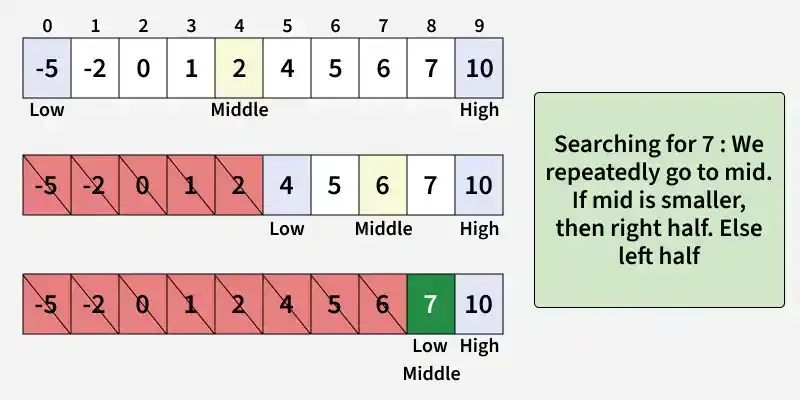
Binary Search is an efficient searching algorithm that finds an element in a sorted array by repeatedly dividing the search range into two halves.
- Works only on sorted arrays.
- Reduces the search space by half in each step.
- Faster than Linear Search for large datasets.
#include <iostream>
using namespace std;

int main() {
    int arr[] = {10, 20, 30, 40, 50};
    int key = 40;

    int left = 0, right = 4;

    while (left <= right) {
        int mid = left + (right - left) / 2;

        if (arr[mid] == key) {
            cout << "Found at index " << mid;
            return 0;
        }

        if (arr[mid] < key)
            left = mid + 1;
        else
            right = mid - 1;
    }

    cout << "Not Found";
    return 0;
}
Output
Found at index 3
5. What is the Difference Between Linear Search and Binary Search?
Linear Search and Binary Search are both used to find an element in a collection of data, but they differ in how they perform the search.
| Feature | Linear Search | Binary Search |
|---|---|---|
| Search Method | Checks elements one by one. | Repeatedly divides the search space into halves. |
| Data Requirement | Works on sorted and unsorted data. | Works only on sorted data. |
| Time Complexity | O(n) | O(log n) |
| Space Complexity | O(1) | O(1) |
| Best Use Case | Small or unsorted datasets. | Large sorted datasets. |
| Implementation | Simple to implement. | Slightly more complex to implement. |
6. What is the difference between depth-first search (DFS) and breadth-first search (BFS)?
Depth-First Search (DFS) explores one branch of a graph or tree as deeply as possible before backtracking, whereas Breadth-First Search (BFS) explores all nodes at the current level before moving to the next level. DFS typically uses a stack (or recursion), while BFS uses a queue.
- Traversal: DFS goes deep into one path first, while BFS visits nodes level by level.
- Data Structure: DFS uses a Stack (LIFO) or recursion, whereas BFS uses a Queue (FIFO).
- Use Cases: DFS is useful for path finding, cycle detection, and topological sorting, while BFS is ideal for finding the shortest path in an unweighted graph and level-order traversal of trees.
7. What is the Time Complexity of Binary Search?
The time complexity of Binary Search depends on how many times the search space is divided. Since it halves the search range in each step, it is much more efficient than Linear Search.
- Best Case: O(1) - The target is the middle element.
- Average Case: O(log n) - The search space is halved in each step.
- Worst Case: O(log n) - Continues halving until the element is found or the search space becomes empty.
8. Why Does Binary Search Require Sorted Data?
Binary Search requires the data to be sorted because it decides whether to search the left or right half by comparing the target with the middle element. This decision is only valid when the elements are in sorted order.
- Compares the target with the middle element.
- Eliminates half of the remaining search space.
- Incorrect results may occur if the data is unsorted.
9. How Does Hash-Based Searching Work?
Hash-based searching uses a hash function to convert a key into an index (called a hash value), allowing elements to be stored and retrieved directly from a hash table. Instead of searching through every element, the algorithm computes the index and accesses the corresponding location.
Working:
- A hash function computes an index from the given key.
- The element is stored at the computed index in the hash table.
- When searching, the same hash function computes the index again.
- If the key matches the stored element, the search is successful.
- Collisions are resolved using techniques like chaining or linear probing.
10. What is Interpolation Search?
Interpolation Search is a searching algorithm that estimates the likely position of the target element in a sorted and uniformly distributed array. It is an improved version of Binary Search for uniformly distributed data.
- Works only on sorted arrays.
- Estimates the target's position instead of checking the middle element.
- Performs best when values are uniformly distributed.
11. What is Ternary Search?
Ternary Search is a divide-and-conquer searching algorithm that splits the search range into three parts and determines which part may contain the target element.
- Requires the input data to be sorted.
- Uses two middle indices to divide the search space.
- Continues searching only in the section that can contain the target.
int ternarySearch(int arr[], int left, int right, int key) {
    while (left <= right) {
        int mid1 = left + (right - left) / 3;
        int mid2 = right - (right - left) / 3;

        if (arr[mid1] == key)
            return mid1;

        if (arr[mid2] == key)
            return mid2;

        if (key < arr[mid1])
            right = mid1 - 1;
        else if (key > arr[mid2])
            left = mid2 + 1;
        else {
            left = mid1 + 1;
            right = mid2 - 1;
        }
    }
    return -1;
}
12. What is Exponential Search?
Exponential Search is a searching algorithm that quickly identifies a search range by repeatedly doubling the index and then applies Binary Search within that range.
- Starts searching from index 1 and doubles the index (1, 2, 4, 8...).
- Narrows the search to a small range before applying Binary Search.
- Efficient when the target is located near the beginning of a large sorted array.
int binarySearch(int arr[], int left, int right, int key) {
    while (left <= right) {
        int mid = left + (right - left) / 2;

        if (arr[mid] == key)
            return mid;

        if (arr[mid] < key)
            left = mid + 1;
        else
            right = mid - 1;
    }
    return -1;
}

int exponentialSearch(int arr[], int n, int key) {
    if (arr[0] == key)
        return 0;

    int i = 1;
    while (i < n && arr[i] <= key)
        i *= 2;

    return binarySearch(arr, i / 2, min(i, n - 1), key);
}
13. What is Jump Search?
Jump Search is a searching algorithm for sorted arrays that searches by jumping fixed-size blocks instead of checking every element. Once the correct block is found, it performs a linear search within that block.
- Jumps ahead by fixed-size blocks (typically √n).
- Performs a linear search only within the identified block.
- More efficient than Linear Search for large sorted arrays.
int jumpSearch(int arr[], int n, int key) {
    int step = sqrt(n);
    int prev = 0;

    while (arr[min(step, n) - 1] < key) {
        prev = step;
        step += sqrt(n);

        if (prev >= n)
            return -1;
    }

    while (arr[prev] < key) {
        prev++;

        if (prev == min(step, n))
            return -1;
    }

    if (arr[prev] == key)
        return prev;

    return -1;
}
14. How do you search in a rotated sorted array?
A rotated sorted array is a sorted array that has been shifted around a pivot. The element can be searched efficiently using a modified Binary Search without restoring the array.
Steps:
- Find the middle element.
- Determine which half of the array is sorted.
- Check whether the target lies in the sorted half.
- Continue searching in the appropriate half until the element is found.
15. How do you search in an unsorted linked list?
In an unsorted linked list, the elements are not arranged in any specific order. Therefore, the only way to find a target element is to traverse the list sequentially from the head until the element is found or the list ends.
- Start from the head node.
- Compare each node's value with the target.
- Move to the next node if it does not match.
- Stop when the element is found or the end of the list is reached.
#include <iostream>
using namespace std;

struct Node {
    int data;
    Node* next;
};

bool search(Node* head, int key) {
    while (head != nullptr) {
        if (head->data == key)
            return true;
        head = head->next;
    }
    return false;
}

int main() {
    Node* head = new Node{10, nullptr};
    head->next = new Node{20, nullptr};
    head->next->next = new Node{30, nullptr};
    head->next->next->next = new Node{40, nullptr};

    int key = 30;

    if (search(head, key))
        cout << "Element Found";
    else
        cout << "Element Not Found";

    return 0;
}
Output
Element Found
Explanation: The algorithm visits each node one by one until it finds the target value (30). Since the list is unsorted, every node may need to be checked.
16. Can Binary Search be Applied to a Linked List?
Binary Search is generally not efficient on a linked list because linked lists do not support direct access to the middle element. Finding the middle node requires traversing the list, which increases the overall cost.
- Binary Search requires fast access to the middle element.
- Linked lists provide only sequential access.
- Linear Search is usually preferred for linked lists.
17. What is the Difference Between Searching in Arrays and Linked Lists?
Arrays and linked lists store data differently, which affects how searching is performed.
| Feature | Arrays | Linked Lists |
|---|---|---|
| Memory Layout | Contiguous memory locations. | Nodes stored at different memory locations. |
| Random Access | Supports direct indexing (O(1)). | Sequential access only. |
| Binary Search | Efficient on sorted arrays. | Not efficient due to lack of random access. |
| Preferred Search | Linear Search or Binary Search. | Linear Search. |
| Insertion/Deletion | Costly due to shifting elements. | Efficient with pointer updates. |
Example:
Array: [10, 20, 30, 40, 50]
Directly access index 2 -> 30Linked List:
10 -> 20 -> 30 -> 40 -> 50
Traverse node by node to reach 30
Explanation: Arrays allow direct access to any element using its index, making Binary Search efficient. Linked lists require sequential traversal, so Linear Search is generally preferred.
Time Complexity:
- Array (Binary Search): O(log n)
- Linked List (Linear Search): O(n)
18. When would you choose Linear Search over Binary Search?
Linear Search is preferred when the data is unsorted, the dataset is small, or random access is unavailable. Unlike Binary Search, it does not require any preprocessing or sorting.
Use Linear Search When:
- The data is unsorted.
- The dataset is small.
- Searching in linked lists or sequential data structures.
- Sorting the data is not practical.
#include <iostream>
using namespace std;

int linearSearch(int arr[], int n, int key) {
    for (int i = 0; i < n; i++) {
        if (arr[i] == key)
            return i;
    }
    return -1;
}

int main() {
    int arr[] = {40, 10, 70, 20, 50};
    int n = sizeof(arr) / sizeof(arr[0]);
    int key = 20;

    int index = linearSearch(arr, n, key);

    if (index != -1)
        cout << "Found at index " << index;
    else
        cout << "Not Found";

    return 0;
}
Output
Found at index 3
Explanation: Since the array is unsorted, Binary Search cannot be used. Linear Search checks each element one by one until it finds the target.
19. What factors determine the choice of a searching algorithm?
The choice of a searching algorithm depends on the characteristics of the data and the performance requirements of the application.
Factors to Consider:
- Whether the data is sorted or unsorted.
- The size of the dataset.
- The type of data structure (array, linked list, hash table, etc.).
- The required search speed and memory constraints.
Unsorted Array -> Linear Search
Sorted Array -> Binary Search
Hash Table -> Hash-based Search
20. What are the real-world applications of searching algorithms?
Searching algorithms are widely used to quickly locate data in software systems, making applications faster and more efficient.
Applications:
- Search engines for finding web pages and documents.
- Database systems for retrieving records efficiently.
- File systems for locating files and folders.
- E-commerce platforms for searching products and users.
Example:
Google Search ->Finds web pages
Amazon -> Searches products
Bank Database -> Retrieves customer records
File Explorer -> Locates files
Coding Interview Questions for Interviews
The following list of 50 searching coding problems covers a range of difficulty levels, from easy to hard, to help candidates prepare for interviews.
Easy Problems
- Missing Number
- Second Largest
- Common in three Sorted
- Transition point in a binary
- Floor in a Sorted
- Pair with difference
- Square Root
- Rotation Count
- Matrix Sorted Search
- Bitonic Peak Search
Medium Problems
- Search in Rotated Sorted
- Majority Element
- K’th Smallest/Largest in Unsorted
- Count Frequency in Sorted Array
- Peak Element
- Smallest Missing Positive
- All triplets with zero sum
- First & Last Positions in Sorted Array
- Matrix Sorted Search
- Two Repeating Elements
- Single in Sorted Array
- Two elements with sum closest to zero
- Count ≤ Elements from 2nd Array
- Smallest Number with n Factorial Zeros
- k-th smallest in given n ranges
- Minimum Repeats for Substring
- Remove Coins for ≤ K Difference
- Capacity To Ship Packages Within D Days
- Count Pairs with Sum > 0
- Minimum Repeats for Substring
- Farthest Smaller Element Right
- Ternary Search
- Distribute N candies among K people
- Smallest Difference Triplet from Three arrays
- Minimize Tower Equalization Cost
- Maximum Modulo Pair
- K-th Missing Positive