

Queue is one of the most fundamental linear data structures and is frequently tested in technical interviews due to its wide range of practical applications. Understanding queue operations, implementations, and variations is essential for solving many data structure and algorithm problems.
- Covers the most commonly asked queue interview questions with concise explanations.
- Helps strengthen concepts related to queue operations, implementations, complexity, and applications.
Table of Content
Theoretical Questions for Interviews
1. How would you find the size of a queue?
The size of a queue represents the number of elements currently stored in it.
- It is updated whenever an element is inserted or removed.
- A maintained count allows the size to be retrieved efficiently.
- The operation takes O(1) time when the count is maintained.
2. How do you declare a Queue?
A queue is created using a data structure that supports insertion at the rear and deletion from the front.
- It can be implemented using an array or a linked list.
- The chosen implementation depends on the application requirements.
- Most programming languages provide built-in queue implementations.
#include <iostream>
#include <queue>
using namespace std;

int main() {
    queue<int> q;

    // Insert elements into the queue
    q.push(10);
    q.push(20);
    q.push(30);

    // Print and remove elements from the queue
    while (!q.empty()) {
        cout << q.front() << " ";
        q.pop();
    }

    return 0;
}
import java.util.LinkedList;
import java.util.Queue;

public class Main {
    public static void main(String[] args) {
        Queue<Integer> q = new LinkedList<>();

        // Insert elements into the queue
        q.add(10);
        q.add(20);
        q.add(30);

        // Print and remove elements from the queue
        while (!q.isEmpty()) {
            System.out.print(q.peek() + " ");
            q.poll();
        }
    }
}
from collections import deque

# Create a queue
q = deque()

# Insert elements into the queue
q.append(10)
q.append(20)
q.append(30)

# Print and remove elements from the queue
while q:
    print(q[0], end=' ')
    q.popleft()
using System;
using System.Collections.Generic;

public class Program {
    public static void Main() {
        Queue<int> q = new Queue<int>();

        // Insert elements into the queue
        q.Enqueue(10);
        q.Enqueue(20);
        q.Enqueue(30);

        // Print and remove elements from the queue
        while (q.Count > 0) {
            Console.Write(q.Peek() + " ");
            q.Dequeue();
        }
    }
}
// Create a queue
let q = [];

// Insert elements into the queue
q.push(10);
q.push(20);
q.push(30);

// Print and remove elements from the queue
while (q.length > 0) {
    console.log(q[0]);
    q.shift();
}
Output
10 20 30
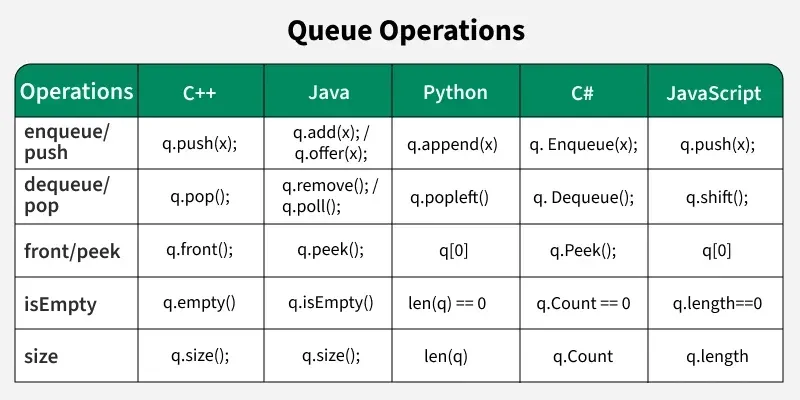
3. What are the main operations of a queue?
A queue supports a set of basic operations for inserting, removing, and accessing elements while following the FIFO principle.
- Enqueue: Inserts an element at the rear of the queue.
- Dequeue: Removes and returns the front element from the queue.
- Peek: Returns the front element without removing it.
- isEmpty: Checks whether the queue contains any elements.
- Size: Returns the number of elements currently in the queue.
Queue: [10, 20, 30]
Enqueue(40) -> Queue: [10, 20, 30, 40]
Dequeue() -> Returns: 10 -> Queue: [20, 30, 40]
Peek() -> Returns: 20
isEmpty() -> Returns: false
Size() -> Returns: 3
4. Can a queue be resized at runtime?
Whether a queue can be resized at runtime depends on how it is implemented.
- An array-based queue typically has a fixed capacity.
- A linked list-based queue can grow and shrink dynamically.
- Dynamically resizable queue implementations expand automatically when needed.
5. How is a queue stored in memory?
The memory representation of a queue depends on its underlying implementation.
- An array-based queue stores elements in contiguous memory locations.
- A linked list-based queue stores elements as linked nodes in memory.
- The choice of implementation affects memory usage and operation efficiency.
6. What is the time complexity for enqueue and dequeue operations?
The time complexity of queue operations depends on the underlying implementation.
- Enqueue takes O(1) time in linked list and circular array implementations.
- Dequeue takes O(1) time in linked list and circular array implementations.
- A naive array-based queue may require O(n) time for dequeue due to element shifting.
7. What is the difference between a queue and a stack?
A queue and a stack differ in the order in which elements are inserted and removed.
| Queue | Stack |
|---|---|
| Follows the FIFO (First-In, First-Out) principle. | Follows the LIFO (Last-In, First-Out) principle. |
| Elements are inserted at the rear and removed from the front. | Elements are inserted and removed from the top. |
| Uses enqueue and dequeue operations. | Uses push and pop operations. |
8. What problem does a circular queue solve compared to a simple linear queue?
A circular queue overcomes the space limitation of a linear queue by reusing vacant positions created after dequeue operations.
- Eliminates the false full condition in a linear queue.
- Reuses empty spaces by wrapping the rear to the front.
- Improves memory utilization without shifting elements.
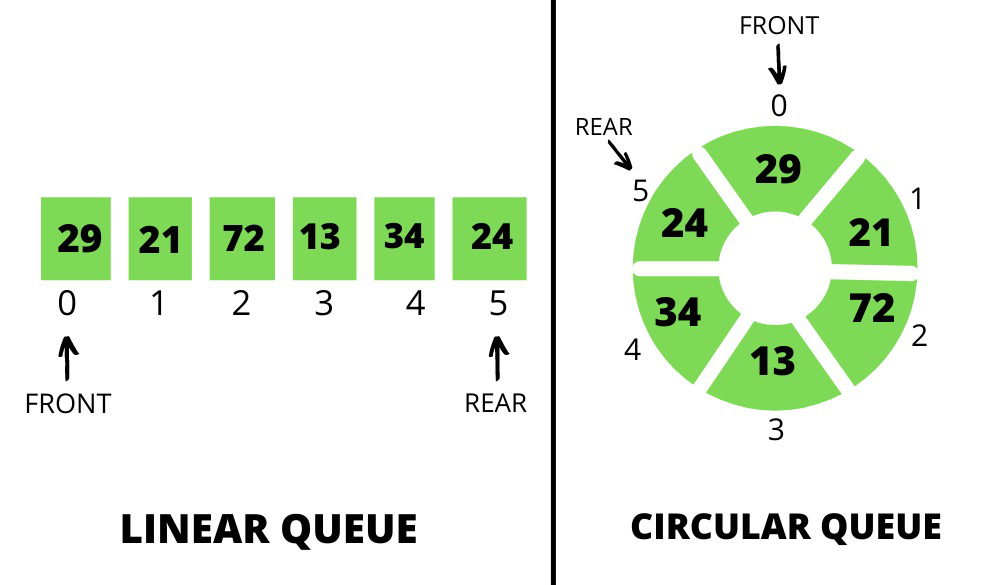
9. What is a circular queue?
A circular queue is a queue in which the last position is logically connected to the first, allowing efficient reuse of available space.
- The rear wraps around to the front when it reaches the end.
- Reuses vacant positions created after dequeue operations.
- Improves memory utilization by eliminating wasted space.
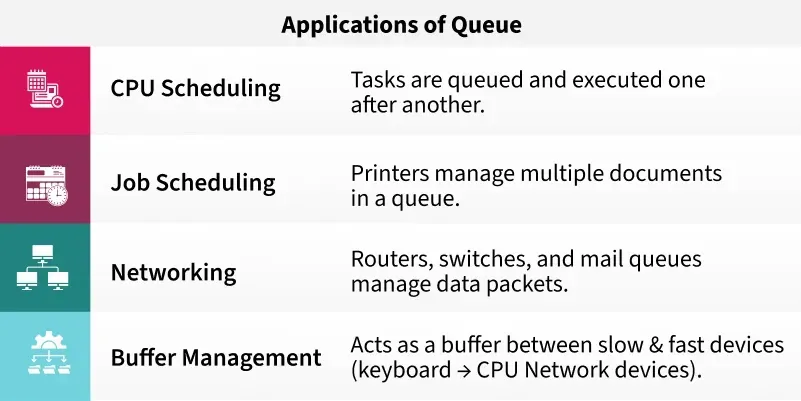
10. What are the applications of a queue?
Queues are widely used in systems and algorithms that require processing elements in the order they arrive.
11. What is priority queue, and how is it different from a normal queue?
A priority queue processes elements based on their priority rather than the order in which they are inserted.
| Priority Queue | Normal Queue |
|---|---|
| Elements are removed based on their priority. | Elements are removed in FIFO (First-In, First-Out) order. |
| Higher-priority elements are processed first. | The earliest inserted element is processed first. |
| Used in scheduling, graph algorithms, and simulations. | Used in task scheduling, buffering, and BFS traversal. |
12. How would you implement a priority queue?
A priority queue is commonly implemented using a heap, which allows efficient insertion and removal of elements based on their priority.
- A binary heap is the most commonly used implementation.
- A min-heap removes the smallest-priority element first, while a max-heap removes the largest-priority element first.
- Heap-based implementations support efficient insertion and deletion operations.
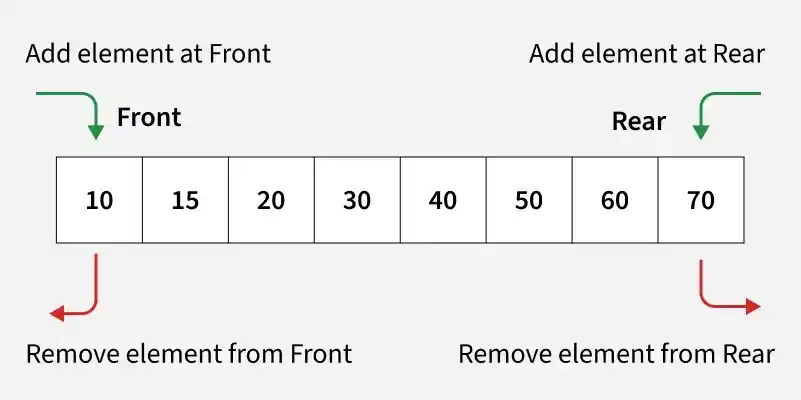
13. What is a deque and how is it different from a queue?
A deque (double-ended queue) is a linear data structure that allows insertion and deletion of elements at both ends.
| Deque | Queue |
|---|---|
| Supports insertion and deletion at both the front and rear. | Supports insertion at the rear and deletion from the front only. |
| Provides greater flexibility for element access. | Strictly follows the FIFO (First-In, First-Out) principle. |
| Used in applications requiring operations at both ends. | Used when elements must be processed in arrival order. |
14. What is the time complexity for searching in a queue?
Searching in a queue requires examining elements sequentially because direct access is not supported.
- Time Complexity: O(n) in the worst case.
- Elements are searched one by one until the target is found.
- Queues are optimized for insertion and deletion, not searching.
15. How would you reverse a queue?
A queue can be reversed by using either a stack or recursion. The most common approach is to push all queue elements onto a stack and then pop them back into the queue. Since a stack follows the Last In, First Out (LIFO) principle, the order of elements gets reversed.
Using a Stack:
- Remove each element from the queue and push it onto a stack.
- Pop all elements from the stack and enqueue them back into the queue.
- The queue is now reversed.
- Time Complexity: O(n) and Auxiliary Space: O(n)
Using Recursion:
- Dequeue the front element from the queue.
- Recursively reverse the remaining queue.
- Enqueue the removed element back into the queue.
- Time Complexity: O(n) and Auxiliary Space: O(n)
16. What is a blocking queue?
A blocking queue is a thread-safe queue in which enqueue and dequeue operations wait until they can be completed.
- An enqueue operation blocks when the queue is full.
- A dequeue operation blocks when the queue is empty.
- Commonly used for thread synchronization in producer-consumer systems.
17. How would you implement a queue using two stacks?
A queue can be implemented using two stacks by using one stack for insertion and another for deletion. This approach preserves the First In, First Out (FIFO) order while using the Last In, First Out (LIFO) behavior of stacks.
Enqueue (Push):
- Push the new element onto the first stack (stack1).
- Time Complexity: O(1)
Dequeue (Pop):
- If the second stack (stack2) is empty, move all elements from stack1 to stack2.
- Pop the top element from stack2.
- If both stacks are empty, the queue is empty.
- Time Complexity: O(1) amortized, O(n) in the worst case
18. How can you handle overflow in a queue?
Queue overflow occurs when an attempt is made to insert an element into a queue that has no available space. The handling method depends on the queue implementation.
- Resize the queue: In an array-based queue, allocate a larger array and copy the existing elements into it.
- Use a dynamic queue: Implement the queue using a linked list so that memory is allocated as needed, reducing the chances of overflow.
- Use a circular queue: Reuse empty positions created by dequeued elements to utilize the available space efficiently.
- Handle the error gracefully: Display an overflow message or throw an exception if insertion is not possible.
19. How would you implement a queue using a linked list?
A queue can be implemented using a linked list by maintaining two pointers: front (head) and rear (tail). The front pointer is used for deletion, while the rear pointer is used for insertion.
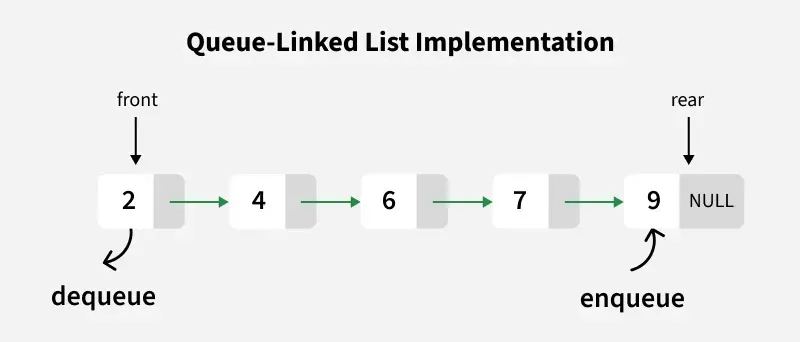
Enqueue:
- Create a new node.
- If the queue is empty, set both front and rear to the new node.
- Otherwise, link the new node to the current rear and update rear.
Dequeue:
- If the queue is empty, report underflow.
- Remove the node pointed to by front.
- Update front to the next node.
- If the queue becomes empty, set rear to nullptr.
20. What is the difference between a queue and a deque?
A queue and a deque differ in the way elements can be inserted and removed.
| Queue | Deque |
|---|---|
| Follows the FIFO (First-In, First-Out) principle. | Allows insertion and deletion at both the front and rear. |
| Elements are inserted at the rear and removed from the front. | Elements can be inserted and removed from either end. |
| Suitable for FIFO-based processing. | Suitable for applications requiring operations at both ends. |
Coding Interview Questions
Easy Problems
- Circular Array Implementation
- Linked List Implementation
- Generate Binary Numbers
- Reverse First k of Queue
- Implement Queue using Two Stacks
Medium Problems
- Flipping Bits with K-Window
- Interleave the first and second halves
- Check if a queue can be sorted
- Reverse a queue using recursion
- First negative integer in every window of size k
- First non-repeating in a Stream
- Minimum time required to rot all oranges
- Implement Stack using Queues
- Implement Stack using Two Queues