

Hashing interview questions are commonly asked to evaluate your understanding of hash tables, hashing techniques, collision handling, and efficient problem-solving. This collection covers the most important questions to help you prepare for coding and technical interviews.
- Covers the most frequently asked Hashing interview questions with concise answers.
- Suitable for both freshers and experienced professionals preparing for technical interviews.
Table of Content
Theoretical Questions for Interviews
1. What is hashing?
Hashing is a technique used to map data (keys) to a fixed-size value called a hash code using a hash function. The hash code is then used to determine the location where the data is stored, enabling fast lookup, insertion, and deletion operations.
- Uses a hash function to convert keys into hash values.
- Enables average O(1) time complexity for search, insertion, and deletion.
- Commonly used in hash tables, dictionaries, caches, and database indexing.
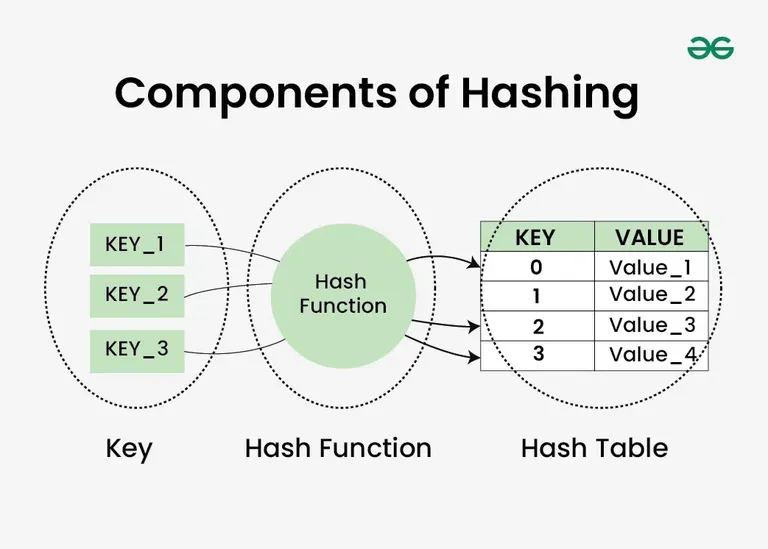
2. What is a Hash Function?
A hash function is an algorithm that takes a key as input and computes a fixed-size value called a hash value or hash code. This hash value is used to determine where the key should be stored or searched in a hash table.
- Converts keys of any size into fixed-size hash values.
- Helps distribute keys across the hash table for efficient operations.
- An ideal hash function minimizes collisions and computes hash values quickly.
For example, using the modulo method: H(x) = x % 10
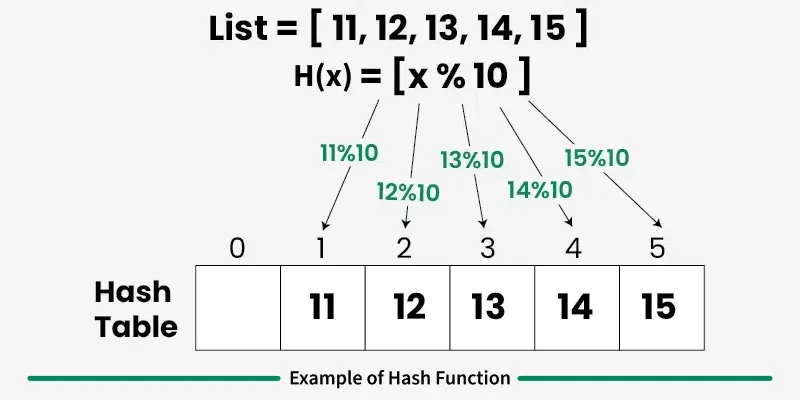
This function converts any large number into a value between 0 and 9, making it suitable for indexing in a hash table. Hashing enables efficient storage and fast retrieval of data.
3. What are the properties of a good hash function?
A good hash function distributes keys uniformly across the hash table, reducing collisions and ensuring efficient performance.
- Uniform distribution: A good hash function spreads values evenly across the hash table to avoid clustering.
- Efficiency: It should compute hash values quickly with minimal computational overhead.
- Deterministic: The same input should always produce the same hash value.
- Minimizing collisions: It should reduce the chances of different inputs mapping to the same hash value.
4. What is a hash table? How do you declare it?
A hash table is a data structure that stores key-value pairs and uses a hash function to determine where each key-value pair is stored for fast access.
- Stores data as key-value pairs.
- Supports average O(1) search, insertion, and deletion.
- Resolves collisions using techniques like separate chaining or open addressing.
- Can be declared using the language's built-in hash table implementation.
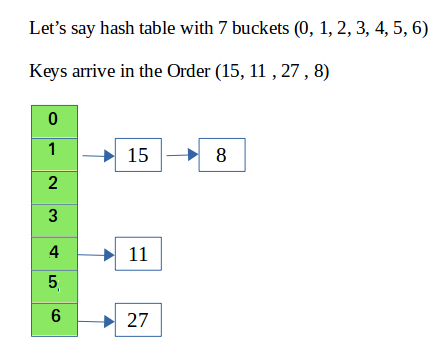
5. What is the difference between a hash function and a hash table?
A hash function is an algorithm that computes a hash value from a key, whereas a hash table is a data structure that uses the hash function to store and retrieve key-value pairs efficiently.
| Feature | Hash Function | Hash Table |
|---|---|---|
| Definition | Algorithm that computes a hash value. | Data structure that stores key-value pairs. |
| Purpose | Maps a key to an index. | Stores and retrieves data using hash values. |
| Input | A key or value. | Key-value pairs. |
| Output | A hash value (index). | Stored or retrieved data. |
| Dependency | Used by a hash table. | Relies on a hash function for indexing. |
6. What is a collision in hashing?
A collision occurs when two or more different keys produce the same hash value, causing them to map to the same index in a hash table.
- Inevitable because the number of possible keys is usually much larger than the number of table indices.
- Can reduce the performance of hash table operations if not handled properly.
- Common collision resolution techniques include separate chaining and open addressing.
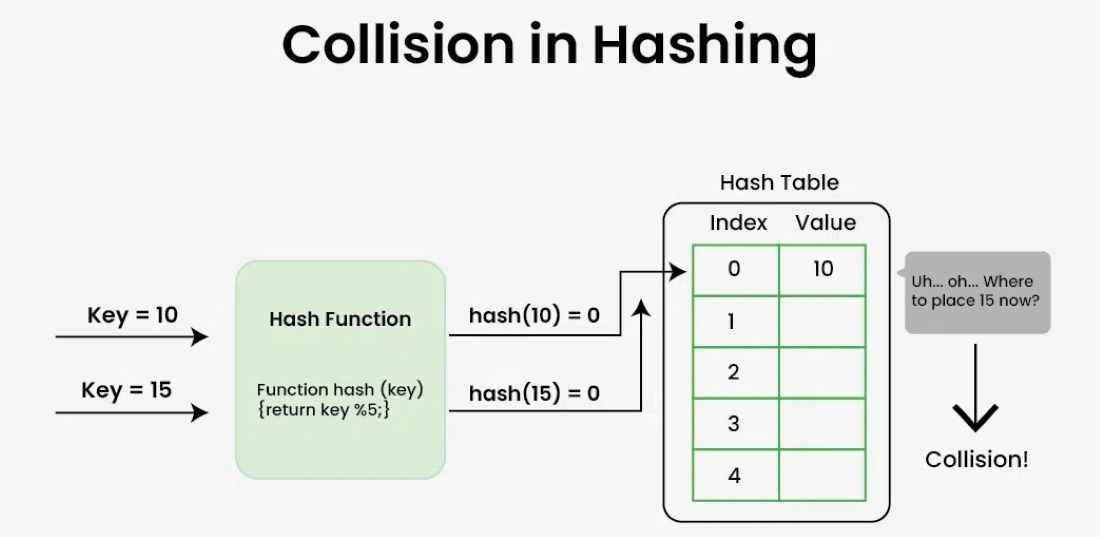
7. What are the different techniques for collision resolution?
Collision resolution techniques are methods used to handle situations where multiple keys map to the same index in a hash table.
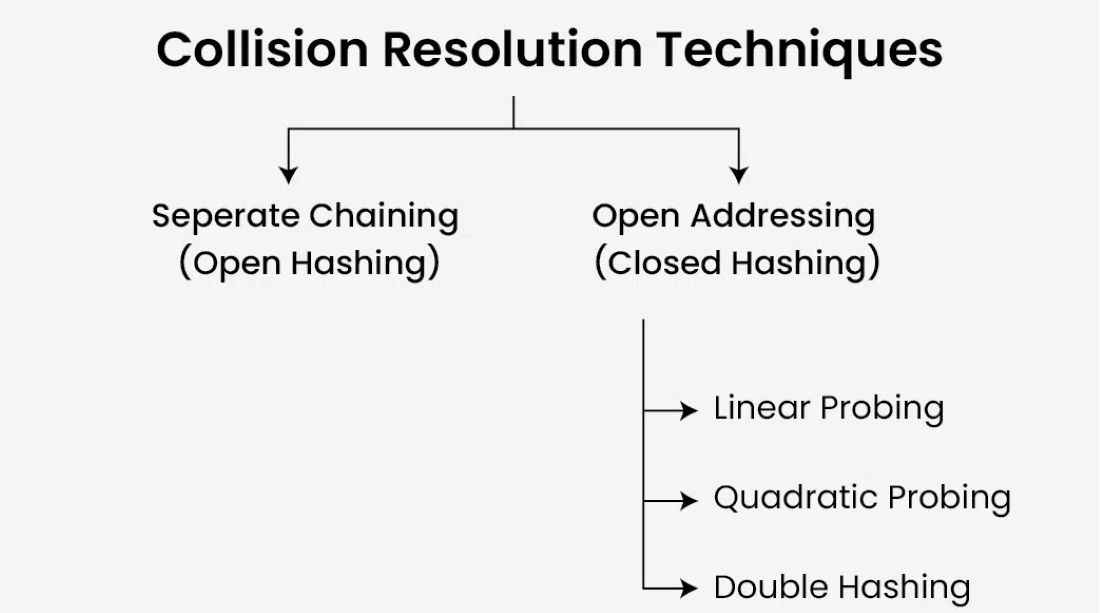
1. Separate Chaining: Stores colliding keys in a linked list or another secondary structure at the same index.
2. Open Addressing: Resolves collisions by finding another empty slot within the hash table using probing techniques:
- Linear Probing: Checks the next available slot sequentially.
- Quadratic Probing: Checks slots using quadratic intervals to reduce clustering.
- Double Hashing: Uses a second hash function to determine the probing sequence.
8. What is the difference between separate chaining and open addressing?
Both separate chaining and open addressing are collision resolution techniques, but they handle collisions differently.
| Feature | Separate Chaining | Open Addressing |
|---|---|---|
| Storage | Stores colliding keys in a linked list or another secondary structure. | Stores all keys within the hash table itself. |
| Collision Handling | Multiple keys can exist at the same index. | Finds another empty slot using probing techniques. |
| Memory Usage | Requires extra memory for linked lists or secondary structures. | Does not require additional storage outside the table. |
| Performance | Performs well even at high load factors. | Performance degrades as the table becomes full. |
| Examples | Linked list, dynamic array at each bucket. | Linear probing, quadratic probing, double hashing. |
9. What is the time complexity of search, insertion, and deletion in a hash table?
The time complexity of hash table operations depends on the quality of the hash function, the load factor, and the collision resolution technique used.
| Operation | Average Case | Worst Case |
|---|---|---|
| Search | O(1) | O(n) |
| Insertion | O(1) | O(n) |
| Deletion | O(1) | O(n) |
- The average case is O(1) when the hash function distributes keys uniformly.
- The worst case becomes O(n) when many keys collide and map to the same location.
- Maintaining a low load factor and using an efficient collision resolution technique helps preserve constant-time performance.
10. What is a load factor?
The load factor is the ratio of the number of stored elements to the total number of slots in a hash table. It indicates how full the hash table is.
Load Factor = Number of Elements / Number of Slots
- A lower load factor generally results in fewer collisions and better performance.
- A higher load factor increases the likelihood of collisions and slower operations.
- When the load factor exceeds a certain threshold, the hash table is often resized and rehashed.
11. Why is rehashing required?
Rehashing is the process of creating a larger hash table and redistributing all existing elements into it using a new hash function or table size. It is performed to maintain efficient hash table operations.
- Reduces collisions by increasing the number of available slots.
- Improves the performance of search, insertion, and deletion operations.
- Usually triggered when the load factor exceeds a predefined threshold.
12. Why does chaining perform better than linear probing at high load factors?
Primary clustering and secondary clustering are collision-related problems that occur in open addressing hash tables.
- Primary Clustering: Consecutive occupied slots create long clusters, increasing probe lengths.
- Common in linear probing, where adjacent collisions accumulate into larger clusters.
- Secondary Clustering: Keys with the same initial hash value follow the same probing sequence.
- Common in quadratic probing and can be reduced using double hashing.
13. What is a perfect hash function?
A perfect hash function is a hash function that maps each key in a given set to a unique hash value, ensuring that no collisions occur.
- Produces a unique index for every key in the given dataset.
- Eliminates collisions, resulting in faster lookups.
- Best suited for static datasets where the set of keys does not change frequently.
14. What is cuckoo hashing?
Cuckoo hashing is a collision resolution technique that stores each key in one of two possible locations determined by two different hash functions.
- Uses two hash functions to provide two candidate positions for each key.
- If both positions are occupied, an existing key is displaced and relocated to its alternate position.
- Provides O(1) average-case lookup by ensuring each key can exist in only one of two locations.
15. What is a Bloom filter?
A Bloom filter is a space-efficient probabilistic data structure used to test whether an element is a member of a set.
- Uses multiple hash functions to map elements to a bit array.
- Can quickly determine if an element is possibly present or definitely not present.
- May produce false positives, but never false negatives.
16. What is the difference between hashing and a self-balancing BST?
Hashing and self-balancing binary search trees (BSTs) are both used for efficient data storage and retrieval, but they differ in how they organize and access data.
| Feature | Hashing | Self-Balancing BST |
|---|---|---|
| Data Organization | Uses a hash function to map keys to indices. | Stores keys in a sorted tree structure. |
| Search Time | O(1) average, O(n) worst case. | O(log n) for search, insertion, and deletion. |
| Data Ordering | Does not maintain sorted order. | Maintains elements in sorted order. |
| Range Queries | Not efficient. | Efficient due to ordered structure. |
| Examples | Hash Table, unordered_map | AVL Tree, Red-Black Tree |
17. What are the different types of hash functions?
Hash functions use different techniques to convert keys into hash values. The choice of hash function affects the distribution of keys and the number of collisions.
- Division Method: Computes the hash value using the remainder of division by the table size.
- Multiplication Method: Multiplies the key by a constant and extracts a portion of the result.
- Mid-Square Method: Squares the key and uses the middle digits as the hash value.
- Folding Method: Splits the key into parts and combines them to produce the hash value.
- Universal Hashing: Randomly selects a hash function from a family of functions to reduce collisions.
18. What are the applications of hashing?
Hashing is widely used in applications that require fast storage, retrieval, and lookup of data.
- Databases: Enables fast indexing and record retrieval.
- Hash Tables: Supports efficient search, insertion, and deletion operations.
- Caching: Quickly stores and retrieves frequently accessed data.
- Password Storage: Stores hashed passwords for secure authentication.
- Data Integrity: Generates checksums and fingerprints to detect data modifications.
- Compilers: Implements symbol tables for efficient identifier lookup.
19. What is the difference between linear probing, quadratic probing, and double hashing?
These are open addressing techniques used to resolve collisions in a hash table.
| Technique | Probe Sequence | Advantage | Limitation |
|---|---|---|---|
| Linear Probing | Checks the next slot sequentially. | Simple and cache-friendly. | Suffers from primary clustering. |
| Quadratic Probing | Uses quadratic intervals to find the next slot. | Reduces primary clustering. | Can still suffer from secondary clustering. |
| Double Hashing | Uses a second hash function to determine the step size. | Minimizes clustering and distributes keys more uniformly. | More computationally expensive due to the second hash function. |
- Linear probing is the simplest approach but is more prone to clustering.
- Double hashing generally provides the best key distribution among the three techniques.
20. What are the advantages and disadvantages of hashing?
Hashing is widely used for fast data retrieval, but its performance depends on the quality of the hash function and collision handling.
Advantages
- Provides O(1) average-case time complexity for search, insertion, and deletion.
- Efficient for implementing dictionaries, sets, and symbol tables.
- Simple to use for key-based data retrieval.
- Scales well for large datasets with a good hash function.
Disadvantages
- Performance can degrade to O(n) in the worst case due to collisions.
- Does not maintain elements in sorted order.
- Range queries and ordered traversals are inefficient.
- May require rehashing, which can be expensive for large tables.
Coding Interview Questions
The following list of 20 coding problems on Hashing that covers a range of difficulty levels, from easy to hard, to help candidates prepare for interviews.
Easy Problems
- Subset Check
- Union and Intersection of two Linked Lists
- A pair with given sum
- Two pair sum
- Missing elements of a range
- Symmetric Pairs
- Duplicates within k distance
Medium Problems
- Largest subarray with 0 sum
- Distinct elements in K-size Window
- All subarrays with 0 sum
- Largest subarray with equal number of 0s and 1s
- Count Subarrays with XOR
- Longest Consecutive Subsequence
- Pair Sum Divisible by K
- Separate Chaining for Collision Handling
- Open Addressing for Collision Handling