

In Boolean Algebra, NAND and NOR are known as universal gates because they can be used to implement any digital circuit or logic gate. By connecting these gates in different configurations, all basic logic gates can be realized using only NAND or NOR gates.
- Universal Property: Each of the NAND and NOR gates can individually implement all basic logic gates such as AND, OR, NOT, XOR, and XNOR.
- Practical Importance: Using only one type of universal gate simplifies circuit design, manufacturing, and maintenance in digital systems.
Implementation of AND Gate using Universal Gates
Implementation using NAND Gates
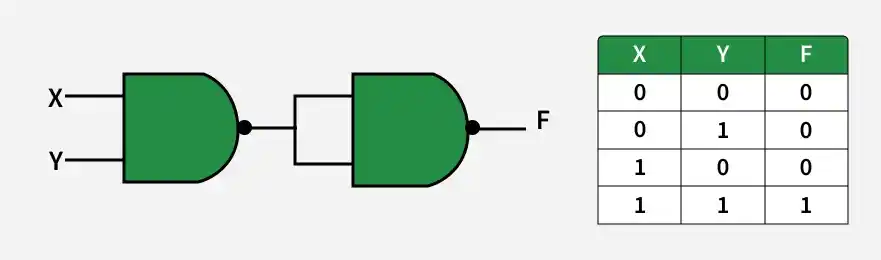
The AND gate can be implemented using two NAND gates. The first NAND gate performs the NAND operation, while the second NAND gate acts as a NOT gate by connecting both its inputs together. This configuration inverts the NAND output and produces the AND output.
Implementation using NOR Gates
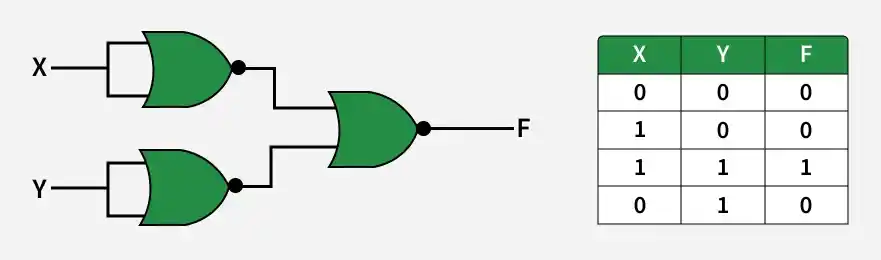
The AND gate can be implemented using three NOR gates. The first two NOR gates act as NOT gates by connecting their inputs together, while the third NOR gate combines their outputs to produce the AND output. This configuration uses De Morgan's Law to implement the AND function using only NOR gates, demonstrating that NOR is a universal gate.
Implementation of OR Gate using Universal Gates
Implementation Using NAND Gates
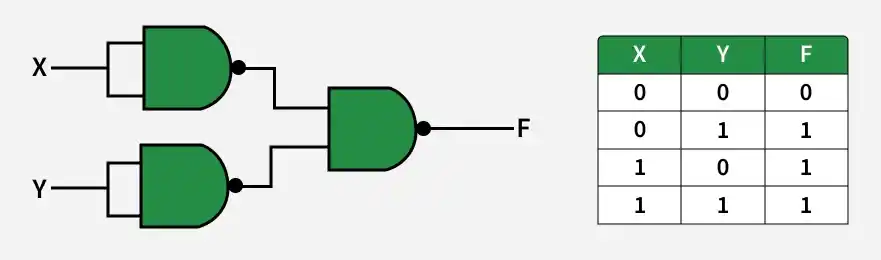
The OR gate can be implemented using three NAND gates. The first two NAND gates act as NOT gates by connecting their inputs together, while the third NAND gate combines the inverted outputs to produce the OR output. This configuration uses De Morgan's Law to implement the OR function using only NAND gates.
Implementation using NOR Gates
The OR gate can be implemented using two NOR gates. The first NOR gate performs the NOR operation, while the second NOR gate acts as a NOT gate by connecting both its inputs together. This configuration inverts the NOR output to produce the OR function using only NOR gates, demonstrating that NOR is a universal gate.

Implementation of NOT Gate using Universal gates
Implementation using NAND Gates
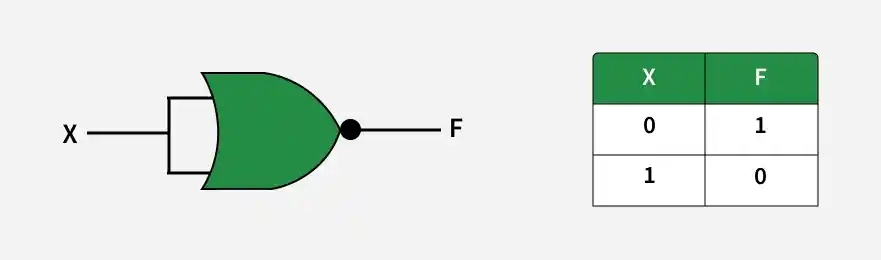
The NOT gate can be implemented using a single NAND gate by connecting both its inputs together. When the same input is applied to both terminals, the NAND gate behaves as an inverter and produces the complement of the input. This configuration implements the NOT function using only a NAND gate.
Implementation Using NOR Gates
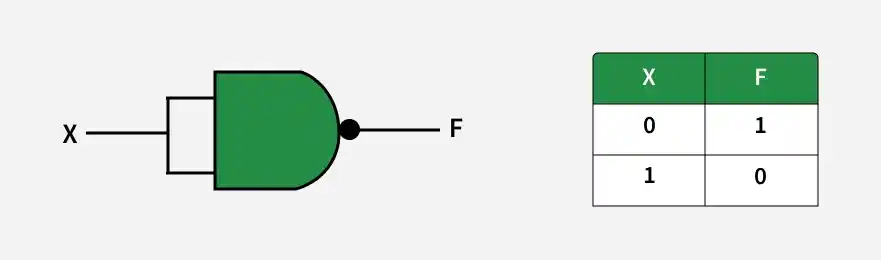
The NOT gate can be implemented using a single NOR gate by connecting both its inputs together. When the same input is applied to both terminals, the NOR gate acts as an inverter and produces the complement of the input. This configuration implements the NOT function using only a NOR gate.
Implementation of XOR Gate using Universal gates
Implementation using NAND Gates
XOR gate can be implemented using four NAND gates. The first NAND gate generates an intermediate output, while the remaining NAND gates combine the input signals to produce the XOR output. This configuration uses only NAND gates to implement the XOR function, demonstrating that NAND is a universal gate.

Implementation Using NOR Gates
The XOR gate can be implemented using five NOR gates. The NOR gates generate intermediate outputs that are combined to produce the XOR output. This configuration uses De Morgan's Law to implement the XOR function using only NOR gates, demonstrating that NOR is a universal gate.

Implementation of XNOR Gate using Universal Gates
Implementation Using NAND Gate
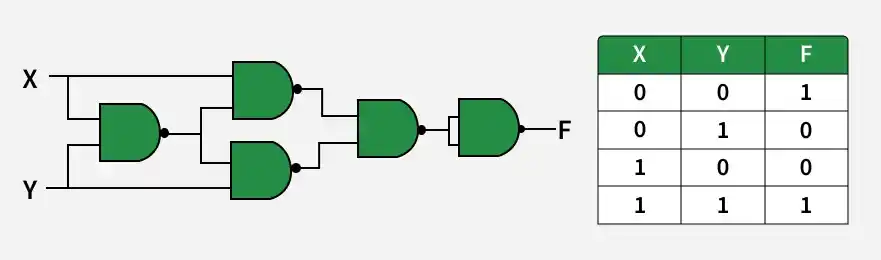
XNOR gate can be implemented using five NAND gates. The first four NAND gates generate the XOR function, while the fifth NAND gate acts as a NOT gate to invert the XOR output and produce the XNOR output. This configuration demonstrates that NAND is a universal gate.
Implementation Using NOR Gate
The XNOR gate can be implemented using four NOR gates. The NOR gates generate intermediate outputs that are combined to produce the XNOR output. This configuration uses only NOR gates to implement the XNOR function, demonstrating that NOR is a universal gate.

Implementation of NOR Gate using NAND Gates
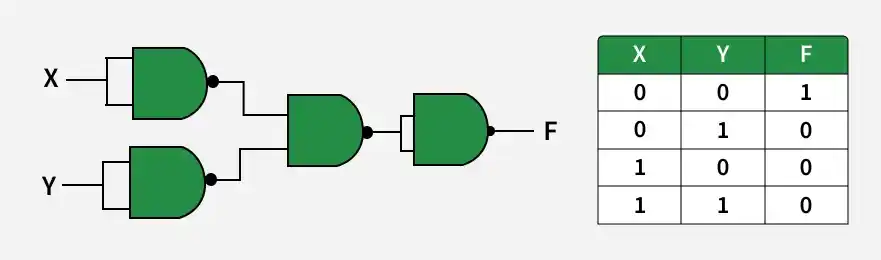
NOR gate can be implemented using four NAND gates. The first two NAND gates act as NOT gates by connecting their inputs together, while the remaining NAND gates combine the inverted inputs to produce the NOR output. This configuration uses De Morgan's Law to implement the NOR function using only NAND gates.
Implementation of NAND Gate using NOR Gates
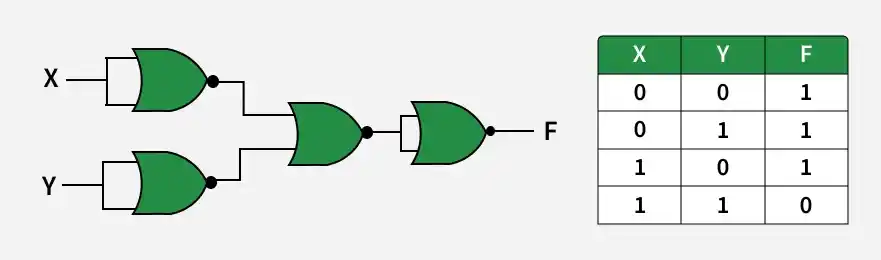
The NAND gate can be implemented using four NOR gates. The first two NOR gates act as NOT gates by connecting their inputs together, while the remaining NOR gates combine the inverted inputs to produce the NAND output. This configuration uses De Morgan's Law to implement the NAND function using only NOR gates.
Advantages
- Simplicity: These are gates that can be used for all forms of logical operations hence can help reduce the number of components in a circuit.
- Cost-Effective: Fewer parts are required when developing one type of gate only thus lowering costs of manufacturing.
- Flexibility: Universal gates can perform any digital logic function which makes it convenient to design any type of circuit.
- Reliability: The dependence of a small number of various gates can result in increased reliability in digital circuits.
- Ease of Integration: Universal gates can be easily integrated into existing systems, even for complex designs.
Disadvantages
- Increased Gate Count: Complex logic functions require more NAND or NOR gates than other basic gates.
- Higher Power Consumption: Additional gates increase power consumption, especially in complex circuits.
- Slower Speed: Extra gates can also bring in more propagation delay, and hence lower the speed of the circuit.
- Complex Design: Circuit design becomes more complicated because complex functions require a larger number of universal gates.
- Limited Optimization: The use of only one type of gate may offer fewer optimization possibilities and therefore result in less efficient designs.
Applications
- Basic Digital Circuits: Universal gates are employed widely in elementary digital circuits for carrying out simple logical operations.
- Memory Units: NAND and NOR gates are used in memory circuits such as SRAM and DRAM.
- Arithmetic Logic Units (ALUs): Universal gates are used in ALUs to perform arithmetic and logical operations.
- Signal Processing: Universal gates are used in digital signal processing and communication systems.
- Embedded Systems: Universal gates are widely used in embedded systems and small-scale digital circuit designs.