

The Quine–McCluskey method, also called the Tabulation Method, is used to simplify Boolean expressions, especially when the number of variables is greater than four. It provides a systematic way to find the minimal Boolean expression.
- Uses a systematic tabular approach.
- Identifies Prime Implicants (PI) and Essential Prime Implicants (EPI).
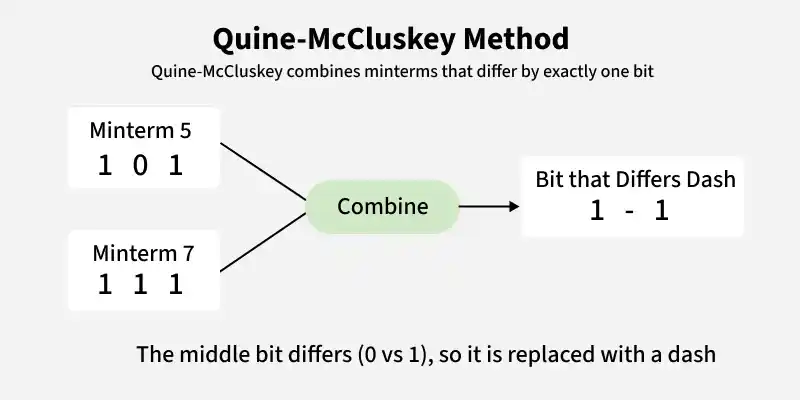
Terminologies
- Implicant: A group of adjacent 1's representing a product term.
- Prime Implicant (PI): The largest possible implicant that cannot be combined further.
- Essential Prime Implicant (EPI): A prime implicant that covers at least one minterm not covered by any other prime implicant.
Note: The method requires converting decimal minterms to their binary representation for grouping.
Steps for Quine McCluskey Method
- Convert the given minterms into binary and group them based on the number of 1's.
- Compare adjacent groups and combine terms that differ by only one bit.
- Replace the differing bit with a "-" (don't care) symbol.
- Repeat the combining process until no further combinations are possible.
- The remaining terms are the Prime Implicants (PIs).
- Construct the Prime Implicant Table using the prime implicants and minterms.
- Identify the Essential Prime Implicants (EPIs).
- Write the final simplified Boolean expression using the selected implicants.
Solved Examples
Example: Simplify using tabulation method : F(A,B,C,D) =∑ m(0,1,2,4,6,8,9,11,13,15)
Solution: Convert the given minterms into their binary representation and arrange them according to the number of ones present in the binary representation.
| TABLE 1 | |||||
|---|---|---|---|---|---|
| Group | Minterm | A | B | C | D |
| 0 | 0 | 0 | 0 | 0 | 0 |
| 1 | 1 2 4 8 | 0 0 0 1 | 0 0 1 0 | 0 1 0 0 | 1 0 0 0 |
| 2 | 6 9 | 0 1 | 1 0 | 1 0 | 0 1 |
| 3 | 11 13 | 1 1 | 0 1 | 1 0 | 1 1 |
| 4 | 15 | 1 | 1 | 1 | 1 |
Table 1 groups the given minterms according to the number of 1's in their binary representation.
Table 2 is formed by comparing adjacent groups and combining minterms that differ in only one bit. The differing bit is replaced with "-".
| TABLE-2 | |||||
|---|---|---|---|---|---|
| Group | Pair | A | B | C | D |
| 0 | (0,1) (0,2) (0,4) (0,8) | 0 0 0 - | 0 0 - 0 | 0 - 0 0 | - 0 0 0 |
| 1 | (1,9) (2,6) (4,6) (8,9) | - 0 0 1 | 0 - 1 0 | 0 1 - 0 | 1 0 0 - |
| 2 | (9,11) (9,13) | 1 1 | 0 - | - 0 | 1 1 |
| 3 | (11,15) (13,15) | 1 1 | - 1 | 1 - | 1 1 |
Table 3 is obtained by repeating the same comparison process until no further combinations are possible.
| TABLE-3 | |||||
|---|---|---|---|---|---|
| Group | Quad | A | B | C | D |
| 0 | (0,1,8,9) (0,2,4,6) | - 0 | 0 - | 0 - | - 0 |
| 1 | (9,11,13,15) | 1 | - | - | 1 |
No further combinations are possible after Table 3. Hence, the remaining terms are the Prime Implicants.
The remaining terms in Table 3 are the Prime Implicants. These are listed in the Prime Implicant Table, where each prime implicant is matched with the minterms it covers. The Essential Prime Implicants are then selected to obtain the simplified Boolean expression.
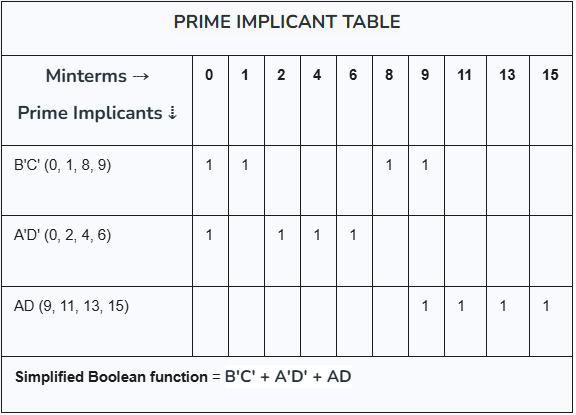
Since minterm 1 is covered only by B'C', minterms 2, 4, 6 only by A'D', and minterms 11, 13, 15 only by AD, these are selected as the Essential Prime Implicants. Therefore, the simplified Boolean expression is:
F = B′C′ + A′D′ + AD
Example: Simplify using tabulation method : F(A,B,C,D,E,F,G) = ∑m(20,28,52,60)
Solution: Convert the given minterms in their binary representation and arrange them according to number of one's present in the binary representation.
| TABLE-1 | ||||||||
|---|---|---|---|---|---|---|---|---|
| Group | Minterms | A | B | C | D | E | F | G |
| 0 | 20 | 0 | 0 | 1 | 0 | 1 | 0 | 0 |
| 1 | 28 52 | 0 0 | 0 1 | 1 1 | 1 0 | 1 1 | 0 0 | 0 0 |
| 2 | 60 | 0 | 1 | 1 | 1 | 1 | 0 | 0 |
Table 1 groups the given minterms according to the number of 1's in their binary representation.
| TABLE-2 | ||||||||
|---|---|---|---|---|---|---|---|---|
| Group | Pair | A | B | C | D | E | F | G |
| 0 | (20,28) (20,52) | 0 0 | 0 - | 1 1 | - 0 | 1 1 | 0 0 | 0 0 |
| 1 | (28,60) (52,60) | 0 0 | - 1 | 1 1 | 1 - | 1 1 | 0 0 | 0 0 |
Table 2 is formed by comparing adjacent groups and combining terms that differ by only one bit. The differing bit is replaced with "-".
| TABLE-3 | ||||||||
|---|---|---|---|---|---|---|---|---|
| Group | Quad | A | B | C | D | E | F | G |
| 0 | (20,28,52,60) | 0 | - | 1 | - | 1 | 0 | 0 |
Table 3 is obtained by repeating the same comparison process until no further combinations are possible.
| Prime Implicants Table | |
|---|---|
Minterms ⇢ Prime Implicants ⇣ | 20 28 52 60 |
| A'CEF'G'(20,28,52,60) | 1 1 1 1 |
Simplified Boolean Function = A'CEF'G'
A'CEF'G' is the simplified Boolean function because it is the only prime implicant that covers all the given minterms.
Advantages
- Suitable for Large Boolean Functions: Efficiently minimizes Boolean functions with many variables where Karnaugh Maps become difficult to use.
- Systematic and Tabular Approach: Follows a structured step-by-step procedure, making the simplification process organized.
- Produces Minimal Expressions: Generates minimal Boolean expressions in both Sum of Products (SOP) and Product of Sums (POS) forms.
- Independent of Visual Grouping: Eliminates the need for visual pattern recognition required in Karnaugh Maps.
Disadvantages
- High Computational Complexity: The number of comparisons increases rapidly as the number of variables grows.
- Large Tables for Complex Functions: Manual implementation becomes difficult because of the increasing size of intermediate tables.
- Time-Consuming: Requires multiple comparison and merging steps, making it slower than Karnaugh Maps for smaller functions.
- Less Practical for Manual Simplification: Better suited for computer implementation than hand calculations for large Boolean functions.