

Karnaugh Map (K-Map) is a graphical method used to simplify Boolean expressions without using lengthy Boolean algebra. It helps reduce the number of logic gates by grouping adjacent cells in a truth table, making digital circuits simpler and more efficient.
- K-map can be used for SOP and POS forms.
- It organizes truth table values into a grid for easy simplification.
Depending on the required representation, a K-Map is filled with 1s (for SOP) or 0s (for POS), and adjacent cells are grouped to obtain a simplified Boolean expression.
Steps to Solve Expression using K-map
- Select the K-map according to the number of variables.
- Identify minterms or maxterms as given in the problem.
- For SOP, place 1s in the cells corresponding to the minterms (0s elsewhere).
- For POS, place 0s in the K-map cells corresponding to the maxterms (1s elsewhere).
- Group adjacent cells in powers of two (1, 2, 4, 8, 16, ...) while covering the maximum possible cells.
- From the groups made in step 5 find the product terms and sum them up for SOP form.
SOP FORM(Sum of Product Form)
SOP (Sum of Products) is a method of representing Boolean expressions in which variables are combined using the AND operation to form product terms, and these product terms are combined using the OR operation.
K-map for 2 variables
A 2-variable K-Map consists of four cells. Each cell represents one combination of the two input variables.

K-map of 3 variables
A 3-variable K-Map consists of 8 cells, with each cell representing one minterm of the Boolean expression.
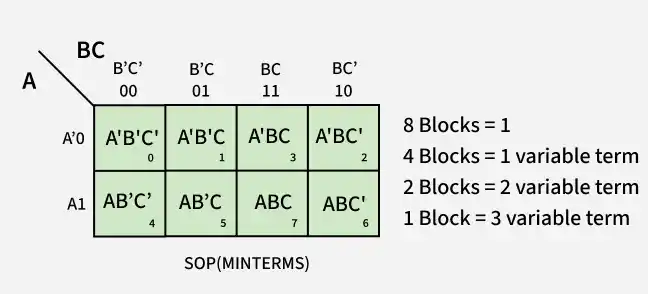
Example:
F(A, B, C) = Σ(1, 3, 6, 7)

- From the red group, we obtain the product term: A’C
- From the green group, we obtain the product term: AB
Combining the product terms, we get the simplified Boolean expression:
F = A'C + AB
K-map for 4 variables
A 4-variable K-Map consists of 16 cells, with each cell representing one minterm of the Boolean expression.
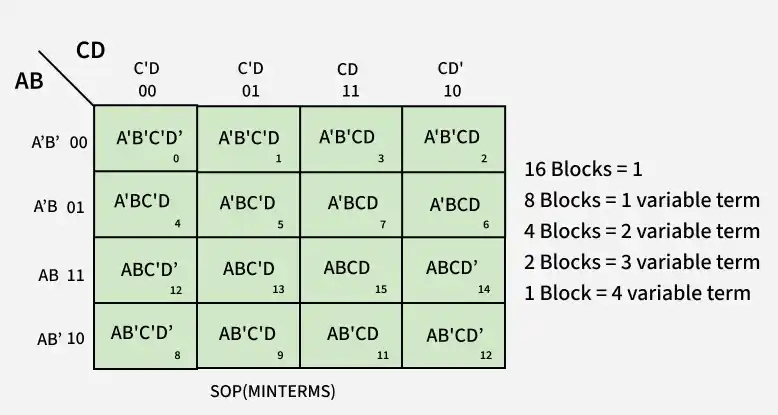
Example:
F(A, B, C, D) = Σ(0, 1, 2, 3, 12, 13, 14, 15)

- From the red group, we obtain the product term: AB
- From the green group, we obtain the product term: A'B'
Combining the product terms, we get the simplified Boolean expression:
F = AB + A'B'
POS FORM (Product of Sum Form)
POS (Product of Sums) is a method of simplifying and representing Boolean expressions. It uses the OR operation to form sum terms and the AND operation to combine them.
K-map for 2 variables
A 2-variable K-Map consists of four cells. Each cell represents one maxterm of the Boolean expression.

K-map of 3 variables
A 3-variable K-Map consists of 8 cells, with each cell representing one maxterm of the Boolean expression.
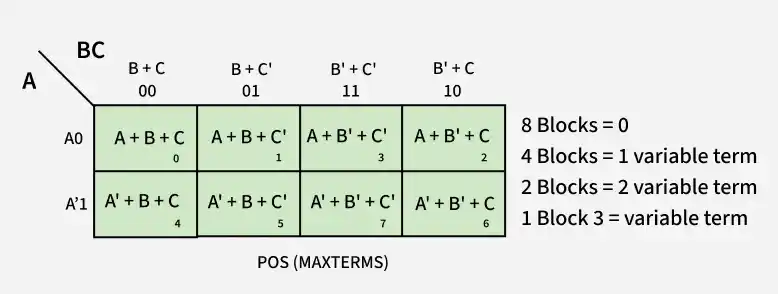
Example:
F(A, B, C) = Π(0, 3, 6, 7)

- From the red group, we obtain the variables: AB
- Complementing these variables gives: A' B'
Form the sum term:
(A' + B')
- From the brown group, we obtain the variables: BC
- Complementing these variables gives: B'C'
Form the sum term:
(B’+C’)
- From the yellow group, we obtain the variables: A' B' C’
- Complementing these variables gives: A B C
Form the sum term:
(A + B + C)
Combining the sum terms, we obtain the simplified Boolean expression:
F = (A' + B')(B' + C')(A + B + C)
K-map of 4 variables
A 4-variable K-map consists of 16 cells arranged in a 4 × 4 grid. Each cell represents one minterm or maxterm, making it easier to simplify Boolean expressions.
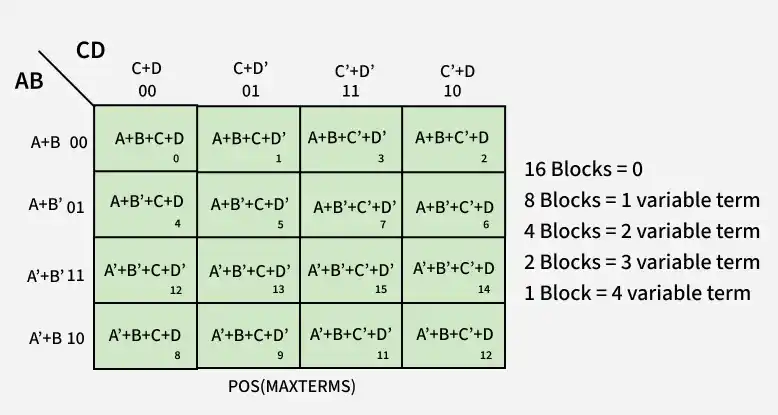
Example:
F(A,B,C,D) = Π(3,5,7,8,10,11,12,13)

- From the green group, we obtain the variables: C’DB
- Complementing these variables gives: CD’B’
Form the sum term:
(C+D’+B’)
- From the red group, we obtain the variables: C D A’
- Complementing these variables gives: C’D’A
Form the sum term:
(C’+D’+A)
- From the blue group, we obtain the variables: A C’ D’
- Complementing these variables gives: A’CD
Form the sum term:
(A’+C+D)
- From the brown group, we obtain the variables: A B’ C
- Complementing these variables gives: A’BC’
Form the sum term:
(A’+B+C’)
Combining all the sum terms, we obtain the simplified Boolean expression:
F = (C+D'+B')(C'+D'+A)(A'+C+D)(A'+B+C')
Advantages
- Makes Logic Simpler: It makes complicated Boolean expressions simpler.
- Minimizes Logic Gates: Simplifying the logic helps us to use fewer logic gates, making circuits more efficient.
- Reduce Errors: The visual representation of k-map helps to avoid errors while simplifying.
- Time-Saving: It's quicker than traditional methods for simplifying logic.
Disadvantages
- Limited to Fewer Variables: K-maps are best suited for 2 to 4 variables and above it, process becomes hard and complicated to manage.
- Not suitable for all functions: In some cases, its hard to group terms correctly, leading to errors and making simplification difficult.
- Space Limitations: As the number of variables increases, the K-map grid becomes too large to handle easily.
- Requires Careful Grouping: Sometimes incorrect grouping of terms can cause mistakes in logic simplification.
Also attempt Quiz on K-MAP