

A systematic process used to identify and evaluate potential risks within information systems. Purpose focuses on detecting weaknesses that could be exploited and ensuring the protection of data confidentiality, integrity and availability.
- Finds security weaknesses and ranks them based on how serious they are.
- Checks whether systems follow security guidelines and best practices.
- Helps security teams manage and fix vulnerabilities more quickly and efficientl
Types of Vulnerability Assessment
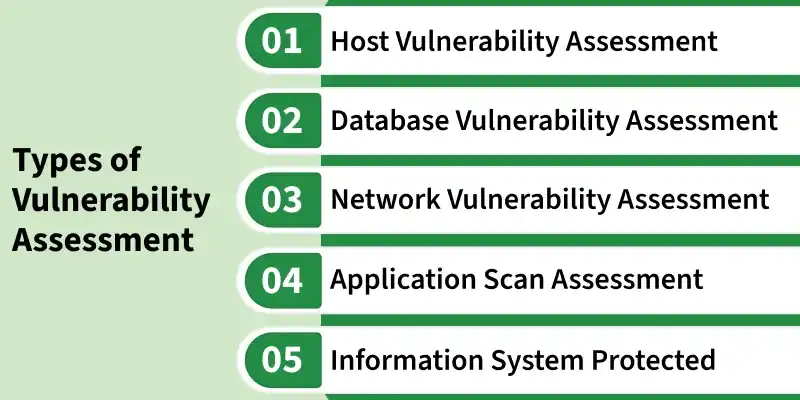
- Host Vulnerability Assessment: Conducts analysis on the servers and host systems so as to expose and contain backend attacks.
- Database Vulnerability Assessment: Provides for the prevention of unauthorized access to data within the database in terms of confidentiality, integrity and availability.
- Network Vulnerability Assessment: Evaluates the security of networks to attain protection against incoming and existing network complexity.
- Application Scan Vulnerability Assessment: Scans application code for application-level vulnerabilities in frontend and backend automated tools.
Working of Vulnerability Assessment
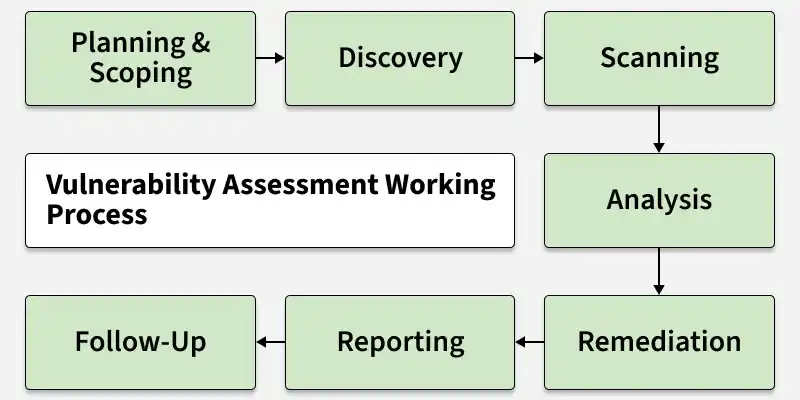
- Planning and Scoping: Identify the parameters, aims and objectives and target system of the assessment.
- Discovery: Collect general information about the system: hosts, ports and software, etc. Collect it with using specialized software and through manual assessment.
- Scanning: Make a scan to each host in order to detect open ports, mistakes or problems in configurations.
- Analysis: Analyze scan information to identify imperatives and determine their potential vulnerability.
- Reporting: Record exploits, their consequences and rank suggestions for insurance.
- Remediation: Apply remedies, modify settings and work on the fortification of the architecture.
- Follow-Up: Ensure fix and verify that fix is correct & look for new vulnerability.
Vulnerability Assessment Tools
- Nessus: Comprehensive vulnerability scanner for networks, operating systems and applications.
- OpenVAS (Greenbone): Open-source vulnerability assessment and security scanning tool.
- Qualys VMDR: Cloud-based vulnerability management, detection and response platform.
- Rapid7 InsightVM (Nexpose): Risk-based vulnerability assessment and remediation solution.
- Nmap with NSE (Nmap Scripting Engine): Network discovery and basic vulnerability detection tool.
- Nikto: Web server vulnerability scanner for identifying insecure configurations and outdated software.
- Burp Suite: Web application security testing and vulnerability assessment tool.
- Acunetix: Automated web vulnerability scanner for detecting SQL injection, XSS and other web application flaws.
Advantages
- Detects system weaknesses before any data breach occurs.
- Provides list of possible vulnerabilities for each device in system.
- Maintains security records useful for future assessments.
- Supports proactive risk management and improves overall security posture.
- Helps prioritize vulnerabilities based on severity and impact.
Limitations
- Some advanced or zero-day vulnerabilities may remain undetected.
- Assessment tools may not always produce fully accurate results.
- Requires regular execution to remain effective over time.
- May generate false positives that need manual verification.
- Implementation and maintenance can require time and resources.
For more details refer Differences between Penetration Testing and Vulnerability Assessments