

Accountancy is the process of measuring, processing, and recording an organization’s financial and non-financial statements.
- Responsible for prescribing the accounting conventions, principles, and techniques to be followed by an organization during the accounting process.
- The nature of accounting is dynamic and analytical and hence requires special abilities and skills in an individual to interpret the information better and effectively.
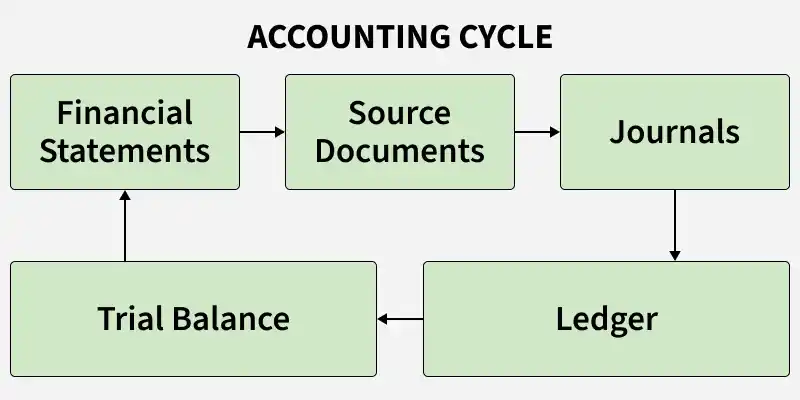
Basics of Accounting
Fundamental knowledge and principles necessary for understanding the accounting process and financial reporting.
Principles and Theory
Accounting runs on a standardized rulebook so financial statements from different companies, or even different countries, can be compared.
Concepts and Conventions
These are the foundational assumptions things like treating the business as separate from its owner, or only recording what can be measured in money.
Recording of Business Transactions
Before a transaction reaches a financial statement, it passes through a set of books, vouchers, day books, and the ledger.
Accounting Equation
Every transaction, no matter how complex, must keep Assets = Liabilities + Capital balanced.
- Introduction
- Equation for Increase in Assets & Liability and Assets & Capital
- Equation for Decrease in Assets & Liability and Assets & Capital
- Equation for Changes in Capital, Liability & Assets
Journal Entries
Largest and most practical module in accountancy, every type of transaction a business encounters, from drawings to GST to insurance claims.
Bank Reconciliation Statement (BRS)
A business's cash book balance and its bank passbook balance almost never match on a given date because of timing differences.
- Introduction & Need
- Bank Statement vs BRS
- Preparation of BRS without Correcting Cash Book
- BRS without Correcting Cash Book
Depreciation, Provisions, and Reserves
Fixed assets lose value over time, and prudent businesses set money aside for known and unknown future costs. This module covers both.
- Introduction
- Methods of Charging Depreciation
- Straight Line Method (SLM) of Depreciation
- Written-Down Value Method (WDV)
Trial Balance and Rectification of Errors
The checkpoint where you verify that total debits equal total credits, and where you go hunting when they don't.
Bills of Exchange
A formal, negotiable instrument used in credit transactions between buyers and sellers.
Financial Statements
This is where individual journal entries and ledger balances come together into the Trading Account, Profit & Loss Account, and Balance Sheet — adjusted for items that don't show up in the trial balance.
- Introduction
- Financial Statements with Adjustments
- Journal Entries for Adjustment
- Adjustment Examples — I
Capital and Revenue
Misclassifying a capital item as revenue (or vice versa) distorts both the P&L Account and the Balance Sheet.
Accounting for Partnership: Basic Concepts
A partnership solves the sole proprietorship's core problem; one person bearing all the capital, risk, and management burden.
- Introduction
- Partnership Deed and the Indian Partnership Act, 1932
- LLP vs Partnership Firm
- Interest on Partner's Capital
Goodwill
Represents the value of a firm's reputation and earning capacity beyond its net tangible assets.
Reconstitution: Change in Profit Sharing Ratio
Sometimes existing partners simply agree to change how profits are split, without anyone joining or leaving.
- Reasons for Change in Profit Sharing Ratio
- Treatment of Accumulated Profits and Reserves
- Treatment of Investment Fluctuation Fund
- Revaluation of Assets and Liabilities
Reconstitution: Admission of a Partner
When a new partner is admitted, the existing partners sacrifice part of their share, and that sacrifice has to be compensated, usually through goodwill.
- New Profit Sharing Ratio on Admission
- Sacrificing Ratio
- Accounting Treatment of Goodwill on Admission
- Hidden Goodwill on Admission
Reconstitution: Retirement or Death of a Partner
When a partner retires or dies, the remaining partners gain a share of profit, and the outgoing partner (or their estate) must be settled fairly for their stake in the firm.
- Retirement of a Partner
- New Profit Sharing Ratio on Retirement
- Gaining Ratio on Retirement
- Sacrificing Ratio vs Gaining Ratio
Dissolution of Partnership Firm
Dissolution means the firm's business ends entirely, its assets are realized, and its liabilities are settled.
- Dissolution of Firm vs Dissolution of Partnership
- Firm's Debt vs Private Debt
- Realisation Account vs Revaluation Account
- Treatment of Accumulated Profit
Partnerships aren't the only structure businesses use to raise capital. The next module moves into companies, which raise funds by issuing shares.
Accounting for Share Capital
Companies raise capital by issuing shares to the public.
Issue and Redemption of Debentures
Debentures are a form of long-term borrowing a company takes from the public, repayable with fixed interest.
- Debentures
- Types of Debentures
- Shares vs Debentures
- Accounting Treatment and Presentation of Debentures
Financial Statements of a Company
Company financial statements follow a more formal, legally mandated format than a sole proprietorship's.
- Introduction
- Objectives and Characteristics of Financial Statements
- Balance Sheet of a Company
- Preparation of Profit and Loss Account
Analysis of Financial Statements
Raw financial statements become useful for decision-making only once they're compared; across years, against budgets, or against other firms.
Accounting Ratios
Ratios distill financial statements into single, comparable numbers that measure liquidity, solvency, efficiency, and profitability.
Cash Flow Statement
A company can be profitable on paper and still run out of cash. The cash flow statement tracks actual cash movement across operating, investing, and financing activities.
- Introduction
- Objectives, Importance and Limitations
- Classification of Business Activities in Cash Flow
- Cash Flow from Operating Activities
Overview of Computerised Accounting System
Manual bookkeeping has largely given way to accounting software.
- Sourcing of Accounting Software
- Computerised Accounting System
- Meaning, Features, Advantages
- Manual vs Computerised Accounting
Accounting for Non-Profit Organizations (NPO)
NPOs like clubs, charities, and societies don't prepare a Trading or P&L Account, they use a parallel set of statements built around receipts, payments, income, and expenditure.