FOWC With Fandango — Earring

Welcome to Fandango’s One-Word Challenge (aka, FOWC). I will be posting each day’s word just after midnight Pacific Time (U.S.).

Today’s word is “earring.”

Write a post using that word. It can be prose, poetry, fiction, non-fiction. It can be any length. It can be just a picture or a drawing if you want. No holds barred, so to speak.

Once you are done, tag your post with #FOWC and create a pingback to this post if you are on WordPress. Please check to confirm that your pingback is there. If not, please manually add your link in the comments.

And be sure to read the posts of other bloggers who respond to this prompt. Show them some love.

MLMM Friday Faithfuls — Death Valley Days

Written for the Mindlovemisery’s Menagery Friday Faithfuls prompt from Jim Adams. The topic this week is the extreme heat that much of the nation and the world is experiencing this summer.

Jim highlighted Death Valley, CA in his post. He noted that summer months in Death Valley frequently see consecutive days over 125°F (51.7°C) in the shade. Death Valley sits 282 feet below sea level and the dark rocks and soil absorb solar radiation, making surfaces hot enough to cause instant burns to exposed skin. It is exceptionally arid, and it is the driest location in North America.

My wife and I drove through Death Valley on one of our many cross-country drives between 2010 and 2015. And yes, it was hot — in triple digits — when we drove through it.

Jim’s post triggered memories for me of the old Western TV show called “Death Valley Days.” It was was an anthology western built around true stories and frontier legends from and around Death Valley, California. It wasn’t about one recurring family or hero; each half-hour episode told a different tale. Each episode was introduced by a host, the most famous of which was Ronald Reagan. Other hosts included Stanley Andrews (aka The Old Ranger), Robert Taylor, and Dale Robertson.

The stories usually involved mining camps, wagon trains, prospectors, outlaws, settlers, and other hard-luck people trying to survive the Old West. A lot of episodes were based on local lore and historical incidents tied to the Southwest.

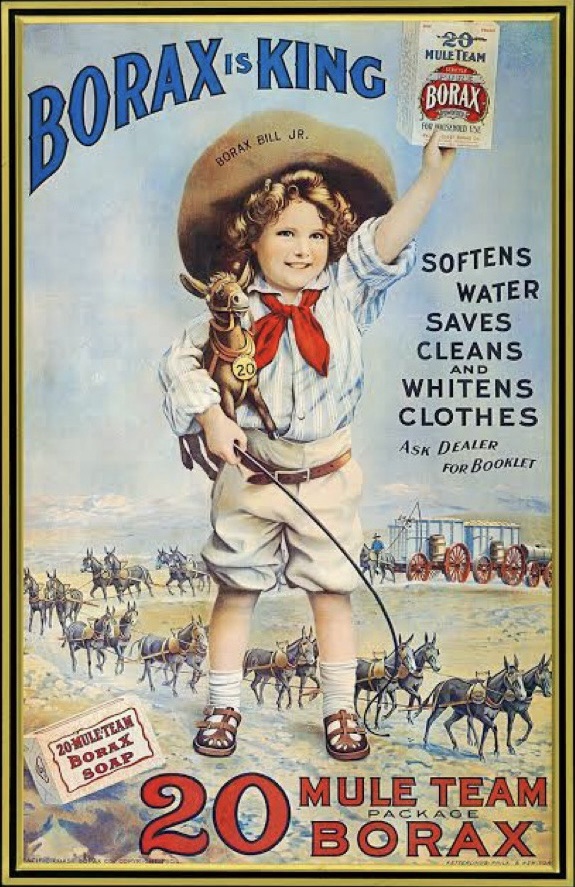
The show was sponsored by 20 Mule Team Borax, which tied neatly to Death Valley’s history and gave the series its identity. It also became one of the longest-running Western series on radio and television. The TV series ran from 1952 to 1970. A radio version of the show ran from 1930 to 1951.

The radio show often felt more like a Western noir in spirit — darker, grittier, and was dependent upon dialogue and sound effects to tell the stories. The TV version played more like a straightforward historical adventure anthology, leveraging visuals and scenery and had a more conventional Western style. And it was also more “family-friendly.” The overall premise stayed the same — stories from the Old West, especially around Death Valley, but the medium changed the mood quite a bit.

Note: I remember watching the TV show, but I wasn’t born yet when the radio version was in its prime.


Photo from Wikipedia.

Great Minds Think — The Blue Envelope

The prompt is called “Great Minds Think” and it’s the brainstorm of fellow bloggers Sarah and Rohini. The two of them alternate weeks. This week’s challenge is to write a story inspired by the featured sentence. Use it as your opening line, your central premise, or simply the spark that ignites your imagination. The featured sentence is:

“Please tell me you didn’t open the blue envelope.”


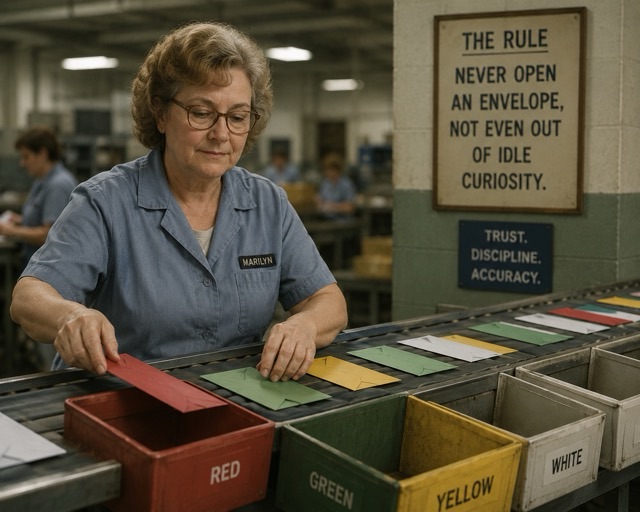
Marilyn had spent ten quiet years on the envelope-sorting line, her hands moving in a steady rhythm that felt almost like breathing. Red, green, yellow, white — each color slid through her fingers and into its proper bin. There was only one overarching rule and it was simple: never open an envelope, not even out of idle curiosity. But there was one exception, spoken in hushed tones during training: if a blue envelope ever appeared, she was to absolutely not open it. No one explained why.

For a decade, she never saw any blue envelopes. Then, on an ordinary Thursday morning, a flash of blue broke the monotony. It was small, slightly heavier than the others, and cold to the touch. Marilyn froze, while the conveyor belt kept humming beneath her hands. She should have placed it aside, followed protocol, pretended it was just another oddity in a long line of oddities.

Instead, her curiosity, normally quiet and patient, but persistent, couldn’t be denied.

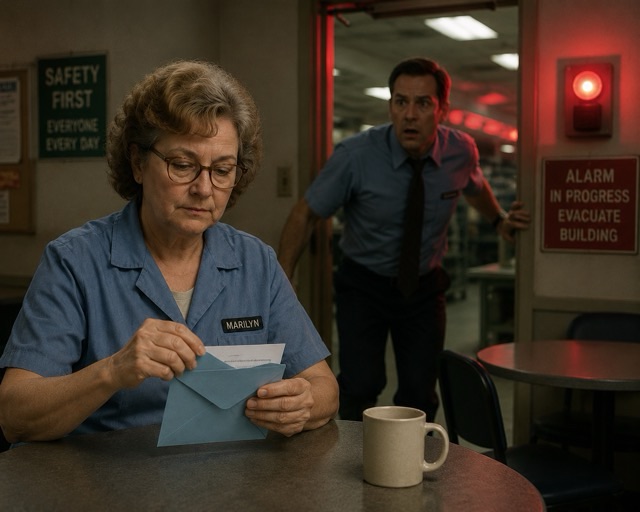
Marilyn slipped the blue envelope into her pocket and waited until break. In the dim corner of the break room, she peeled the flap open. Inside was a single sheet of paper, densely typed, stamped with symbols she didn’t recognize. The first line read: “If you are reading this, the breach has already begun.”

Before she could read further, a piercing alarm erupted through the building. Red lights flashed. Doors clanged shut. Footsteps thundered down the hallway.

Her supervisor skidded into the room, face pale, eyes wide with something beyond anger. It was more like genuine fear.

“Please tell me you didn’t open the blue envelope.”

Marilyn held the paper in trembling fingers. She didn’t speak. She didn’t need to.

The supervisor exhaled sharply, as if bracing for impact. “Then we don’t have much time.”


Images conjured using ChatGPT.

Violet’s Literary Quotes — The Clue

Police detective Fred Morrisey has seen a lot in his more than 30 years on the force, but when he sees the mutilated body of a young child found at a dump site, he says to his partner Detective Ron Hayden, “The depravity of man’s heart knows no floor.”

Ron said nothing. He simply stood beside Fred, hands buried in the pockets of his rumpled trench coat, staring at the small shape beneath the white forensic tent. The morning fog drifted lazily across the landfill, softening the mountains of refuse into gray islands. Gulls circled overhead, their cries sounding strangely like laughter.

A crime scene technician approached. “No identification. No missing persons report matches yet. Whoever left the body knew this place. Tire tracks disappear into the garbage trucks’ ruts.”

Fred nodded, but his attention had settled on something almost invisible — a tiny silver item lying several feet away. It was shaped like a paper crane. Clean. Untarnished. Deliberately placed.

“Bag that,” he said quietly.

Ron frowned. “You think it’s connected?”

“I think nothing at a dump stays clean by accident.”

Hours later, back at police headquarters, the medical examiner delivered another surprise. The child had not died where she was found. Soil trapped in her shoes contained traces of white quartz and red clay, minerals absent from the landfill but common in the abandoned quarry north of the city.

The quarry.

Fred leaned back in his chair. Twenty-two years earlier, he’d worked his first homicide there. Different victim. Different killer. But the case had left him with recurring nightmares and a nagging certainty that one crucial detail had slipped through his fingers.

Ron noticed the change in his partner’s expression. “I’ve seen that look before,” he said.

Fred slowly opened a battered notebook he hadn’t touched in two decades. Pressed between its yellowed pages was a photograph of another silver paper crane.

“No,” Fred said, his voice barely above a whisper. “I’ve seen this before.”

Outside, thunder rolled across the city, though the forecast had promised clear skies. Fred had learned long ago that storms rarely announced themselves before they arrived. Neither did evil.


This story has was written for Violet’s Literary Quotes, where she gave us, “The depravity of man’s heart knows no floor,” from Stephen Graham Jones book, The Buffalo Hunter Hunter.


Image conjured using Copilot.

Friday Fictioneers — The Undesirables

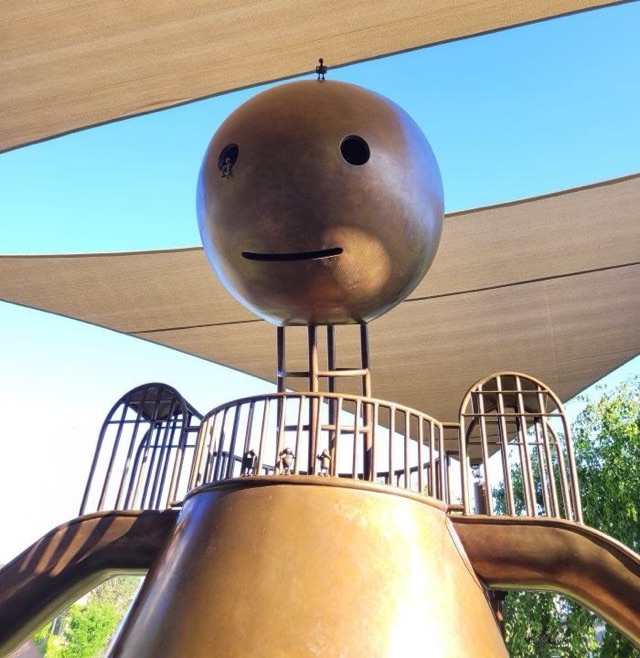
The year was 2036, and over the past decade, dozens of these strange looking structures appeared around the country. While they looked innocent, like they should have been part of children’s playgrounds, they were constructed at industrial waste sites.

Rumors of their purpose ran far and wide, but despite the attempt by the government to keep the intended use secret, intrepid journalists discovered they were used to remove what the government deemed “undesirables.”

Those the government determined to be a drain on society — immigrants, the elderly, the disabled — rode the conveyor belts to the top, never to be seen again.

(100 words)


Written for Rochelle Wisoff-Fields’ Friday Fictioneers prompt. Photo credit: Lisa Fox.

Fandango’s Flashback Friday — July 10th

This was originally posted on July 10, 2017.

Crappy Caper

IMG_2399

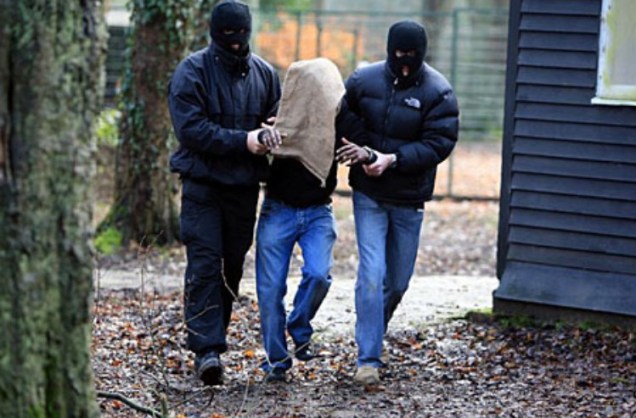
Two thugs grab me off the street, pull a burlap sack over my head, and toss me into the back of a van. One of the ruffians is waiting in the driver’s seat, starts the engine, and speeds away while the two who grabbed me use ropes to secure my hands and feet in the back of the van.

I hear the driver ask his fellow kidnappers, “Where to now, guys?

The two men in the back of the van look at each other, which of course I can’t see because I have a burlap sack over my head, but which I imagine they would do when confronted with such a question.

One of them shouts to the driver, “Bruno, this whole caper was your idea. Don’t you have a plan or are you flying by the seat of your pants?”

“Dunno,” replies Bruno. “Hadn’t thought that far in advance. Ask the guy we grabbed what he thinks.”

“So, whaddya think?” one of the kidnappers in the back of the van asks me.

“Surprise me.”

“Hey Bruno, he says to surprise him.”

“No way,” Bruno calls back. “I’m going to drive around in circles until he tell us where to take him.”

“Take me home,” I yell back at the driver.

“Ha, ha, very funny,” Bruno replies. “Vinny, break one of his thumbs unless he tells you where we should take him.”

“Okay, Vinny, let’s not be hasty,” I say to whichever one of the kidnappers with me in the back of the van is Vinny. “This is an important decision. Give me a second to ponder it.”

“You got a minute to decide.”

I quickly toss around some options in my head. It can’t be in the city. They could drive the van around to the side of an abandoned building, pull me out of the van, and move me into the building without being noticed. Not a building.

Not a forest either. They could drive the van deep into the woods and no one would be around to see or hear me. So not a forest.

“Break his freakin’ thumb already,” I hear Bruno yell from the driver’s seat. “I’m using up all the gas.”

“Wait, wait!” I plead. “Give me just a few seconds more.”

An island is surrounded by water. You can’t drive a van right up to an island. They’d have to lift me out of the van and move me to a boat in order to get to the island. Surely someone would see a man with a burlap sack over his head, hands and feet bound, being carried by a couple of thugs from a van to a boat, and would call the police. Or maybe I’d be able to figure out a way to free myself and get away.

“Take me to an island,” I say.

“He says an island,” Vinny yells up to Bruno.

“What island?” Bruno yells back.

“What island?” Vinny asks me.

“Oh for crissake. What kind of incompetent, bumbling kidnappers are you three, anyway? This is your goddam crappy caper.”

“That’s right,” yelled Bruno from the front of the van, “but it’s your goddam crappy nightmare.”

My eyes flutter open and I stretch my arms out after waking up from my brief nap. “I just had the strangest dream,” I say aloud to no one in particular.


Today’s one-word prompt is “caper.”

FOWC With Fandango — Pound

Welcome to Fandango’s One-Word Challenge (aka, FOWC). I will be posting each day’s word just after midnight Pacific Time (U.S.).

Today’s word is “pound.”

Write a post using that word. It can be prose, poetry, fiction, non-fiction. It can be any length. It can be just a picture or a drawing if you want. No holds barred, so to speak.

Once you are done, tag your post with #FOWC and create a pingback to this post if you are on WordPress. Please check to confirm that your pingback is there. If not, please manually add your link in the comments.

And be sure to read the posts of other bloggers who respond to this prompt. Show them some love.

RXC — Irony and Juxtaposition

This post was written in response to Reena’s Xploration Challenge. This week’s RXC prompt number is #438, and Reena has given us three quotes that juxtapose words or ideas effectively.

They are:

Then she asked us to:

  • choose one of the quotes to fire our piece
  • coin a similar line with juxtaposition
  • use juxtaposition in letter or spirit in our piece
  • Talk about what luxury or simplicity mean to us.

I decided to coin my own juxtaposition line. And one that also features a touch of irony as well. The line is:

“The President covets the Nobel Peace Prize while, at the same time, escalates the war he started with Iran.”

This statement sets up a sharp contradiction between a peace-prize aspiration and war-making behavior, which fits irony. But at the same time, because the two ideas are placed side by side for contrast, it also creates juxtaposition.

Irony involves an incongruity between what is expected and what actually happens, or between a stated ideal and the reality of conduct. In my sentence, “covets the Nobel Peace Prize” suggests peace, while “escalates a war with Iran” suggests the opposite, so the tension is the point.

Juxtaposition is simply the placement of two contrasting things side by side to create an effect or comparison. My sentence does that by pairing “Nobel Peace Prize” with “war with Iran,” so the contrast is visually and rhetorically immediate.

Bottom line, were I to label this statement, I might call it “ironic juxtaposition” or maybe “juxtaposition used to create irony.”

Trump is an expert at using ironic juxtaposition. He often praises “X” while doing “not-X.” That structure creates juxtaposition first, and then irony when the listener notices the mismatch between the stated ideal and the actual action.

For example, he calls for national unity while attacking opponents, scapegoating groups, or widening partisan conflict.

For example, he presents himself as a political outsider or champion of ordinary people while embracing wealth, insiders, or establishment power.

For example, he touts openness, accountability, or truth while facing accusations of concealment of criminal and unethical behavior.

For example, he invokes honesty, service, or public virtue while the surrounding behavior suggests lies and opportunism.

For example, as in the sentence I used, he claims to be a champion of peace, diplomacy, and restraint while announcing strikes, troop surges, or escalations.

And yet he continues to serve as President of the United States even though he is totally unhinged and is a danger to country he leads.

Talk about irony and juxtaposition!

Can You Tell a Story in 60 Words?

For her “Can You Tell a Story In…” prompt today, Esther Chilton has challenged us to tell a 60 word story incorporating the words insomnia, dare, tambourine, dust, fox, and fan.

Insomnia kept Dave awake until the moon looked exhausted. On a dare from his wife, he grabbed a tambourine and slipped into the old barn.

Each step stirred dust from ancient floorboards. A curious fox emerged, watching without fear. The old ceiling fan creaked once, though no electricity remained.

Ultimately, Dave finally grew tired and went back to his bed.


Image conjured using Gemini.

Thursday Inspiration — I’m Sorry, So Sorry

For this week’s Thursday Inspiration prompt, Jim Adams has given us the word “sorry,” and he gave us the Connie Francis recording from 1958, “Who’s Sorry Now.” My response today is a piece of flash fiction based loosely on a song from a Connie Francis contemporary, Brenda Lee, and her 1960 number 1 hit, “I’m Sorry.”


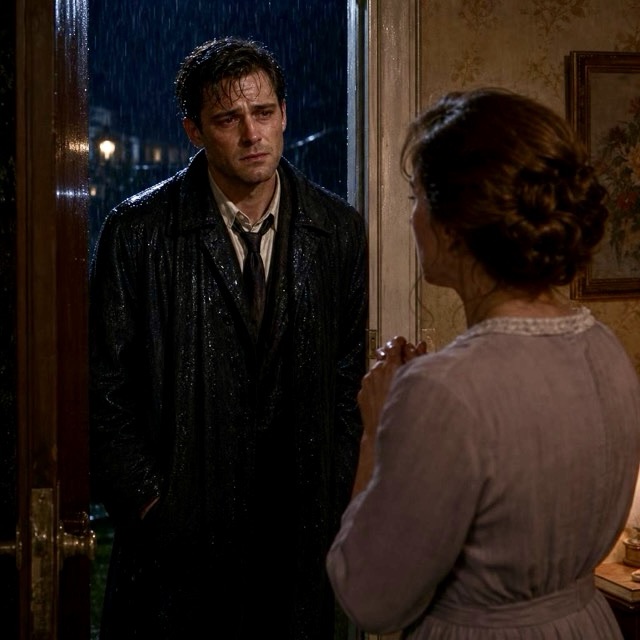
He stood in the doorway with rain on his coat and hurt in his eyes. Brenda felt the old words gathering like thunder. She had been foolish, reckless, too proud to see how quickly a careless promise can turn to wreckage. When she finally spoke, her voice was barely a whisper. “I am sorry, Tom, so sorry. I was such a fool and I apologize with everything I have left.”

Tom looked away, jaw tight. Brenda’s apology could not mend what trust had broken. She told him that mistakes like those she made with him belong to the young, but admitted that her naivety and youth were not excuses for the damage she had done. Love had blinded her once; now shame had stripped away even that comfort.

Still, she begged Tom to hear the truth beneath her trembling. She wasn’t defending herself for what she did. She was only feeling and expressing remorse.

The room stayed silent except for the rain outside of the opened door. At last Tom reached for his hat and turned and walked away.

And Brenda understood that some apologies arrive too late, carrying both love and loss in the same breath.


Image conjured by Jim Adams using Leonardo.ai.


“I’m Sorry” was recorded in 1960 by Brenda Lee when she was just 15, and it became one of the defining hits of her career. The song was written by Dub Allbritten and Ronnie Self, and its emotional delivery helped make it a classic teen-pop ballad.

Brenda Lee’s label initially hesitated to release the song because she was so young, and they worried a teenager might not sound convincing singing about heartbreak. Once it was released, though, the recording’s plainspoken sincerity and strong arrangement made it stand out immediately.

The song reached number 1 on the Billboard Hot 100 in July 1960, giving Lee her biggest pop success. It also became closely associated with the Nashville Sound, helped by the polished backing vocals and production style that gave it broad crossover appeal.

Beyond the chart success, “I’m Sorry” became one of Brenda Lee’s signature songs and one of the era’s best-known examples of a youthful but deeply felt pop performance. Its opening line is so memorable that it’s still instantly recognizable decades later.