Kings, Knights, Pirates, and a Multinational Conglomerate

It’s the Middle Ages but Not as You Imagine Them

By Michael Fredholm von Essen

Merchants played a powerful role in the Baltic region, as well as on the Continent. Most powerful was the Hanseatic League, which was a multinational business concern divided into three subsidiaries, each known as a Drittel (‘Third’). These were the Wendish-Saxon Drittel, under Lübeck; the Gotland-Livonian Drittel, under Visby; and the Westphalian-Prussian Drittel, under Dortmund. From an economic perspective, no Scandinavian king could compete with the wealthy Hanseatic League, which produced revenue streams that northern kings only could dream of. Then, as now, money was a key source of conflict. In Scandinavia and the Baltic region, trade decided the fortune of kingdoms.

The Nordic Middle Ages were different. Yes, you will find the expected kings, barons, knights, and crusaders, and chivalric tournaments were popular, but Scandinavia and the Baltic Sea region contained so much more. Piracy, for one thing. The Baltic Sea was at times controlled by a confederation of pirates, known as the Victual Brothers, which were led by their own ‘king’ of the Baltic. Their fleets might consist of up to 100 ships and 2,000 men. When the pirates accepted mercenary service, they received knightly rates, significantly higher than those of other mercenary companies. In the fifteenth century, the Victual Brothers extended their zone of operations to the waters of the North Sea, Iceland, and Greenland, which still hosted thousands of Nordic settlers who collected provisions and hunted on the North American coast.

When Charles, the editor of Helion’s new series A Time of Knights, asked me to contribute a book on the Battle of Visby 1361, I immediately accepted. Visby was, and is, the only urban centre on the island of Gotland, the largest island in the Baltic Sea and, incidentally, the one on which I grew up. Legends and stories of the battle remain common on Gotland, and for more than a century, battlefield archaeology has given us an increasingly better understanding of the event. The Battle of Visby was the culmination of a major campaign, in which a professional Danish invasion army confronted the militia of the Gotland Republic. The battle had all that Charles expected from the new book series, including predatory kings, battle-hardened knights, rambunctious mercenaries eager for coin, pious but learned churchmen, a confirmed saint, rumours of witches, and the walls and towers of a proud city – but also wealthy merchants with gold and silver that might make any king jealous.

Visby was a Hanseatic city. The wealth of the Hanseatic League primarily came from two sources. From around 1200 onwards, the League’s greatest revenue stream derived from the world’s then most important fish market, the annual Scanian herring market. It was held in autumn from St. Bartholomew’s Day to St. Dionysius the Areopagite’s Day on the shore between the two small Scanian castle towns of Skanör and Falsterbo. When the herring market approached, fishermen would arrive from near and afar to erect huts, trading booths, and temporary shops close to the area where the herring was spawning. When this seasonal event took place, it was said that herring was so abundant that one could scoop up the fish with one’s hands. There is evidence that commercial fishing of herring in the region took place already around the year 800 AD.

The demand for fish was huge in western and central Europe. Following the very nearly universal acceptance there of Catholic Christianity, the Church was able strictly to forbid the eating of meat on Fridays and during Lent, the 40-day fast from Ash Wednesday to Easter. But fish was permitted nourishment, and none was more easily available than Baltic herring. Herring had a high fat content, which also made it an inexpensive source of protein during winter. Moreover, merchants had found that it was possible to conserve fish by salting. This discovery, apparently made in the twelfth century, enabled the export of herring in barrels as far afield as to France, Spain, and Italy.

But originally of even greater importance was the Eastern trade, which followed the route from the Baltic through Novgorod and Kiev to the Crimea and Constantinople. The mother trade of the Baltic, it was first dominated not by the cities of the League but the independent merchant-farmers of the Gotland Republic. The Eastern trade, which emerged already in the first centuries AD, was the foundation for Gotland’s wealth and importance. It made the Gotlanders northern Europe’s leading merchants and brought huge volumes of gold and silver to the island. The Gotlanders brought furs and wax from Novgorod and the East to Germany, Flanders, England, and elsewhere in the west. Furs were an important luxury product, while wax was of extraordinary importance since all churches for religious reasons needed constant supplies of wax candles. In return, the Gotlanders exported weapons and other goods to the East. They also traded in iron, copper, fish, timber, whale-oil, and other necessities for European lands. England, for instance, imported both wooden staves for longbows and essentials for shipbuilding such as tar, pitch, hemp, flax, and especially timber from the Baltic region. Without the Eastern trade, England would have had far fewer of the longbows and warships that in time came to symbolise English growing military and naval power.

In 1361, King Valdemar of Denmark coveted Gotland’s wealth. Meanwhile, Gotland suffered from tensions over trading rights between the traditional rural merchant-farmers, the Gotlanders, and the Visby burghers, many of whom were of German origin, of the Hanseatic League. When King Valdemar landed on the island with Danish knights on horseback and experienced German mercenaries on foot, his chief adversary was the Gotland Republic’s well-armed rural militia. While many merchant-farmers had the means to raise armed men, the militia was untrained. Defeated twice, the Gotlanders withdrew to Visby, expecting the city’s burgher militia and mercenaries to join them against the invaders. Would the Visby burghers join the Gotlanders in the battle against the Danes?
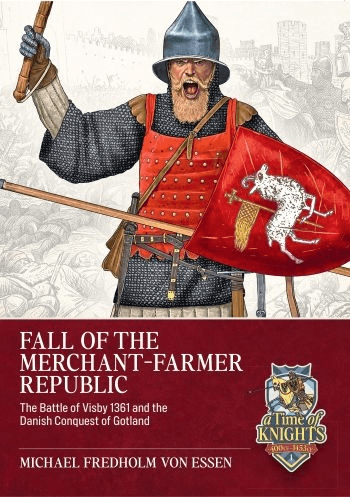
You can purchase Fall of the Merchant-Farmer Republic: The Battle of Visby 1361 and the Danish Conquest of Gotland here.

The Italian Army in the Battle of the Alps 1940 – Reassessing a Forgotten Campaign

Italy’s brief campaign against France in June 1940 has long been treated as an historical footnote: a symbolic gesture by Mussolini, overshadowed by Germany’s Blitzkrieg and dismissed as an opportunistic sideshow. In The Italian Army in the Battle of the Alps 1940, Massimiliano Afiero challenges that caricature head-on, offering the first modern, full-scale operational study in English of what was, in reality, a hard-fought and demanding mountain campaign.

Fought across more than 300 kilometres of some of Europe’s most inhospitable terrain—from Mont Blanc to the Mediterranean—the Alpine offensive confronted Italian forces with extreme weather, formidable French fortifications, and severe logistical constraints. Afiero places the campaign firmly within its political and military context, beginning with Mussolini’s decision to enter the war and the sobering reality of Italy’s military unpreparedness in 1940. Rather than glossing over these weaknesses, the book treats them as central to understanding how the campaign unfolded.

At its core, this is a detailed operational history. Afiero reconstructs the fighting sector by sector, tracing Italian advances through the Little Saint Bernard, Moncenisio, Maddalena, and Riviera axes, and examining clashes with French Alpine troops and fortress garrisons defending the so-called “Maginot Line of the Alps”. Particular attention is given to the actions of the Alpini, Bersaglieri, regular infantry divisions, Blackshirt units, Border Guard formations, and supporting artillery, alongside the French units opposing them.

One of the book’s key contributions is its dismantling of persistent myths. While acknowledging serious shortcomings in equipment, logistics, and coordination, Afiero demonstrates that Italian troops frequently fought with determination and courage, often under appalling conditions. Numerous small-unit actions, local breakthroughs, and acts of individual bravery are documented in detail, restoring a human dimension to a campaign too often reduced to political theatre.

The volume is richly illustrated with contemporary photographs, detailed maps, and specially commissioned colour artwork, all of which help clarify the complexity of operations in mountainous terrain. Technical appendices examine weapons, uniforms, and specialist equipment, including Alpine artillery, light tanks, and the limited but important role of the Regia Aeronautica. The inclusion of orders of battle, unit histories, and first-hand accounts makes this a valuable reference work as well as a narrative study.

More than a history of a short campaign, The Italian Army in the Battle of the Alps 1940 is a serious reassessment of Italy’s first major land operation of the Second World War. It will be essential reading for anyone interested in Alpine warfare, Italian military history, or the opening phase of the conflict in Western Europe—and a timely reminder that even “forgotten” campaigns deserve to be understood on their own terms.

You can purchase The Italian Army in the Battle of the Alps 1940 here.

Fighting Effectiveness in Practice: Tanks in Unexpected Places

There is no shortage of books on the British Army in the Second World War. Many recount campaigns; others revisit familiar debates about generalship, doctrine, and performance. What Tanks in Unexpected Places does—quietly but decisively—is shift the lens. Rather than asking what happened, Jonny Briggs asks a more demanding question: why did some formations consistently perform better than others?

At the centre of this study is the 4th (Independent) Armoured Brigade, a formation that fought across multiple theatres and, as Briggs demonstrates, was repeatedly trusted with some of the most difficult operational problems. This alone makes it worthy of attention. But the real value of the book lies in how it uses the brigade as a vehicle to interrogate the deeper mechanics of combat effectiveness.

Briggs structures his analysis around three interlocking themes: leadership, morale, and organisational learning. These are not treated as abstract concepts, but as lived realities at the tactical level—where decisions are made under pressure, cohesion is tested, and survival often depends on the smallest units functioning effectively. The result is a study that bridges the gap between high-level doctrine and the granular experience of war.

One of the book’s most striking contributions is its challenge to the long-standing narrative of British military underperformance. Rather than accepting broad generalisations, Briggs demonstrates that effectiveness varied significantly between formations. In the case of 4th Armoured Brigade, success stemmed not from any single factor, but from a dynamic interplay of leadership quality, adaptability, and a culture that encouraged learning from experience. The brigade’s ability to absorb lessons—whether from its own operations or from enemy practice—and translate them into improved performance emerges as a defining characteristic.

The study is also notable for its methodological ambition. Drawing on archival material, war diaries, and veteran testimony, Briggs integrates insights from organisational theory and the social sciences to construct a more nuanced understanding of how military units function. His working definition of “fighting effectiveness”—encompassing mission success, sustainability, morale, and learning—provides a useful framework not only for historians but for contemporary military professionals.

Importantly, the book does not romanticise its subject. It acknowledges failures, frictions, and the inherent chaos of combat. Terrain, enemy capability, and the limits of doctrine all play their part. Yet within this complexity, patterns emerge—patterns that suggest that effective formations were those able to think, adapt, and act coherently under pressure.

In many ways, Tanks in Unexpected Places is less about tanks than about people and systems: how they interact, how they learn, and how they perform in extremis. It is a study that rewards careful reading and will resonate with anyone interested in the realities of warfare beyond the headline narratives.

Buy Tanks in Unexpected Places: The Fighting Effectiveness of 4th (Independent) Armoured Brigade 1943-45 here.

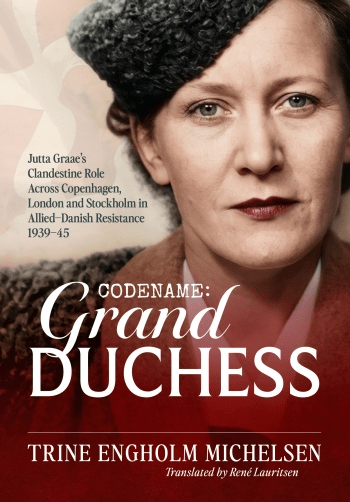
Codename: Grand Duchess — Reclaiming an Intelligence War from the Margins

There is a particular challenge in writing the history of intelligence. By its very nature, it resists narrative. It obscures, fragments, and erases itself. Yet, every so often, a figure emerges who forces us to reconsider what we think we know—not through grand proclamations, but through quiet, sustained influence. Codename: Grand Duchess is one such work.

Drawing on newly opened archives and an unusually rich triangulation of Danish, British, and Swedish sources, Trine Engholm Michelsen reconstructs the life and wartime role of Jutta Graae—a figure long relegated to the margins of Danish resistance historiography. As the book makes clear from its opening pages, Graae was “known under at least three code names” and operated across Copenhagen, Stockholm, and London as a central node in Allied intelligence and resistance activity.

What makes this study particularly compelling is not simply its subject, but its interpretative ambition. Graae was not a conventional operative. She held no rank, commanded no unit, and left behind only fragmentary personal testimony. Yet she emerges here as a strategic actor—an organiser, facilitator, and above all, a connector. From a bank vault in Copenhagen, she transformed an ostensibly mundane space into a clandestine hub for intelligence exchange and resistance coordination, linking Danish sources to British networks at a time when formal state structures had effectively collapsed.

Michelsen’s narrative unfolds with a deliberate clarity. The early chapters situate Graae within the social and cultural milieus that shaped her—bourgeois Copenhagen, interwar London high society, and the emerging networks of Anglo-Danish exchange. These are not mere biographical details; they are the foundations of her wartime effectiveness. The book demonstrates convincingly that Graae’s access—to people, spaces, and trust—was her greatest operational asset.

As the war progresses, the study deepens into a sophisticated examination of intelligence as practice. The reader is drawn into the mechanics of resistance: courier routes, microfilm, coded messages, and the constant tension between secrecy and action. Particularly striking is the depiction of the Danish intelligence service’s uneasy relationship with both MI6 and SOE—an environment of overlapping agendas, mutual suspicion, and pragmatic cooperation. Graae’s role within this ecosystem is both subtle and decisive.

Crucially, Codename: Grand Duchess does not romanticise its subject. It acknowledges the ambiguities and tensions inherent in resistance work—between intelligence gathering and sabotage, between national and Allied priorities, and between competing visions of Denmark’s wartime and post-war future. The book’s treatment of these themes is measured and analytically grounded, reflecting Michelsen’s background as an intelligence analyst.

Perhaps most importantly, the work challenges long-standing assumptions about the gendered nature of wartime contribution. Graae’s invisibility was not accidental; it was structural. As Michelsen notes, she “knew almost everything, but kept quiet about it all”. This study restores not only her story, but also a broader understanding of how intelligence networks functioned—often through figures who operated outside formal hierarchies.

In sum, this is a significant contribution to both Danish wartime history and the wider study of intelligence and resistance in the Second World War. It is a work that will resonate not only with historians, but also with those interested in the less visible dimensions of conflict—where influence is exercised not through command, but through connection.

Register your interest in Codename: Grand Duchess: Jutta Graae’s Clandestine Role Across Copenhagen, London and Stockholm in Allied–Danish Resistance 1939–45 here.

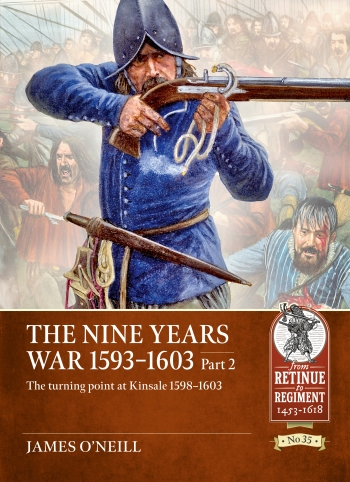
The Nine Years War in Ireland: A Guerrilla War? Not So Much

By James O’Neill

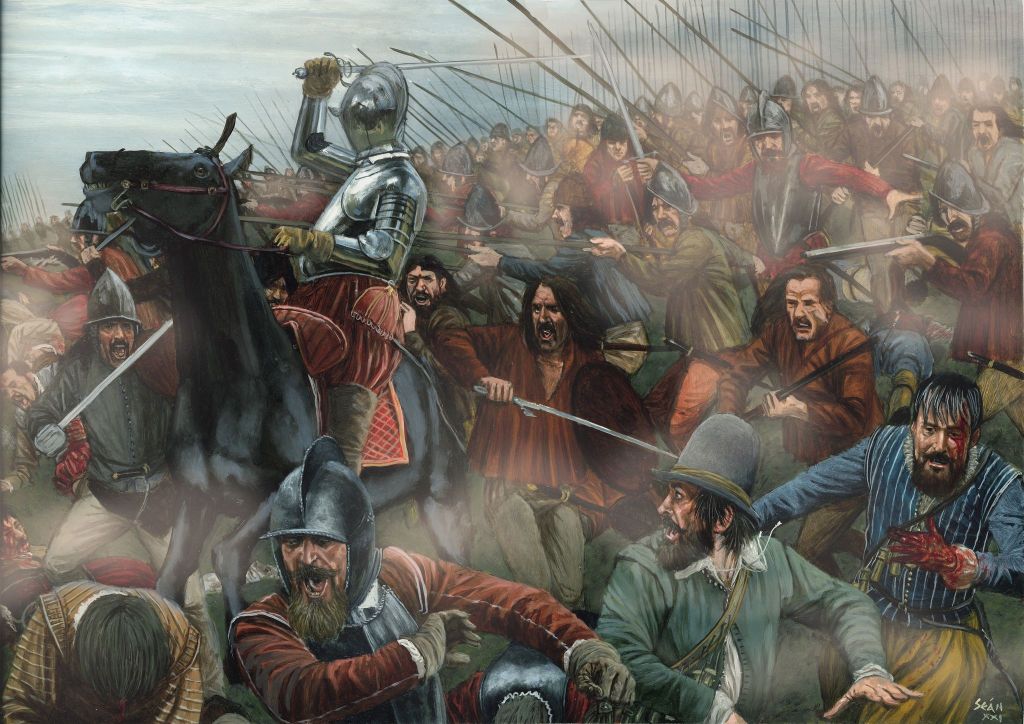
Now that The Nine Years War, 1593-1603: The turning point at Kinsale 1598-1603 is out, I can’t stop myself addressing one of the bugbears that has plagued the history of their conflict: guerrilla war.  I have been researching this particular conflict for well over twenty years (on and off, I have a life, for God’s sake). As I have told you many times before (and likely will again), there are many misconceptions around the conduct of this war. One of the most enduring and stubbornly difficult to shift has been the notion that this was a guerrilla war where hit-and-run tactics by a plucky yet primitive (another myth) Irish force kept the Crown army on their toes until Queen Elizabeth finally got serious and finished the matter with the devastating defeat of the Earl of Tyrone and his allies on Christmas Eve, 1601 at the battel of Kinsale.

Just typing those words got my hackles up, so I’ll be clear right from the start. This was not a guerrilla war; hit-and-run tactics did not predominate, and the Irish ranged against Elizabeth I’s armies were anything but primitive. Now that I’ve got my fulminating out of the way, I’ll explain why this was so.

First, with the notion of a guerrilla war. For the 21st-century mind, this conjures up images of low-tech part-time irregular troops, as seen in any number of Hollywood movies about Vietnam, where the indigenous guerrillas come out of the darkness/bushes (whatever you prefer) to attack the well-armed and highly organised regular forces of their enemy, only to withdraw at a moment’s notice and return to civilian life. This infuriates their opponents, who wish they would just stand still to be mown down by their superior firepower. Apply this to late 16th-century Irish warfare, and the mind is filled with hairy Irish kern skipping from bush to bush, much as they are portrayed on film in The Private Lives of Elizabeth and Essex (1939), starring Betty Davis and Errol Flynn.

One of the most commonly misused terms in relation to this war is ‘hit-and-run’. By this, I understand it to mean attacks on English forces, with intense, often bloody combat followed by a rapid retreat by the Irish into thick woods or broken ground, where they are safe from English counterattack. This again feeds into the public consciousness of guerrilla war, but a close examination of major engagements in the opening and mid-stages of the war clearly shows that this was not the case. At an early encounter near Tulsk (Co. Roscommon), the English withdrew. Yet the first significant engagement was at Belleek in 1593, where the Crown army under Sir Henry Bagenal overwhelmed Irish defenders on the River Erne. This is definitely an English win. That Tyrone intended it to be an English win as part of a deception plan is by-the-by. Next was the Battle of  Ford of the Biscuits in 1594, in which the Irish routed the Crown army and retained the field.

At the engagements at Crossdall and Clontibret (Co. Monaghan) in May 1595, the Crown army broke contact, leaving the field to the Irish. In the same year, the Crown army abandoned the field or broke contact at the battles at Nephin Mountain (Co. Mayo) and Mullabrack (Co. Armagh). In 1597, the English were routed at Aldfreck (Co. Antrim) and barely escaped destruction during the retreat from Ballyshannon (Co. Donegal); the devastating defeat of the English field army at Yellow Ford (Co. Armagh) in 1598 is well known. So, how do people still consider this a hit and run when the Irish retain the field in the vast majority of the major engagements for much of the war? Only when the tide is turned by Mountjoy in 1600 are the Irish forced to concede ground. Even then, it was Mountjoy who abandoned his ground against Tyrone in the Moyry Pass (Cos Armagh and Louth) in September-October 1600. He barely managed to escape with his troops after Tyrone engaged his retreating army from fortified positions along Mountjoy’s line of retreat north of Carlingford (Co Louth). Mountjoy was almost forced to march his men into the sea to escape the withering fire from his right flank, but superior numbers allowed them to break through to Carlingford to the south. Again, it was the Irish who held the field and the Crown army who broke contact.

Perhaps it was the underlying operational plans that caused some to mistake this for a guerrilla war. Crown officers noted that when the Irish pushed south to attack the Pale, the area of English-controlled territory along the east coast of Ireland, centred around Dublin. The Irish were noted for fighting a mixed war. This saw Tyrone deploy both large and small units into the field. Smaller units split off from the larger units to engage in spoiling operations, presenting English commanders with a grave dilemma. Who to oppose? Should they concentrate on opposing the main force, leaving the countryside open to spoliation? However, should the crown army disperse, there was nothing to check any advance by the Irish main force. This was noted by Sir Geffrey Fenton in 1598 when he reported that the Crown had no ‘itinerant army’ to oppose the Irish raids. Irregular operations worked in concert with larger main force units, enabling Tyrone to retain the strategic and operational initiative, forcing the English response to be piecemeal and reactive.

Beyond the large operations directed by Tyrone, the small-scale and localised campaigns by the earl’s allies across Ireland should have come as no surprise to English officers with continental experience, as this type of warfare had become a common, if not the defining feature, of day-to-day warfare on the continent. During the 1570s, wars in Holland were generally not fought in large-scale battles but in skirmishes and other unconnected, limited engagements. Indeed, it was Blaise de Monluc who reported that small war was in the ascendant in France, where war had become a series of ‘fights, encounters, skirmishes, ambushes, an occasional battle, minor sieges, assaults, escalades, captures and surprises of towns’. But somehow in the modern popular imagination, these blend in with the large encounters and sieges of those wars. In contrast, the Irish conflict remains what the Earl of Essex described as a miserable and beggarly war (we’ll hear more from him in Chapter 1. Spoiler alert: it doesn’t end well for him).

There was one characteristic of irregular war that did appear in Ireland, and that was the deliberate targeting of civilian populations. This was commonly seen when the Crown made large-scale main force efforts to engage Tyrone. No competent commander will allow themselves to be engaged while the enemy has the advantage, and this was true of Tyrone, who regularly refused contact, allowing English armies to erode through disease and desertion.  The vast majority of cases of civilian victimisation in war have occurred after a counter-force military policy has failed to deliver victory. The conduct of the war by the crown conformed to this pattern. For most of the conflict, the Irish held the initiative and, in most cases, initiated contact. Slow-paced infantry units deployed by the Crown were regularly outmanoeuvred by lighter Irish forces. Frequent failures to make contact caused Crown forces to turn their attention to a target they could attack: local civilians. This is how attacks on civilians during the war first emerged, at a local level.

Now, attacks on civilians in Ireland were often motivated by xenophobia and bigotry (and there was plenty of that), but these were not the only motivating factors. Damaged morale or a sense of ineffectiveness due to soldiers’ inability to close with an opposing military force can be allayed by a sense of empowerment that comes with mass murder or executions. In other words, if they can’t get at the enemy they want, troops can turn on a perceived enemy they can get; they can turn on the native civilian population. However, as the Crown forces recovered in 1600-1601 and started to gain the initiative, attacks on civilians became English policy to cow the native Irish, using terror and scorched earth tactics to separate Tyrone from his adherent lords and allies. Though Lord Deputy Mountjoy was clear that this policy was to elicit Tyrone’s betrayal, others, such as Sir Arthur Chichester, were distinctly more genocidal in their approach, whose goal was to reduce a population whom he thought fit only to be slaves. If you were not aware of this stage of the war, Chapter 5 will not spare the details.

Whoa, that last bit got pretty dark. But my point still stands. While there are elements that could lead one to conclude this was a guerrilla/low-intensity war, it was not the defining characteristic at all. So, to conclude, if you keep calling this a guerrilla war, for God’s sake, give your head a wobble.

The Nine Years War 1593-1603 Part 2: The turning point at Kinsale 1598-1603 is now available to buy here.

British Amphibious Warfare 1739-1815: Success and Failure Across Five Continents

By Andrew Young

In studies of British amphibious warfare, practice has long tended to outrun theory. The landings, descents, sieges, and raids of the long eighteenth century are well documented, yet the conceptual frameworks through which contemporaries attempted to understand and systematise these operations have often been treated as an afterthought. Chapter 5 of British Amphibious Warfare, 1739–1815 seeks to redress that balance by placing Thomas More Molyneux – soldier, thinker, and system-builder – at the centre of the story.

Molyneux is not an obvious figure. He did not command great expeditions, win famous battles, or leave behind a heroic death. Yet his 1759 work Conjunct Expeditions represents one of the most sustained attempts by a British officer to explain how land and sea power might be integrated into a coherent way of war. My chapter, ‘For Want of System’, argues that Molyneux was grappling with a problem that haunted British strategy throughout the eighteenth century: how to translate maritime advantage into consistent strategic effect ashore.

Rather than treating amphibious warfare purely as a series of technical problems – boats, beaches, tides – Molyneux approached it as a system of relationships: between army and navy, between political direction and military execution, and between strategic intent and operational design. He was acutely aware that British failures were rarely the result of lack of courage, but of friction, misunderstanding, and poor coordination. In this sense, Molyneux was less a theorist of landings than a diagnostician of dysfunction.

This concern with system, or its absence, forms a golden thread that runs throughout the volume. From the catastrophic collapse at Cartagena in 1741, through the uneasy successes and failures of the French coastal descents, to the more mature operations of the Revolutionary and Napoleonic Wars, the contributors repeatedly return to the same underlying question: why did Britain sometimes get amphibious warfare so right, and at other times so disastrously wrong?

Each chapter approaches that question from a different angle. Case studies such as Louisbourg, Belleisle, Charleston, Ceylon, and Walcheren reveal how local conditions, command relationships, intelligence, logistics, and political pressure shaped outcomes. Others, including operations in the Adriatic and the Low Countries, show how experience accumulated over time, gradually embedding a body of practice even when formal doctrine lagged behind. Read together, these chapters suggest that Britain’s eventual amphibious effectiveness was not inevitable, but learned: unevenly; painfully; and often retrospectively.

Molyneux sits at the heart of this story precisely because he recognised the pattern while it was still forming. His frustration – for want of system – echoes across the campaigns examined in this volume. By placing his ideas alongside the lived experience of operations across five continents, this collection brings theory and practice back into conversation, offering a richer understanding of how Britain’s amphibious way of warfare was forged.

Chapters and Contributors

  1. Overview: British Amphibious Warfare 1739–1815
    Andrew Bamford
  2. Cartagena 1741: A Byword for Calamity
    Tom Golding-Lee
  3. ‘So Glorious an Enterprise’: The Siege and Capture of Louisbourg, 1745
    R.N.W. Thomas
  4. Lorient 1746: Lessons Unlearned
    Andrew Bamford
  5. ‘For Want of System’: Thomas More Molyneux and the Birth of a British Way of Warfare
    Andrew Young
  6. ‘The Whole Island is a Fortification’: Belleisle 1761
    Samuel Dodson
  7. A Tale of Two Operations: Philadelphia 1777 and Charleston 1781
    James R. McIntyre
  8. Cheese and Treason: Ceylon 1795
    Philip Ball
  9. From Den Helder to Aboukir: Practice Makes Perfect
    Carole Divall
  10. Amphibious Warfare in the Adriatic During the Napoleonic Wars
    Dave Watson
  11. When Things Go (Very) Wrong: The Walcheren Expedition of 1809 and the Difficulties of Amphibious Warfare
    Jacqueline Reiter

British Amphibious Warfare 1739-1815: Success and Failure Across Five Continents is available to buy here.

The Glorious Crusade of 1688: Religious Iconography of William, Prince of Orange

By Mark Shearwood

William III Landing at Brixham, Torbay, 5 November 1688 by Jan Wyck, 1688.

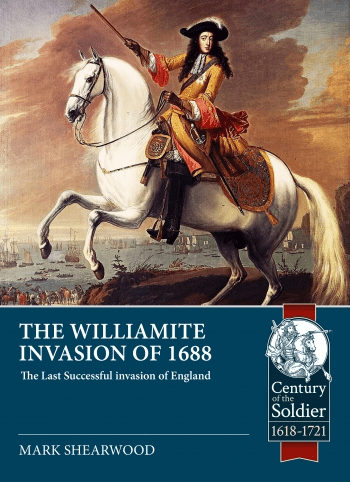
The events of November 1688 have been given numerous names from Bloodless Revolution, the English Revolution, the Extraordinary Revolution, a Famous Revolution, the Great Revolution, the Peaceful Revolution, the Sensible Revolution, a Stupendous Revolution and even as the Bourgeois Revolution, the Unglorious, Inglorious Revolution, a Protestant Crusade as well as the Glorious Revolution. The term ‘Glorious Revolution’ was first used in by John Hampden’s (Member of Parliament for Wendover 1689-1690) in his testimony before the House of Lords in late 1689.[1] The events have also been categorised as a coup or indeed as an invasion which is the focus of my latest book for Helion & Co, The Williamite Invasion of 1688: The Last Successful Invasion of England (due for publication in the second half of 1688.

In this article I am going to consider the religious iconography and language that was designed to depict William’s invasion of England as a religious crusade against the Catholic James II, king of England. While the anti-Catholic propaganda of the period is well-known and documented, the imagery was designed to evoke the religious rhetoric of the earlier crusades to the Holy Land and the Albigensian crusade against the Catharism of Languedoc (now southern France) between 1209-1229. The imagery and language used were designed to link William and his intervention in England to biblical references of Christ, the archangels, and to St Michael and St George. The references would have been well known to all levels of England’s population through the church and the bible.

Print by Johann Sadeler, Antwerp after design by Crispijn van de Passe, Date: 1639, Rijksmuseum. RP-P-1904-3388

Looking at the language use in the proclamation announcing William’s arrival into the county town of Exeter, we see the direct use of biblical imagery designed to justify William actions, framing them as freeing the country from sin and evil as the only champion of the Protestant faith. Handbills were published after William’s entry into Exeter (9th November 1688) and were distributed throughout the country by his supporters. These stated that when William entered the city, he was accompanied by 200 Finlanders or Laplanders dressed in bear skins and black armor, and each soldier was carrying a broad flaming sword.[2]

The image of flaming swords is one straight out of myth and legends, and a direct reference to the bible and specifically to the archangels Jophiel and Uriel.[3] Anyone reading the description would be familiar with the biblical reference and the link to Adam and Eve’s disobedience and their exile from God due to their sins. They would also understand the link between the bearer of the flaming sword and the guardian of the Tree of Knowledge, and although William is not depicted carrying one, his bodyguards were carrying them. The link between James II’s abandonment of the Protestant religion and William’s subsequent arrival to either restore the Protestant religion and expel the king from the country would not have been missed by all those reading the handbills.

The imagery of William on a rearing white horse is one of the most prevalent ways of depicting the prince, from written accounts during the invasion and subsequent war in Ireland to murals still pained on the end of terrace houses in Glasgow and Belfast. This image is a direct referral to both Christ and St George and St Michael. In an age where religious iconography was well known and understood, the biblical link would have not been missed by the Protestant population. One of the most prominent passages of Revelations states that ‘And I saw heaven opened and behold a white horse; and he that sat upon him was called Faithful and True, and in righteousness he doth judge and make war’.[4]

The preceding passage within revelations describes a rider that conquers a country and was given a crown, stating  ‘I looked, and behold, a white horse, and its rider had a bow, a crown was given to him, and he went out conquering and to conquer’.[5] While this passage introduces is actually introducing the first of the four horsemen of the apocalypse, the reference to the rider being William who not only conquered England but was also given the Crown of England by Parliament would not have been lost to all those reading the broadsheets.

The white horse held significance within the collective memory of England, with it representing the mount of heroes and the bearers of divine messages, symbolizing purity, innocence, and sovereignty. There is also a link between William being depicted on a white horse and the Uffington white horse whose folk lore was linked to power and protection. By being associated with the myth of the white horse, William became the visual representation of the triumph of good over evil, which in this case meant the Protestant faith over the Catholic faith, and more specifically against Louis XIV of France and the Pope.

During the late seventeenth century ballads were an important part of the information cycle, with printed sheets of the latest political ballad sold on street corners, while the seller sang the new ballad to gain attention. Each of these songs were sung to existing ‘well-known’ tunes, bringing a sense of familiarity to the listener and enticing people to listen to, and remembering the latest lyrics.  The Ballad ‘A Full Description of these Times; or the Prince of Orange’s March from Exeter to London’ published believed to be published in late 1688 to early 1689 links the Dutch invasion and William’s intervention in England to the medieval crusades with the line ‘Now a Figg for the Devel the Pope and the Turk’[6]. This reference to the Devil, the Pope (and therefor the Catholic faith), and the Turks, was designed to re-ignite the fears of the Ottoman invasion of Christian lands, with the Turkish sieve of Vienna still on the recent collective memory of the population. This link to the ‘evil Ottoman Turks’ was further highlighted by the repeated references to freeing the country from slavery, while this is generally linked to ‘slavery’ under an absolute Catholic monarch, it also was a reminder to the Ottoman practice of enslaving Christians within their territories.[7]

William of Orange never viewed his invasion of England as a religious crusade, unlike his English supporters, he was not anti-Catholic. He had established a coalition against Louis XIV consisting of Catholic and Protestant countries, with his invasion force contained more Catholic soldiers than the English army of James II. Although the events of 1688 were described as part of a Protestant crusade within a biography of the Prince of Orange published in England in 1689, it was not sanctioned by the Anglican church.[8] William’s invasion had been sanctioned by Pope Innocent XI on the condition that it was to pursue William’s and his Wife’s claim to the throne and not to subjugate English Catholics. While the Williamite crusade may have only been in the minds of the princes’ supporters and propagandists, the impact of their iconography is still in evidence today.

You can register interest in The Williamite Invasion of 1688. The Last Successful invasion of England here.


[1] L. G. Schwoerer, ed., The Revolution of 1688-1689: Changing Perspectives (Cambridge: CUP, 1992) p. 3.

  Hertzler, Who Dubbed It ‘The Glorious Revolution’’, p.582.

[2] Anon, A True and Exact Relation of the Prince of Orange: His Publick Entrance into Exeter (Exeter, N.P. 1688).

[3] Genisis 3:24.

[4] Revelations 19:11.

[5] Revelations 6:2.

[6] Anon, A Full Description of these Times; or the Prince of Orange’s March from Exeter to London (N.L.: A.B., N.D.).

[7] Anon, A Letter of Advice to all Protestant Soldiers, and Seamen (London; N.P., 1688).

[8] T. Edwards, The Character of His Royal Highness William Henry Prince of Orange (London: Randall Taylor, 1689)

Wars of the Three Kingdoms

By Carl Fredrik Sverdrup

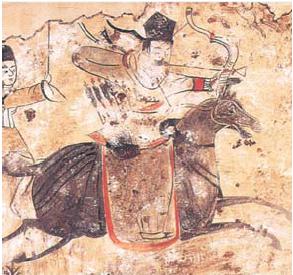
Among the great commanders of antiquity, few figures are as influential—or as misunderstood—as Cao Cao. Founder of the state of Wei and dominant military power in northern China at the end of the Eastern Han dynasty, Cao Cao operated in a world defined by political collapse, demographic catastrophe, and near-continuous war.

Yet despite his achievements, Cao Cao’s reputation has long been shaped less by military reality than by hostile tradition. Later histories and popular literature cast him as a cruel and deceitful villain, an image reinforced by the spin of rival courts and the enduring influence of romance narratives. This volume sets out to move beyond caricature and reassess Cao Cao as a general—judged by campaigns, decisions, and results.

War in a Failed State

The collapse of Han authority in 189 CE shattered China’s administrative and economic foundations. Population levels fell dramatically, agricultural systems broke down, and loyalty among officers and soldiers became fluid. Cao Cao fought without the advantages of geography, technological superiority, or overwhelming manpower. His opponents were drawn from the same military culture, used the same weapons, and operated under the same constraints.

What distinguished Cao Cao was not brute force, but organisation and skill. He combined operational flexibility with an acute understanding of logistics, supply, and manpower. His destruction of enemy depots, deliberate use of manoeuvre, and careful avoidance of unnecessary risk repeatedly allowed him to defeat larger forces. At the same time, he rebuilt civil administration, reformed landholding to stabilise food production, and appointed officers by merit—often recruiting former enemies.

Campaigns, Not Legend

This book examines Cao Cao’s military operations from his first independent command in 190 CE to his final expedition in 219, reconstructing campaigns in operational terms: movements, logistics, terrain, command decisions, and outcomes. It also places his achievements in comparative perspective through analysis of later campaigns conducted by Zhuge Liang and Sima Yi within the same post-Han strategic environment.

Drawing primarily on the Sanguozhi and its later commentaries, the study addresses the limitations of traditional Chinese historiography, including partisan distortion and an inherited tendency to exaggerate the role of advisors at the expense of commanders’ own agency. By focusing on what armies actually did—and what those actions achieved—the book offers a more balanced and evidence-based assessment.

A General Reconsidered

Cao Cao was neither the reckless tyrant of later legend nor a passive ruler guided by others. He was a deliberate, adaptive commander who understood that wars are won through preparation, supply, and disciplined execution as much as battlefield courage.

By stripping away centuries of political and literary bias, this volume restores Cao Cao to his proper place as one of the most capable military leaders of the ancient world—and a case study in command under conditions of systemic collapse.

Wars of the Three Kingdoms: Cao Cao and Warfare in the Chinese World from 189 CE to 238 CE is now available to buy here.

Eyewitnesses at Salamanca

By Gareth Glover

The Battle of Salamanca was undoubtedly one of Wellington’s greatest victories, and we have many eyewitness accounts of the fighting from the infantry; but rather surprisingly, there are few eyewitness accounts of the famous charge of Major General Le Marchant’s heavy cavalry brigade, which did so much to decide the day.

However, the publication With Wellington’s Cavalry, which contains the letters of two brothers (John and George Luard) and their two uncles (Charles and George Dalbiac), who all fought alongside each other in the 4th Dragoons during the Peninsular War, has now significantly helped fill this gap.

Charles Dalbiac wrote a very descriptive letter to his wife about the action:

‘…We were through them in an instant & the whole were either killed, wounded or taken. Whilst this passed, the 3rd [Dragoons] and 5th Dragoons [Guards] had administered the same fare to the remainder of the French Brigade which had been opposed to the 3rd Division and which were then retreating in quick step close upon the right of the 4th Dragoons. These operations occasioned no halt, the prisoners being left for the infantry to secure. The Brigade pushed on at a gallop and next fell in with a column of about 6,000 infantry, which I take to have been the support of the 3 Battalions first charged by the 4th Dragoons. This column gave us their fire and brought down some men and horses, but instantly shared the fate of their comrades. By this time, owing to our having been under the necessity of changing our front by carrying the right shoulders forward, owing to the ground having narrowed upon us & to the partial thinning of our ranks, the 3 regiments became a good deal mixed and in many parts it was 3rd & 4th/ 5th & 3rd/, still however preserving a firm & regular front, & in a solid impenetrable mass without intervals. This circumstance which in any other instance would have proved highly prejudicial to cavalry, was of the most essential benefit. The attacks were all made in one of the evergreen oak woods you have often seen in this country and where the regular advance of a Squadron must be impeded. This had little effect however upon the Brigade, which continuing to advance on the gallop, next encountered a Brigade of the enemy’s infantry formed in column serre and drawn up under cover of some oaks to receive us. When within 20 yards, they poured in a most tremendous fire; here fell our gallant General Le Marchant, having set a noble example of intrepidity to his Brigade. Here also Captain White, our AQMG received a mortal wound & also Colonel Elley a slight one, & here were brought down to the ground one 3rd of the Brigade by the fall of horse or rider, the loss of either, as you well know, rendering the other unserviceable. The remainder however of the Brigade reached the enemy’s column in an instant, which being most vigorously charged, faced about, we had now nothing to do but to take prisoners ad libetum and I do hope as few were put to the sword as circumstances rendered safe & of course justifiable. Lord Edward Somerset however, having spied 5 guns on the left, separated as soon as possible with the right Squadron (in which your nephew J[ohn] Luard commanded a division) and charging took the whole of them. In the meantime, I got together about 30 files and following the wake of the enemy’s column, kept crying ‘Bas vos armes vite en arriere ou tous seront tailler en pieces’ [Put your weapons away, or they will all be cut to pieces] I was even cheerfully obeyed and more than once thanked by the French officers for the manner in which the prisoners were treated. After this, we could not collect above 3 Squadrons to advance out of the Brigade… We commenced the attack about 5, in about 40 minutes afterwards had defeated all their infantry opposed to them and taken 5 guns …’

John Luard recorded his thoughts in his daily journal:

 ‘…We were moved under a hill close under the enemies [sic] guns, but safe from their fire; for all their shot went over us. While here I made a sketch of the ground in a small book I always carried in my sabretache, but unfortunately I lost it.19 At 5 [pm] the 3rd Division, which was on the left of our army, was brought by the rear, to our right & attacked the left of the enemy & drove them from a hill, we supported. The enemy line gave way & we continued to advance & charge until dark for about a mile, taking 5 guns & a great many prisoners. I turned the leader [horse] of one of the artillery guns, which was making its escape.’

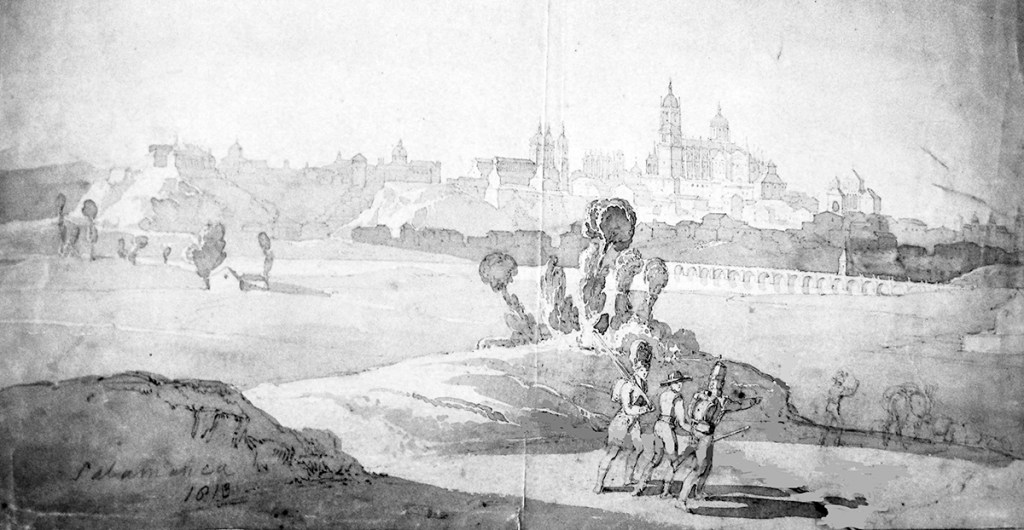
You will note that he mentions making a quick sketch of the battle while waiting to charge. John was a proficient artist and sketched many scenes while on campaign in Spain and Portugal, which also form a major highlight of the book. Unfortunately, as he records, his Salamanca sketch was lost, but he did sketch the army entering Salamanca, which is shown here.

The letters and journals of the Luards and Dalbiacs bring the life of a cavalryman in the Peninsular War and the Waterloo Campaign very much to life and will also challenge the accepted narrative of a number of engagements, including Albuera.

With Wellington’s Cavalry: The Letters & Journals of the Luard & Dalbiac brothers during the Peninsular and Waterloo Campaigns is now available to buy here.

Shamrocks Among The Poppies

War in Afghanistan through the eyes of the Irish warriors who fought there in 2006

By Derek Plews

The Colours of the Royal Irish Regiment, two banners, woven in silk of the finest quality, are emblazoned with the battle honours awarded to it – and its antecedents – reflecting a glorious history that spans more than 300 years.

One of the earliest is Martinique, in 1762. The most recent is Iraq, in 2003. Others include Barrosa (1811); Sevastapol (1854); Egypt (1882-1884); South Africa (1899-1902); Somme (1916 and 1918) Ypres (1914/15/17/18); North Africa (1942-43); Italy (1943-45); Normandy Landings (1944); and Korea (1950-51).

But there is no place on the banners for Musa Qal’eh 2006, even though the fighting that took place there, during that long, hot summer and early autumn, was on a par with some of the other actions listed above, both in terms of the ferocity of the combat and the steadiness and fortitude displayed by the soldiers.

Of course, the lack of a Musa Qal’eh battle honour can be easily explained. The Royal Irish Regiment did not serve there as a formed unit in 2006. The bulk of the battalion was in barracks, behind the imposing grey stone walls of Fort George, near Inverness, recovering from an operational tour in southern Iraq and preparing to deploy to Afghanistan 18 months later.

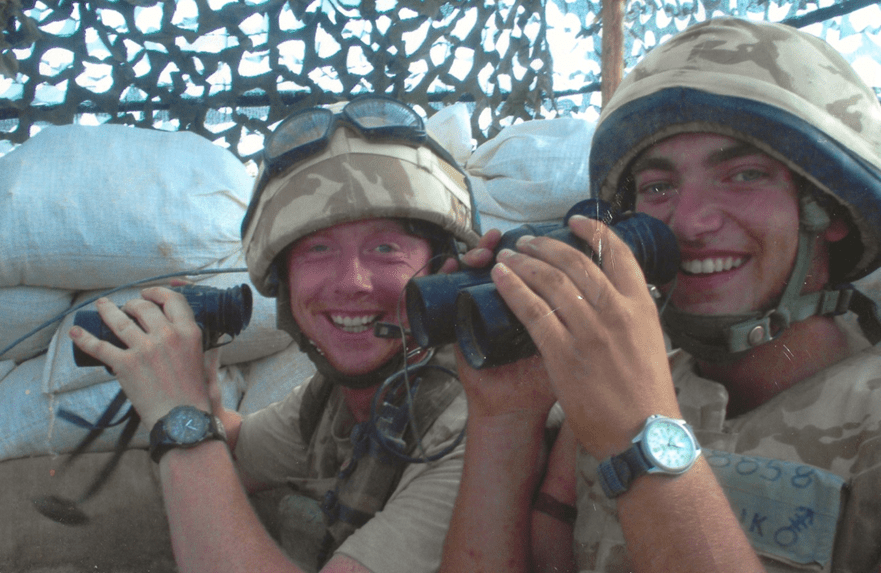
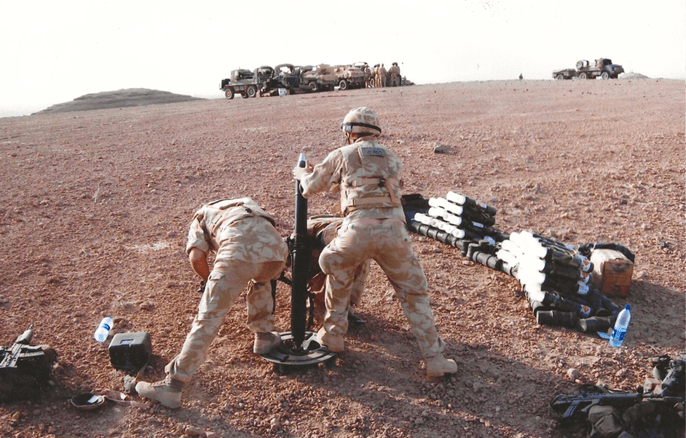
Mortar Fire Controllers, Corporal John Harding (left) and Lance Corporal Rab McClurg, Musa Qal’eh, 2006 (Photo: Danny Groves).

But nearly 60 Royal Irish soldiers, formed into two rifle platoons, and two mortar detachments, did find themselves in the blast furnace that was northern Helmand that year, fighting for their lives under the title of Easy Company, 3 Para Battlegroup, 16 Air Assault Brigade. Barrosa and Somme platoons were composites, put together from the cream of the first battalion in response to a call for reinforcements for an under-strength 3 Para, facing a growing Taliban insurgency. 

The story of Easy Company has been well told by the man who commanded it,  Adam Jowett, a Parachute Regiment officer, in his excellent work entitled “No Way Out”.

Royal Irish Regiment mortar detachments at Musa Qal’eh. From left to right: Corporal John Harding, Ranger Ricky Armstrong, Ranger Adam Dunlop, Ranger Jason Mooney, Corporal Danny Groves, Lance Corporal Rab McClurg, Ranger David McFarland, Ranger Smith. Seated: Ranger Dougie McLaughlin and Rgr Crockard (Photo: Danny Groves).

But as I read it, two things occurred to me. The first was that it was an officer’s account, based on his own recollections and experiences. The second was that there was room for another version, told from a different perspective: a soldiers’ eye view, from closer to the coalface, reflecting the contribution made by the Royal Irish Regiment Rangers[1] and NCOs who formed the bulk of the fighting force, and told in their own words. At the same time, I felt a new account represented an opportunity to plug a gap in the regimental historiography.

And so, Shamrocks Among the Poppies was born.

The title reflects the Royal Irish Regiment’s Tactical Recognition Flash, a green shamrock on a black background, and the fields of opium poppies that could be seen by the defenders, from the walls of the District Centre in Musa Qal’eh, as they fought off repeated Taliban attacks.

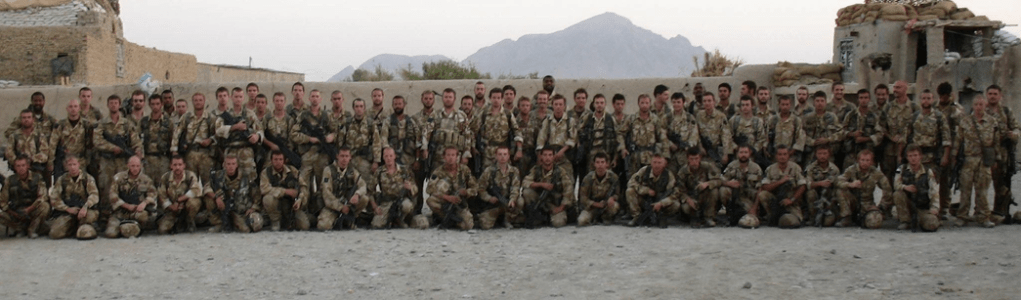
Easy Company, 3 Para Battlegroup, including the Royal Irish Regiment’s Somme Platoon. Barrosa Platoon and mortar detachments, Musa Qal’eh, 2006. This photograph was taken after the ceasefire (Photo: Stephen Gilchrist).

The book was originally conceived in three parts. The first would deal with the decision-making that took the British army to Afghanistan in 2006 while it was still heavily engaged in Iraq. The second would explain why ministers and senior military commanders agreed to send a relatively small force to undertake a potentially massive task. And the third would be an account of the fighting at Musa Qal’eh – why we went there; why we allowed ourselves to become fixed there; the consequences of those decisions in terms of the fighting and the resulting casualties; and how the siege was finally resolved. In my mind, the book would end with the survivors climbing into the back of Chinook helicopters, at a remote desert landing zone, for the short flight back to safety.

But as I began to interview veterans, it became very clear, very quickly, that the book could not end with a helicopter ride back to civilisation. For many of the soldiers who fought at Musa Qal’eh, the combat was still going on… in their minds. And it was still claiming victims. Some found the daily battle with their demons was just too painful to bear and ended it, or attempted to end it, by their own hands.

So, the final section exposes the impact of high-intensity combat on the mental health of some of those who experienced it – a significant proportion of whom have since been diagnosed with various psychological issues including Post Traumatic Stress Disorder – and how the nation initially failed to ensure that veterans – particularly those based in Northern Ireland – could get easy access to much-needed, life-saving therapy.

Bedding-in the mortar base-plate during Operation Snakebite, the insertion of Somme Platoon into Musa Qal’eh (Photo: Danny Groves).

As a military historian more at home with the battlefields of the First World War and engaging with events through the prism of dusty documents from deep in the vaults of the National Archives and other repositories – at a range of more than a century – I found the process of researching and writing a contemporary history to be quite different from my previous experiences.  

For example, many of the witnesses were still alive. So, instead of reading their long-forgotten reports and letters, I had to persuade them to speak to me face-to-face (or at least on the phone). And then I had to get them to open up. I found myself falling back on interview techniques I had been taught as a trainee journalist, more than four decades earlier.

I was warned, early on, that the Musa Qal’eh cohort were a “a difficult bunch”. That was not far wrong.

Many of the soldiers who fought there found it cathartic to talk about their experiences. But they were reluctant to engage with people unless they believed they would understand what they had been through. Many civilians, with no experience of military operations, found their accounts difficult to comprehend.

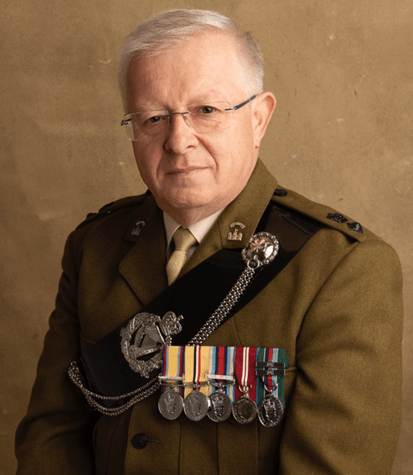
The author, Lt Col (Retd) Derek Plews

Luckily, I had served in Iraq and Afghanistan, and although I had not seen the fighting they had witnessed, I was given the benefit of the doubt. But not before they checked me out, sending one of their number to conduct a Close Target Reconnaissance at my kitchen table, over several cups of tea.

Having passed the test, however, they allowed me in to their circle and talked openly about what they had seen and done, and how it had affected them, at the time and later. I feel privileged to have been taken into their trust.

I was equally pleased with the level of access I was given to former senior MOD decision-makers and policy officials. I had been a Defence civil servant and ex-colleagues helped to smooth the way by providing contacts, making introductions and (presumably) providing assurances of my good character and positive intentions.  I found that after 20 years, some senior officers were happy enough to rake over the coals of their advice and the decisions that were based on it.

Politicians were less forthcoming. Two Defence Secretaries who were involved in the decisions that sent British troops to Helmand, failed to respond to my requests for interviews. However, evidence provided by them (and others) to various House of Commons Defence Committee inquiries, and the copious records of the Chilcot Report (Iraq Inquiry) lessened the impact of those refusals.

The result is a book that is part geo-political odyssey, describing the long process that led the British army to Iraq in 2003 and to Afghanistan three years later; and part an eye-witness account of some of the toughest fighting British soldiers had experienced since the Korean War, told through the words of the men who fought there.

It begins with British Prime Minister, Tony Blair and his vision of the UK as a global leader; his decision to align with arch-conservative US President, George W Bush – a man who should have been his political nemesis; and how that critical relationship drove decisions for war – in Iraq and later in Afghanistan. It also describes in detail the background and high-level decision-making process that led to the UK deciding to re-invest in Helmand Province in 2006. And it sets out how generals and ministers may have ignored the growing Taliban threat on the ground in order to justify sending such a small force to undertake such a potentially huge task.

As explained above, the poppies in the title are a reference to the view from the rooftops of the District Centre at Musa Qal’eh. But they are also there as a reminder of what much of the fighting in Helmand was all about.

According to the UN Office on Drugs and Crime, in 2006 Helmand Province was the opium capital of the world. If it had been a country, Helmand would have been right at the top of the UN list of opium-producing nations, closely followed by the rest of Afghanistan. Ninety per cent of the heroin that was being injected into the veins of British addicts at that time was refined from Afghan opium.

And just as drugs are a catalyst for crime in the UK, so, too, was the case in Helmand. The province was a battle zone before the soldiers of 16 Air Assault Brigade arrived there. It was a lawless place where the drug traffickers and their armed militias held the real power and often dispensed it from the barrel of an AK47 assault rifle. Even the provincial Governor, Sher Muhammad Akhundzada, was believed to have been deeply immersed in drug-running.

Announcing the deployment of British troops, in January, 2006, Defence Secretary, John Reid, referred to the drugs menace emanating from Helmand as part of the justification for the move. His words were music to the ears of the Taliban, who used them as part of a sophisticated information campaign, aimed at turning the poppy-growers of Helmand against the UK force. The British, they claimed, were coming to burn their poppy fields, leaving them destitute and unable to repay the loans they had taken from the opium barons to rent land and buy seed. So, even before the first British boots hit the Helmand sand, large swathes of the local population had been turned against them and were ready to take up arms to drive out the invaders and their Government of Afghanistan allies.

The result was penny-packets of soldiers – too small in number to do anything but protect themselves – being sent to Sangin, Now Zad, Kajaki and Musa Qal’eh, as the north exploded in bloody battle.


[1] Ranger is the Royal Irish Regiment’s term for a private soldier.