You know those godawful American domestic sitcoms? The one where the central male character surrounds himself with a crew composed of extended family, and they all go off on zany adventures while his long-suffering housewife, the wet blanket voice of reason, rolls her eyes and deals with the fallout of their antics?
Imagine that, but Breaking Bad.
Kevin Can F Himself is the result. It stars Annie Murphy, aka the daughter in Schitt’s Creek (that makes this the second show she’s been in with an implied profanity in the title, so she gets two nickels), as the housewife, Allison, with the emphasis on the long suffering.
The lead character of the sitcom is Kevin, which is why he gets his name in the title of the show, but it’s what happens when he’s not on screen that explains why he can F himself.
The sitcom is brightly lit, based around the classic sitcom house (door at one end that opens into a living room where all the armchairs face the fourth wall, with stairs going up along the back wall, and a door leads through to a kitchen with chairs around only three sides of the kitchen table). The cameras are stationary, switching to other characters through cuts. Characters deliver their lines with an emphasis on clearly announcing the next scripted joke in preference to conveying deep emotion, and the studio audience laughs uproariously at every one of them, even if the joke was lame. Nobody swears.
Kevin holds two parties, one sophisticated for his boss, and one trashy for his friends.
Kevin and his idiot best friend Neil start a band.
Kevin gets into a feud with an unseen neighbour.
Kevin decides he wants to start a family with Allison.
Kevin stands for election to the city council.
They reuse the ‘two parties’ plot, in the same season, one for a meal with Allison, the other at the arcade with Neil.
It’s a bad sitcom, written perfectly as a bad sitcom.
But the moment Allison is alone, everything changes. A darker, more natural lighting emerges. Shadows appear. Characters no longer talk like they’re just there to entertain an audience. Allison swears.
The camerawork closes in as handheld cameras catch every twitch of the fingers and every crease of the forehead.
You see the fourth wall. The set literally has a wall where the studio audience supposedly was a second earlier.
This sudden shift signals the other half of the show. You know I mentioned Breaking Bad? Allison breaks bad, except instead of dealing meth, her bad is plotting the murder of her emotionally abusive, narcissistic manchild of a husband.
But it’s not just a show of two halves. The crime thriller side of Allison’s life keeps interfering with the sitcom, even if Kevin is largely clueless. First of all, the token chick of Kevin’s gang, Patty, gets drawn into Allison’s plot, drifting away from Kevin’s orbit, and we discover there’s a lot more to her than the two-dimensional sitcom version. Other overlaps occur, including a deadly serious storyline late in the series that leaves Kevin traumatised within his brightly coloured world, even if he gets better as soon as he thinks of a new any scheme.
In trying to break free from her old life as a domestic sitcom housewife, Allison is destroying the lives of those around her. Sitcoms have no consequences for the actions of their characters, but the crime drama is all about the consequences of bad decisions.
The first season ends with a shocking act of realistic violence taking place involving a sitcom character in the sitcom world, before that character is yanked, apparently permanently, into the dramatic world.
The technical aspects of the show are brilliant. The syncing up of a stupid comedy with a gritty crime drama shouldn’t work, but it absolutely does.
Season one is included with Amazon Prime in the UK, but the second season needs paying for. I’ll be doing that just as soon as payday arrives.
It’s been a while. Aside from a busy life, I’ve been doing a spot of proofreading for another writer and then spending National Novel-Writing Month (or November, as people usually refer to it) trying to write my latest stab at a novel.
(Quick note: It has taken me a long time to read this book, starting in November 2024 and finishing in February 2026, so some of the following paragraphs are a little out of date.)
A quick side-note on NaNoWriMo – it’s been a bit controversial for the past few years. Last year there was a sordid child grooming scandal, the details of which I didn’t want to get too far into, but NaNoWriMo didn’t handle it all that well. This year, they decided that it was okay to write your 50,000 word novel using generative AI like ChatGPT.
NaNoWriMo, for those without prior awareness, is a thing where you write 50,000 words over the course of November, producing a (relatively short) novel – that translates to 1667 words per day, every day, for a month. The prize is basically bragging rights, a certificate, and the opportunity to buy merchandise. I’ve achieved this once, and bought a commemorative hoodie, which turned out to be of a lot thinner fabric than my creative writing group’s hoodies, so I never wear it. Usually though, I set my own target of 1000 words a day and don’t sweat it if I don’t make it. After all, any words is more than zero words.
Are you seeing the problem with allowing AI-written novels? NaNo is a writing endurance test, but you can produce thousands upon thousands of words of prose simply by typing, “Write a 50,000 word story about two dogs climbing a mountain.” The writing of the resultant novel, Canine Climb: An Adventure on a Mountain, will be generic to the extreme and, above all, not yours.
Many people who know more about AI than I have written lots of words about this, but to summarise, generative AI (words or images) works by analysing millions of examples of the medium, scraped from across the internet. Most of these documents were plundered without permission from the copyright holders. So, essentially, generative AI, as it stands today, is a great big copyright violation.
(There’s also the issue that the automatically scraped image collections sometimes include child abuse images by accident.)
I’ve played around with ChatGPT before now, mainly testing what the technology was capable of (such as writing song lyrics or rewriting bible stories in the style of certain celebrities – it refused Hitler and Trump, but I managed to make it swear like a trooper by doing Frankie Boyle), and up until House of Hell, I’ve been appending several StarryAI images to these reviews. My rationale for the latter was that it’s not like this is a money-making venture, but my attitude has shifted, so there’ll be no more AI images on my blog.
Anyway, you’re here for the sarcastic review of a Fighting Fantasy gamebook.
This is the 12th book, 1985’s Space Assassin, by Andrew Chapman. Chapman also wrote another science fiction entry to the series, The Rings of Kether, as well as The One Where You’re A Slave Trader, Seas of Blood. He also co-authored the Clash of Princes two-player duology. Space Assassin is the only Fighting Fantasy book illustrated by Geoffrey Senior, who is otherwise best known for his work in comic books, particularly Transformers.
The premise of this book is pretty simple: Cyrus, the ‘tyrannical ruling scientist’ of the local Od sector has been raiding my home world to abduct experimental subjects. It’s just a thing that we’ve gotten used to: bad weather, traffic jams, hordes of mutants and robots descending on the planet to abduct our neighbours. But now, he’s really gone too far – he’s planning to shower the entire planet with radioactive isotopes and viruses for shits, giggles and science. As a result, the authorities have enlisted the Planetary Assassins’ Guild to infiltrate Cyrus’ ship, the Vandervecken, and capture him alive. I’m the solitary assassin that they decide to send.
I have questions:
The Od sector has a ruling scientist? Is he actually in charge of the sector, or is he the head of the local scientists?
If he is the ruler, does that make this a rebellion by my planet’s authorities?
If it’s a rebellion, why am I not killing him?
I’m a hired assassin, armed to the teeth and trained in twenty-seven different martial arts, so why am I not killing him?
I’ve a vague memory from childhood that this book’s essentially a dungeon-crawl in space, so the plot is always just going to be an excuse. Cyrus is an evil wizard; I’m an adventurer.
I wonder if he has much treasure?
As an aside, ‘Vandervecken’ is a peculiar name. It’s actually the name given, with various spellings, in various stories to the captain of the Flying Dutchman. It doesn’t feel that meaningful, in the context of this story, unless you consider that the Flying Dutchman was regarded as a portent of doom. If the Vandervecken appears in orbit above your world, I guess there’s a pretty good chance you’re about to get raided for test subjects.
It could also be a reference to Larry Niven’s novel Protector, the second part of which is called Vandervecken, with the same spelling used in Space Assassin.
The name ‘Cyrus’ is a bit of a stock villain name, sounding sinister and also being one of the few words that rhymes with ‘virus’. It could also be inspired by the original Cyrus, Cyrus the Great of Persia. (Well, I say ‘original’, but he was actually Cyrus II – he was named after his grandfather.) Cyrus II was a conqueror, defeating the Median Empire, which, so far as great historical achievements go, is a bit average. He wasn’t really a scientist though, so I’m settling on the ‘sounds sinister and rhymes with virus’ rationale for his name.
Mechanically, this book is noteworthy for having one of the more involved ranged combat systems in the Fighting Fantasy series, including not just a point-buy system for generating your initial equipment, but also grenades and two types of ranged weapon.
Ranged combat is resolved by Testing Your Skill (sorry, rolling two dice and hitting if you score equal to or less than your Skill). Your opponents then each get to fire back. If you get hit, you get to make a saving throw of sorts, using your Armour stat. This is Testing Your Armour (sorry, rolling two dice, blah blah blah). Whether successful or not, your Armour is depleted by 1 point (the book notes the similarity with Testing Your Luck). If you succeed, you suffer no damage. If you fail, you suffer one die of damage.
Yes, that’s right, a single round of ranged combat, against a single opponent, can cause you up to 6 points of Stamina loss. Now try not to get shot by two opponents at a time…
Fortunately, you start play with some Pep pills, which restore 5 points of Stamina each. You have four of them. That’s a maximum of 20 restored points of Stamina, compared to a typical Fighting Fantasy adventure’s 40 points of provisions.
Obviously, not all books are created equal. House of Hell was a great example of that, in that combat was relatively rare, and Stamina recovery almost non-existent, as befitting its survival horror tone. I played through Starship Traveller without fighting a single round of combat, in a system with one-hit-kill phaser combat. In Space Assassin, I have Armour. Let’s see how this works.
Hey, there’s something I never noticed on previous playthroughs – if I get into a gunfight when I don’t have a gun, I can fight thanks to my extensive martial arts training, but I only cause 1 Stamina point of damage per hit. I’ll still be using Skill tests to determine hits, rather than the attack strength mechanic of hand-to-hand combat, which is odd.
Interestingly, if you’re in a shootout with multiple opponents, you have to kill the first listed opponent before you can move onto the next. Meanwhile, hand-to-hand combat against multiple opponents is always one-at-a-time, despite the existence in the Fighting Fantasy canon of simultaneous combat rules. I guess that’s your martial arts training forcing the ninjas to take turns to attack you.
I roll stats. If I’m an elite assassin, trained in twenty-seven different martial arts, both human and alien, why the hell do I have Skill 7? Stamina is a bit better at 21, and my Luck is 10. Armour is also pretty respectable; determined as a die plus 6, I get 10.
The number of points you have to buy equipment is determined by rolling a single die, and you must use some of those points to buy a firearm (either an electric lash, an electroshock handgun that only causes 2 Stamina damage per hit, or a military-grade assault blaster which does the usual 1-6 damage). This makes no sense. Compulsory purchases should never cost points, otherwise what’s the purpose in having the points? An electric lash costs 1 point, while an assault blaster costs 3 points. Why not make the electric lash free, and cost the assault blaster at 2 points?
I roll 4 points. With Skill 7, I should probably maximise the impact of any shots I manage to land and take the assault blaster. However, on the basis that I’ll be able to use an electric lash to obtain someone else’s blaster, I go for the lash. The remaining 3 points I could spend on extra Armour or some grenades, either of which will provide an edge in ranged combat. However, I go for something quite cool and hopefully practical: a gravity bomb. This is a portable black hole generator used for demolitions. I can hear Jayne from Serenity already…
Just a reminder that although Jayne is a cool character, Adam Baldwin sucks. He came up with the Gamergate hashtag, elevating a psycho stalker ex-boyfriend’s pathetic online manifesto into the stupid culture war that arguably set the template for QAnon and the alt-right in general. EDIT: Since I started writing this article, the United States has descended into a fascist-infested hellscape. Thanks, Adam.
Hmm. This book allows you to carry up to five items of equipment, not including weapons. So, my electric lash doesn’t count towards the five, and nor would an assault blaster, but what about grenades? Or the gravity bomb? It’s unclear, but I’m ruling that they don’t. The points buy mechanic is for ‘weapons’, so anything I buy there doesn’t count towards the five-item limit. On the other hand, you can also buy Armour points, which clearly aren’t weapons. Some clarity would have been useful, particularly since you can theoretically max that out before the game begins by spending 6 points on an electric lash and five grenades.
Interestingly, although the adventure sheet gives initial and current values for Skill, Stamina, Luck and Armour, with the exception of restoring Stamina, there is nothing in the rules that says those initial values are a cap on that stat. Without the potions of Skill or Luck of the fantasy entries in the series, that probably makes initial scores mechanically redundant.
And now I’ve noticed the lack of potions, I hope there aren’t too many things that reduce Skill in this book, and that there are steady replenishments of Luck as you go along.
Let’s find out. I smuggle myself, my electric lash and my portable black hole into a supply shuttle on a backwater world where the Vandervecken is refuelling. Paragraph 1 features a neat little description of how I ride the shuttle most of the way up to the ship, before I open an airlock, glide out into space, and then break into the Vandervecken through another airlock. At the end of the paragraph, I’m given the option of checking out a pile of organic refuse, trying one or other of a pair of maintenance hatches, or blasting through a security door with a gravity bomb.
Let’s see what a gravity bomb can do…
The gravity bomb blacks out the door for a microsecond with its sphere of annihilation, and creates in soundless destruction a perfectly round hole to the room beyond.
Impressive. The security android on the other side of the door is less impressed though, and points an assault blaster at me.
It only has Skill 5, so the ensuing shoot-out sees me at an advantage. Three hits from my electric lash take it down, but unfortunately it blasts me, I roll double-six for my Armour save, and strips me of 5 Stamina points. I pop a Pep pill and take the android’s assault blaster for myself. I didn’t expect to find a decent gun quite that quickly. (It’s literally the third paragraph of the adventure.)
It turns out the security android was guarding a small brig, consisting of two cells. I open the first and meet one of Cyrus’ victims, an old man covered in scars and bandages. He’s glad to see me, but notably the text doesn’t say what happens to him after I have a conversation with him. Do I leave him in the cell? Does he flee somewhere deeper into the ship to try and find some way of escape? Either way, he tells me a little about the ship’s pilot, who he describes as a ‘canny machine’ that worries about all sorts of things. Apparently, if he asks me about thinking or feeling, it’s safest to say I don’t know.
The next cell contains an Imp, which is apparently a mogwai with an attitude problem. It bites off a chunk of my armour and then climbs back up the wall, glaring at me with nasty red eyes. For some reason, I don’t get the option to shoot it. I’m a professional killer, who’s just been attacked by an alien that is quarter of the size of an ewok, but four times as annoying. Oh well.
I am curious about the morality of this protagonist. I’m a hired assassin sent on a capture mission. Do I actually do any assassinating in space over the course of this book, or is Space Assassin just a cool title for the book?
So far, I’ve destroyed an android, which probably doesn’t count as killing someone.
A few tunnels away (this dungeon crawl on a spaceship has tunnels), I meet a pair of rodent-like alien Fossniks. Because I’m apparently a pacifist assassin and a raging pervert, I hold them at gunpoint, force them to strip, tie them up, and then steal their keys.
“We are but humble scientists,” they plead, “have mercy; don’t kill us.” I’m on a spacefaring kidnap-and-torture-laboratory. I don’t think being a scientist is really something to admit to an armed intruder.
I use the Fossniks’ keys to get through a security door into their kitchen, where I fill one of my equipment slots with a pair of cereal bars, each of which can restore 5 Stamina points. That was worth keeping locked behind a security door.
Further into the ship, I encounter another security android. This one is a squat tripod with a pair of electric lashes sticking out of its torso. I try to bluff my way past, pretending to be a security guard. Quite why I thought this would work, I couldn’t tell you. Needless to say, this wi-fi-linked droid checks with the HR department and starts shooting at me without warning, winging me before I get to return fire.
Well, that was a disaster. My Skill 7 puts me on a par with this droid, but it gets to fire its electric lash twice each round. My first two hits with my big bad assault blaster each score 1 point of damage before my third one knocks it out. In the meantime, this irritable pepper pot zaps me five times, shredding my Armour down to just 1 point and stripping me of 6 Stamina points.
I hope like hell there’s some way of restoring lost Armour points somewhere on the Vandervecken, because I’m currently virtually naked.
The security droid turns out not to be a checkpoint, but was guarding a safe in the floor, which has three colour-coded buttons to open it. Which of these three buttons do I press first? Maybe at some point earlier in part of the ship I haven’t visited, someone would have told me the combination, but otherwise, I’m faced with a blind choice. I pick a button.
I get the right combination. Lucky, really, because if I’d hit the wrong button, that gravity bomb would have instakilled me. I leave the room, my armour reduced to rags, munching on a high energy Cadbury’s Brunch bar, and the proud owner of a second-hand black hole generator.
In a library, I find three microfilm books: one on the nervous systems of molluscs, one on neurotoxins, and one on robotics. I only have time to read one (why would I waste even that much time?), so I choose robotics. I figure that there are clearly a lot of hostile androids aboard the Vandervecken, so I should learn a little bit about the subject.
Also: microfilm. Microfilm? Back in 1985, microfilm was what you used to check archives in a library. Wikipedia will probably explain it better, but my understanding is that it was an ugly, oversized machine where you inserted a roll of film, upon which was a series of high res photographs of the pages of a book. This was mostly used for government records like the census. You turned a knob to slide through the roll of film until you reached the page you’re looking for, and then read the page projected up onto a larger screen. Or something. I’ve never used one, but I vaguely recall being shown one at my local library. Nowadays, we have the internet.
The next security door I come across is labelled ‘Cephalo Squirrels: Handle With Care’. Common sense says I should ignore this door, but instead I just ignore the warning sign.
A series of corridors, with a load of side-rooms containing interesting things and occasionally traps, plus the occasional guard to fight and very little sign of a plot? This could be Firetop Mountain or, if you squint, Darkwood Forest. This is only Andrew Chapman’s first Fighting Fantasy book, I suppose; I remember The Rings of Kether being a bit more plot-based, while Seas of Blood is a swashbuckling travelogue. I hope I’m not disappointed when I get to those entries in the series.
The cephalo squirrels are suspended in a glass cage in the middle of the room. What’s a cephalo squirrel? I don’t know, except that they have black fur (except the ones that have been shaved) and six limbs. Out of curiosity, I open the cage and get swarmed by the little buggers. I manage to lure one of them in with a piece of fruit from a nearby crate. It takes a bite, climbs up onto my shoulder, and goes to sleep. Okay, I now have a cephalo squirrel and a pocketful of sleeping fruit. Do either of these count as filling equipment slots? The book doesn’t say, but the squirrel is asleep on my shoulder, rather than tucked into a pouch. For simplicity, I’ll count both the fruit and the squirrel as items.
I’m going to give the squirrel a name. Squiggle. I’ll be very unhappy if my new friend gets dismembered by an irritable android.
I encounter two buttons at a dead end, which presumably unseal the corridor. There is no indication whatsoever which button is the correct one. (I’ve ranted before about how much I hate this kind of ‘puzzle’ in gamebooks – it turns decisions into a game of chance, which is particularly annoying when the bad choice results in an instakill.
The Grail was not actually one of these puzzles. Any child who was awake during RE lessons would know that Jesus wasn’t really into gold and jewels, unlike most of his churches. (Yes, Elsa Schneider was murdering him by choosing the wrong one, but Donovan was still stupid enough to drink from it.)
The floor drops away and I fall down a long chute that apparently spits me out of the bottom of the Vandervecken over… wait, what? A doughnut-shaped planet. I’m also travelling at 260km/h until I suddenly slow down and land safely on the planet’s surface.
Squiggle stirs and purrs gently in her sleep, completely unperturbed by a terminal velocity plunge through the atmosphere. Slight oversight by the author and editor there…
Somehow, I put this book down for a year and only just picked it up. It’s almost time to not do NaNoWriMo this year either.
The book announces that, now I’m on a planet’s surface, directions will be given as compass points. The very next paragraph, I get four options: north, south, east and west, either heading over a plain, into some hills, or into a forest.
I choose the forest, which is composed of blue trees, and immediately get attacked by a carnivorous plant, which is presumably also blue, but manage to evade its tendrils.
Squiggle is presumably still asleep.
I’m given the option of taking a closer look at the forest, so I take it. I discover nothing other than unspecified exotic plants and wildlife, and am sent back to the previous paragraph with the instruction to make a different choice. That was a waste of time for the reader, but has absolutely no impact on the story for the character, since there’s no Time mechanic that could add drama.
I keep going south and leave the forest, before heading down a canyon carved into the ground. I reach a lake and, because I’m wearing an airtight spacesuit, I just go for a swim.
Ooh, look, a submarine. Ooh, look, an octopoid bivalve the size of a house! I guess maybe I should have read the book about mollusc nervous systems.
It has Skill 9, Stamina 8. That’s a very low Stamina score for a creature the size of a house, but Skill 9? Crikey. As ever with Fighting Fantasy books, any fight against a higher-Skilled opponent is a complete bastard of a slugfest. I lose a whopping 18 of my 20 Stamina points before I manage to punch and kick the thing to death.
I suffer no penalty to fighting underwater, even for the slowdown of water resistance to my limb movements. I guess one of my twenty-seven martial arts involves fighting sub-aquatic creatures. Or maybe that’s what explains the bivalve’s colossal Skill 9; it has the advantage in underwater combat.
As a nice bonus, reading that book on mollusc nervous systems would give me an extra point of damage against the bivalve.
I reach the submarine, get inside, and find it has one control – an on/off button. I press On and rest, regaining a few Stamina points before the sub emerges back on board the Vandervecken. Okay, so if it wasn’t already obvious, that entire doughnut-shaped world was inside the Vandervecken. They have that level of technology on this spaceship, but their library uses microfilm archiving.
Before leaving the sub, I eat my second high energy cereal bar and pop a pep pill, taking my Stamina back up to a less anxiety-provoking 16.
There’s only one exit from the submarine docking pond, so I go back into the dungeon crawl.
Oh, Christ… I’m above the ‘planet’ again, on a narrow floating path several miles up. I follow this outdoor dungeon crawl through a few ‘left or right’ blind decisions, for several kilometres and find a house-sized aluminium cube at the end of the path.
I walked for several kilometres to get to the cube. How big is this spaceship? The Vandervecken is only described as ‘huge’, and you’re surprised to see the platform is several miles up, implying that it shouldn’t be quite so large as to hold the doughnut in it. Add in the fact that I somehow managed to take a submarine several miles up into the sky, and it’s pretty clear that there’s some sort of spatial compression or folding going on. Even Warhammer 40,000 would struggle to have ships of this size.
The cube is accessible through a door. If this was Firetop Mountain, that cube would be a small guardroom off to one side of the tunnel, and you know I can’t help but check those out. This one’s full of a hundred cryogenic sleeping tubes. I don’t know about you, but I’m not sure I could fit one hundred coffins into a typical house, but maybe I’m overthinking this. I am several miles above a planetoids in a pocket dimension, after all.
Only two of the pods are occupied, so of course I’m going to wake one of them up. The book points out that the metabolic rate of one of them is slightly higher than the other. My guess is that that’s the one that’s going to lunge at me the moment I wake them.
Maybe not. It’s a human. I attempt a conversation, but after a bit of aimless chatting, it suddenly transforms into a giant bat-like creature, which bites off a chunk of my Armour.
I’ve done many things to get out of a pointless conversation, but I’ve never considered metamorphosis.
My Armour, for those keeping score at home, is now zero.
It’s a Tharn Doppelgänger, apparently, and I punch it to death, but it’s Skill 8 versus my 7 costs me dearly. I’m back down to 4 Stamina.
I hope these pep pills aren’t addictive, because I pop two more of them and have now run out.
Because I’m a fool/adventurer, I now open the other cryo-pod.
Nope.
Nope nope nope nope nope.
Oh, go on then. I try to engage the human-sized spider in conversation.
You wave your arms around, roll your eyes and make clicking insect noises – but you soon stop when you remember that spiders often eat insects. The spider, meanwhile, has been watching your antics very closely. “Very nice,” it says, evidently thinking you were dancing for it.
The spider turns out to be a prisoner from the planet Ti. It doesn’t have much to offer in the way of information, but gives me a sachet of Anti-Mollusc Formula Four, which could have come in handy earlier against the bivalve.
With no other way onwards, I go back the way I came, taking the other path until I find another T-junction. I pick a direction and walk it.
The path disappears into a wall – I appear to have reached the edge of the pocket dimension/hold containing the alien countryside below, and I immediately encounter two security guards. These two security guards, in fact:
Actually, the description says that the zero-G fangball game is showing on all ten monitors in the room, not eight.
They’re suspicious of me, and I fail to bluff them into thinking I’m a member of the crew, so rather than surrender, I fight.
A two-on-one shootout? Jayne maybe had a point. I wanted a portable black hole though.
In an uncharacteristic display of competence in combat, I drop the first guard with a single burst from my assault blaster. Then I exchange a few missed shots with the second, as well as each of us taking a few 1 Stamina point glancing blows (I have no Armour left), before I finally end him too.
That was fun. The random damage of an assault blaster adds a lot of unpredictability to the combat. The Fighting Fantasy combat system has never been the most complex of systems – it basically exists to add gaminess to a Choose Your Own Adventure story – but that extra damage roll definitely adds to the tension of the violence and reduces the attritional nature of it a bit (as demonstrated by my hand-to-hand-to-hand-to-hand-to-hand combat with with the octopoid bivalve earlier).
I appear to have tripped an alarm, so I hastily leave the security nexus and find myself in a room with a large pool. As I skirt it, a pair of human-octopus hybrids lunge out of the water at me.
Boy, it sure would be nice if I had some Anti-Mollusc Formula Four, don’t you think? Oh, wait, I do. I sprinkle them with the contents of the sachet, and the retreat into the water, letting me run past.
The next room has a heavily-armoured alien, whose armour in the illustration looks more than a little samurai-inspired. It is toting a gun called a disintegrator. Bullets (or lasers – it’s unclear what an assault blaster actually fires) are bad enough, but disintegration sounds a lot worse. There are three doors behind it, and it tells me I have to answer its riddle if it’s going to let me pass… What? Really? This really is just a dungeon crawl. After the wonderful plot, setting and characters of Talisman of Death and House of Hell, both of which really showed what the gamebook format was capable of doing, I struggle to get enthused by Dungeons & Dragons-style encounters.
It asks its question: OTTFFSSE – what comes next?
I could point out that there’s no reason why any of us, including my (presumably human) space assassin would know English, so knowing the initial letters of the numbers 1-8 would be beyond us both. I won’t though, as this is, ultimately, a children’s book, so it’s actually quite a challenging puzzle.
I will point out that I have literally encountered this same riddle in a Dungeons & Dragons cartoon tie-in book, so my snobbish comment about D&D encounters from three paragraphs ago turns out to be surprisingly accurate.
The anti-cheat mechanic of the answer is neatly explained. You convert the letter (N) into its numerical position in the alphabet (14), multiply by ten, and go to that paragraph. I guess the fact that the OTTFFSSEN riddle involves numbers might be confusing, but the text offers examples (A=1 and so on). It’s not the most adeptly woven-into-plot riddle you’ll ever encounter in Fighting Fantasy, but it’s decent enough.
Now I just need to pick one of three identical, unmarked doors to proceed through. Sigh…
I ignore a warning sign in a disused part of the ship, and find a whole load of little shiny pellets. I pick up a handful and recognise them as plutonium. It’s only 3.6 Roentgen. Not great, not terrible.
I die of radiation poisoning. Shouldn’t have ignored the warning sign…
I can’t be bothered starting the book from the beginning again, so I rewind time a few paragraphs and decide to take the other corridor instead, finding myself at the bottom of a shaft. There’s a lever on the wall that the text tells me could activate an anti-gravity elevator to take me upwards.
It doesn’t. The floor gives way and I get jettisoned out of the Vandervecken’s waste disposal chute and slowly suffocate in space. Suggesting the lever was something else entirely was unforgivably sneaky of the author, but I’m liking the imaginative instadeaths.
Re-rewind, and I’ll climb the shaft using the handholds instead.
I reach the top of what the text now explains was a garbage chute, and find two labelled maintenance hatches: ‘ACCELERATOR 4B’ and ‘TRANSTUBE 113-24’. I think I remember this bit from the first time I read the book.
For shits and giggles, I take the accelerator hatch.
You know CERN, that massive looped tunnel in Switzerland that contains, well, a particle accelerator? Another instadeath as I get fried by a volley of mu mesons. This is where I first heard of mu mesons and particle accelerators in general. At this point, I would normally offer you, the discerning reader, a potted summary of what mesons are, but I have a blind spot when it comes to nuclear physics. They’re subatomic particles, theorised by Hideki Yukawa in 1934 and identified two years later by Carl David Anderson. Everything else is beyond me.
Taking advantage of my inability to understand the laws of physics, I rewind time again and take the other hatch, which is presumably going to be a transport tube or something.
Oh, this is getting ridiculous now. After a short distance down the tunnel, there’s a weird vibration. I put my hand on the floor to investigate, and get hit by a train going at 300kph. This is, unsurprisingly, another instadeath.
Every single route from the door I chose after the OTTFFSSE riddle leads to an instadeath. Entertaining instadeaths, but still instadeaths. We’ve seen this before in Fighting Fantasy, in at least two places in House of Hell (the temple and the kitchen), but at least on that occasion the temple fork revealed lots of the rich backstory for the Drumer mansion and its inhabitants.
Just to reiterate, there were three doors after the riddle, all identical, and with no way of working out which one was the best route. That’s unsportsmanlike behaviour.
I rewind a little further and take a different one of those doors, finding myself in a room with 77 miniature black holes. It’s fine. The spheres of annihilation move out of my way as I stride through them.
The next room contains eight mechanical animals, who… right… who ask me a riddle. “The moon is red, the sky is pink. What is faster: light or time?”
Is this physics or a logic puzzle? Why is the moon red? Reflected light, I guess. The sky is pink because of dust in the atmosphere? Is that even relevant or just a weird bit of flowery language?
Light, because something physicsy about nothing being faster than light, which is why time travel can’t happen without putting your thumb in the pages of a gamebook. But if time didn’t move faster, you’d not be able to measure the speed of light, as it’d outpace the time, or something?
Like I say, I have a blind spot with physics.
I’m correct, but I have no idea why. Another riddle: “Up is up, and down is down. But do they really exist or are they ghosts?”
Good grief. They don’t exist, because they’re your perception of the local gravitational field.
I’m correct. Awesome. Next question: “Where are you going?”
Okay, that’s different. I tell them I’m going to kill Cyrus, and they decide they might need to find new employment and start discussing possibilities. Nice break from the dungeon crawl riddle format.
The final two animals… Christ… They do that riddle. You know the one. There’s two of them, each stood in front of a door. “The right door is the one you want.” “Don’t listen to him. He lies.” “Only sometimes.”
Now, they haven’t explicitly said that one always tells the truth and the other always lies. In fact, they’ve introduced the uncertainty that one only ‘sometimes’ lies. Is there logic here, or does it meant the entire riddle is undermined and it’s now a random selection of a door?
If it’s true that the right door is the correct one, that animal’s telling the truth, and the accuser is lying. However, the first animal must also be telling the truth when it admits to sometimes lying.
If it’s a lie that the right door is the correct one, then the accuser is telling the truth. The liar says that it only lies ‘sometimes’, which would be untrue if it lies all the time.
It’s the left door.
I take the left door.
“It’s a piece of cake!”
And am immediately engulfed in electric blue fire that takes away three dice worth of Stamina(!) before I flee back the way I came and take the right door instead.
Was this entire encounter composed entirely of insane troll logic, or have I mis-applied actual logic to that door puzzle?
I now have 3 Stamina points and no pep pills remaining. I may need to eat a cephalo squirrel to keep my strength up.
The very next room includes a pair of robot sentinels that immediately open fire on me. Even though that microfilm book on robotics that I read earlier gives me +1 damage if I fight them, I’m currently vulnerable to being killed by a particularly powerful sneeze, so I evade them instead by jumping up onto an overhead gantry and use those 27 martial arts I’m allegedly an expert in to leap through the doorway behind them. A couple of Luck tests and I’m home free, on the bridge of the Vandervecken.
The ship’s pilot is a shiny and chrome android. It says hi. I engage in pleasantries. The pilot says, “Tell me, since you’re a person who deals with life and death, consciousness and non-consciousness, do you think that it is possible that one of us simply the creation of the other’s mind? Do you think that you could be dreaming me, or that I could be dreaming you?”
That’s a bit metaphysical for a children’s story. I like it.
Remembering the conversation I had with the man in the brig, back at the very start of the story, I tell it that I don’t know.
This is actually bad advice. After another attempt at philosophy, the pilot gets bored and sends me on my way. If I’d engaged it in discussion, I’d have been told which of the three doors off the bridge I should take. As it is, it’s a nearly-blind choice: a door labelled ‘COMPUTER’, one with a star and one with a crescent.
The prisoner in the brig was an unreliable witness. I should be annoyed at the story misleading the reader, but the character was presumably just ignorant of philosophy.
The conversation I didn’t have uses the word ‘axiomatic’. Again, this is a children’s book. Nice.
The door with the star? It’s another particle accelerator, this time blasting me to pieces with positrons, for a negative instadeath.
Does Cyrus not believe in putting locks on his particle accelators?
The computer room holds the Vandervecken’s computer, which is described as old-fashioned, and has disk drives. This book predicts the obsolescence of the floppy disk. You’re given the option of shooting the computer, if you’re so inclined. I’m not.
The third room is Cyrus‘ luxuriously-appointed study. Note that this is immediately through the door from the bridge, where you could have resolved the conversation with the pilot through a volley of gunfire. Regardless, Cyrus is caught by surprise. Good sound-proofing. That must be it.
The encounter with Cyrus is nicely done. You can either chat with him over a bottle of Antares Red, while you persuade him to surrender and come quietly (and he poisons you), or he can threaten you with an anti-armour homing dart launcher that’s actually just part of a carriage clock (more fool you, Cyrus – I’ve not worn any armour since the encounter with the Tharn Doppelgänger!), or he can play a hand of cards with you (during which he pulls out a concealed firearm), and if all else fails he just switches off the lights while running for the exit.
This evil wizard is no Zagor or Balthus Dire. He’s actually aware of how outclassed he is by the assassin come to kill… er… arrest him, and is appropriately afraid.
I pursue him towards his docking bay. It’s at this point that your actions on the bridge become relevant. If you made friends with the pilot, or if you shot up the computer room, you unwittingly slow down Cyrus’s escape. If not, you arrive just in time to see his escape vessel take off and accelerate into hyperspace. This is great, since it’s never explained what happens to cause you to catch up. Did shooting the computer interfere with the launch protocols? Is the pilot sat on the bridge, watching with grim satisfaction as Cyrus discovers the hatches are locked on his personal starship.
Unfortunately, Cyrus has found a Waldo, a suit of power armour, and tries to kill you with it. This is a straight shootout with a Skill 9, Stamina 12 bad guy, though if you found a tube of ball bearings at any point in the adventure (I didn’t), you get to knock off one point of that Skill as you roll them out under the Waldo’s feet.
I have Stamina 3, no Armour. I can’t be bothered rolling dice at this stage.
I destroy the Waldo and turn to 400.
“You drag the unconscious Cyrus from the Waldo. Your mission is a complete success. Congratulations.” That’s it. That’s your paragraph 400. I guess Chapman was up against a word count.
This is the first Fighting Fantasy book where the big bad survives (although if the conversation you have with Cyrus is anything to go by, he’s likely to face capital punishment once you get him back down to the planet’s surface). How many others have a big bad that survives? Appointment With FEAR makes a point of you not killing the baddies, and we see the Titanium Cyborg being arrested on the final page, Legend of the Shadow Warriors has you heal the man who became Voivod, and I have a vague memory that The Black Vein Prophecy ends with you saving Feior? There may be some others, but I can’t think of them right now.
Final equipment summary: I have a gravity bomb to take home and play with my pet cephalo squirrel, Squiggle, and my electric lash has been downgraded to a sidearm to my badass second-hand assault blaster. Whatever suit of armour I brought with me is held together by the straps of my bandoliers.
Final assassinations-in-space tally: two security guards.
Space Assassin was one of my favourite Fighting Fantasy books back in the day, largely due to the mechanical things it did with weapon loadout and the Armour stat. Re-reading it now, I realise how little plot it actually had. It was apparently written by Andrew Chapman after he first read The Warlock of Firetop Mountain, and if that’s the case, it shows. There’s very little continuity between encounters aboard the ship, and quite a bit of inconsistency in the variety of creatures you face. For example, some books will have you facing mainly demons, or undead, or orcs, or particular types of android. Here, every encounter is different. It never feels like the Vandervecken is a living, breathing place in the manner of the House of Drumer or the city of Greyguilds, or even Port Blacksand (which was pretty much an outdoor dungeon). It’s just room after room after room of aliens or robots that might be hostile or might be friendly.
But what was good about it? Many of the individual encounters are pretty neat. As I just mentioned, some of the encounters are with friendly, or potentially friendly, creatures, rather than it being ‘here are some orcs; fight the orcs’.
The shooting combat is good. Less brutal than Starship Traveller’s ‘set phasers to lethal’ system, but Space Assassin is a more action-oriented book than the Star Trek tribute of the earlier book. Armour adds a bit of survivability, particularly since you often find yourself fighting against multiple opponents. I wish there had been more opportunities to repair or replace damaged armour though, particularly in a game where the finale is a shootout against a very powerful opponent. Similarly, more pep pills or other means of restoring Stamina would be handy.
The best bit? The points build system for equipment. If I were to rewrite this book, aside from inserting a plot, I’d expand that into something more involved. Lean into the roleplaying game elements. Your Armour is no longer random roll, but you get the option of several suits of armour – for example, lighter scout armour that perhaps increases your Skill in hand-to-hand combat or agility tests, combat armour that doesn’t have any fancy rules but is pretty resilient, or heavy armour that mirrors the bonuses applied by the scout armour, but is near-impenetrable. Likewise, a wider array of guns and other bits of equipment. For example, rather than needing to find the infra-red goggles that help you find the light switch in Cyrus’s study, you could buy them before you even set foot on the Vandervecken, and they could come in handy at several other points in the story as well, or not.
I know I’ve been quite critical of Space Assassin, but that’s driven by disappointment that it wasn’t as good reading it as an adult as it was when I was about ten years old. I’ve got higher standards, and there are other, later, books in the Fighting Fantasy series now that demonstrate how much better gamebooks can be at telling a story.
Actually, I may not have changed that much. Thirty-plus years later, I still don’t know what the word ‘axiomatic’ means.
Today, I have Google though: ‘self-evident or unquestionable’.
And that was Space Assassin, a sci-fi epic so epic that it took me 15 months to read it. Next up, another sci-fi one, but a little bit less epic and less spacey: Freeway Fighter.
(The header image from this article is a still of a Weyland-Yutani commando from Alien 3. Remember those guys?)
I don’t get much writing done these days, due to life getting in the way, but over the past few months, I’ve been getting tempted to launch yet another work-in-progress project.
In this case, it’s a space opera. Soft sci-fi, but with a nod towards realism wherever my BA English Language and Creative Writing (2:2 Hons) can comprehend the science.
I’m kind of attached to the word ‘hegemony’, and now need to work out how an interstellar nation that started out as a theocratic, militarist empire is actually a theocratic, militarist hegemony.
And how to make them not actually villains, but just another group of people who believe certain things that might be abhorrent to other groups of people in the setting.
Anyway, so far I have 1525 words of prologue. Quite what the rest of the plot involves is still up in the air, but it likely involves a violation of a nuclear weapons test ban treaty.
Please excuse the first draftiness of it all.
—-
“I remember when all this was fields,” Envoy said.
“Eh?”grunted the nomad from behind his rebreather mask. He followed Envoy’s gaze and took in the unending expanse of Martian dust. Then he turned about, looking at his own tracked land-crawler, covered as it was with bundles of reclaimed scrap metal, and the small environment tent that Envoy had pitched at the side of the track. The wind was already depositing a thin layer of red dust over the silver fabric. “What do you mean,” the nomad asked, “‘fields’?”
“Large areas of grass, usually surrounded by a fence, often with cows,” Envoy explained. “Sometimes sheep.”
“I know what a fucking field is, stranger. I meant: what do you mean by saying you remember when all this was fields?”
Envoy suppressed an amused smirk. Unlike the nomad, he wasn’t wearing a rebreather, and it didn’t pay to be rude. This wanderer was suspicious enough of him, for some reason. Envoy’s lungs were enhanced and could cope just fine with the thin Martian atmosphere. Likewise, the rest of his biology would ignore the residual background fallout that lingered in many regions of the Red Planet. Perhaps, he reflected, he should have dressed more like the nomad, in his heavy layers of padded insulation against both radiation and the cold. His heated body-glove, efficient as it was at keeping his biological systems functional in the Martian climate, made him stand out, and he could do without that right now.
“How are you with your history?” he asked, by way of distraction.
The nomad, clearly starting to become irritated, shrugged. Envoy suspected he regretted stopping to exchange news and share supplies, as was the usual custom between the nomad scavengers of Syria Planum. “I know as far back as the Rebirth,” he said.
That made sense. The Martian Hegemony taught its citizens – its cultists, one could argue – only what it felt they needed to know. Since it was common knowledge everywhere else in human space, that Mars was once a hospitable planet was not forbidden lore, but it was something that was seriously downplayed in Martian culture. All the people of Mars the planet needed to know, so their leadership caste believed, was that Mars the god protected them and required their service in return.
This nomad looked to be ex-military, being by Envoy’s estimate two hundred and twelve centimetres tall, and concealing massive knots of grafted muscle beneath his ragged desert robes. The Barsoom-VII plasma rifle hanging from a strap on his shoulder, although battered and several generations out-of-date, was clearly a souvenir of his time in the Martian Legions.
It was already a wild card factor to the plan that a stray Martian would encounter Envoy on his mission, but for that stray Martian to be a veteran soldier was an additional complication.
If Envoy had believed in god, he’d have been worried he’d offended Him.
Perhaps he had offended Mars. If not already, then he definitely would in the next few minutes. Three minutes and twenty seconds, actually.
“Mars was a gem of terraformation, back in the day,” Envoy said, pushing aside his concerns. Better to keep the nomad engaged, rather than give him the chance to wonder why Envoy was camping where he was. “This is when you people didn’t consider yourself Martians, just temporarily inconvenienced Earthlings, tucked away in your domes and tunnels until the atmosphere became breathable.”
“I’m proud to be a Martian,” the nomad grunted.
“I think that was one of the points of disagreement, now you mention it,” Envoy said with a grimace. “Once you came out onto the surface and saw the trees, one lot felt that they were Martians and wanted their independence from Earth, and the other lot were a bit homesick. They liked their…” What did people like about Earth, he asked himself. “Their oceans and their Himalayas and their soap operas. And both sides liked their nuclear weapons.”
“I know what happened next.”
“There’s a certain sense of inevitability when two opposing factions have almost as many irreconcilable differences as they do atomic warheads. The disagreement was resolved in a mutually assured fashion. As they say, war doesn’t determine who is right – only who is left.”
The nomad snorted a dry laugh. “Who said that?”
“I did, just now.” Envoy chuckled. “Bertrand Russell said it first.”
“Who?”
“Philosopher, fond of pacifism, less fond of nuclear weapons.”
The nomad’s face was concealed behind his rebreather, but Envoy could hear the disgusted curling of his lip. “A pacifist? Was he from Earth?”
“When he was alive, everyone was from Earth.”
“You’re obviously older than you look. Did you know him?”
“Oh, god, no. I came along centuries after that.”
“How old are you?” The nomad drew back his hood and tugged his rebreather down to hang around his neck. His face was tanned almost to leather, like that of most people who lived on the unshielded surface of Mars, and his hair was cropped short in the military style.
“I was created in the late twenty-fourth century Anno Domini,”
“What’s that in the modern calendar? How does it convert… Wait, ‘created’?”
Envoy nodded. “I did. I usually say ‘crafted’, actually. Bespoke.”
“You’re an android? You don’t look like an android.”
“I’m not. What you’re seeing here…” He removed his gloves and held up his hands. “…is flesh, bone and blood, just like yours. Grown in a vat, obviously, but so was a fair amount of your tissue, right? My brain though… I don’t actually have one. There’s a neural processor inside my skull that does much the same thing though.” That was an understatement. It made the human brain look like the hunk of jelly it was.
“It doesn’t bother me,” the nomad said. “We had robots in the legion.”
“I’m not… never mind.” His internal chronometer reminded him that it was almost time. He sent out a quick radar pulse, just to check if his target was following its filed flight plan. It was.
The nomad flinched. “What was that for?” he asked, eyes narrowing suspiciously.
Damn. Damn. The Martian had radar detection implants, probably left over from his legion days. Had he worked in signals intelligence?
“Just orienting myself,” Envoy said, slightly more quickly than he intended.
“The pulse width on that, and the energy level… Why are you lurking out here in the desert anyway?”
“Why are you?” he retorted, pretending indignation. “It’s a free planet.” It wasn’t, but the Martians liked to tell themselves it was.
“We’re under a military flightpath here, you know that, right?” The nomad unslung his plasma rifle. “That wavelength, the width, the energy level, all that was how we used to spot enemy aircraft.”
Envoy held up a finger to shush the nomad. He began his upload.
“What are you doing?” The nomad pointed his rifle at Envoy and activated its capacitors. They whined as they charged.
“Bertrand Russell would be very disappointed in me,” Envoy said, nodding towards his tent, a short distance away.
“Why?” The nomad was restless. He was a hair’s breadth away from firing, for which Envoy wasn’t yet ready.
“One second…”
“Tell me what you’re doing, stranger, or I drop you.”
Upload complete. Envoy felt strangely wistful. His program, the sum total of all of his experiences, decisions, mistakes and successes, now resided, in duplicate form, in the data banks of an orbiting spacecraft. He wondered what that made the version of him that still sat in the neural processor in his skull. As a rule, he didn’t back up his software, the unique mass of algorithmic code that made up his intelligence. If his uniqueness was to mean anything, it needed to remain unique. If he ever admitted that to an IT professional, they’d have a heart attack. As he looked down the muzzle of the nomad’s Barsoom-VII, he felt a sense of loneliness that he had never experienced before. Maybe he had felt it previously. Whenever he uploaded himself, it was because death was impending a short time later, so he had no memory of his experiences in those lost seconds, minutes or hours.
Perhaps that loneliness, of knowing that everything you are is about to disappear, was something that humans dreaded. They invented gods, whether the Abrahamic or Hindu ones still popular in parts of the Commonwealth, or the warped re-imagining of the Roman Mars that this nomad worshipped, to give meaning to their lives and remove meaning from their deaths.
As the target aircraft, a Martian diplomatic fixed-wing aeroplane, passed low overhead, he sent another transmission to the device in his tent.
“I warned you,” the nomad growled, having clearly felt the transmission in his implants, and pulled the trigger.
A bolt of plasma struck Envoy in the centre of his chest and burst. The kinetic force only knocked him back a single step, but it was the massive heat transfer into his body that killed him. Aside from cooking his meat, it caused every drop of water in his torso to super-heat to steam, the sudden expansion bursting him into bloody mist from the waist upwards.
Talisman of Death is a book I’ve got no real nostalgic connection to. Despite it being one of the older Fighting Fantasy gamebooks, I’ve only read it once and never owned it until recently. I assume this is because there weren’t many copies of it in the local library system when I was a child. That makes it the first book in the series where I’ll be more or less going into the adventure blind, rather than with memories of previous play-through welling up in my mind.
It’s a co-authored book, by Jamie Thomson and Mark Smith, who also co-authored Sword of the Samurai, and is set not on the usual world of Titan, but on Orb, which never features in Fighting Fantasy again. Orb is, however, the setting for Thomson and Smith’s Way of the Tiger series of gamebooks. They also collaborated on the Falcon and Duel Master series of gamebooks. Thomson also went on to co-author the 43rd Fighting Fantasy book, Keep of the Lich Lord, with Dave Morris, before the two of them went off to write the Fabled Lands series (into which Keep of the Lich Lord was later adapted, presumably because the rights reverted to the authors when the book went out of print for more than a few years).
Mechanically, Talisman of Death is classic Fighting Fantasy: Skill, Stamina, Luck, 10 meals’ worth of provisions, a potion, plus a sword and a backpack. No leather armour though, not that it makes any difference to the rules.
One notable innovation (the lack of which I’ve complained about in several previous reviews) is the incorporation of how to fight more than one opponent into the core rules section. I’m surprised it took eleven books and two years to realise that was a sensible thing to do.
I roll up my stats, and get Skill 10, Stamina 21, Luck 8, and pick a Potion of Luck to bolster that weaker stat. Not a bad stat line overall, and I didn’t even have to modify the Skill roll in the way I suggested in my previous review of Caverns of the Snow Witch.
My memories of this book are so hazy that I know almost nothing about the plot, other than the blurb on the back of the book: The Evil One’s minions are seeking the titular Talisman of Death, and I’m the only one who can stop them. I also recall that I’m some random Earthling plucked out of space/time by the gods, trained in swordsmanship, and sent to Orb. This is actually the first Fighting Fantasy book to have a pantheon of gods, even if it’s not the same pantheon that is later developed for Titan. Somehow, the previous books have all avoided developing a religious culture for Allansia. The closest we got was the Good paladin/angel manifestation in Scorpion Swamp, as well as the efficacy of Christ-free crucifixes against vampires.
On with the story: I wake up in a white castle in the clouds, with a beautiful blue sky outside that’s notably lacking a sun, and I’m wearing a leather jerkin, dark green leather breeches and calf-skin boots. Many animals died to bring me this outfit. It might also count as armour, unless it’s soft leather.
Ever on the lookout for signs that the series is assuming I’m male, that outfit seems pretty masculine to me, at first glance, but then again, non-chainmail-bikini warrior women tend to dress that way in fantasy.
Oh, and I’m brilliant with the sword, which is surprising, as I wasn’t when I went to sleep. On Earth.
Fortunately, a songbird explains to me that I’m the Champion of Fate, and am currently in the Garden of the Gods, on the world of Orb. What’s Orb, I ask.
“You will find it most strange and full of wonder, as it is very different from Earth. Men must share it with not just talking creatures such as I, but with weird and fell monsters, giants, dragons and demons. There are warlocks and sorcerers, too, great wielders of magic, in the city, But do not fear, you have been chosen to be our champion, for you are more likely to succeed than any other on Earth.”
Yeah? Well, I’ll have you know that I’ve just killed a demon with a culturally-appropriated Indonesian knife, and I’ve still not made it to my vague, work-related appointment.
That’s my head-canon anyway. I can’t imagine the traumatised protagonist of House of Hell ever made it to their important meeting, even if the fire brigade did turn up and found them covered in stab wounds and dog bites, while babbling about trying to find a district nurse, right next to a blazing example of Colonial Americana in the English countryside. I think there would have been an even bigger delay once the police started pulling the first of fifty or so burnt human corpses from the rubble, and an even bigger delay than that once they found the charred corpse of a peer of the realm, hugging the body of an actual, dishonest-to-God, demon. Plus, their car was in a ditch with a flat battery, so it’s not like they could go anywhere, even without an arrest for arson and lots of murders.
It’s so much easier to think that being abducted by alien gods and whisked away to Orb would make more sense, and also explains why I was picked, rather than, say, any one of the thousands of people on the planet already trained in swordsmanship.
And then I meet a god and goddess. Today’s turning out to be quite eventful. Castles in the sky, talking birds, an actual sword, and now I meet a pair of deities.
They explain nothing to me, except that as gods, they can’t interfere directly with the cosmic scales getting tipped in the wrong direction, but they can manipulate mortals to do that for them. That sounds like interference to me, but who am I, a mere mortal, to argue? I’m being sent down to Orb’s surface, and they beseech me not to fail them.
Wait, fail them at what?
This makes me really angry (me the protagonist, not me the reader), and I resolve to find my way back home instead. Screw their all-important, yet unspecified, quest.
I lose consciousness again.
And it was all just a dream… No, actually, it wasn’t. I’m now in a vast underground chamber, and something just howled. Orb isn’t all castles in the clouds; I realise I have no idea what’s down here with me. More immediately though, a group of adventurers is running towards me.
They’re an interesting mix: a shieldmaiden with a crossbow (kind of hard to make use of her shield while carrying a crossbow, but…), a robed wizard with a golden mask, a mace-wielding priest with a red cross on a white surcoat (hey, it’s another crusader type on another world without Christianity), and a dashing-looking knight with a glowing two-handed sword. “Who are you,” the shieldmaiden demands, “and what are you doing here in the Rift, the spawning place of all evil?”
Of all the places on Orb that the gods could send me to, and they sent me to the worst of them? Brilliant.
I tell them the truth, that I’m from another world. The priest casts a spell to check I’m not lying, and I barely react to the fact that SOMEONE HAS JUST CAST A SPELL. Like, ACTUAL GODDAMN MAGIC!!!!!!
I mean, there’s no special effects described, so basically he wiggles his fingers or mutters a few words, and then says, “Yup, this guy’s on the level.”
The wizard comments that all the exits are blocked, and he only has the power to teleport one of the four out of the Rift. But, he adds, perhaps this stranger (me, obviously) has been sent by the gods to carry on our quest.
Mate, you have the power to teleport one, and only one, person out of this underworld, and you’re still here? You’re better qualified to carry the talisman to safety anyway. I’ve never even been to this planet before.
The crusader-priest-polygraph dumps a load of exposition on me. The god Death (you know, tall, bony, TALKS LIKE THIS) can’t come to Orb, or everything dies. Makes sense. Unfortunately, he has minions in somewhere called the City of the Runes of Doom (their Tourist Board really struggles with attracting visitors), and they’ve manufactured a talisman that will allow them to… uh… summon Death.
Not sure why they’d want to destroy Orb, because it’s where they keep all their stuff.
To prevent this act of self-destructive stupidity, the holy Loremasters of Serakub (the good guys, it seems) have sent an army of crusaders to steal the talisman from someone called the Fleshless King. These four are the only ones left. That went well. Oh, wait, it did go well. The cleric hands me the Talisman of Death.
So, do I throw this into a volcano, or…? It can’t be destroyed. However, if I find my way back to Earth, I can take it with me, beyond the Fleshless King’s grasp.
I take the talisman and put it on. Christ, this is an evil god-summoning artefact, and I’m wearing it like it’s from Claire’s Accessories.
Conveniently, my objective is already to escape Orb and return to Earth. An ugly cursed amulet is exactly what I want as a souvenir.
The wizard gives me 10 gold pieces and instructions to go west from wherever he sends me, until I reach the city of Greyguilds-on-the-Moor, and then prepares to teleport me. At this point, a horde of ‘creatures’ boils into the cavern.
Dark elves and cave trolls, apparently. How do I recognise them as such? Dunno, since an elf is an elf is a humanoid figure when you’re in a dark underground chamber, and these trolls are in a cave, though I bet they don’t look like this:
There’s also a huge shadowy form looming behind the horde. Someone had just watched the Ralph Bakshi animated version of The Lord of the Rings, clearly. (If you don’t know the scene I’m referring to, Peter Jackson referenced it in his live action films, as he did several of the iconic shots from the Bakshi cartoon.)
Oh, right, that’s why it’s a mix of dark elves and trolls being herded into battle by this Balrog while a group of adventurers tries to transport a super-powerful magical artefact from A to B. What are the origins of Middle Earth orcs? Yeah, they’re corrupted elves. Subtle.
There’s a reference to the dark elves using magic, which is why they manage to overpower the adventurers. Again, I’m from Earth. The only magic I’ve seen is Dynamo turning a paper butterfly into a real one for the entertainment of Natalie Imbruglia, and I was only watching that because Natalie Imbruglia is one of the most beautiful women in the world. Give me more detail. What horrific or brightly coloured things are happening to the shieldmaiden that allows the elves to defeat her? The only magical special effect I’ve encountered so far is that the paladin’s sword glows.
Then I get teleported out, which is another magical effect, but not a particularly dramatic one. I’m stood at the top of the Rift. I need to go west, and I even know which way that is. How do I know this? I have no map, no compass, no GPS. Am I following the sun?
I’m on another world. Does the planet spin in the same direction as Earth? Does it rotate around its star in the same direction? If I follow the sun, am I going to be going north instead, due to the planet being on a tilted axis?
I assume the narrative knows what it’s doing, and that what it tells me is west is actually west. It would have been nice to have better directions than the cardinal compass points when I’ve no way of measuring those.
Would a magnetic compass even work on Orb? Not all planets have magnetic poles like Earth; Mars and Venus don’t, although other planets in the solar system do.
I can either take a direct route across open ground, or a more indirect route through a forest. This is a good choice to present the reader with. Yes, there’s not much information being provided, but then I don’t have much information in-character either. The only things I know are that Death’s minions are looking for the talisman, which I have, and that I need to go west towards Greyguilds-on-the-Moor (which the text has thankfully started shortening to just Greyguilds). Going through the forest would conceal me from sight, but take longer and I could get lost. Plus I have no idea what lives in a fantasy world’s forests.
I opt for the more direct route.
Inevitably, this is a bad idea, as after a short while I spot two bands of warriors heading to intercept me. One is a bunch of twenty or so orcs (how do I know what an orc is?), who are ugly and brutal looking, and bear the banner of a purple claw, and the other is a smaller group of dark elves (again, how do I know they’re dark elves, or even elves at this distance?) similar to those the crusaders fought in the Rift.
So, my choices are to get hacked to death with rusty hatchets, and then get eaten, or to get tortured for hours in exquisitely elegant ways, before being neatly finished off with a long, shiny dagger through the throat. I hide instead.
It doesn’t work. Fortunately, it turns out that the orcs and dark elves are hostile towards each other, and I manage to escape as the elves wipe out the orcs using magic, although I lose the contents of my coin purse in the struggle.
At the bottom of a valley, I stop for a drink from a stream. A nearby willow tree tries to kill me. Interestingly, in one of the circumstances in which I fight this tree, it has Stamina 12. In the other, it has Stamina 20. This is presumably a typo or an editing error, as there was no damage done to the tree in the Stamina 12 scenario. However, the fight only goes on until you hit the tree four times, at which point the tree stops trying to whomp you, so it doesn’t make any real difference.
Hey, how about that, the sap from the willow is a good source of healing. I scrape a glob of it off my arm and save it for later, before leaving the tree behind me and following the stream west along the valley floor.
Oh crap. A dark elf. He’s from the same group from earlier, tracking me (or the talisman, maybe). He’s sniffing at my trail – I assume the text means that literally – and points in my direction. The illustration here, by Bob Harvey, is interesting, largely because my image of elves, and dark elves in particular, is defined by their presentation in Games Workshop – tall, lithe, eerily attractive humanoids who look pretty sleek in their armour. This one looks, based on his proportions, to be about five feet tall, with a big nose (all the better for sniffing you with, my dear) and generally ugly profile.
His armour does remind me of Games Workshop imagery though, specifically the old-school 1980’s Citadel Miniatures dark elves, as can be seen here. In fact, reading the linked article from the Collecting Citadel Miniatures wiki, it seems the early Citadel dark elves were short in stature, having been based on the dark elves of Norse mythology, rather than their later, more developed, Warhammer imagery.
It should be noted that this group of dark elves numbers just five individuals, and they took out an entire warband of twenty orcs using magic. On multiple occasions during the journey to Greyguilds, encounters with these elves (including if I make the wrong decision now) result in them paralysing me with magic and dragging me down the Rift.
The sniffing of my trail was literal. Wading down the river means they lose my trail, a la the classic way of evading bloodhounds.
The elves do eventually catch up, but shy away when a large group of armoured riders approach from the west.
They’re all women, which is interesting, in terms of representation in Fighting Fantasy. The shieldmaiden was the first person I met after descending onto Orb, and now here’s a band of twenty more badass women. It’s not like female characters have been absent throughout the previous books, but they’ve tended to fall into traditionally feminine roles: Balthus Dire’s ridiculously vain wife, the ghost of Dire’s laundress, Owen Caralif’s agency-less daughter Mirelle in City of Thieves, Mordanna the dead/dying old woman in House of Hell (okay, that’s an unusual role) and so on. There were the two unnamed cavewomen on Fire Island, and the elf adventurer in Deathtrap Dungeon, and of course the Snow Witch, who were all pretty badass, but lacking characterisation.
They ask what I’m doing out here. How you answer dictates how you enter Greyguilds, and there’s a certain degree of guesswork involved as to what the correct answer should be. However, this isn’t a list of blind choices, as are often the problem with Fighting Fantasy. Of course, you know very little about Orb, so there’s some guessing, but there’s also common sense. If you claim to be the sole survivor of a caravan, be ready to say where your caravan was coming from, and of the connotations of that answer.
One of the options is to pretend to be deaf and dumb, which seems a bit out there insofar as plausibility goes, but avoids me having to guess what answer won’t get me arrested or killed. They’re actually quite amused, and one of them comments, “A deaf warrior – well there’s a turn-up for the scrolls!”
If they’d left that idiom as it should be, ‘a turn-up for the books’, I’d have probably let this slide. But they had to fantasy it all up by referring to scrolls. A ‘turn-up’ is a term meaning a stroke of unexpected good luck. So what’s the ‘book’? It’s the notebook carried by bookmakers at a sports event, in which bets are recorded. In other words, it’s an unexpected stroke of good luck at the races. Bookmakers have only existed since 1795, when Harry Ogden stood at Newmarket (thanks, Wikipedia), and Orb appears to be several hundred years of social development before that. And, even if bookmakers did exist on Orb, why would they use scrolls, when the point of the notebook is that it has an integrated hard surface upon which to write, something that a scroll does not.
Anyway, the warriors let me share a horse with a rider called Elvira, who (regardless of what truth or lie I tell them) does not like to share. The advantage of them thinking I’m deaf is that the riders eventually start chatting unguardedly among themselves as we ride towards Greyguilds. They’re the Greyguilds Watch, and that they’re in disagreement with the local Priestesses of the All-Mother, who they consider to be too lenient.
I hope this doesn’t mean the Watch are medieval Judge Dredd types.
They’re quite nice actually, so long as you maintain the fiction that you’re deaf, and they drop me off in Greyguilds, on a road called Moorgate. It seems a rather nice place, a lot better than Port Blacksand anyway, and the locals are a mixture of people shopping and young men and women carrying scrolls. I assume Greyguilds has a university or some sort of arcane college. And now I’m asked if I want to visit Store Street or Smith Street. Since I have no idea what I’m doing in Greyguilds, and no money following my close escape from the orc and dark elf war bands, I pick one at random. Smith Street.
Some distance down the street, a hooded beggar confronts me. Then I realise there’s no face under the hood, just a pair of glowing eyes. “Did you think you could run from Death?” it hisses.
To avoid violence, I pretend not to have the talisman any more. This Minion of Death doesn’t believe my lie and touches me, sucking away 1 Skill and 2 Stamina. Right, self-defence it is then.
The Temu Nazgûl goes down like a sack of wet hobbit-weed, though it takes another point of my Skill with it. Ouch.
Fortunately, a rest lets me restore one of those lost Skill points, and I have a bite to eat while I do so.
There are no shops on this stretch of Smith Street, which means it was deserted apart from me and the ‘beggar’. Not sure how that works. The illustration shows houses, and surely two people fighting would draw some attention.
Personally, I’d have put that encounter down an alley. This isn’t Blacksand; there’s no suggestion that you can have battles in the streets of Greyguilds during business hours.
I head onto Silver Street and, due to a trick of the wind, overhear three thieves in a nearby house preparing to rob the jeweller’s shop just ahead. I could go into the house and confront them, but the more sensible thing appears to be to get to the jeweller’s before them.
The jeweller takes one of them on, while I handle the other two simultaneously. The rules for this are actually in the rules section! What an innovation! I kill one of the thieves and the other flees.
Yesterday morning, I was a normal person (House of Hell head-canon or not). Today, I’m a killer. This is not traumatic.
Oliol the Jeweller has killed his opponent too. Two dead bodies, killed with swords, so blood sprayed all over the shop. He’s remarkably cheerful, and gives me 10 gold pieces and a box containing a magnificent ruby. Nice.
I thank him and leave.
So, is he just going to drag those butchered criminals out the back door and let the dogs chew on them? Or is he going to flag down the next passing city watch patrol and explain that some randomer turned up, killed that guy, while he killed that guy, and the other guy ran off?
I carry on off Silver Street and onto Booker’s Walk. There’s a library here, along with another building that appears to have lots of young people in togas, being led along by an old guy in robes. I get to pick one.
Have I missed it or do I not actually have a clue what I’m doing in this city? I’m wandering aimlessly, with no idea who or what I need to find in Greyguilds. Surely, I should be asking people where I can find a wizard or someone who can send me back to Earth.
Still, I appear to have found some potential avenues of enquiry on Booker’s Walk. The library might have some books, but what I assume is a university will have some people who’ve read them, so I go there.
The Guilds of Learning are surprisingly empty of people inside, so I just wander around, looking in scrolls in the reading rooms. Turns out those City Watch women worship a god called Fell-Kyrinla. That’s all I know about that. I spend more time reading up on the various types of magic and magicians of Orb, and, in a nod to the target audience of Fighting Fantasy books, find myself most interested in necromancy, ‘for these are the death magicians who perform human sacrifices and other unspeakable abominations in their pursuit of power,’ which is cool, in a 13-year-old boy kind of way.
I assume that I can read whatever language the Orb-dwellers write in just as easily as I can understand the definitely-not-English that they’re speaking.
A book bound in strange, multi-coloured scales is drawing me in. This can’t go badly at all. I read the book.
It’s title is Tome of Misfortune… Oh. Dammit! Who the hell writes that in the first place, and who else leaves it lying around in a bloody university library?
It sucks away a point of my Luck, but where does that Luck go? I theorised in a previous post (Island of the Lizard King, I think) that there’s a principle of the conservation of magic in play on Titan, and possibly Orb as well. You can make an amulet that grants you a boost to your Luck, but to balance everything out, to get it to work, you have to make a cursed artefact of a similar type, to maintain the net global amount of whatever metaphysical or physical concept (in this case, Luck) that you’re interfering with.
Alternatively, there’s an extremely lucky author out there, who writes books that are good at reeling the reader in, but ultimately make their life worse.
Having tried to read The Lost Symbol, I suspect that it’s Dan Brown.
Annoyed at being tricked into reading just the front cover of a piece of trash fiction, I abandon my efforts at finding someone who knows about magic. Instead, in the gathering gloom of evening, I carry on along Booker’s Walk and… wait, what? I step into a concealed mantrap that snaps shut around my ankle.
Is this magic, because how in the hell did this suddenly-appearing cult of Death worshippers know to set a trap designed for hunting animals in a forest, in the middle of a street in the university district of Greyguilds? Any drunken student could have got stuck in that?
Maybe it’s magic. There is a lack of special effects described on other bits of magic I’ve witnessed, so maybe it’s so subtle that I think I’ve just put my foot in it, rather than been targeted by an Ankle-Biting Impedimentary Immobility Charm.
And just like that, the leader of these representatives of the Priesthood of Death seizes the Talisman from around my neck and announces that they can now summon their master to Orb.
Well, damn. Is that the end of the story then, or am I again going to get saved by the cavalry at the last minute?
I get saved by the cavalry at the last minute. Again.
For the second time in this adventure, the City Watch tell the cultists to stand down, one of the cultists starts incanting a spell, several of the Watch, or their horses, turn tail and flee, others charge the cult, and it all goes chaotic for a little while.
The priest who took the Talisman gets decapitated while running away. Christ, the Watch take no prisoners. Well, except me, earlier today, apparently.
Not now though. Now, they just leave me with my ankle caught in a trap and take the Talisman of Death off to the Temple of Fell-Kyrinla.
I take it all back. Although Greyguilds is a more pleasant-looking town, it’s easily as vile and inhospitable as Port Blacksand.
A random bloke shows me the quick release catch on the trap and invites me stay at his house for the night. Stranger danger! I’m tired, I’m fed up, and so yeah, I’ll go back to the house of some guy who’s roaming the streets at night. He takes me back to his bungalow, and I actually get a decent night’s sleep and wake up in the morning with all of my internal organs internal.
He has been watching me sleep though…
I talk in my sleep, something about having something stolen from me, apparently. He asks me how I ended up caught in a trap in the middle of Greyguilds. From the illustration, he seems like a scholar of some sort, and it’d be rude not to share something with him, so I tell him all about myself.
Turns out that Apothecus (for that is his name) is a historian. He knows about the Talisman of Death and agrees that I need to get it back from Hawkana, the high priestess of Fell-Kyrinla. He suggests that while he does some research on the Talisman, I enlist the Thieves’ Guild, to which end he points me towards the Red Dragon Inn on the Street of Seven Sins.
Hmm. I probably killed a Thieves’ Guild member yesterday evening. Worse, one of his accomplices got away. This could get awkward.
Apothecus also gives me a jade rose, to show him when I return, which will prove I’m not a shapeshifter.
Great, that’s a thing on Orb, is it?
I make my way to the inn, which is a beer-cellar hive of scum and villainy, and get chatting with the barman. He regales me with a story about one of his former customers, Heimdol the Mighty, who was killed after losing an arm-wrestling bout against someone called Tyutchev. Tyutchev, who then carved his initials into Heimdol’s forehead (which suggests Tyutchev has more than one name), is apparently a worshipper of Anarchil, the god of insane chaos.
Why’s he telling me this? Am I going to meet him at some point in this adventure? I’m going to meet him, aren’t I?
I approach a bunch of patrons who look like criminals. Pretty bigoted of me, really, but it turns out that my irrational prejudice against scruffy working class people is accurate on this occasion: they’re thieves. They invite me to meet them at the Thieves’ Guild, which is inside a disguised coal-hole on Hornbeam Road.
Success. Things are going well.
A tall, wiry man with curly dyed-blonde hair and a clothing ensemble best described as ‘black’, enters the beer cellar, accompanied by a woman wearing a patchwork of armour. The barman mutters under his breath, and then greets Tyutchev and Cassandra.
Bugger. I’m reminded of the prescient words of Lieutenant Aldo Raine of the US Army: ‘You know, fightin’ in a basement offers a lot of difficulties. Number one being, you’re fightin’ in a basement!’
I try and ignore the newcomers, but Tyutchev tells me he doesn’t like my face. Aware of what happened to Heimdol’s face, I apologise for being ugly and leave.
Getting out of the Red Dragon Inn alive gains you a point of Luck.
In the interests of completeness, I had a flick through the various combinations of threats, insults, violence and localised earthquakes that can result from engaging with these two characters. It’s not difficult to avoid getting into a fight with these two highly-statted individuals, so long as you’re cringingly polite to them and don’t stand up for yourself at any point.
With the detailed descriptions, level of characterisation and just sheer badassery of Tyutchev and Cassandra, I’m getting the distinct impression that Greyguilds-on-the-Moor might actually be the setting for Jamie Thomson’s and Mark Smith’s Dungeons & Dragons games, and I just met their player-characters.
That incident with Heimdol the Mighty probably happened in-game as well. The DM probably reacted with horror when one of his friends described in detail how he was carving his initials into the forehead of the man he just killed. Or he just expected it. There’s nothing like a roleplaying session for unveiling your friendship circle’s repressed sociopathic tendencies.
On the way back to Apothecus’s house, a small boy invites me to do some work for some really clever scholars. I’m more than half-expecting a Blacksand-style mugging, but he leads me to the Guilds of Learning, so maybe it’s legit.
Two scholars, Moreau and Polonius, want me to test a war-beast they’ve been developing. Wait, what? Holy… WHAT THE HELL IS THAT?
That, it turns out, is a vivisect. It’s a giant cockroach with massive hairy arms for legs, and two badly-positioned heads (one of a crocodile, the other of an ogre).
How do I know it’s an ogre’s head? I’ve been on this planet for less than a weekend, and not met any ogres in that time. Anyway…
I volunteer to fight the beast (which is lucky, because if I declined, these two psychopaths would trap me in a room with the thing, the arseholes). Polonius can help me if it’s too difficult, using a sleep spell.
Yes, Moreau is clearly a reference to H.G. Wells’ The Island of Dr Moreau, in which a mad scientist creates monstrous hybrids through vivisection. Polonius is another literary reference, to Hamlet, though I can’t see the relevance of that character (Hamlet’s evil uncle’s servant) to this situation.
I kill the vivisect without suffering a scratch, thanks to its low Skill and lucky dice rolls. However, if I had asked Polonius to intervene, it turns out the spell doesn’t work.
There’s an interesting game mechanic here: in both paragraphs in which you fight the vivisect (the voluntary and the involuntary one), you can call on Polonius’s assistance, in which case you remember the paragraph number you’re on, and turn to 158.
Hilariously, when you demand payment, Polonius pats the pockets of his robe, unable to find where he left his money. However, he hands me a scroll containing a Spell of Agonising Doom, good for one use, to assuage my obvious anger.
Judging by the success of that sleep spell, what do you bet that if I ever have to resort to using this scroll, it doesn’t work?
Later on, over dinner, Apothecus introduces me to his friend, Diodorus, another sage, although his specialism is inter-planar travel. Being a historian doesn’t sound quite so cool and impressive now, does it?
Diodorus suspects that the gods used a portal to get me to Orb. I’d honestly assumed it was just them being, you know, gods. However it happened, Diodorus advises that to get back to Earth with the talisman, I need to travel south-east from Greyguilds to the Great Plateau, and then up Mount Star-Reach, which has a portal at its summit.
If all that wasn’t enough, he also teaches me an invocation to be granted the aid of the All-Mother.
Interestingly, if I hadn’t revealed my quest to Apothecus and then gone back to his house for dinner, using the jade rose token to prove I wasn’t a shapeshifter, then I’d not have got this critical quest information.
On the way to find the Thieves’ Guild, I stop to watch a conjurer performing tricks on the street. One of his tricks is creating clouds of smoke, through which I notice that antihero-of-another-story, Tyutchev, creeping through the smoke, shortly before numerous people discover their purses have been stolen.
This has to be something that happened in a roleplaying game, and this conjurer is another member of Tyutchev and Cassandra’s party.
As I leave the scene of the crime, a servant appears and presents me with an invitation to drink sherry with his master, Mortphilio, one of the elders of the city.
Why is one of the elders interested in me? Also, that name…
Mortphilio sounds suspiciously like it means Death-Lover.
I go to Mortphilio’s house, a large, gothic mansion with bat-like gargoyles, because I’m an idiot, and am led through to a gloomy parlour at the back of the house. Mortphilio is a decrepit invalid, so probably harmless, right? No sooner have I noticed the soporific effect of the four black candles burning in the gloomy, bamboo-walled chamber, the human skull on the mantelpiece starts talking: “This is the one, master.”
Mortphilio the necromancer sics the winged skull at me, and I kill it without breaking a sweat. Unfortunately, those bamboo walls… they’re bones, not bamboo. I flee from the horde of skeletons that pop out of the architecture into the main house… which is a gods-damn Temple of Death.
There are hundreds of worshippers here (which puts the forty that were in the cellar of the House of Hell to shame) and, thanks to the light of the black candles, I can see that ‘many of them have embraced death already’.
What does that even mean? Are they dead? Undead? Branded with a skull on their foreheads? I could do with another sentence of description there.
Similarly, I somehow know that the high priest’s name is Somnus. Has he been referenced earlier, because I don’t remember it? My only encounters with the Death cult has been when they mugged me in the street and when I fought the down-on-his-luck Ringwraith.
There’s a pretty good chance you’ll die in here, but I pick the right option and get a nifty little magic helmet into the bargain. Unfortunately, my Skill is already at its maximum, so the +1 Skill it grants me is meaningless. Skill boosts from weapons and armour really should be boosts to Attack Strength instead.
I continue on towards the Thieves’ Guild. There’s a really neat bit of bastardry now. ‘Have you been told about the storm drain?’ the narrative asks. Why yes, yes I have, you might answer, and you head in to find the secret entrance to the Guild. Test Your Luck. If you’re lucky, you survive a vicious trap. If you’re unlucky, you get eviscerated by a harpoon trap (and sent back to a divine respawn point, just as the shieldmaiden and her comrades are getting slaughtered by Dark Elves – how do you know they’re -Dark- Elves?). Once you’re inside the Guild, the thieves point out that they didn’t actually want you to visit, or else they’d have told you the safe route into their headquarters. If you try and fight them, a crossbow sends you to back to the Rift respawn point.
Meanwhile, if you weren’t obnoxious towards the thieves in the Red Dragon ale cellar, you’re not told to enter via the storm drain, but by that safe route. The way these options are structured is a subtle deterrent to cheaters, with the better choice being the ‘no, I don’t know about this secret entrance to the place I’m trying to get to’ paragraph, in which you go straight to the concealed coal hole on Hornbeam Road. It’s reverse psychology brilliance.
Once inside the coal hole and through the coal cellar, I discover the Thieves’ Guild is opulent in the extreme. This is no Riften.
Wait, if the non-trapped entrance is via a coal cellar, where you crawl down a chute and over a pile of coal, how the hell does the Thieves’ Guild look so nice? It should be filthy with coal dust.
Maybe there’s another door, and I’ve just gone in through the guests’ entrance.
Presumably covered in black dust, I meet Vagrant, the leader of the Thieves’ Guild, and enlist their aid. There are various conversation options to be taken, but all the bad ones sooner or later lead to you being killed and sent back to the respawn point. I get lucky/play it smart and manage to recruit four thieves to assist me in stealing the Talisman of Death: Scarface, Jemmy the Rat, Bloodheart and the young Lord Min. Awesome.
As we leave the Guild lair, I notice some graffiti written, in blood, on the wall: “There is no honour among thieves.” Not awesome.
They might not be honourable, but damn, they’re good. A quick montage of coolness as the thieves break us into the temple of Fell-Kyrinla, and we’re in. Then I balls it all up by being seen by a servant.
The thieves disappear, abandoning me. Great.
I hide but one of the guards sees me. I try and fight but I get stabbed repeatedly and die.
I guess I’m not cut out for burglary.
My spirit wafts towards the Valley of Death, but those two meddling gods pull me aside and offer me a second chance. I take it.
This is a blunt reset, similar to that featuring in Forest of Doom but, in this case, literally restoring a saved game rather than continuing the adventure from an earlier point. I’m fully healed, with 10 provisions again, but have lost everything I’ve picked up along the way. Oh, and I’ve got the Talisman of Death. Let’s see where I get sent back to.
Oh, bloody hell…
At this point, a horde of ‘creatures’ boils into the cavern…
I’m back in the Rift, watching the shieldmaiden and company get slaughtered by dark elves and orcs, before I get teleported up to the surface.
Wait… I keep all the equipment I started the adventure with, so that’s a sword, provisions, five torches and a Potion of Luck, plus the Talisman of Death. What isn’t explicitly included is the 10 gold pieces that the wizard gave me the first time around.
Also, I presumably remember the invocation that Diodorus the interplanar expert taught me to invoke the protection of the All-Mother.
Now, I don’t think the book is written to explicitly facilitate this, but something I’d like to see with this kind of reset mechanic is for there to be actual advantages to dying beyond being given a second chance to make bad mistakes and get killed breaking into the Thieves’ Guild or the temple of Fell-Kyrinla. For example, I could call on the All-Mother as I was being chased down by orcs and dark elves on the way to Greyguilds, even though I only learned it a day ‘later’ in the city itself.
Do I remember that the correct way into the Thieves’ Guild is via the coal hole on Hornbeam Road? Shouldn’t there now be an option to leave the Red Dragon earlier, to avoid that tense conversation with the psychopathic Tyutchev and Cassandra?
As it stands, this reset button takes me back to virtually the beginning of the adventure, skipping only the conversation with the last crusaders. I could easily just roll up a new character from scratch, hopefully getting a better Luck score, or taking a different potion, and only add on a few turns of a page to get to the same point in the adventure.
Anyway, this time, I decide to avoid travelling over open ground towards Greyguilds, because those orcs and dark elves were bloody dangerous. I plunge into the forest instead, and immediately come across a huge she-wolf, the size of a pony, suckling her young. She snarls and gets ready to pounce.
I distract her with some provisions. Smart move, since along comes Wodeman, the Guardian Druid of this sacred grove, who appreciates that I didn’t just stab mama-wolf, and rewards me with a blessing and a golden apple that restores 4 Stamina points (so it basically replaces the provisions I just gave to the wolf).
Further on in the woods, I encounter a sleeping, eight-legged lizard and can try and sneak past it. Eight legs? Is this a basilisk?
It is, but fortunately I manage to avoid waking it, unlike the now-petrified mouse that runs past it shortly afterwards.
Now I’m in the woods, the adventure has bceome a linear sequence of encounters, rather than a plot. At least the journey over open ground became a dramatic chase scene that led directly to being rescued/captured by the Greyguilds Watch. The third encounter in the sequence is an old lady tangled in pond weeds, asking for help.
It’s not just bait, it’s a Grendel, which is apparently an old lady with a beak and six tentacles growing out of her bloated body.
Pretty sure that Grendel was male, and it was Grendel’s mother that was female. And although he is a swamp-dweller, he’s also normally portrayed as a non-tentacled giant or humanoid monster (and his mother is normally portrayed as a naked, CGI Angelina Jolie, covered in gold paint – I swear, go and read the original myth).
So ‘the’ Grendel dies a stabby death, and the next paragraph unceremoniously dumps me in front of the Watch cavalry. Their shield heraldry, I notice from the illustration (though not the text), is a pair of crossed swords over the female symbol (♀).
This is actually the Roman symbol for the goddess Venus, and is also used in astronomy as shorthand for the planet (the male symbol is used for Mars, planet of the war god, which says something about society’s attitude to masculinity). Seems that, on Orb, it’s also the symbol for Fell-Kyrinla.
Having experienced the brutality and callousness of the Watch in my previous life, and knowing a little more about Orb this time around, I lie and pretend to be the last survivor of a merchant caravan from Serakub. They give me a lift to Greyguilds and don’t even try and confiscate my sword (although Elvira still hates having me behind her on her horse).
Ah, yes, the book does tell you you’re arriving at Greyguilds in the late afternoon. I missed that the first time around.
Instead of going down Smith Street, which is where I met the Poundstretcher Black Rider, I instead travel along Store Street, where I meet a short-haired woman in green robes, who recognises me as a stranger and asks, politely, who I am.
With the parallels between this story and The Lord of the Rings, I’m reminded of this:
“I think a servant of the Enemy would look fairer and feel fouler.”
Frodo Baggins, upon meeting Aragorn
Nevertheless, I tell her I’m on a holy quest and have just travelled across the wilderness. She introduces herself to me as Lillantha, a priestess of the All-Mother, after I tell her I met Wodeman on the way to Greyguilds, and invites me to come and pray with her. Since the druids seem a little friendlier than the followers of Fell-Kyrinla, and she’s probably not going to take me to Mortphilio’s house, I accept.
It’s all very pleasant. Considering I’ve been into three temples on Orb and was either nearly killed or actually killed in the first two, this one’s my favourite. Lillantha gives me a shirt of lightweight magical chainmail as a gift, because what adventurer carrying the evil one’s favourite piece of jewellery to a mountain doesn’t get to wear a shirt of mithril?
She also lets me know that the gates of Greyguilds are guarded by followers of the All-Mother on the evenings of market days and for three days afterwards, so that’d be a good time to sneak out of the city if I ever need to. (Presumably, it’s the Fell-Kyrinla-aligned Watch that do it the rest of the week.)
Back on Store Street, I meet another Envoy of Death. Rather than being an impending lawsuit from New Line Cinemas, this one is a funeral director who transforms, unnoticed by everyone else in the street, into a skeleton. Oh, and the coffin in the back of his little hearse with the little horse has my name on it.
It demands the Talisman of Death. Remembering how hostile its comrade on Smith Street was, I attack it straight away. (I’ll worry later about the rest of the street witnessing me murder an undertaker.)
Oddly, no one seems to care that I just murdered an undertaker. The crowd that parted to let the hearse through isn’t mentioned, nor is the storekeeper that greeted the ‘undertaker’ immediately before it spoke to me. If this is weird supernatural stuff, then it’s not noticed by the protagonist. Honestly, it feels like an oversight by the authors.
I head onto Bookers Walk and am presented with the same scene as last time. This time around, I investigate the library, rather than the university, and peruse a book about the history of Greyguilds. The various religions hold all the power in the city, and it turns out that Vagar, god of thieves, liars and cut-throats, has the most followers. ‘Thieves, liars and cut-throats’? That explains why this city’s Thieves’ Guild is a lot more casually murderous than those in most fantasy settings. According to this book, and matching what Lillantha implied earlier, the city’s armed forces are split between the warrior-women of the ‘evil’ goddess Fell-Kyrinla, and the followers of the All-Mother.
Oh, and there’s a temple of Death in the city as well.
It’s right there, in black and white in the book. It would have been useful, perhaps, if the wizard in the Rift had mentioned that detail to me. There’s me, thinking that these robed cultists and sinister undead monsters were operating at least slightly covertly.
I leave the library when it gets dark and promptly step into a mantrap. Again. I have the Talisman stolen from me. Again. Then the Watch arrive, butcher the Death cultists and steal the Talisman, leaving me to rot with my foot trapped. Again.
Apothecus approaches, lets me out of the trap and invites me home. Out of curiosity (as a reader) and because I already know the information he has to provide me (as a character), I politely decline. “No, thank you, I’m just on my regular evening bleed-from-the-ankle.”
Saying yes is the better choice, because there are no inns around by the time my wounded ankle becomes too painful to walk on, so I end up sleeping rough in an alleyway. I always like it when an injury received in the text actually has lingering effects. Less nice is when I get woken up by an ogre slamming my head against a wall. I’ve been mugged for the second time in one night. What are the odds?
I kill the ogre. I wonder if its head will later end up mounted on a vivisect?
Actually, unless fate is a thing, it’s unlikely that it’s the same ogre. In the timeline where I fought the vivisect, I hadn’t killed this ogre. If fate dooms it to die tonight, then it could end up glued to a cockroach, but the very fact I’m able to fork the timelines by taking a different route this time around is an indication that predestination isn’t a thing on Orb. (EDIT AFTER FINISHING THE BOOK: Oh, am I wrong on this assumption!)
Also, I’m on a meddling mission from the gods, which suggests ‘fate’ is whatever some random deities think it is at any given moment.
I do know that being mugged three times in one night isn’t my fate, so I find somewhere else – specifically an empty stable – to sleep.
The paladin from the Rift appears to me in a dream, suggesting I hire the Thieves’ Guild to liberate the Talisman of Death from the temple of Fell-Kyrinla. That was convenient. Who needs a warm bed, hot meal and the friendship of a scholar when I can have rough sleeping, damp straw and getting my head slammed against a wall by an ogre?
I get mugged for the third time in one night, this time by a Death Knight, aka a suit of empty black armour with a rather disturbing lack of face behind its visor. With its Skill 10, Stamina 15, and my current Skill 10, Stamina 17, this is going to be an attritional fight.
Fortunately, when my Stamina drops below 6, an apparition of the paladin appears, slices the Death Knight in half with its sword. Both of them then vanish, leaving only the paladin’s holy sword behind. Another magical artefact that gives a +1 boost to Skill, when my Skill is at its maximum value already.
I’ve double-checked the rules at the start of the book. No, magic items can’t increase your Skill above its initial value, even if that’s what is presumably intended.
After a really bad night’s sleep, I go to the Red Dragon Inn, as recommended by the dead paladin, to recruit some thieves.
How and why does a paladin not only recommend I enlist the Thieves’ Guild, but also where to find them? I guess he wasn’t always Lawful Good. I manoeuvre my way through the conversation with the thieves-who-look-very-much-like-thieves-but-it’s-rude-to-say-that, avoiding getting sent to the storm drain by way of not being a dick at them.
And here come Tyutchev and Cassandra. I’m tempted to send the conversation in a different direction, for shits and giggles, but since that involves being stabbed repeatedly by a pair of psychopaths, I decide to employ tactical wimpiness, apologise again for my face (I wonder if Tyutchev experiences deja vu at that?) and then leave.
Without an invitation to dinner at Apothecus’ house, I need to find my own entertainment for the evening. Cobbler’s Walk or Merchant Street? Merchant Street, I think.
I visit an alchemist called Alembic. Really? Did he invent the alembic, or is this just a nom de selling stuff? Unfortunately, without having been given the 10 gold pieces at the start of this iteration of the quest, thanks to the reset button dropping me about two paragraphs too late, I only possess a single gold piece, found in the straw in that stable. I can’t afford a damn thing. “Just looking,” I say, to his probable irritation, and then leave.
I need an inn for the night, and find the Silver Trinket, which the text notes looks a lot nicer than the Red Dragon. I can’t afford the 3GP for a room for the night, but the landlord lets me do the washing up instead (nice touch!) and get a room and a warm meal for free. I have to wash up after myself though, so it isn’t all good.
In the morning, I recruit the Thieves’ Guild again. “There is no honour among thieves!” Yeah, yeah, I know.
We break into the temple of Fell-Kyrinla, and there’s that servant again. Maybe I should have said to the guys to wait for a minute or two before we enter, so we could avoid him. There’s a couple of missed opportunities with this reset button.
I knock the servant out with the pommel of my sword, and then Lord Min slits his throat with a dagger. Hmm. I could have intervened, but I don’t want the honourless thieves to turn on me.
Fell-Kyrinla’s apparently an evil goddess, so it follows that her followers do evil deeds. However, does that make it okay to slit their throats while they’re unconscious?
No.
I absolutely deserve to lose that Luck point for letting him die.
We sneak further into the temple until we come across the high priestess. “Hounds of Hell! It’s Hawkana, the High Priestess!” hisses Jemmy the Rat, helpfully, and then adds, less helpfully, “I’m off!” And so are the rest of the team. Bastards.
Hawkana sees me, gets a bit miffed that I interrupted her communing with her goddess, magically slams the doors shut, and blasts me with a fireball. That’s 6 Stamina points lost. (Bloody hell, that’s a lot.)
Interestingly, the narrative emphasises that being set on fire is really painful and I can hardly see. Other Fighting Fantasy books have been quite blasé about being hit with dragon fire or similar.
I’m given the option of using various items I may have picked up on my travels against Hawkana. The Scroll of Agonising Doom that I got from the idiot vivisectionists is a really good choice here. Unfortunately, that was in a different leg of the Trousers of Time. Here, it’s just me, a sword and third degree burns.
Hawkana is tough. She’s Skill 12, Stamina 14. Her Skill is two points higher than my own and she’s just blasted away a good third of my Stamina.
And I kill her, through sheer good luck and having one Stamina point when she has none.
I recover the Talisman of Death from the altar of Fell-Kyrinla and notice that Hawkana’s wounds are healing. Damn.
I pull the glowing ring off her finger and slip it on my own. What is it with me and randomly throwing on magical jewellery? Fortunately, it’s a ring of regeneration and returns those 6 Stamina points she blasted away. I assume it also closes up those hideously weeping burns that cover large parts of my body.
I open the temple doors and find the Thieves’ Guild crew, who’ve been taking turns to watch through the keyhole as I get set on fire. Good of them to stick around, I guess, though I’d imagine they were hoping that Hawkana and I would kill each other, and they could just lift the talisman off our corpses.
The alarm’s well and truly raised and we flee the warrior women of Fell-Kyrinla, only for Bloodheart the thief to try and stab me in the confusion. The Greyguilds Watch live up to their reputation for saving my life in the worst possible way, and riddle him with crossbow bolts.
We escape the temple and regroup. Scarface looks surprised to see me and asks about Bloodheart. “Failed, you treacherous dogs,” I reply.
Really?
Remember, I’m not a typical Fighting Fantasy protagonist. I’m an alien abductee from Earth. When was the last time you heard someone call someone else a treacherous dog?
Jemmy the Rat runs away without another word, while Scarface and Lord Min declare that they’re not going to fight the killer of Hawkana, and leave with a little more dignity.
I rest in the Thieves’ Guild safe house for a while before I try to flee the city.
Brilliant. Guess who turns up, courtesy of a tip-off from Lord Min? Tyutchev, Cassandra, and a giant floating octopus who appears to be getting it on with Cassandra. When I refuse to hand over the Talisman of Death, the octopus transforms into Thaum, the illusionist who was helping Tyutchev with his cut-pursery earlier. So blatantly a gang of PC’s.
Or maybe they’re just a very well characterised and written set of recurring villains a step above every other villain faced in Fighting Fantasy to date.
I dodge Thaum’s spells and get into it with Tyutchev. The first time I stab him, Thaum turns him invisible. Cheating little…
Tyutchev is a master swordsman, and now he’s invisible. Cassandra is also pretty nasty in combat, according to the bad branches of the Red Dragon Inn conversation, and Thaum is chucking spells around everywhere. I call for divine intervention.
“All-Mother, nature herself, preserve me!” Fortunately, I remember this from my previous life, where Apothecus’ friend, Diodorus, taught it to me.
You’re given five gods to choose from during this fight, or the alternative is to fight Tyutchev using just your own skills. Every single option, apart from calling on the All-Mother, results in that blond-haired arsehole slicing off your head and causing the gods to press the reset button. In a conventional Fighting Fantasy book, this would be a One True Path moment, where refusing Apothecus’ offer of a room for the night, and then returning to his house in the evening to meet Diodorus, causes you to fail the quest. However, because of the reset button, you can either remember the invocation of the All-Mother from previous attempts, or you now have a chance to learn it for the first time, thanks to taking a different leg of the Trousers of Time.
In theory, you could Groundhog Day this book, just trying every option and then dying until you get it right.
An eagle swoops down and picks me up in its talons, flying me and my magical artefact of ultimate evil towards my goal, that mountain over there.
Is this a dig at The Lord of the Rings, eighteen years before the Peter Jackson adaptation of The Return of the King popularised smartarses asking why Frodo didn’t just fly an eagle into Mordor?
The reason, incidentally, is this:
Those eagles would be ripped to shreds before they even flew over the Black Gate, and the Nazgûl would have picked the One Ring out of the bloody mess that was once Frodo Baggins.
In this case, the Talisman of Death feels really heavy to the eagle, forcing it to dump me in an alley off Store Street, where I encountered the knock-off Nazgûl.
In a subtle moment similar to the narrative asking if you’ve been told about the storm drain, it now asks if I’m wearing magical chainmail (i.e. if I spoke to Lillantha the priestess of the All-Mother and got told about the arrangements over who guards the city gates on which days). If you say no, you’re given a couple of options, including heading to the cemetery as recommended by Apothecus. If you say yes, the narrative gives you the same options, and also points out that it’s market day and asks if you want to lie low in an alleyway until evening.
I choose to lie low in an alleyway, before slipping out at nightfalls to head for Moorgate, which should be guarded now by the All-Mother’s followers.
Sonofabitch! One of the dark elves that attacked the crusaders in the Rift (and in a previous lifetime pursued me along the valley towards Greyguilds) has infiltrated the city and tries to kill me. Nice bit of continuity there.
Once out of Greyguilds (thank you, followers of the Allmother!), I’m given three routes to take to get to the plateau – directly across the moorlands, along the old trade road, or over some heath and into the hills. The road is likely to be patrolled, I’d have thought, whether by Fell-Kyrinla’s unhelpful valkyries or by servants of the Rift. The direct route is also an obvious one, so I’ll go over the heath.
I beat up a griffin and cadge a lift on its back to the plateau. And promptly get attacked by a pterodactyl. Because obviously.
Also, remember what I said earlier about the difficulty of flying an eagle to Mount Doom when there are airborne reptiles in the service of the big bad? Oh well.
I kill the pterodactyl and continue across the plateau. A panicking triceratops attacks me next. Dinosaurs are bloody tough. Fortunately, when the tyrannosaurus rex(!) that was chasing it arrives, the triceratops wins and then limps off, sparing me an obscene combat against a Skill 12, Stamina 30 king of the tyrant lizards.
I find a sulphurous cave and investigate it. It’s a sleeping dragon. Nope. Nope nope nope. I leave the cave and reach the end of my journey… only to encounter that very same dragon, who announces that he is bound by the Gods (you know, some of whom I’m working for) to prevent anyone going through the portal on Mount Star-Reach.
With a bellow he empties his cavernous lungs. Rolling jets of flame engulf you, before you can attack him. You are charred to a cinder. Your quest ends in sight of your goal.
Time for the reset button. I appear in the Rift, possessing only… no, wait… Thankfully, this second save point takes me to just outside Greyguilds, having just escaped the city, with 15 Stamina points and all my equipment barring certain specified items that you can pick up after the reset point.
Rather than fight a griffin and a series of incredibly tough dinosaurs, I take a different route to Mount Star-Reach. Let’s try the direct route this time.
The talisman seems to be warning me of the presence of the minions of Death. First up is a wraith, who wakes me up in the night, scares me a bit and then leaves. The next night, it’s six of the bastards.
There’s a previously unnoticed inscription in the talisman: “One talisman to rule them all…” No wait, I’ve not got my reading glasses on. That’s better: “I am Death’s talisman. I am protected by the Faceless Ones who serve my wielder.”
Wait, I’m the wielder of the talisman, so why are these legally-distinct-Black-Riders tormenting me?
I tell them to piss off and let me sleep. They do so, but remind me that once some other servant of Death nabs the Talisman back, they’ll become lords under the reign of Death. I really don’t care. I just want to sleep, which I do.
The next morning, I reach the plateau, and rather than climb the steep slopes, I find a secret cave that will, hopefully, lead to the top.
Oh look, a frieze with a picture of a dragon. I’ve got a bad feeling about this.
There’s some inscriptions on the pillars in the first few caves I go into: “Behind the symbol on the first door lies that which you risk your life for,” and “Put yourself in the place of the monkey. To the left is danger. The idle shall act.”
These smell suspiciously like there’s a logic puzzle coming up…
I find four doors, each with a picture – a serpent, a monkey, a scarab and a dragon. Right, so, behind the serpent is something that I risk my life for. Put myself in the place of the monkey – in other words, pretend I am the monkey door – and to my left is danger (the scarab). ‘The idle shall act’ is clearly a reference to the giant idol, labelled as ‘Damolh, Son of the god Nil, Mouth of the Void’, and it squishing me to death if I open the wrong door.
I have no idea.
Well, I do. The first door – the serpent – seems to be what I’m meant to go for, but when I do, I get bitten by a snake and go straight back to the reset. I retrace my steps to have another go, reading a different pillar this time: ‘Furthest from the poison of the scarab beetle, you will find a venom more deadly than dragon fire.’
I could have done with that five minutes ago, thanks. Also, it’s exactly as deadly as dragon fire. Trust me.
And then I fail to Indy-roll under a descending stone slab door, which crushes my rib cage ‘like a concertina’. Thomson and Smith like their gruesome deaths, particularly when the poor protagonist lives to remember them.
So. Much. Therapy, once I get back to Earth.
Back to the idle idol of Damolh.
So the serpent door is out. The scarab door is dangerous and presumably animates the idol, so that one’s out as well. That leaves the monkey and the dragon, and I’m not sure which is which.
Monkey. It’s a blank wall behind the door, so I guess, through trial, error and two deaths, I pick the dragon door.
It’s a tomb. Not what I expected. And I’m trapped in it. After a while, I decide to rob the tomb, and take the spear out of the mummified corpse’s hands. Two important things: the spear has ‘Dragonsbane’ inscribed on its shaft, and also the mummy doesn’t want me to have it.
This is another magical weapon that gives me +1 to my Skill, but the rules-as-written mean that it doesn’t help me as I’m already at my initial Skill.
I defeat the mummy, compounding my grave robbing with, what, murder?
The base of the sarcophagus is, for some reason, hollow, so I smash my way through it and find a tunnel leading to the top of the waterfall. As I get onto the plateau, I meet a group of hogmen. As in, pig-people. I’m pretty sure these are unique to Orb, as they never show up on Titan. I’m given the option of attacking them or trying to communicate, but the narrative contains no indication of their numbers, which is vital information for that decision.
I give them some salted meat as a gesture of friendship.
I’ve just remembered, my provisions consist of salted pork.
Pork.
FFS…
(And yes, I’ve just checked back to the game rules, where you’re given your provisions – no, it doesn’t say what they’re made of.)
To appease the DIY ham sandwiches (just add bread!), I go with them to their village. I’m not a captive, I’m a guest, right?
Their chief, fortunately, forgives my moment of cultural insensitivity and agrees to help me, because whenever this dragon wakes up, it despoils the local area, including this village. The only way to protect myself against dragonfire (oh, yes please) is to steal three of its scales while it’s asleep (what, what?) and turn them into a shield.
How does he know this, and if he knows this, then why over the last few generations in which this dragon’s been asleep, haven’t his people stolen some already, to prevent their village from being transformed into a (deliciously smelling) barbecue?
The theft of the scales is surprisingly easy. This burglary went a lot better than the time I burgled a temple full of fanatics, in the company of a team of traitorous cutthroats. Times, plural.
The book does that subtle thing again, where it asks whether you’ve got a particular item to establish if you know certain information – in this case, the gum you need to use to make a dragon-scale shield. Otherwise, you’d just be a weirdo who saw a mythical creature lying on a vast pile of gold coins, and you stole its dandruff.
I’m not entirely sure how I made a strap or handle or whatever, since the book doesn’t say. Anyway…
I reach the portal at the top of Mount Star-Reach, and the dragon says, ‘I am bound by the gods to guard the portal.’ Does he rehearse this and say it to everyone he meets, or is it just what he’s been planning to say to the next person that comes to the portal, in different timelines?
I try and negotiate, because that’s the nice thing to do. I warn him the world is about to be destroyed by Death, so I just need to get through that portal there. The dragon isn’t overly impressed, since Death can’t touch him, due to being a divinely-appointed guardian. A bit antisocial, don’t you think? I explain about how I can stop it all by taking the talisman through the portal. The dragon explains to me that metal objects can’t pass through the portal, so if I just put all my weapons and armour over there, I’ll be able to go through.
What this foolish dragon doesn’t realise is that I have also seen TheTerminator, which came out in 1984, the year before this book was published. I ask him if he thinks I’m an idiot. He explains to me in a surprisingly soothing voice, which sounds like warm honey, that he doesn’t make the rules. He sounds really quite reasonable.
Wait, no. He’s beguiling me. With a successful Luck test, I shake it off like Taylor Swift and do what’s normally a bad idea in Fighting Fantasy boss fights, and resort to violence.
Then, I test my Skill to dodge a flail of his claw as I move in to attack. Just kidding, no I don’t. I roll two dice and go to one paragraph if the result is equal to or less than my Skill, and another if it’s greater.
Seriously, at what point do these books start testing your Skill instead of going through that awkward phrasing. About book 40? 50?
Anyway, I stab the dragon. He’s Skill 12, Stamina 20, which is better than me on all counts. Fortunately, Dragonsbane causes 5 points of damage each time I hit him, and the fight finishes when he’s reduced to Stamina 5.
Battered, bloody and about to keel over, I win the fight and the dragon transforms into an old man who begs for mercy and offers to let me through the portal, if he takes me with him.
Nuh-uh. You’re a psychopathic dragon who has already tried lying to lull me into a false sense of security, and clearly relished the first time you incinerated me. Without a single instant of remorse, conscience or regret, I murder the old man. Take that, psychopath!
Turn to 400.
I get back to Earth and meet the two gods, who reveal that they’re Time and Fate. Not a big reveal, but thanks for the basic politeness of an introduction. The last line of the book is Fate and Time saying, ‘We may call upon you again!’
Maybe, but not as part of the Fighting Fantasy series, Orb!
My god, that was a long one, thanks to some time-loops that mean I ended up going through pretty much all 400 paragraphs, but I enjoyed it. The world-building in Talisman of Death is top-notch, with an entire setting revealed through a mixture of details, carefully deployed lore-dumps, and implication. I’m still convinced that Tyutchev et al are Thomson and Smith’s Dungeons & Dragons party, but the vast cast of characters in this book, from Apothecus to Hawkana, to the thugs from the Thieves’ Guild, to the semi-competent vivisectionists Moreau and Polonius, are all stand-outs despite their individually small screen-time.
Sure, the plot is basically a Chosen One version of The Lord of the Rings, which possibly misses the argument that Frodo was just some bloke, rather than having been chosen by the gods, but the distinctive setting means that the Tolkien tributes aren’t too distracting.
On that note though, I couldn’t get past the first couple of chapters of The Wheel of Time series when I realised how blatantly Robert Jordan was ripping off the Shire sequence at the start of The Fellowship of the Ring, so Thomson and Smith were definitely doing something right. (I later discovered that Jordan was doing it as an overt pastiche, so I might yet give that series another go.)
I’ll have to keep an eye out for the Way of the Tiger books.
Next up, back into space for some badass military sci-fi, Space Assassin.
Or House of Hades, if you’re American, because your country was founded by people so uptight the English kicked them out. (Thank you, Robin Williams.)
Transatlantic idiosyncrasies aside, House of Heck was, like the previous book, Caverns of the Snow Witch, originally published in shortened form in Warlock magazine in 1984, before being reshuffled and expanded for full publication.
There’s a couple of other noteworthy things about House of Darn. Firstly, it’s the first Fighting Fantasy book where the protagonist isn’t a veteran adventurer (the captain of the Starship Traveller counts), but just some average person. Secondly, that person is from the modern day. Well, the 1980’s, which is the modern day with bigger hair and fewer mobile phones. Thirdly, the illustration for paragraph 264 was excised from some later editions due to the implied nudity of the woman about to get sacrificed to Satan.
Oh yes, there’s that as well. House of Dash It All is a horror story in the style of 1970’s Hammer Horror films, and the cult aren’t worshipping some fantasy world’s demonic pantheon, but the actual, literal, Devil of the Abrahamic faiths, or at least his servants.
Only ten books in and Fighting Fantasy is getting controversial. You can see why the yanks shrunk away from the actual title as well when you bear in mind that this book was published during the hysteria about Dungeons & Dragons leading children into satanism.
Patricia Pulling was an awful person. I mean, she obviously suffered an unspeakable tragedy when her son, a D&D player, shot himself dead, but then she spent the last fifteen years of her life launching or supporting frivolous lawsuits against roleplaying games on the fantasy that the magic in D&D was real, and a curse had caused his suicide. Since she was full of shit and/or extremely unstable herself, whenever she acted as an ‘expert witness’ on satanism in roleplaying games, she was committing perjury. Fortunately, none of those lawsuits were successful, due to courts relying on facts rather than deranged conspiracy theories about a vast underground network of devil worshippers ensnaring vulnerable young people through the medium of dungeon-crawling.
Oh God. Wait… If she’d been alive today, she’d have been tweeting QAnon theories and predicting that the One True President would be returned to office, upon which day his first act would be to lock up all the Democrats for being fans of popular, but not that good, roleplaying systems.
Anyway, the crusade spawned by Pulling’s inability to process her own feelings of guilt over failing to address her son’s obviously deteriorating mental health or prevent his suicide was eventually debunked extensively by author and game designer Michael A Stackpole (I mainly know him from his Battletech novels, as well as the X-Wing series for Star Wars) in his 1989 Pulling Report. Have a read of it when you have an hour or so to spare. It’s comprehensive.
So yeah, that’s the cultural environment into which House of Asshat was released.
I can see the meeting with the publisher now:
“Steve, I’ve just read the first draft of Ian’s thing with the vampire sorceress in a cave. It’s pretty good. What have you come up with for book ten?”
“You’re a lost motorist who takes refuge in a haunted house during a storm.”
“Interesting, and a bit different from the others. I like it.”
“Then you use a letter opener to stab your way through a coven of devil worshippers.”
“Are you sure about that? I mean…”
“And I’ll include the names of real demons in the text, for authenticity.”
“It’s going to be a tough sell, particularly in the US market, but…”
“The final boss is Patricia Pulling.”
“And that’s where the line is, Steve.”
“Also, I want to ritually sacrifice a naked woman.”
“Steve, we’ve talked about this…”
“I can negotiate.”
In all seriousness, with Patricia Pulling making waves, it’s hard to think that this book wasn’t something of a deliberate challenge to her awfulness.
– In House of Nuts, you also have a Fear stat, which starts at 0 but goes up to a predetermined maximum score (D6+6). I roll a 6, so I can acquire up to 12 Fear points before I *checks notes* die.
– In The Warlock of Firetop Mountain, you can kill a dragon. In this book, you can literally die of fright. These protagonists are not the same.
– Fear is essentially a Call of Cthulhu-style Sanity meter.
– According to the Titannica fan wiki, the optimal path through House of Poo causes you to gain 8 Fear. In other words, you can play the game perfectly but there’s a 1 in 3 chance that you didn’t roll high enough during character creation and just die. That’s a design flaw that should not have got past editing. I prefer my difficulty levels on the lower end (for me, a gamebook is about how you reach one or other endings of the story, not if), but it’s inexcusable to make a book impossible because of a particular stat roll before the story even begins; I can only assume this was an error.
– Although I rolled Skill 10, I start the game unarmed, so am effectively 3 points lower than that during any fights until I find something pointy to play with.
– And no provisions or potions (or setting-appropriate equivalents). This is survival horror. If I had a packed lunch or a Thermos of soup, it’s back in the car.
– The opening paragraph of the introduction makes the modern setting clear – you’re driving through the rain but, like Brad Majors and Janet Weiss, you’ve taken a wrong turn. Let’s hope you don’t end up in a creepy old mansion where the master of the house is having one of his… affairs.
– It’s all the fault of some creepy old guy who directed you this way. You’re rather annoyed at him, but it’s still quite a shock when you run him over twenty minutes later.
– Except there’s no body, my car’s in a ditch and the battery’s dead. Nice suggestion of the supernatural, although since this is the early 1980’s, I’m probably just drunk at the wheel and hallucinated him.
– The book doesn’t specify where these events are taking place, other than naming a town twenty miles back down the road as Mingleford. That could be English, or maybe North American, or frankly anywhere else where some British sea captain once stuck a flag. This fits the setting, though the few Hammer Horror films I’ve actually seen are very British in feel. I imagine that foreign language translations of the book rename Mingleford as something more locally relevant.
– Anyway, I approach the house in the pouring rain, and lightning flashes, illuminating it briefly, and… Damn it, Janet…
Yes, that’s a young Susan Sarandon. Up in the window is Richard O’Brien, and above him is a prototype for the Crystal Dome. “Start the fans, please!”
– I notice that the light at the window isn’t electric, but probably an oil lamp, but the narrative then breaks POV to point out that I don’t notice that there’s no telephone line going to the house, and if I had then I might have turned back.
– Aside from that immersion-breaker, this intro is pretty good at building atmosphere.
– Unfortunately, the final line harks back to the Rocky Horror Picture Show again: “Tonight is going to be a night to remember…” One of the Criminologist’s lines in Rocky Horror, in similar circumstances, is: “Tonight would be a night they would remember for a very long time…”
– In paragraph 1, I approach the delapidated old mansion, and there are three ways to proceed: rapping on the door knocker, pulling a cord, or creeping around the side of the house to where someone’s turned a light on.
– Well, the obvious thing to do when approaching a house in the dark is to ring the doorbell. Anything else will scare the occupants.
– The butler answers and invites me in after I explain my predicament. “The Master is expecting you.” Wait, what?
– Anyway, the butler leaves me in an incredibly well appointed room while he goes to fetch his boss. I admire the paintings, and one of them only goddamn starts speaking to me! “Stranger, beware this place, for it is cursed! Many have succumbed to its power, myself included. The evil Lord Kelnor will already be plotting your death. Drink not his white wine. Or if you can, begone. Escape while you may!”
– Well that’s weird (and worth my first Fear point). I’m clearly hallucinating. Have I got schizophrenia? And what kind of stupid made-up name is Kelnor?
– In walks Lord Kelnor, the Earl of Drumer. Oops. Maybe I’m not hallucinating. He’s wearing a smoking jacket. Bearing in mind it’s the middle of the night, that means ‘posh person’s dressing gown’.
– Drumer is, of course, an anagram of ‘murder’.
– If his name was actually Kelnors or Skelnor, rather than Kelnor, it would be an anagram of ‘snorkel’, though that would be less sinister.
– The butler’s name, it turns out, is Franklins. This is an anagram of ‘skin flan’, if you take out the ‘r’, and ‘r’ stands for ‘rex’, as in the King of Hell, so his name means ‘King of Hell who wants to turn you into a skin flan’, which is foreshadowing.
– Forget Patricia Pulling; I should be in QAnon.
– My initial objective in this book is to get my car fixed and get on my way. I don’t know if it’s that this book is riffing off the same tropes that Rocky Horror joyfully parodies, or if Steve Jackson spent the late 70’s and onwards going to late night cinema showings while wearing basque and suspenders, but the phrase, “I’ll get you a satanic mechan-iiiii-ic…” keeps cycling through my mind.
– I drink the brandy that Kelnor offers me, and that warm fuzzy loveliness that is brandy in front of a fireplace calms me down enough that I erase that Fear point.
– This is a children’s book in which drinking alcohol is advantageous. Cool.
– Dinner’s ready. Kelnor actually got his cook out of bed to make me a meal. What a generous chap. I have a choice of red or white wine. I think I’ll try the wh… no, the red.
– Lovely wine, this. Proper stuff, not aspirin-drugged supermarket rubbish at all.
– Now I have a choice over whether to have duck or lamb. Are these reheated leftovers, or has the cook actually prepared multiple options for me? A ham and cheese sandwich would have sufficed.
– I pick duck, but in a nice bit of tension-building, the decision doesn’t actually matter. Lord Kelnor and I chat about my unspecified job (for which I have an unspecified appointment in the morning, hence my late night drive through an unspecified area of an unspecified country in the middle of the night), before moving onto his own background.
– His lordship’s lands once spread for miles around, with lots of tenant farmers, but then his sister died at thirty-two, found dead in the woods with strange marks on her neck.
– I wonder if I’ll find some garlic somewhere in this house?
– The peasants started muttering about witchcraft and black magic and the house being cursed and… Wait, ‘peasants’? He calls working class people ‘peasants’? Is the Earl of Drumer hundreds of years old or is he just a Conservative Party MP?
– Actually, if this is Britain, he probably is a member of the House of Lords, and as a landowner almost certainly a Conservative peer.
– Assume the current year is 1984, the year of publication, and although the text doesn’t describe Kelnor beyond him being tall and wearing a smoking jacket, the illustrations suggest he’s in his 50’s or 60’s. If he was born around 1920, that’s still rather late for talk of peasantry, even if tenant farmers were still a thing (academic citation: Downton Abbey).
– My car has windscreen wipers and headlights, but they’ve existed since 1903 and 1904 respectively (thanks, ChatGPT), so if this book’s set at some point in the early twentieth century, Kelnor could be from the mid-1800’s, but there’s no suggestion it’s anything other than the modern day.
– Assuming he’s not supernaturally long-lived, and there’s no indication of that, besides my little psychiatric wobble with the painting, it seems he’s just the kind of person who refers to poor people as ‘peasants’.
– Another selection of after-dinner foods to choose from. For once, the irritating Fighting Fantasy complete absence of any hints as to which decision is the wisest is actually helping in this scene. Are the decisions important? I have no way of knowing unless I take the wrong option. It’s a brilliant way of building tension.
– Spoiler: this choice does matter, but I choose the correct one, and Franklins leads me to the Erasmus room, where I shall sleep for the night.
– ‘Erasmus’ does not, apparently, have any meaning in demonology. It’s likely a reference to the Dutch Catholic humanist and scholar Desidirius Erasmus, who emphasised in his writings the importance of education and critical thinking.
– Rather than go to sleep, I opt to go for an explore. The door is locked. Franklins has gone and locked me in!
– I mean, I’m a complete stranger in a house full of valuables, but that’s still pretty unfriendly, so I wait up in the darkness for someone to come in. This is rather unsettling and I gain a Fear point.
– My patience is rewarded when a hunchback comes in with a bedtime drink. I do have the option of assaulting this person with a stigmatised disability, but instead I sneak past him and lock the door behind me, trapping him in the Erasmus room.
– I’m going to keep track of how many people I kill tonight. Still zero, so far.
– My undiagnosed mental health issues kick in again as a ghost appears and tells me to come into a room at the end of the landing, saying “Thank God I’ve found you in time.”
– Is this a trap? No, it’s just a hallucination and I was going into that room anyway.
– This is the Apollyon room, an ornate bedroom. I’ve no idea how I know the name of the room, but let’s assume there’s a brass plaque by the door.
– Apollyon, incidentally, is a biblical reference, specifically in the Book of Revelation. It’s the king of demonic locusts associated with destruction and torment. The name is Greek and means ‘Destroyer’ or ‘Exterminator’.
– The ghost tells me that Lord Kelnor, Earl of Drumer, is a Black Priest of the Night and yesterday he captured a pretty young district nurse to sacrifice to the Demons of Hellfire. I need to find the Kris knife as it’s his only weakness, and it’s probably to be found in…
– Some ghostly Great Danes (the dogs, not the Vikings) suddenly attack the ghost, presumably how she died, and she fades away.
– I think I need to rescue this damsel in distress, so she can get back to changing the dressings on old people’s abscesses.
– Ah, yes, there are name plates on the rooms. The next two are the Azazel and Mephisto rooms.
– They’re both demons or fallen angels. Azazel is associated with scapegoat rituals (ie offloading a community’s sins onto one volunteer or sacrificial animal), while Mephisto is keen on tempting people, particularly in the Faust legend.
– The Azazel room is an old-fashioned, very cluttered science lab. There’s a skeleton hanging from a hook. Maybe I’m paranoid, but I’m keeping half an eye on that thing. Ooh, a letter opener. I now have a weapon.
– I don’t search the rest of the room, because I get spooked by two voices outside, which then leave.
– I try the Mephisto room next, but it’s empty, apart from a broken window and a length of knotted rope, which I take.
– The next room along is the Balthus room. Aside from the obvious reference to Balthus Dire, antagonist of Steve Jackson’s Citadel of Chaos, Balthus also refers to the French-Polish artist, Balthasar Klossowski de Rola (1908–2001). Balthus was known for his paintings of very young girls in sexually ambiguous or unsettling scenes. To put it politely, his artwork has been accused of being paedophilic. I guess Puffin Books didn’t have access to Wikipedia back in the early 80s.
– The Balthus room is empty apart from a box on the mantelpiece. I try to open the box, but the catch is stiff. Then I get attacked by the curtain, which punches me in the chest and drops me to the floor.
– Oh no, it’s not enchanted drapes. It’s just the reanimated rotting corpse of some bloke.
– I fight the zombie.
– As anyone who’s read Jack Chick’s Dark Dungeon, an insane and notorious Christian tract about the Satanic influences of the titular roleplaying game, and definitely not Dungeons & Dragons, will know, ‘fighting the zombie’ is a thing you can do by yourself, separate from the rest of your roleplaying group. Although the character in the tract is sitting at her mother’s kitchen table during that scene, she’s supposedly locked herself away in a hermit-like existence, leading to the use of ‘fighting the zombie’ as a euphemism for masturbation, as in, “Don’t come in, mother, I’m fighting the zombie!”
– Of course, Dungeons & Dragons is a multiplayer game, and one might ask why Marcie has a GM screen set up on the dining room table.
– “Don’t come in, mother, I’m Fighting the Fantasy!” That’s more appropriate.
– Read Dark Dungeon online here at the official Jack Chick website. There are no adverts, so the more traffic we send to those awful people, the more it costs them. Just don’t buy anything. (Content warning: Suicide, religious bigotry, stupidity.)
– Anyway, I fillet the zombie like it was a letter that really needed opening. It was already dead when I started, so I’m still on zero murders.
– Shame that just being attacked by the zombie netted me two Fear points. Very Call of Cthulhu, but I think I need to find some more brandy.
– The box on the mantelpiece contains the key to let myself out of the room. Turns out the door locked behind me when I entered.
– Back on the landing, I find an unmarked door and go through it, finding myself on a short corridor with a window at one end and the Diabolus room off to my left.
– Holy hallucinatory messages, Batman! I swear, for an evil House of Poop, most of the spooky stuff appears to have been helpful. Apart from the zombie, obviously, and those Great Danes were kind of horrible. “Mordana in Abaddon,” is written in the condensation on the window, with the narrative advising me to turn to a particular paragraph when that message becomes relevant. I’m not normally fond of combination lock puzzles, but this variation is unintrusive and encourages close reading of the text. (Appointment with F.E.A.R. does something similar with its investigatory clues.)
– Oddly, if I look at the window on the short corridor, I’m not given the option to enter the Diabolus room, and if I’d gone into the Diabolus room, I’d lose the opportunity to look at the window. (Having checked what happens in the Diabolus room, I’m glad.)
– Diabolus, incidentally and probably obviously, is Latin for ‘devil’ or ‘demon’, and is usually used to refer to Satan in Christian tradition. I bet you feel educated for that, but I started offering quick (Google-facilitated) insights into the room names, in the hope that they had some relevance to what was inside them (no, basically), so I’m carrying on.
– There’s another unmarked door along the landing, opposite the main staircase down to the ground floor. I go in and find myself in a storeroom. I’m not sure why, considering I’m on the upper floor of the house, but it’s full of crockery and cutlery, including a very sharp meat knife, which I take as a spare weapon.
– Oh bollocks. There’s also several cloves of garlic on the shelf. We all know what garlic means.
– There’s also an unlabelled bottle of white liquid. I’m not going to drink it, but I’m curious about this probable schmuck-bait, so let’s scout ahead. Oh. I expected bleach or floor polish. No. It’s that poisoned white wine I was warned about.
– Describe white wine to me. Ask fifty different people to describe the appearance of white wine. Ironically, the colour white is unlikely to be mentioned. I’m truly mystified by this idea that white wine in House of Buggery is actually as white as red wine is red…
– I leave the storeroom through the door at the back of it (it has two doors, unusually perhaps for what’s essentially a large cupboard, though I suppose it makes it easier for the servants to get things without traipsing around the entire upper floor). There’s another short corridor here, ending in the door to the Shaitan room, and to my right is the Mammon room. On my left is an unmarked door.
– Expecting another storeroom, I try the unmarked door. It’s locked. I try the key I picked up in the Balthus Room (internal doors in a house likely all use the same key, is my logic), but it doesn’t fit, and the book directs me to the page I would have gone to if I’d not bothered trying. Nice little red herring ‘choice’ there. If I hadn’t explored the Balthus room and picked up the key in there, I’d have been kicking myself for not exploring properly. As it is, it’s not possible for me to go through this door (at least not yet). I opt for the Mammon room.
– There’s some boxes in here, and I rummage through them. Ah. I see. ‘Mammon’ is a Biblical concept of material possessions and the pursuit of wealth, often personified in Christian tradition as a demon. Finally, there’s an obvious connection between the room’s name and its function. This is where Kelnor’s family store all of their jewellery. I steal a gold ring rimmed with rubies and engraved with the words ‘From George, to Margaret, 1834’. That year’s going to part of a puzzle, I suspect.
– And, as I turn to another page, I catch a glimpse of the paragraph where that ghostly voice warned me about Kelnor and the white wine. The voice came from a painting of Lady Margaret of Danvers, 1802-1834. George, whoever he is, gave Margaret that ring in the same year she died. I’m not sure stealing it was the best plan ever, but what the hell? What’s the worst that can happen, right?
– The curtains open and shut without anyone else being in the room. Weird. I go and investigate, only to fall over as I try to lean on a bedpost that passes its dodge roll, and then get attacked by an armchair, but pass my own roll to dodge out of the way.
– Yeah, no, not poltergeists, I’m out of here. I flee the Mammon room and head for the Shaitan room instead.
– ‘Shaitan’ is another obvious one, being the Arabic word for ‘Satan’, and is commonly used in Islamic tradition. I wonder if Kelnor ever spends time not acting like a satanist, and invites his friends from the House of Lords over for brandy and coke parties? (Spoiler: this is the 1980’s, so that’s not a reference to soft drinks.) If so, does Lord Mingleford never ask awkward questions about why the bedrooms all have sinister names? Or does he think it’s just an eccentricity, like why Kelnor never lets any of his friends drink the white wine or eat cheese in the house?
– Anyway, the Shaitan room is a large bedroom with a big four-poster bed and, in the middle of the room, a three-piece suite. This is a big room. The door locks behind me, I gain a Fear point, and along comes a disembodied voice. I wonder if my appointment tomorrow morning is with a psychiatrist?
– “So, our visitor is inquisitive, eh? Or are you trying to leave the house? Perhaps your hospitality is not to your liking? Maybe you would like to see some more – shall we say – amusements?” I’m calling it: Kelnor is stood behind the curtain, being weird at me.
– I don’t know why I’m being so sceptical about the supernatural. So far, I’ve seen several ghosts, not seen a poltergeist, read some haunted writing, and stabbed up a stinking, decomposing, reanimated corpse.
– Oh, there’s actually nothing supernatural going on. It’s not Kelnor, but a bloke sat in a high-backed armchair that was facing away from me. Perfectly normal.
– How did he know I was who I was though? He’s a bit pale, isn’t he?
– Yeah, the vampire-garlic symbiosis strikes again. I whip out my vegetable and wave it at the pale guy who most definitely isn’t non-supernatural. He backs off towards one of the two doors at the far side of the Shaitan room. I throw the garlic at him (WHY?) and get there first. It’s a cupboard, but the back panel has been slid aside to reveal a secret passage. Cool.
– That was the third or fourth encounter with a vampire in the Fighting Fantasy series so far and, although brief and non-fatal, it was fun. There were numerous instadeath choices available, and if I’d picked the other door, I’d have been attacked by a pair of zombies. You can even wear the ring you find in the Mammon room, which is bad idea, since it makes it easier for the vampire to hypnotise and then kill you.
– This vampire is presumably George. He gave the ring to Lady Margaret of Danvers back in 1834, and used it to kill her.
– The vampire survived the encounter, so I wonder if I’ll meet him again. For some reason, he doesn’t follow me. Probably picking garlic out of his hair.
– There’s a small room partway down the secret tunnel that has a weird mystical haze hanging on the wall, ‘almost like a curtain of sparkling water’. Oh, yes, I’ve got one of those at home and this looks just like that. I stick my head through it and it turns out I’m peering out of a mirror into a reception room. I can hear voices, so I duck back into the secret room until the coast is clear, then step out into the reception room.
– The thing this book does very well is keep you aware that you’re being stealthy. You’re aware you’re in hostile territory from the moment Franklins locks you into your bedroom (and earlier, really, if you consume the wrong things at dinner). If you see or hear people coming, you often get the option of trying to hide, and every choice about whether to fight someone is in the context of you’re just ‘some bloke’ (or lady – I’ve not noticed any gendering when other characters have been referring to me).
– Oh, FFS, Kelnor’s ancient. I’ve just pieced it together. His sister died with marks in her neck at thirty-two, which is the same age at which Lady Margaret of Danvers was killed by George the vampire. Kelnor keeps his sister’s murderer living in the house. That’s a weird thing to do.
– I suspect that the ghost I met earlier was Lady Margaret, but in that case, where do the Great Danes come into it? Did George set the dogs on her, or are the ghostly hounds some sort of defence mechanism of the house, keeping the resident spectres in line?
– Wait, why is there an illusory ‘mirror’ not-actually-hanging on the reception room wall? What’s its purpose?
– I leave the reception room and find my way through the darkened hallways to the kitchen. The back door is right there. The keys are sat on the cooker. I could escape from the House of Poomchukker right now, if I wanted to. However, there’s an NHS employee somewhere in this house, about to get sacrificed to Satan. I can’t really leave her here, can I?
– There’s a neat little trap in this room, that again plays on the fact that this entire book is a stealth game. Try the door? It’s locked. Hmm, maybe you should pick the keys up off the top of the cooker? The hob’s very hot and the keys burn your hand, causing you to scream. You can test your Luck to see if it was your off-hand, rather than your weapon hand, to reduce the Skill and Stamina damage suffered, but it doesn’t matter either way. That scream sealed your fate: four cultists arrive to investigate the scream. Outnumbered, you surrender and are dragged down to the cells in the basement. It’s not an instadeath as such, but it’s still a game over, and who knows how long you’ll live afterwards?)
– I mean, I reckon the danger of the keys could have been flagged up a little more. They’re described just as being on top of the cooker. Maybe specifying that they’re lying on one of the electric hobs is a little fairer.
– I enter the pantry instead. Who the hell left a ghoul in here? I fight it, I kill it, and it falls over onto a stack of pans…
– And those four cultists turn up and drag me off to the cells for a game over.
– Wow. Really? The entire kitchen of the House of Drumer is a dead end. If you enter, you will end up getting dragged off to that cell in the cellar.
– House of Bumholes is an old-school horror movie, right?
– I pick up the remote control for the VCR and press Rewind…
– I leave the reception room and find my way through the darkened hallways to the door opposite the door into the kitchen, which for some reason I’m averse to entering. I need a key to get through this door. Without the key, I decide to enter the kitchen instead…
– (Doing some five-finger-scouting, it turns out that that key was from a locked room in the secret room with the magical mirror into the reception room, which I didn’t have the Golden Key to enter on this playthrough. Inside the room opposite the kitchen, you confront Kelnor and Franklins. So, by fleeing from George the vampire into the secret passage rather than back out onto the landing, I skipped a large part of the house, and ended up at a finale I was completely unready for. Also, the key that I didn’t have has a number inscribed on it, which you subtract from the paragraph reference you’re on. It’s not quite a combination lock puzzle, but I’m not entirely sure how I feel about it. I’ll think about it.)
– For now though, I press Rewind again…
– I whip out my vegetable and wave it at the pale guy who most definitely isn’t non-supernatural. He backs off towards one of the two doors at the far side of the Shaitan room. I throw the garlic at him (WHY?) and run for the door back to the upstairs landing.
– It’s locked.
– And I have no garlic left.
– Balls.
– George kills me.
– Rewind…
– (Incidentally, Edge of Tomorrow is an excellent film. Think Groundhog Day, but with Tom Cruise getting shot in the head more often.)
– Yeah, no, not poltergeists, I’m out of here. I flee the Mammon room and run down the landing, past the Asmodeus and Eblis rooms, stopping to try the door of the Tuttivillus room.
– Asmodeus is a demon from Jewish and Christian traditions, usually associated with evil and temptation. In Christianity, he’s a Prince of Hell. In Judaism, he’s a king of demons with a fondness for tempting people into sexual immorality (so he’s clearly not all bad).
– Eblis (or Iblis) is a figure from Islamic tradition synonymous with Satan. He was a jinn that refused Allah’s command to bow down to Adam, and was cast out of Paradise. Ever since, he tempts people into sin.
– Tuttivillus is a flavour of Italian ice cream.
– No, actually, he’s a minor demon or imp found in medieval Christian folklore, who hangs around in churches(!), making a record of any mistakes made by the clergy during services. He then snitched on these erroneous vicars to higher-ranking demons. He was a cautionary tale, basically, to get people to pay attention during religious rituals.
– It’s a bedroom with barred windows. Cosy. Actually, the bed looks very inviting. The book asks me if I want to go to sleep. Considering what happened last time I was shown to a bedroom, no. I look out of the window instead, for some reason.
– Gah! +3 Fear points for seeing an old man. A bit steep, but then it is the one that gave me crappy directions, who I then ran over twenty minutes’ drive later, and is now swinging by the neck from a tree, as a long-dead corpse. I’m on 8 Fear now, and am still on the upper floor of the House of Boobies. Only four more points, and I’ll have a heart attack and die. I run out of the room, round the corner, and face three doors: Belial on the left, Abaddon on the right, and an unmarked door dead ahead. I start with the Belial room.
– Belial is a Judaeo-Christian demon associated with treachery and rebellion, and is generally regarded as being wicked and lawless. Conversely, in Warhammer 40,000, Belial is a Dark Angels Chaplain, hunting down the traitorous Fallen.
– It’s a study, but the furniture is all covered in sheets. I take a breather and regain enough Stamina to take me back to my maximum. Small mercies. Then one of the sheets begins to rise up into the air, as if being pulled up on string, and I gain a Fear point.
– I grab the sheet and… Oh. It was actually being pulled up on a piece of string. That’s okay then; erase that Fear point. But… who was pulling it up on string? Rather than find out, I leave the room.
– For some reason, I no longer have the option of going through the unmarked door, so I go into the Abaddon room.
– Abaddon is a Hebrew word meaning ‘destruction’ or ‘place of destruction’, and is portrayed in Jewish and Christian tradition as either the place or as an angel or demon embodying destruction. He’s also a Chaos Space Marine with a very big sword, very short temper, and very small arms.
– There’s an old woman asleep in the Abaddon Room. For some reason, I decide to wake her up. This is a bit tricky, as she’s actually stone cold dead. (And now I’m up to 10 Fear points. I’m doomed.) Then she wakes up and stares at me with pure white eyes, asks how dare I walk into the bedroom of the lady of the house, and tells me to go away and leave her to die in peace.
– Wait, this is the lady of the house? Is this Kelnor’s wife?
– I ask her questions about the house. After all, she’s hardly likely to pose any kind of… A wooden panel opens and a pair of Great Danes bound into the room to savage me. (Do they live in a secret compartment in the wall, because that’s not the usual habitat of canines?)
– I stab to death a pair of animals with a letter opener. Still on zero murders, so long as you’re not PETA.
– The old lady keeps hurling threats at me while I search the room for… what? Anything interesting, I suppose. I notice that she gets rather agitated when I approach her herb garden near the window. Since I was attacked by a pair of her very large dogs, I don’t feel so bad about bullying a helpless old (dead) lady, so threaten to destroy her plants if she doesn’t tell me what she knows. She still refuses, unless I can tell her her name.
– Why? Has she forgotten?
– I don’t get this puzzle. I’ve got the answer, courtesy of some condensation on a window, but why is the key to getting her to answer telling her her name?
– Oh crap.
– This woman, Mordana, is the lady of the house. [SPOILERS TO FOLLOW] Kelnor is not the master of the House of Butts. This must be Franklins’ wife, and therefore she’s probably a demon. How do you control demons? By knowing their true name.
– I ask her about secret rooms in the house. I hit paydirt. She tells me about the Master’s most secret hiding place and how to get into it. (By subtracting ten from the paragraph reference when I’m in the appropriate location.) However, I’ll need the new password, and Mordana doesn’t know it. Shekou does though. Oh good, who’s… This possible demon has fallen asleep again. Maybe she is just an old lady after all.
– Having now explored most of the rooms upstairs, I decide to head down the main flight of stairs to check the downstairs. Looks like I’m going to avoid encountering George this time.
– At the bottom of the stairs are two doors. The one to the right is actually, from the map I’ve been using, an alternative door to the room where you confront Kelnor and Franklins later in the book. It’s locked. Instead I go into the opposite room, as the alternative was to go out of the front door, and I’m not actually trying to escape. Remember, this is a rescue mission for that district nurse (who never even gets a name, if I recall).
– Also, from a previous time I’ve played this book, there’s a +3 Fear jump scare behind that front door, and that’ll be enough to kill me at this stage in the book.
– The drawing room is unoccupied, so I loot some silver ornaments, specifically a short dagger and a hip flask, which I fill with brandy. Behind the carriage clock are some letters belonging to the earl, including one from another Satanist, Count Pravemi, who has recently survived a raid on his home, and suggests Kelnor improves his own security. Pravemi says he knows the password to Kelnor’s secret cache is ‘Goathead’ and suggests he changes it to ‘something which will remind you of the sound advice of a good friend’. So, the new password’s ‘Pravemi’ then.
– While I’m searching the room, the fireplace bursts into life in a very literal way, and two fire sprites leap out and advance on me. How do I know that these are fire sprites? Sprites don’t exist in the real world, so why am I giving them that name? Anyway, I back away – can I even hurt them if I stab them? They’re living flickers of flames, for Christ’s sake. So I pick up one of the many potted plants in the room and hurl the contents at the sprites, smothering them under a load of wet soil.
– Weirdly enough, despite these arguably being the most obviously supernatural creatures I’ve faced, they’re not worth even one Fear point. I mean, fire is scary, and fire with faces and that chases you around the room is just plain terrifying.
– I leave the room hastily, and find myself in the study. Writing starts appearing on the sheet of paper on the desk, costing me another Fear point. Damn, I’m at 11 out of 12 now. My heart rate is pounding. The writing says, ‘Find Shekou’.
– I’m trying to, goddammit. He knows the current password to the earl’s special room.
– Are all these supernatural hints the work of one ghost, or are there a whole bunch of dead people cursed to haunt the House of Wank, and who are all taking whatever opportunity they can to help me? The implications of that are interesting. Are the ghosts picking me in particular? Or did the district nurse who came over to trim Mordana’s ingrowing toenails find ‘Don’t eat the cheese,’ written in blood on her notebook?
– I look through the bookshelf and find Mystical Symbols and Their Part in Magical Rituals. This is, presumably, a book about mystical symbols and their part in magical rituals. Oh, no, it’s actually a hollowed out container for a pentacle that has power over devil worshippers. Cast into the metal of the pentacle is a potent number related to the Devil himself: 66!
– Pardon?
– 66!
– That’s not related to the Devil in any way.
– Well, no, but there’s only 400 paragraphs in this book, so we’re dropping the third ‘6’.
– Fair enough.
– I pick up another book, on medieval portraiture, and spot a button on the wall behind it. At this point, I get the choice between pressing the button, or keeping the very valuable book. If I press the button, it opens a secret door. I can then choose to explore that passage or leave the room via the other door, without taking the book. Why can’t I both go down that secret passage and take the book with me? This is a flaw/oddity/strange design choice that occurs frequently in this book.
– House of Farts is an unusual Fighting Fantasy book in that it’s technically a dungeon crawl, but through a realistically laid out building, and one that’s significantly smaller than, say,Craggen Rock from The Citadel of Chaos. You can take several routes through the house (as my VHS rewinding earlier demonstrates), but there’s not the freedom of a video game to walk wherever you want to, whenever you want to.
– The logistics of making the gamebook work like that would be quite intimidating, particularly when you bear in mind that there are NPC’s also living in the building, but I think it could be doable with codewords to indicate certain events have occurred, and a Scorpion Swamp style ‘If you have already explored the Abaddon room, turn immediately to page x’ when you enter that location. At the time House of Knickers was written, gamebooks as a genre weren’t that advanced.
– I follow the passage, which gradually becomes a staircase down to the cellar. (No, this isn’t the staircase with Kelnor’s secret cache room – I checked.)
– Instead, this is the house’s dungeon, with four cells, three of which are occupied. I assume the fourth one is the one that you get put into when you make too much noise in the kitchen. The occupants of the other cells are a pretty young girl who begs to be released, a tall man who asks you to kill him so that Kelnor is deprived of the opportunity, and a balding man in a grey gown who doesn’t say anything.
– Incidentally, the illustration for this page depicts them all being in one large cell, or charitably three very narrow cells.
– I’ve not really mentioned the illustrations in this book. I’m not sure why, because there are some real corkers in there, courtesy of Tim Sell. The double act of Kelnor and Franklins appear in two, one when you first meet them, and one where you confront them for the finale, and the difference in demeanour bookends the story nicely. The various other inhabitants of the house (living and dead) are characterfully illustrated, and are all pretty damn sinister. There seems to be a family resemblance between Kelnor and George the vampire, although that’s probably coincidental, as George is implied to be Kelnor’s brother-in-law.
– But, you know, aristocrats and gene pools…
– Interestingly though, despite this house being the home of an earl with apparent aristocratic rulership of the surrounding area, not one of several illustrations show a typical British or European stately home of any era, instead leaning more towards an American colonial/plantation style of mansion, right down to having a covered veranda around the front door, from which the master of the house can survey his land/enslaved people. The version on the front cover appears to be made of bricks, but the internal illustrations are that kind of wooden clapboard popular in North America but rarely seen in Europe (the UK at least) in anything larger than a garden shed. The Addams Family are more likely to live in that house than Lord Kelnor, Earl of Drumer.
– Back to the cells. This is a discreetly dangerous room. One of the three prisoners is useful, telling you that you need to find the Kris knife in order to defeat the evil in the house. One of the prisoners murders you. One of them is a hysterical district nurse. Success! Unfortunately, I have no way of opening the cell door. Suck! You only get the chance to speak to one of the prisoners before you have to leave, or else you get grabbed and take up (brief) occupancy of the fourth cell.
– Ooh, this house has its own torture chamber and even a torturer on staff. I wonder if he’s listed as such in the house accounts, or whether he’s officially a gardener or kitchen hand. Now starts a fun memory game, as you try and convince the torturer and his team of pain technicians (Orville and Dirk) that you’re actually a friend of the earl and could you please untie me from the rack right now, pretty please?
– Remember all those room names upstairs? I hope so, because otherwise you’re going to fail this test and become a good few inches taller and significantly deader.
– The letters are D, A, K, M, S.
– My answers are Drumer, Abaddon, Kris (dammit, why did I not think of Kelnor?), Mordana, Shaitan.
– I scored an excellent 21 out of a maximum 25. For some reason, the points you score for each word are spread across five paragraphs, rather than just listing them all in one paragraph. I guess it keeps the tension ratcheted up.
– Speaking of tension and ratchets, I’m still being stretched on a rack, so if you could… Thank you.
– I coldly leave the torture chamber, and get scared to death by bats.
– Not zombies. Not a corpse flopping out of a cupboard or hanging from a tree. Not a knife-wielding cultist at the front door. Not a ghostly apparition or even just a feeling of anxiety while waiting in a darkened bedroom. I suffer a fatal heart attack after a flying mouse lands on my head.
– No, I don’t. Ignore it and keep going. Fear 12 is where the wimpy motorists get sorted from the badass vigilante action heroes.
– Anyway, like a badass, I hide under the cellar stairs until the bats go away.
– Under the cellar stairs… Hmm…
– I trace the outline of a secret door and the book gives me a choice of four passwords to get through it. ‘Goathead’, Kelnor’s old choice of password, is one option, and ‘Pravemi’, the name of the friend who told Kelnor to change it, is another. Other options are ‘Murder’ and ‘Kris’.
– Obviously it’s not ‘Goathead’, since Count Pravemi told Kelnor that he knew it.
– It’s not ‘Kris’. We know this, because ‘Kris’ is derived from the Greek for ‘Christ’, and the thing in the room is the Kris knife. Kelnor’s not an idiot and probably has an aversion to the word anyway.
– Hilariously, the password isn’t ‘Pravemi’. Despite that being the obvious choice if you’ve read the letter, but not yet got the actual password off Shekou the hunchback, again, Kelnor is not an idiot. What he is, though, is the kind of bastard who doesn’t appear to mind if his sister gets eaten by his vampire housemate.
– I say ‘murder’, and the door opens.
– Count Pravemi is most likely in a shallow grave somewhere, with his heart ritually removed. Probably his tongue as well, the nosey, blabber-mouthed fool.
– I enter the actual secret room and find the Kris knife. And this is where this book gets problematic.
– You see, the Kris knife is described as pearl-handled with a wavy silver blade. The inscription on the box reads: The Kris Knife. A blade fashioned for the glorification and pleasure of the Demons of Hellfire – our true Masters. To be used only by Initiates. Never to be wielded in the presence of the Masters.
– So, what’s up with that?
This. This is what’s up with that.
– That picture, borrowed without permission from eBay (it’s on sale for $2500, if anyone’s interested), is an Indonesian kris knife. The kris is a real-world part of Indonesian culture, with its own mythology and mystical associations, and Fighting Fantasy just recast it as being a sacrificial knife used by devil worshippers to glorify their demonic masters. It even has the same wavy blade. Not cool.
– You know what is cool? That UNESCO awarded the kris the status of Masterpiece of the Oral and Intangible Heritage of Humanity in 2005.
– Anyway, back to the 1980’s, when that kind of cultural appropriation was ‘fine’.
– I ascend the stairs to the ground floor and find myself in a reception room with a large mural of a country scene on one wall, and a mirror… hang on, I’ve been here before, in another life, but from the other side of the mirror. When you look at the mirror from this side, you gain a Fear point due to the shock of not having a reflection in the illusory mirror. I go through. Unfortunately, I still don’t have the Golden Key (not my capitals) required to open the right-hand door in the chamber behind the mirror. I think, at some point, I’m going to end up in the kitchen again…
– For now though, I search the reception room and find a leather box hidden under the table. Nice. I didn’t see that last time. Someone’s coming! I’m given the option of hiding behind the curtains or ducking through the illusory mirror. Picking the curtains results in you being discovered as the approaching figures are looking for the very box you’ve just picked up. In a brief moment of hilarity, you are described as sheepishly holding the box and given the option of handing it back to them. Then the comedy ends and you’re plunged into a knife-fight to the death with one or both of them. Instead, I dive through the mirror.
– The writing of this book is quite elaborate. Essentially, you as the character follow a series of potential paths through the book, with circumstances or occasional (annoyingly arbitrary) author fiat meaning that you don’t try certain doors/routes. Think of it like a rail shooter video game, in which you are propelled onwards without full control of your journey, with how you deal with the environment and its threats as they pass you by being the interactive element. As is demonstrated here, sometimes those routes overlap each other or even have you travelling in the opposite direction along the rails.
– This entails moments like this, where the reception room is written twice, once as if I was entering through the mirror, and once where I enter from the corridor that leads off from the entrance hallway. I’m not sure how Steve Jackson went about it, but if I were planning this book, I’d map the entire house out before I started writing, with intended paths drawn on that map. Rooms and corridors would be described in notes, rather than when I reached the appropriate paragraph of the story, so that if the protagonist visits somewhere more than once, I’m consistent about the building.
– Actually, that’s not quite accurate. What I’d do if I was writing House of Flamin’ Nora is make it more free form, allowing the reader more agency to explore the house as they like. Not quite sure how I’d facilitate that, in a building as complicated as the House of Drumer. Maybe use Scorpion Swamp-style nodes, but probably not laid out in a grid pattern. Perhaps even have randomly-occurring encounters with plot-relevant entities (essentially scripted ‘wandering monsters’) that are possibly triggered when you enter an otherwise NPC-free room.
– I should give it a try at some point.
– Awesome. This leather box contains the Golden Key that I need to open that door right there, that I couldn’t get through on the play-through in which I came down from the vampire’s room.
– I open that door right there, and find an iron key with a number cast into it. That would be the key I need to get into the room opposite the very dead-end kitchen.
– Now, how to actually get there? I know the route, out-of-character, but which rail am I riding on now?
– Oh, simple enough. I can either go down the stairs in the secret passage from George’s room (though not up – presumably the vampire encounter isn’t written to be played from that direction), or I can head back through the mirror and into the entrance hallway, which sets me on the rail that leads towards the kitchen/locked door choice.
– I opted to go back through the mirror, but decided to check out what was in the other direction, for the purposes of review. In summary: you encounter a chamber of 40 cultists. If you stick around and watch, you see the high priest kill the district nurse and get a brief but grotesque description of the coven rubbing her blood all over their bodies. If you escape from this room alive, you can find two cells containing out-of-favour members of the cult, one of whom turns on you in order to get back into favour, and then you find a room with three Great Danes, before finally being captured by the coven. That entire series of encounters is a dead end that puts the kitchen sequence to shame.
– Interestingly, one of the prisoners gives some quite specific details on how you can complete the book, although he gets a key fact wrong. Not that it matters, since you’re doomed anyway.
– Also, that pentacle that I found, where you turn to page 66 to control devil worshippers, is used if you accidentally alert the ritual. It’s also useless, since you’re on a doomed path. The dead-endedness of this sequence is somewhat peculiar.
– That human sacrifice scene has an illustration that was removed from some later editions. It’s this one:
Children’s books, ‘80s-style
– The most naked person to appear in a Fighting Fantasy book, I believe. A bound and naked woman isn’t really kiddy-friendly, I guess, although since the rest of the book has illustrations of corpses falling out of cupboards, old men hanging from nooses and that +3 Fear monstrosity that’s standing at the front door. I presume the later editions still describe how this poor woman gets ritually murdered and her killers smear themselves with her blood.
– There’s a discrepancy here that makes me think that the brief to the artist wasn’t quite comprehensive. The woman on the altar has long dark hair. It’s actually the same woman, the district nurse, who you can find in the coven’s cell block. In the illustration for that room, she appears to have a lighter bob and looks, well, less woman and more child. The text for the cells describes her as a ‘pretty young girl’ and explicitly says she has dirty fair hair. Her identity as the district nurse, and not actually a child, isn’t revealed until you try speaking to her.
– This, people, is what happens when you refer to women in their twenties, who have earned their nursing degrees, as ‘girls’.
– I also think it would have been nice if she had a name.
– Anyway, back in the main continuity of the story, I have the cast iron key, so I can get into the red room. (Not the one from Fifty Shades of Grey – I’m about to confront a completely different wealthy psychopath with a love of tying up naked young ladies.)
– The room’s empty, but there’s a bell-pull for summoning the butler. (The butler gets summoned? Hmm…) I get the option of searching the room, in case of traps. This involves testing my Luck. If I’m lucky, I don’t find anything. If I’m unlucky, I don’t find anything. But it builds atmosphere, right? As a reader, you wonder what would happen if you had the opposite result, and what it is you’ve missed seeing. Also, you’re down 1 Luck point for the final fight.
[SPOILERS TO FOLLOW]
– I ring the bell and Franklins appears, looking surprised to see me. I demand to speak to ‘the master of the house’, so he goes and gets Kelnor. For some reason, I explain to Kelnor that I know what’s going on in the house and I’m going to put a stop to it. The two of them advance towards me, splitting into a pincer movement around a table. I have to choose which man to murder.
– I’m not sure where in the book it is that you find out the identity of the actual Master of the House of Eckythump, but I’ve missed it on this play-through.
– The butler did it.
– In video games, and also in Fighting Fantasy books that have simultaneous combats (I don’t recall seeing any of those in this book), when confronted by multiple opponents, I usually find that killing the weakest one first is the best strategy, as it reduces the amount of incoming damage. In this circumstance, if I lunge at this elderly man, stab him up, and by the time Kelnor reaches me, I’ll only have one opponent to fight. Alternatively, if I took on the fitter (if not actually younger, thanks to him being from at least the 1830’s) earl, I might still be fighting him by the time Franklins stabs me in the back.
– That’s my excuse for targeting Franklins first, and I’m sticking with it.
– Franklins actually pulls away as I approach him. That’s a surprise (not in-character, but because of what the butler is shortly to be revealed to be). Kelnor even yells, “Move in, man! Step up and attack!” Which is a wonderfully upper-class bit of dialogue, straight from the playing fields at Eton.
– I corner the old man in, appropriately, the corner, and engage him in combat. Skill 8, Stamina 8. Not a wimp, but not a serious challenge either. The first time I hit him though…
– He screams, then scowls at me and transforms into a towering Hell Demon with Skill 14, Stamina 12, and I have to fight that bastard to get to paragraph 400. Fortunately, I have the Kris knife, the only weapon that can actually harm it, and that grants me a phenomenal +6 Skill.
– There’s some controversy over whether that’s meant to be in addition to the Kris knife being a weapon and thus cancelling out the -3 penalty to Skill that you start the book with. Weapons in House of Hell are supposedly all described in the text with the word ‘WEAPON’, but the Kris knife isn’t.
– Anyway, that +6 Skill is a great help in what’s basically an attritional fight against an otherwise impossible opponent who is trying to make a skin flan out of you.
– Paragraph 400, to avoid twist spoilers for anyone flicking forward out of idle curiosity, mentions that my other attacker (Kelnor) is still alive and rushes over to hug the dead demon. I resist the urge to kill him, partly because the demon several candles out of the room’s chandelier when it fell, setting fire to the curtains. I flee the house, leaving Kelnor behind, and watch the house burn down from a safe distance.
A fitting end, you think, for a house of hell.
Paragraph 400.
– The illustration for the final page features the house ablaze, with ghostly human faces visible in the smoke. This isn’t described in the text, but is presumably the innocent souls haunting the house being released.
– You may have noticed that I’ve completed this book (albeit with 16 Fear points and about four presses of the Rewind button), without having killed a single human being. Technically, it was the demon that started this fire that presumably kills Kelnor, Shekou, George, Mordana (if she wasn’t already dead), the district nurse and her two cell mates (remember, in a successful play-through, you don’t see her die in the ritual), at least two other prisoners that you meet elsewhere in the house, a whole bunch of Great Danes, and forty devil worshippers having a party in the basement.
– I mean, I could have called the fire brigade, but, well, there’s no telephone line leading to the House of Drumer, is there?
– Final thoughts: House of Hell is a brilliant entry in the Fighting Fantasy series. It’s tense, claustrophobic, and playing a regular Joe/Jane rather than than the usual trained adventurer puts the reader in a very different mindset. This book rewards avoiding combat, with you regularly hiding from threats instead of engaging them in battle (even if allows that option). There are very few ways to regain lost Stamina, so every fight is potentially a source of handicap for the rest of the book, just as it should be in a horror game.
– It’s a shame that the final encounter, aside from the twist about who the true Master of the house was, was a straight combat, even with a fancy magical dagger. Sure, make the Kris knife vital, but the series has already given us complex boss fights against Zagor, Balthus Dire, Zanbar Bone and the Snow Witch, and the brief pursuit and stabbing of an elderly man doesn’t really match up to those.
– The extensive dead-end sequences are also a bizarre design decision. There are useful bits of information to be gleaned from characters encountered in those sequences, as well as the horrific rug-pull of being forced to watch the district nurse you’ve probably been hoping to rescue being murdered in a truly ghastly fashion, so why make it something that won’t be seen by a player following the One True Path? I guess Steve Jackson likes his books to be replayable, but my own feelings are that you should always be able to find a route to 400, unless you’re exceptionally foolish or unlucky.
– Overall though, I love this book.
– Next time, it’s book 11, The Talisman of Death, in which you play another regular Earth-person, albeit in a fantasy world that isn’t Allansia, and the VHS Rewind button is implemented as a feature.
The ninth Fighting Fantasy book, published in 1984, is Caverns of the Snow Witch, written by Ian Livingstone. The adventure was first written for Warlock magazine, but then expanded for release as a book. I say ‘expanded’, but ‘extended’ is more accurate. The Big Bad dies halfway through [SPOILERS!!], and you spend the rest of the adventure dealing with the consequences of that, which is an unusual approach to a Fighting Fantasy book, where paragraph 400 traditionally has you standing over the corpse of an evil demon/wizard/demonic wizard, perhaps with a promise of material wealth in the very near future.
– No fancy mechanics in this book, just classic Fighting Fantasy Skill/Stamina/Luck, plus provisions and a freebie potion of your choice.
– Unfortunately, I roll Skill 7. Doomed. Doomed, I tell you.
– Stamina’s a little better, at 17, and Luck is 12. I may need to rely on that Luck score to survive battles with opponents more savage than an inebriated goblin. I’ve got 10 Stamina-restoring meals worth of provisions in my backpack, so I opt for a Potion of Skill, since any reduction to Skill 7 is going to be lethal.
– I’m still recovering, emotionally, from the carving up of my Skill stat in Deathtrap Dungeon, clearly…
– The first sentence of the background passage: “Winters in northern Allansia are always cruel and bitter.” Boom, that’s Allansia’s first name-drop. Before now, the fantasy stories have referenced locales from previous books, with Port Blacksand, for example, being mentioned in both Deathtrap Dungeon and Island of the Lizard King, after its titular appearance in City of Thieves, but the region was never given a name.
– Scorpion Swamp, as I noted in my review of that book, made a little effort, referencing ‘the kingdom’ (without naming it), and introduced a King’s Highway, plus a couple of towns and Scorpion Swamp itself, but didn’t name-check any of the places from previous books. (American Steve Jackson seems to have been given a bit of leeway in adding to the setting, but British Steve Jackson and Ian Livingstone apparently had their own ideas and eventually placed Scorpion Swamp on the southern continent of Khul, rather than rolling it into their nascent Allansia.
– The rest of the introduction talks about how the protagonist has been hired to protect Big Jim Sun’s trade caravan as he heads through the frozen wastes, only to discover that something big and nasty has attacked one of the trading posts and killed everyone there. Don’t worry, Jim, in exchange for 50 gold pieces, I’ll track down this monster and destroy it.
– Did I mention, I have Skill 7?
– Before I go, I tell Jim that I’ll be back later that day. I suspect that this will not be the case…
– There’s an illustration of Big Jim in this introduction, emblematic of the art style of this book. The illustrations, by Gary Ward and Edward Crosby, have the look of medieval woodcuts, but were (according to the Titannica fan wiki) done using black felt tip on A3 paper. Some of them work better than others, but on the whole I much prefer the more realistic art styles of Ian McCaig or Martin McKenna. Ward and Crosby didn’t illustrate any other Fighting Fantasy books, so the series never sees this style again.
– My journey begins with an ice-bridge over a crevasse, which requires me to test my Luck. That’d be great, wouldn’t it, if I were to die within two paragraphs of starting the adventure? I mean, what is this, Beneath Nightmare Castle?
– A pair of snow wolves attack me. They’re pretty minor opponents, stat-wise, but unfortunately, I’m a pretty minor hero.
– Interestingly, there’s an error in my edition of this book: the snow wolves’ stats are presented as STAMINA and then SKILL, rather than the usual SKILL and then STAMINA, so it’s unclear what the actual numbers are meant to be. I’ll just assume it’s the headers that are wrong, and the numbers are meant to be in the columns they’re in.
– I manage to kill the first wolf (they politely attack one at a time), although I’m very badly mauled due to bad dice rolls and having the same Skill stat as my opponent.
– The second wolf bites me. I die.
– It seems that having a low Skill score is the biggest impediment to playing a Fighting Fantasy book, since even run-of-the-mill opponents can become Dark Souls-lethal. Considering that, in most books at least, the protagonist is meant to be an experienced warrior, perhaps generating Skill using D6+6 is too ‘swingy’, with a potential range of results from ‘crap’ to ‘awesome’. A more appropriate method (at least for the books where you are an experienced fighter) would be D3+9, giving a range of Skill 10-12, or if that’s too high, roll two dice and add 6 to the highest result, which would make Skill 7 protagonists far more rare.
– Anyway, griping over: my replacement character is Skill 11 (that’s more like it), Stamina 21 (nice), Luck 7 (thud). I choose a Luck potion this time around; for reasons never fully specified, potions of Luck increase your Initial Luck by one point when you drink them, so that Luck 7 won’t last forever.
– …Before I go, I tell Jim that I’ll be back later that day. I suspect this will not be the case…
– I decide to walk around the crevasse this time. It’s a bit meta-gamey, perhaps, but I don’t want to trust my Luck on that bridge.
– Oh, FFS! A dark shape looms out of the blizzard. It’s a Skill 10, Stamina 11 woolly mammoth, and it’s not happy to see me. I kill it, but have to eat two lots of provisions to recover the damage. Looks like this route avoids the snow wolves though.
– The blizzard gets worse and I’m forced to dig out a snow shelter and eat two more portions of provisions to keep warm. Nice. Provisions are generally regarded as ‘spare Stamina point storage’ in Fighting Fantasy, hence my recurring (i.e. beaten to death and then I keep going) joke about plugging wounds with bread and cheese. It’s good to see provisions used as something more food-like.
– When I resume my journey, I find an abandoned hut. I bet that would have been warmer than sitting in a hole in the snow. Anyway, remember the first rule of Fighting Fantasy: if you find a house, burgle it.
– This trapper’s hut has been recently occupied as well, as I can heat up the stew in the pot and eat it. If I get attacked by three bears, I will be very unhappy.
– I don’t, but I do find a warhammer and a spear under the bed, so I steal those. I mean, I guess once I’ve found the beast I’m hunting, I can come back this way and put them back, right?
– Oh. Maybe I don’t need to, because I’ve just come across a trapper being mauled by a badly-drawn yeti. I bet he wishes he took his spear and warhammer with him when he went trapping.
– Or whatever it is trappers do in the arctic wastes.
– I throw the spear at the yeti and promptly roll a 1. The spear lands harmlessly in the snow. I draw my sword and do it the hard way. This is another brutal fight, with the unwounded version of the yeti having Skill 11 and Stamina 12. In other words, it’s an attritional roll-off.
– I get lucky though, and kill the thing that slaughtered the trading post. 50GP reward, here I come!
– Wait… that trapper’s still alive. With his dying breaths, he tells me a story about how he’s spent years searching for the Crystal Caves, cut out of a glacier by the followers of the Snow Witch, only to accidentally find it just yesterday. (Unlucky!) Apparently, she’s wanting to bring about a permanent ice age so that she can take over the entire world, which is a bad thing.
– I mean, she lives in the Allansian equivalent of the Arctic Circle, and hasn’t even managed to conquer her own neighbourhood yet, so I’m not convinced the world has much to worry about.
– The Snow Witch is described in the text as ‘beautiful yet evil’. Really? I didn’t think that beautiful people could be evil. I thought all beautiful people were good, and only smelly uggos could be megalomaniacal psychopaths. Caverns of the Snow Witch is challenging my mainstream perception of beauty, 1980’s style.
– I don’t get the chance to ask the trapper how he knows all of this exposition, since he dies. I decide to ignore his silly story and go and get my money from Big Jim.
– Just kidding. The story doesn’t even give you that option for a voluntary early game over. (It’d be like selling the Brass Ring to Poomchukker at the start of Scorpion Swamp.)
– Poomchukker.
– I decide to set off towards the Crystal Caves, whether the reader likes it or not, and promptly dodge an avalanche. I do like the atmosphere of this sequence set in the snowy wastes. The prose never lets you forget that the going is tough, and you lose the occasional Stamina point simply because you’re outdoors.
– Hehehe. I was in this quest for the money. Now I’m just in it for the dying of exposure.
– I find the Crystal Caves and head inside. I’m walking down a tunnel carved from the ice. No mention of how gods-damn slippery the floor is.
– I encounter a follower of the Snow Witch. He’s an elf. Nice. Subvert expectations by throwing ‘good’ creatures at us as villains.
– Rather than risk a fight, I tell him I’m here to enter the Snow Witch’s service. He points out that I’m an idiot and the only reason he’s here is that he’s wearing a magical metal obedience collar. Maybe it’s not a subversion after all. Ian Livingstone’s already used the trope of the villain having a load of slaves from the ‘good races’ in Island of the Lizard King. I tell him I’m actually here to kill his boss, and he gives me directions and lends me his cloak as a disguise.
– It’s probably a more plausible disguise than the cloak I wore on Fire Island to free the Lizard King’s slaves.
– The elf’s directions lead me to the kitchen, where a neanderthal kitchen-hand is being bossed around by a gnome.
– Quick side-track here: Neanderthals, aka homo sapiens neanderthalensis, are so-called because the first specimen identified as being of that species of human was located in the Neanderthal Valley in Germany in 1856. Personally, if I was going to feature supposedly-primitive hominids based on the neanderthals, I’d probably come up with a different name (even ‘cavemen’) and just imply through physical description what real-world creatures they’re meant to be analogous to.
– From the illustration, the gnome definitely isn’t wearing a collar, and it doesn’t look like the neanderthal is either. They’re baddies, but the gnome just gave me a bit of stale cake, because I look like I need it.
– The next chamber I enter is a shrine to a giant ice effigy of a demon, surrounded by grovelling cultists. In my cloak disguise, I saunter through… and fail my Luck roll. “Oi, you, why didn’t you stop and sing praises to the Frozen One?”
– I reply, “Let it go,” and run, pursued by a dozen neanderthals, orcs and goblins. One of them tries to trip me with a whip, while another shoots a dart at me. I fail a Luck test and, in a nice play on the usual mechanics, whether the dice roll was odd or even determines which of those two attacks hits. I get a dart in my arm but successfully escape from the cultists.
– (Out-of-character, I’m getting the feeling that I’ve screwed this book. See, I remember that there’s a cupboard in that kitchen, only accessible if you murder the gnome and the neanderthal, that contains a variety of items that come in useful later on. This is an Ian Livingstone story, so if I miss a single item, I’ll probably get eaten by something nasty, but I couldn’t justify my character murdering a pair of kitchen workers, particularly after being given cake.)
– I find a dwarf in a pit, being bombarded with blocks of ice by unseen spectators in a higher cavern. I help him escape, and gives me a sling with three iron balls and warns me to beware of the white rat.
– Which white rat? All white rats? A particular white rat? And why? Does it have rabies? Plague? Is it six feet tall? Bloody hell, what is it with people only telling me half a story? And this guy doesn’t even have the excuse that he’s dying, since I just saved his life.
– Oh, it’s the old ‘which of the three illusionists is the real one’ conundrum. Unfortunately, there’s no indicator as to which one is the real illusionist. I picked randomly and stabbed the correct guy.
– If I recall, there’s a neat variant on this puzzle in the climactic confrontation in The Rings of Kether.
– A genie? He’s a bit far north, isn’t he?
– I attack a frost giant. Wait, you know your old Bible stories, right? What’s the best way of killing a giant? Yep, that’s right. I shoot Frosty Goliath in the head and he drops like a wheelie trying to ice skate. The giant is in possession of a bottle of perfume and three rings, each of which has a different effect when you wear it.
– As with so many such situations in Fighting Fantasy, there is zero indicator as to what these rings do until you put them on. Awesome: I’m now immune to extreme cold, can summon a warrior to aid me, and… lost 4 Skill and 9 Stamina. Jesus, that’s harsh.
– Time for a snack or two. My provisions are getting low.
– Oh yes. I have Skill 7 again. I’m going to die.
– And here’s the thing that’s going to kill me: an animated statue of quartz, with Skill 11, Stamina 13.
– Did you not go into that trapper’s hut and steal the warhammer from under his bed? Then you can’t hurt this thing and will die.
– Actually, you get a second chance: The genie that you found can help you out.
– I’m going to cheat. I’m clearly, in my cursed condition with a Skill score four points lower than my opponent, not fit to fight this golem, so I’ll call on the genie.
– It’s called roleplaying.
– So the genie makes me invisible and I sneak away from the crystal guardian, before being given a blind choice between left and right in the tunnel.
– I kill a zombie. That’s about the toughest opponent I can face at this moment in time , thanks to that bastard cursed ring.
– I loot the storeroom the zombie was guarding and come away with some ground minotaur horn, a dragon’s egg and some garlic.
– In our world, garlic is a herb that you add to food to make it awesome. In Allansia, garlic is a warning that, in a very short time, you will confront a vampire.
– I’ve mentioned in previous posts how, if I ever write a gamebook, you’ll find the garlic after you’ve been forced to use other methods to kill the vampire, or you can find silver bullets in an adventure that doesn’t include werewolves, or there’s holy water that does nothing because the priest is a notorious sinner.
– The other two items are from a list of various items, of which I can carry three.
– Oh, look, a white rat. That doesn’t seem particularly scary. And then it starts growing, so I sprinkle powdered minotaur horn over it, because of an old legend that this interferes with metamorphosis spells.
– See, here’s another of these blind choices. I, the reader, only find out about the powers of powdered minotaur horn a short time after I chose it from a list of items I could pick up. Why not provide me with that information at the time I had to make the decision?
– Incidentally, if I’d not taken the minotaur horn, that rat would have turned into a dragon. With my cursed Skill, there’s no way I could have killed it.
– With the rat neutralised, I open the sarcophagus it just jumped out of.
– Whoa. It’s the Snow Witch, who i just now discover is a vampire!
– Yes, this was foreshadowed by the presence of garlic, but I do like the twist that this evil sorceress, otherwise cast from the same megalomaniacal mould as Balthus Dire or Zanbar Bone (though not, pre-retcon, innocent victim of home invasion, Zagor), is something different.
– I whip out the garlic, and then have to look around for something to ram through this vampire’s heart.
– Remember the gnome and the neanderthal? The ones I didn’t attack because there was no need to do so? If I had, I’d have fought the neanderthal while the gnome ran off to find reinforcements. I would then have been given the option of searching the store cupboard, even though the book warns the reader that the gnome could return with reinforcements at any second. He doesn’t, but the fact remains that the text explicitly deters the player from searching the kitchen.
– One of the items in the pantry is, for some reason, a rune-carved stick. This is the ‘stake’ you need to kill the Snow Witch.
– Wait, there’s a bit of garlic in the zombie-guarded storeroom of spell components, but an enchanted stake in the kitchen pantry? Why would you put them that way around?
– Anyway, I cheat shamelessly to avoid the instadeath of getting my throat turn out by a vampire, and attempt to shove a stake through her heart.
– Interestingly, if you have Skill 10 or more, you stake her automatically. Anything less than that, and you have to Test Your Skill (no, it’s not called that yet) to succeed. Of course, with Skill 10 or more, you’d probably pass that test anyway, so there’s no real point to that bit of mechanics.
– The Snow Witch is dead(er). This being a Fighting Fantasy book, I go and steal her treasure. This goes badly, as the first statue I pick up stabs me repeatedly until I smash it to bits.
– There’s a nice nod to reality when I loot the Snow Witch’s hoard, in that her gold pieces are heavy. For every 50gp I take, I have to leave one item behind. I give up my warhammer, because I’m fed up with autocorrect capitalising the ‘W’ every time I write it, and the spear. I still have my sword, and the adventure’s pretty much done now I’ve killed the baddie, right?
– “Two men suddenly appear at the door, a Dwarf and an Elf.” JRR Tolkien would think that that sentence was ungrammatical.
– Turns out this Evil Overlord (Overlady?) had a secret escape passage behind her throne, er, sarcophagus, so I don’t need to go back the way I came. Good thing too, because as the dwarf and the elf explain, all the obedience collars have failed and all the elves and dwarves are fighting the goblins.
– I’m a hero who just sparked a race war…
– Redswift the elf lives in the Moonstone Hills. I don’t know if that’s a region mentioned previously in the series, but Stubb the dwarf is from Stonebridge, the town in The Forest of Doom whose king is so crap that he needs an allegedly enchanted modular hammer in order to persuade his people to defend themselves against hill trolls.
– ‘Stubb’, as in ‘short thing’. Really? I choose not to point this out to the dwarf in question, in case he stabs me in the knees.
– While walking down a corridor, I’ve just spotted a circular metal disc and picked it up, hoping it’ll come on useful. This book is written by Ian Livingstone, so the odds are good.
– Shortly afterwards, some magical elfin boots. Another paragraph refers to Redswift’s ‘elfin intuition’. Is this an early attempt to make ‘elfin’ happen instead of the more traditional/Tolkienesque ‘elven’? Pretty sure it doesn’t stick.
– And now a star-shaped metal disc which, incidentally, I wouldn’t have found if I hadn’t stuck around to fight a caveman to the death and instead taken the option to flee. Since this caveman has a higher Skill than me (thanks to that damnable curse), running would have been the sensible thing to do.
– Incidentally, was this caveman of the same subspecies of human as the neanderthal I met earlier? Or are they different things in Allansia, and if so, why?
– Also, there was a caveman in Deathtrap Dungeon. I wonder if he was recruited/captured from around these parts?
– Great. Redswift and Stubb have been captured by a Mind Flayer… No, wait, this is a legally distinct creature called a Brain Slayer. Unfortunately, my brain also gets slain, to the tune of another two Skill points and six Stamina.
– I’m now Skill 5, if anyone’s counting.
– Although that’s still high enough to speed-read a scroll before it magically fades to blank. Curious use of the Skill stat: how agile I am, how good I am at stabbing, and how fast I can read.
– Oh yes, and a square metal disc.
– Traditionally, discs are disc-shaped, surely?
– How do the logistics of these puzzles work anyway? Do most of the inhabitants of the second part of the Crystal Caverns have to carry around little metal discs at all times, just in case an intruder murders their boss and then tries to escape down the secret escape tunnel? And what is that intruder finds more than one of the same disc? Is it like a Panini Stickers album, where adventurers meet up somewhere to exchange swapsies? “I’ll give you a star-shaped one for that square one.” “Sorry, I’ve already got three star-shaped ones. Do you have any rounds?”
– I find a shield, which boosts my Skill to a mighty 6. Still doomed. It was trapped, of course, so it’s a good job I speed-read that fading scroll earlier.
– I find a scroll on the wall, but don’t understand it, so I ask Redswift to read it, as everyone knows that elves speak lots of languages. Meanwhile dwarves are dullards who can barely manage one? I’m such a racist.
– Oh crap. Redswift looks quite distressed by what he reads, rips it up and refuses to tell us why.
– I forgot that that’s how that plot element was added to the adventure – a random scroll left pinned to a wall. Considering there’s another encounter with the Snow Witch coming up, that feels like a bit of an immersion breaker – I mean who leaves random spells pinned to doors where anyone could casually glance at them as they passed by?
– Hey look, it’s that second encounter with the Snow Witch, here portrayed as a psychic manifestation within a glass orb. I attempt to demonstrate the design flaw of living in a glass house by throwing a stone (well, firing one from my sling), but it only cracks the orb.
– She’s hamming it up, claiming to have already beaten me. Dude, which of us has a stake rammed through their heart? Whose army is tearing itself apart through internecine conflict? Who’s currently extant solely as a possessed snow globe?
– The Snow Witch in a Snow Globe summons two… Zombies? They’re described as zombies, but they’re more undead clones of Stubb and Redswift, who are busy being suffocated by their obedience collars. Whatever they are, I have to fight them while Snow White thinks up a new game to play with me.
– This fight is simultaneous. Just pretend you’ve read my usual grumble about the rules for simultaneous combat being included in the main text rather than the actual rules at the start of the book.
– We’re playing a game called Discs. It’s basically a slightly more involved version of Gollum and Bilbo’s ‘What has it got in its pocketses, my precious?’, mashed up with stone, paper, scissors, and allegedly made up on the spot by a megalomaniacal undead souvenir, and not at all seeded through the last few encounters by giving me a trio of different-shaped discs. The game’s simple – I conceal one of the discs in my hand and she calls out a shape. If my disc’s shape beats hers, she let’s Stubb, Redswift and myself leave alive.
– Bearing in mind that this piece of damaged merchandise from the Crystal Caverns Gift Shop doesn’t have eyes any more, how do I know she can’t already see what’s hidden in my hands?
– This isn’t a game of skill. Like too many of the puzzles in early Fighting Fantasy, it’s entirely a matter of luck, with a 33% chance of success.
– Fortunately, as with the illusionist earlier, I pick the correct one of three options. The Snow Globe explodes (cheap and nasty gift shop tat that it is) and the Crystal Caverns start to cave in.
– Ding dong, the witch is dead. Again, I mean, and she was already dead before I found her, being a vampire and all. By my count that’s three times she’s died now, which could qualify her for a lead role in Supernatural.
– The three of us escape the collapsing caves (no mention of what happens to the hundreds of other humans, elves or dwarves (or even the goblins and orcs) that the Snow Witch had in her thrall.
– I decide not to bother catching up with Big Jim Sun and claiming the bounty on the badly-drawn yeti, because he probably assumes I’m dead. I’m not sure of the logic there, but I’ll make a mental note to get my 50gp from Jim the next time I see him.
– Instead, we go to Stubb’s home town of Stonebridge. I ran out of provisions several fight scenes ago, so I’m not sure what I eat in the two days we travel south until we reach the River Kok. The Trial of Champions isn’t on at this time of year, so Fang, fifty miles upstream, would apparently be as dull as ditch water.
– Oh look, there’s Firetop Mountain in the distance. It’s a small world. I expect to enter the Vale of Willow, from Citadel of Chaos, any day now.
– A passing traveller warns us that hill trolls are gathering near Stonebridge. What’s the continuity here? Is this taking place before or around the same time as Forest of Doom, or do hill trolls regularly attack Stonebridge?
– We’re attacked by birdmen. The one I fight has an obscene Skill of 12. This is an unavoidable encounter, in which five out of every six players will be at a disadvantage in the fight even at full Skill, and that sixth one will struggle if they’d suffered one of various Skill losses over the course of the story. Ian Livingstone seems fond of reducing Skill through injuries and curses, but not at restoring it, except through picking up things like armour or shields.
– There’s a logical flaw in the mechanics of the game there. The shield I picked up granted me +1 Skill, but only to my current Skill, not my initial Skill, so essentially magical swords or helmets or whatever are actually a form of healing, not an enhancement to your abilities. That bonus also applies to running, jumping and climbing trees, all of which are things that carrying a shield actually impedes.
– A more logical effect for equipment that aids me in combat would be to add +1 to my Attack Strength, rather than Skill.
– In future books, in addition to the slender way of rolling for Skill I pondered earlier, I might treat Skill bonuses from weapons as being bonuses to Attack Strength instead.
– These are, after all, solo games, so there’s no such thing as cheating.
– I cheat and kill the birdman.
– Thanks to Redswift’s awesome elf vision, or possibly a cultural appreciation of seeing dead dwarves, he sees a dead dwarf. Stubb knows him; it’s Morri the Ironsmith.
– There’s a thing I’ve experienced in Warhammer Fantasy Roleplay, where dwarves have a tendency to charge into battle and screw things up for the rest of the party. Stubb, although in Allansia rather than the Old World (the other Old World, not the continent on Titan), lives up to that reputation and hurls himself axe-first at six hill trolls. Redswift and I sigh and dive in after him, taking two each, simultaneously. That’s two Skill 9 opponents, each attacking me in every round.
– The only person hurt by cheating in Fighting Fantasy are the other players, and in Fighting Fantasy there aren’t any.
– We get to Stonebridge and it turns out that the dwarves are all depressed because King Gillibran has lost his hammer and they’ve lost their will to not get cooked and eaten by trolls. (Wait, I’m getting deja vu…) Stubb’s friend, Bigleg, tells him an eagle dropped it over the Darkwood Forest and the two dwarves head off to find it. (It’s bloody Bigleg!)
– I’m sure Stubb will be fine, and won’t due horribly at the hands of wild hillmen or pygmies…
– Also, it’s an interesting decision to set this book overlapping and slightly prior to the events of book 3, Forest of Doom. Unlike, say, Joe Dever’s Lone Wolf or Steve Jackson’s Sorcery!, Fighting Fantasy never tries to build protagonist continuity between books. Even in the case of Armies of Death, where you play a winner of the Trial of Champions, there’s no mechanical link to either of the previous Deathtrap Dungeon books.
– But if a reader was playing the books that way, and reading the books in order, this revelation upends continuity.
– Or maybe Gillibran foolishly lost his hammer again, he has a spare Bigleg, and the eagles suck at carrying hammers over trees.
– Anyway, with Stonebridge being a bit of a downer of a village at the moment, what with the invading trolls and depressed dwarves, Redswift and I decide to go his place in the Moonstone Hills.
– Big Jim still owes me 50gp for killing that yeti, but I get the impression I’m done with snow and ice for now. I’ll grab him when he’s on the way back from his trade expedition, maybe.
– Oh look, another simultaneous combat against two hill trolls. Painful.
– I actually quite like this Stonebridge sequence. It let’s us explore the conflict in a way that Forest of Doom never did, however it doesn’t do it in any depth. Maybe if Redswift and I did something other than randomly encountering patrolling trolls as we try and enter or leave the area, and actually contributed to the war effort in some way, it’d feel more meaningful.
– Redswift sits me down. “You know how, several days ago, we both read that bit of parchment nailed to the door in the Crystal Caverns?”
– “Right?”
– “Well, what I’ve not mentioned is that it was a Death spell and we’re both dying, faster than I expected as well.”
– Bloody Redswift has known about this for days, but didn’t think to mention it because, what, he didn’t want to upset Stubb?
– Well, at least Stubb is going to live a long and healthy life, after he and Bigleg get back from finding Gillibran’s hammer…
– We need to find a healer, specifically a man called The Healer, but first of all, did I drink a particular potion belonging to a dark elf?
– I’m not sure. I don’t recall meeting any dark elves, either in the Crystal Caverns or afterwards. So, I tell the book no, and promptly instadeath.
– Oh, that potion. That dark elf. I remember now. (Good job I started cheating even while I was still underground.)
– Redswift accepts my apology for making him read the scroll, commenting that a few days of freedom was better than ending his life in an obedience collar, and then dies.
– I keep looking for the Healer, periodically losing a Stamina point as the spell drains me.
– It doesn’t help that I get bitten by a friendly passing rattlesnake as I go. Really? Life’s hard enough already with my rapidly haemorrhaging Stamina. I don’t need a mouthful of venom in my calf.
– In the noble tradition of City of Thieves or Forest of Doom, I wander into every house, cave or other dwelling that catches my eye and kill the occupants of they don’t look like The Healer.
– I don’t murder a sleeping barbarian, as my sneaky elfin boots (stop trying to make ‘elfin’ happen!) are great for sneaking past him.
– Finally, I find a cave with a phoenix carved beside the entrance. That could be The Healer’s place, right?
– Ah, the Healer uses mask magic to deal with the Death spell. He places a Mask of Life on my face, and I lose D6 Stamina. So much for Life…
– I avoid falling down a charm on the way to the second stage of the ritual, and the Healer mixes me an eggnog using that dragon egg I stole from the Crystal Caverns. This is meant to keep me calm while I walk past a banshee, but the howling agitates me enough that I snap and attack her with my sword. Skill 12, Stamina 12. This book loves its obscenely-statted monsters. The banshee is a particularly egregious example, since I’m only attacking it because I failed a Skill test, which means I’m definitely of a lower Skill than it.
– For the final part of the ritual, I need to go to the top of Firetop Mountain, wearing the Mask of Life, and watch the sun come up. If I have anything silver, I can summon a pegasus to take me there.
– Damn. I actually have two magic rings from the Crystal Caverns, but I have no idea if they’re made of silver or some other metal. If the book specified, I didn’t write it down.
– I guess I’m walking then.
– It’s a lot quicker to get to the top of Firetop Mountain when you’re going up the outside of it, rather than through that bastard maze.
– I get to the top, have a little nap, and watch the sun come up. The Death spell is cured.
– I decide to travel back to Stonebridge and meet up with Stubb, assuming he’s back from Darkwood Forest. Wow. The dramatic irony of the reader probably being aware of what happens to Bigleg’s party in Forest of Doom was harsh enough already, but paragraph 400 is just laying it on thick.
– Stubb just got Mungoed off-camera.
– And that was Caverns of the Snow Witch. Overall thoughts? There were too many unavoidable fights against high-statted opponents, the loss of D6 Skill and 2D6 Stamina from a random cursed item is inexcusable, and the reliance on the player having picked up specific innocuous items in order to not die at some later stage in the book was some pretty bad One True Pathism.
– But, the strength of Caverns of the Snow Witch comes from its origins. I believe the original version of the story ended after you staked the Snow Witch. Basically, it was another quest to kill an evil wizard in their lair which, after Zagor, Balthus Dire and Zanbar Bone, is getting a bit old hat. (Okay, City of Thieves spent most of its playing time in Port Blacksand, but the finale was still the aggravated burglary of a wizard’s tower.)
– By icing the villain about a third of the way through the book, even if she briefly (and to my mind unnecessarily) reappears later on, Livingstone upended the usual formula for the series ands stopped it from seeming stale.
– There is no apology coming for the pun in the previous paragraph. It was simply an autocorrect for ‘offing’, I’m glad of it, and I’d do it again gleefully.
– What would I change? Well, Stubb and Redswift were essentially walking stereotypes for dwarves and elves. it probably wouldn’t have taken much more for them to become more rounded characters. Redswift’s death was nicely drawn, but I should have felt some form of grief. A more rounded character would have hurt more to lose. The ironic revelation that Stubb is also going to die very soon, as he joined Bigleg’s quest into Darkwood Forest, hit a little harder. All that said, spending about half the book as part of a trio, only to end it sat alone on a mountaintop, was poignant.
– I know I gave Livingstone some stick throughout this article for using the word ‘elfin’ instead of ‘elven’, but I’ve realised I also use Tolkien’s ‘dwarves’ instead of Fighting Fantasy’s preferred ‘dwarfs’. I’m a hypocrite.
– Next time, we visit the modern day (well, the 80’s, so no mobile phones) and take refuge from the rain in the House of Hell.
– The AI images for this post are mainly the result of me trying, and never quite succeeding, in getting an evil vampire sorceress (I’ve deleted a bunch of them, and kept the better ones with the more weather-appropriate of the outfits). I also used a bit of licence in pitting the protagonist against the Snow Witch in a straight up combat, rather than just murdering her in her bed.
I hate drawing maps in Fighting Fantasy books. I mean, there’s no scale given, meaning that that tunnel that goes on for a bit before hair-pinning back on itself is meaningless. (Screw you, Maze of Zagor.)
But then along came an American chap called Steve Jackson, who wrote Scorpion Swamp for a British chap called Steve Jackson and his friend Ian Livingstone, along with Demons of the Deep and Robot Commando.
Funny story: American Steve’s company, Steve Jackson Games, was once raided by the US Secret Service, who seized the manuscript for GURPS Cyberpunk because they thought it was a computer crime handbook, rather than a roleplaying game supplement set in a cyborgs-and-cyberspace near-future. It didn’t help that the author of the book was an actual computer hacker who the Secret Service were investigating, but the raid was a massive overreach. The Electronic Frontier Foundation’s first lawsuit was Steve Jackson Games, Inc. v. United States Secret Service. They won.
Anyway, Scorpion Swamp adopted the ‘draw a map’ approach to playing Fighting Fantasy books and took it to its logical extreme, basing its entire gameplay around the drawing and maintenance of the map. It does this by following the practice of text-based adventure games of using a grid layout of numbered locations, joined by paths following the cardinal directions (North, East, South and West).
From memory, it worked surprisingly well. I liked it enough that when I attempted to write a Fighting Fantasy book, I used the Scorpion Swamp map format. (Also, in all honesty, I was about fifteen and had no idea how to plan out a more narrative game book.
That book was my first serious attempt at getting published. Unfortunately, it was at a time that Puffin Books had put the Fighting Fantasy series on hiatus, so it was also my first rejection letter.
It was also twice as long as it should be (an issue I still struggle with while writing, as readers of this series may have noticed), included some science fiction elements within Allansia, as well as a whole new kingdom, widespread use of gunpowder weapons, and a completely linear final battle that threw the map-based format out of the window.
I adapted part of it into a text-based adventure game as part of my Computing A-Level. Sadly, neither the manuscript nor the computer game still exist, having apparently fallen through the cracks in various hard drive crashes, media format changes and just general digital and physical housecleaning over the past twenty years.
– Anyway, the game. Stats aren’t bad again – Skill 11, Stamina 20, Luck 11. Equipment-wise, I have a sword and some chainmail. That makes a change from the leather armour that Fighting Fantasy protagonists traditionally wear, but there’s no gameplay effect to this.
– Casting spells is a major part of Scorpion Swamp as well, which sometimes gets forgotten in the focus on the mapping system. You’re not a wizard though. You just obtain and expend one-use spell gems over the course of the story. The magic section of the rules mentions that magic is divided into Good, Neutral and Evil magic, and Good wizards cannot cast Evil spells, and vice versa. Of course, that’s mostly irrelevant, because I can cast any spell gems I can get my hands on, although wizards of one alignment won’t sell me gems with spells from the other alignment.
– Good spells are Friendship (make someone better disposed towards you), Growth (make a plant grow) and Bless (heal something that isn’t you). My god, I consider myself to be a generally morally upstanding person, but these are cloying in their fluffy-bunny tree-huggery.
– Evil spells are mostly Good’s counterparts: Fear (make someone scared of you), Withering (wither a plant) and Curse (not actually the opposite of Bless). Curse causes a die of Stamina loss when you cast it, which is bad, but something really nasty happens to the target. This sounds like fun.
– It’s strange how the villainous approach to things seems more appealing than the compassionate one, don’t you think? I guess it’s the transgression of societal norms of Evil that elicits a little thrill, while Good just seems to abide by society’s expectations in a way that’s just so dull.
– Anyway, that’s something I might go into more detail on while lying on a therapist’s couch.
– Neutral spells are functional, and include Skill, Stamina and Luck (which restore up to half of your initial value in that stat), and Fire, Ice and Illusion (create fire, ice or an illusion, respectively).
– I don’t think spell gems are a thing in other Fighting Fantasy books, which is a bit of a jarring discontinuity; from an editorial perspective, don’t introduce a new concept to the world if you’re not going to commit to it.
– In the introduction to the story, the book lays it on thick that it’s not the monsters or the wizards or the ‘wicked men’ that inhabit Scorpion Swamp that have made me and everyone else averse to exploring it. It’s the fact that the place is unmappable, with twisty, turny paths, a perpetual fog that obscures the stars, and even some quality that makes magnetic compasses unreliable.
– Right, stop there. Take a moment.
– Take another moment. Have you spotted it?
– How do the inhabitants of the swamp find their way around?
– Anyway, I discover a dehydrated witch at the side of the road, add water, and escort her to the next town. In return, she gives me the Brass Ring, which turns out to be magical, adjusting to fit my finger perfectly (saves me taking it the psychotic JB Wraggins in Port Blacksand to get it adjusted, I guess), growing warm in the presence of evil and making me instinctively aware of which way is north.
– I mean, it leaves a green band on my finger, but it’s worth it, as I can now become the first person to map Scorpion Swamp.
– The adventure proper opens in the village of Fenmarge, where the inn’s patrons are shocked to hear that I’m going to explore the swamp. The illustration (it’s Duncan Smith doing the art this time) is lovely. Nothing flashy, just six villagers staring at me dumbfounded. I suspect that Smith modelled them on people he knew, as there’s a certain naturalistic appearance to them.
– Apparently, a group of wizards calling themselves ‘the Masters’ has recently moved into the swamp, and they apparently don’t like trespassers. I bet I meet them later.
– Okay, I’ve played this book before. I know I do.
– The first few choices in this book can be summed up as ‘Do you behave like a dick towards these villagers who only have your best interests at heart?’ This is an interesting roleplaying experience. Since the adventure revolves around running an errand for one of three wizards (not Masters), aligned to Good, Evil or Switzerland, it’s an opportunity to flesh out the protagonist’s personality a little.
– There’s also an interesting experience during a conversation with a random villager who suggests working for one of the above three wizards: if you fervently announce that you will only serve the Good wizard, Selator, it turns out that the villager is an angel, or a disguised paladin, or a saint, or something. He blesses you and gives +2 to your Initial Luck score. Bloody hell, that’s good, and it has absolutely no bearing on the game’s plot whatsoever.
– The true form of this ‘villager’, when revealed, is unclear, but it includes a cross on his outfit. (It’s implied to be similar to a medieval crusader or St George.) This, as with the efficacy of crucifixes against vampires, again flags up a certain piece of Judaeo-Christian iconography as having spiritual meaning on Titan, despite never explaining why.
– I didn’t pick that option, because I’m going to go and work for Poomchukker, the Neutral wizard.
– Poomchukker.
– Anyway, for completeness, I’ll mention what the other two wizards are like. Selator is a tree-hugging hippy. It turns out that the Antherica plant is of great use to Good wizards, but worthless to Evil wizards, so the forces of Evil eradicated it. (Seems a lot of effort, but…) Selator has found out that there is one last Antherica plant somewhere in Scorpion Swamp, and with a single berry he can revitalise the species all around Allansia. One plant. Find a single specific plant in a vast swamp. Right.
– Grimslade, whose name suggests he was a PE teacher in an old episode of Grange Hill, is Evil with a capital ‘E’ and wants you to acquire at least three of the amulets worn by the Masters of Scorpion Swamp. Although the book purports to allow the protagonist to follow Good, Neutral or Evil paths, it makes it clear from the start that visiting Grimslade is a REALLY BAD IDEA. Whereas visiting Selator is a straightforward conversation, Grimslade’s tower has the potential (if you annoy the resident) to turn into an exceptionally tough mini-adventure in itself, with numerous instant death endings and near-impossible combats. One opponent has Skill 13 due to a magic sword (+2 Skill if you get it for yourself though) and another boasts an incredible, was-the-editor-asleep, Skill 16!
– If you kill Grimslade, leave his house, because your Brass Ring, already hot from the wizard’s evilness, burns even more when the thing that has a claim on his soul approaches…
– As mentioned, I’m going to visit Poomchukker, largely because of his name. He’s a bit odd. He’s very tall, very fat, very red, and he offers me 100GP if I sell him the Brass Ring. This is, of course, a Game Over ending, though better than any of the instadeaths you might suffer in Grimslade’s tower.
– His name is Poomchukker.
– Poomchukker isn’t a wizard. He’s a merchant who specialises in buying and selling magical artefacts, so lets ignorant peasants think he’s a wizard because they treat him with more respect. His quest is simple: map the route to Willowbend, a town on the northern side of Scorpion Swamp, in exchange for half of his first year’s savings from not having to send trade convoys around the swamp.
– Fortunately, he has a lot of spell gems in stock, but only Neutral ones, because he can’t get hold of Good or Evil ones at the moment.
– Incidentally, Fenmarge is a very large village. It has its own market, three wizards (two of whom are diametrically opposed, yet haven’t burnt half the town down with fireballs), and enough winding streets and clusters of houses that I can get lost several times. (And this, of course, is with my Brass Ring’s compass effect.) Medieval villages are generally pretty small, but Fenmarge reads more like a decent-sized town, akin to Silverton or Fang, though maybe not Port Blacksand.
– With my best map-writing quill in hand, I enter the swamp, and almost immediately stumble upon the Master of Wolves’ house. Makes sense – he’s the Master that visited Fenmarge recently. He’s a bit grumpy and orders me to leave. Since the alternative is to cast a spell on him, and I’ve not got any useful ones, or to kill him, which I have no reason to do (and he’s accompanied by two wolves), I leave.
– Leeches. Ugh. If this happens every time I cross this stream (and it will, unless I cast an appropriate spell), I might need to find an alternative route back after I reach Willowbend.
– Anyway, since I know Willowbend is on the northern edge of Scorpion Swamp, keep going north.
– Sword trees! They’re like normal, animated trees, but they have swords! And the narration implies that I already know what these things are. (To be fair, guessing what they were called isn’t exactly difficult once you see them.) I cast a Fire spell to… achieve not much, and then have to fight them with my sword. Oh well.
– I get stabbed up by a bunch of trees, and although I win, I have to plug my wounds with a Stamina spell gem. (There are no provisions in Scorpion Swamp, so I can’t push cheese sandwiches into my puncture wounds in this adventure.)
– I pocket a handful of sword tree seeds, which can’t possibly go horribly wrong. The fact that there’s new growth appearing in the clearing, even as I’m scooping the seeds up, is a bit concerning.
– I encounter a unicorn, who is rather aggressive due to being wounded. I don’t want to kill a unicorn, and I haven’t any useful spell gems, so I decide to flee. That takes me back the way I came…
– …to the bloody sword trees, who have already grown back! (What the hell is this, the video game Far-Cry 2?) I re-fight the combat, without the marginal benefit of having scorched them with a Fire spell, and even though I’m of higher Skill than them, get mauled badly due to rubbish dice rolls. (Once I find Willowbend, I should probably work out a safer route back to Fenmarge.)
– This time, when I return to where I encountered the unicorn, it’s gone. (This is due to a nice little mechanic in which arriving in a new clearing prompts you to go straight to a different paragraph if you’ve been there before.)
– Heading north from here, I lose 2 Stamina points from the noxious air. Is this a new clearing? Should I mark it on my map? Or is this just a thing that happens between clearings? Going south takes me back to the unicorn’s clearing, while going north takes me to another clearing. It’s unclear, but I’ll mark it down as a new clearing anyway. Any distortion to the map is minimised by this being an extra clearing, rather than missing one out.
– The Foulbrood River (who names these places?) is about 200 metres wide. That’s not much compared to, say, the Nile or the Delaware, but slightly narrower than the Thames as it passes through the middle of London (thank you, ChatGPT, for that info, assuming you’re not hallucinating). English rivers that are about 200m wide include the Medway, Ouse, Avon and Nene. The Foulbrood has crocodiles. I’m not going to attempt to cross it, even with magic to try and freeze it solid. I walk along the bank instead.
– Wait, crocodiles? Where the hell are we that there are crocodiles?
– Oh. Hey, turns out that I’m not even in Allansia! Scorpion Swamp is just off the King’s Highway, which a quick Google search tells me is in Khul. That makes this the first non-science fiction Fighting Fantasy book to be set off the main continent.
– I wonder if American Steve was aware of this when he wrote the book, as there is very little geographic detail in the introduction (even the region in which it’s set is simply referred to as ‘the kingdom’), or if it was even intended that Scorpion Swamp be outside of Allansia. The world of Titan was only really fleshed out as the series went on, which is why the early books around Port Blacksand, particularly Ian Livingstone’s, have such a bizarre range of cultures and environments in a relatively confined space.
– Anyway, I reach a cliff top 20 metres above the water and am given the option of diving into a crocodile-infested river either to the north or to the east. Oh, and there’s a bridge across the river some distance to the east, but there’s no direct path to reach it. You know what, since I’m meant to be charting a trade route, I’ll not turn myself into lunch and will instead remain on dry land.
– Thumb-in-page time, to see what would have happened if I’d thrown myself off a cliff… Yes, those two instadeaths are well-deserved.
– And remember kids, tombstoning is a hobby for idiots, even without crocodiles.
– I head south into the swamp, to try and find a way around to the bridge, and meet a man in the swamp. He seems cheerful and is quite friendly. My Brass Ring grows extremely hot, and I realise that he is a THIEF. Why do Fighting Fantasy books capitalise the names of potential foes? To get this far in the book, I must be capable of reading above a Where’s Spot? level of complexity. Also, how do I know his particular brand of evilness? He doesn’t look like a thief (whatever that means), and the Brass Ring only translates evilness into heat, rather than providing rap sheets, so how do I know he’s not just a random serial killer, animal abuser or Tucker Carlson?
– Anyway, I accept his invitation to sit down for a picnic, and he tells me that he’s a thief who robs random travellers. Oh.
– I avoid his nifty follow-my-finger distraction just in time to dodge him garrotting me, and draw my sword. Holy crap. Random thieves and bandits in most Fighting Fantasy books are pretty run-of-the-mill opponents, but this guy’s Skill 10, Stamina 9. Scorpion Swamp breeds them tough.
– I kill Tucker Carlson (millions of progressives cheer, but then remember they disapprove of violence), but I’m down to Stamina 2, and had to use Luck to knock off his last Stamina point to avoid a risky final winner-takes-all combat round. Those damn sword trees have a lot to answer for. I steal his Red Cloak (why the capitalisation?) and munch on his cheese, which sadly doesn’t increase my Stamina at all. I should try plugging a wound with it, maybe.
– Exits from this clearing are north, east and south. If that toxic swamp gas wasn’t a clearing, then there’d be an exit west from here, to the unicorn’s clearing. Therefore, it must be the clearing south of here that connects to the unicorn. That’s an unfortunate editing error, in that the toxic gas clearing wasn’t clearly presented as being a numbered location on the map in the way that all others have been. Anyway, I go east, looking for a way around to that bridge.
– Scorpions. Lots of scorpions. And they give me a prickling sensation around my Brass Ring (this is not a euphemism). Why? Are they evil? Or lots of little bits of evil? I try and jump over them.
– Roll two dice, and compare them to your… Oh. Your Stamina. Which is currently 2. I roll 11, get stung for 3 points of Stamina loss, and die. Damn it.
– This isn’t the first time I’ve died while doing this series of reviews and had to restart. (Confession time – I also got killed midway through Island of the Lizard King, by a lizard man riding a dinosaur, but just pretended otherwise…) I’m not in the mood to go back to the beginning and start drawing out a new map. If this was a more plot-driven adventure, maybe I’d feel inclined to start again, but the mapping system, that thing I was so fond of when I played this game as a child, doesn’t seem to promote a narrative. There was more plot progression in Grimslade’s tower than there is in the actual swamp.
– I’m going to respawn instead. Skill 9, Stamina 20, Luck 11, so pretty much the same as before, but less good in a fight. That’s useful. Let’s take a couple of spell gems as well: Three Stamina, one Fire, and an Ice gem.
– Right, scorpions jumped over, move on to the next clearing.
– I head north, and finally find that bridge over the Foulbrood River. To the south is a horde of scorpions, so that’s another route I should probably avoid on the way back to Fenmarge, if I can.
– I’m starting to think that Poomchukker would be better off if he just keeps sending his caravans around this goddamn swamp.
– Turns out that not every animal in the swamp wants to kill me. I respect that by not killing it back. Nice eagle. Stop glaring at me.
– Quicksand. Bloody quicksand. Definitely not a safe trade route. Keep going north.
– A giant. “YOU MAY NOT PASS!” he booms, like a house-sized Gandalf. Let’s try and reason with him.
– Well, I didn’t expect that. He breaks down in tears and admits that his wife made him a lovely red handkerchief, but someone stole it. I’ll have to keep an eye out for a THIEF with a very large red… wait… Tucker Bloody Carlson!
– Fun fact: If you kill this giant, the next time you enter the clearing you see that beloved wife sobbing over his corpse. Grimslade has nothing on you, you bastard.
– I head west from the giant’s clearing and find myself at a crossroads. This is another unnumbered clearing, similar to the toxic gas area. As before, I dislike the breaking of the mapping rules in this way. Maybe it’s an editing error.
– I meet a ranger… sorry, a RANGER… and he asks me if I serve Good or Evil. No mention whatsoever of what the Brass Ring is doing at this point, which would be a good guide. I invoke the power of ambivalence and tell him Poomchukker.
– Poomchukker.
– He gives me directions to Willowbend, which is nice of him. Unless I end up stumbling into a den of Lizardmen as they celebrate their annual We Hate All Non-Lizardmen Festival (which goes on for 365 days a year), I assume this means the RANGER was a good guy.
– Oh, look. A will-o’-the-wisp. It wants to show me something in the undergrowth. Fortunately, the RANGER warned me not to step off the path, or else I might have made the mistake of trusting this mythical creature whose every appearance in myth and fantasy fiction, except for that 1981 cartoon with Evil Edna the TV-witch hybrid, had been about luring stupid travelers off the path and to their swampy deaths.
– I guess this is a book written for children, but at the time this was written, the Willo The Wisp cartoon was part of popular culture.
– Incidentally, Willo The Wisp was rebooted in 2005, and Evil Edna was wide-screen.
– No, I’m not joking.
– With some more directions from a passing group of friendly brigands, I find Willowbend, and follow their leader’s recommendation of which of three inns to stay the night. The innkeeper points me towards a wizard who can sell me spells for the return journey. There’s a whole economy around these spell gems.
– And back into the swamp. I have to retrace my steps to Fenmarge now. That’ll be a bit… Irritating. Either I plot a new path and risk death for no real benefit, or I retrace my exact route and face no encounters except for persistent threats like quicksand or those bastard sword trees.
– I mean, logically, I should just walk along the route that Poomchukker caravans already follow. It might take longer, but it’s a safer route.
– Oh well, back into Scorpion Swamp. The path leading to Willowbend was quite linear, and the book recognises this by automatically referring to several clearings as if you’ve been there before.
– Quicksand, check.
– Scorpions, check.
– Okay, slightly new route to avoid wandering along the edge of the Foulbrood River like I did earlier, and I find a corpse with arrows in his chest and a magnet-shaped amulet around his neck. I’m suspicious of that amulet.
– Incidentally, anything magnet-shaped is an anachronism (for what that’s worth in a fantasy setting). Horseshoe magnets were invented in the early 1800’s; the shape makes them stronger than just a simple lump of charged metal.
– Sword trees, damn them, check.
– Stream full of leeches, check.
– Past the hut of the Master of Wolves (he’s not home and it’s all locked up). Turns out he’s the only one of the Masters I’ve met in this adventure.
– Fenmarge. Whether you’ve succeeded or failed at your chosen patron’s quest, you can report in and get whatever reward your due. Thumb-in-page time:
– Selator is the only patron who doesn’t get pissy if you fail. Goody two shoes.
– Grimslade… Well, remember that series of super-tough combats earlier? Tread carefully, or you’ll get another chance to experience them.
– Poomchukker gives you a great big emerald, on top of the agreed fee, if you reached Willowbend; can’t complain about massive stacks of cash as well as a valuable green rock. If you didn’t complete his quest, he -might- give you a healing draught as a trade-in for any spell gems you have left. If, for some petty and stupid reason, you try and murder him, the locals or his loyal goblin maid raise the alarm and it ends badly for you.
– So, that was Scorpion Swamp. You know what? I don’t think I’m as fond today of the map system as I was when I was younger. The main problem I have with it isn’t the map itself; that’s solid, and the ‘If you’ve been here before’ entries in each clearing make the book a functional, if rudimentary, sandbox. (Yeah, a few clearings lack numbers, so it’s not obvious that they’re meant to take up a space on the map, which is an issue – in my own attempt at writing a map-based gamebook, I started numbering from the bottom left of the map, and progressed across the grid, so if the reader got confused they could work it out by counting.)
– No, my issue’s the quest structure itself. Grimslade’s hunt for an indeterminate number of amulets is the only one that promotes searching the entire swamp. Poomchukker’s mapping expedition stops the moment you trace a route to Willowbend, which you know is in the northern end of the swamp, and then there’s no incentive to explore any further. The same applies to Sellator’s quest for the Antherica plant; once you’ve found it, you just take a cutting and go home. And, with the lack of healing available in the book, there’s little incentive to take unnecessary risks on the return leg.
– I don’t want to end each review with a ‘How I would have done it better’ thing, particularly when the author is someone in the roleplaying industry of the calibre of either Steve Jackson, but I’m going to on this occasion. The Good and Neutral quests either needed to be more open-ended, like Grimslade’s, or with multiple set objectives that required further travel around the swamp. Multiple objectives turn a linear journey into a triangular one. A timed component to the return journey would also encourage taking a direct route rather than retracing a circuitous outbound route – what if the Antherica berry was only good for ten clearings’ worth of time, and would then go rotten, or if some of Poomchukker’s competitors in Willowbend tried to sabotage his business by sending assassins into the swamp after you?
– The spell gems were… not brilliant, really. None of them, in my experience, were particularly powerful, though that’s appropriate enough for magic used by someone who’s not a magic-user. You also didn’t have many of them. Considering that these few gems also fulfilled the role of Stamina-restoring provisions and the freebie potion that many of the other books grant you, and it was more often than not that I didn’t have a spell that would assist in a given situation. Ultimately, spell gems didn’t really add all that much to the adventure. If I were to rewrite the book and keep the spellcasting element, I’d probably make the protagonist a wizard’s apprentice, as in Citadel of Chaos, of an alignment (and associated spells) chosen during character creation, which ties in with which patron they end up working for. That would also avoid the idiosyncrasy of this region near the King’s Highway of Khul being home to a lucrative, yet very localised, trade in spells bound into crystals.
– One last time: Poomchukker. The author named a key character Poomchukker, made him a big fat guy with red skin and just left it at that: Dear reader, deal with it.
– Poomchukker.
Next up, Cavern of the Snow Witch, which is what happens when a short adventure in a magazine gets bulked out into a full 400 paragraphs.
This review took ages to write, so I’ve probably lost some of the attempts at AI illustrations in my near-non-existent filing system. Here’s what I’ve managed to throw together based on Scorpion Swamp or the themes therein. Unfortunately, my phone auto-corrects ‘Willowbend’ to ‘Willow end’, hence the badly spelled signs on a few of the pictures (the first three, which were created using Bing Image Creator, whereas the rest are all my usual StarryAI).
My phone also sometimes misreads the keyboard swipes for the word ‘Scorpion’ with the word ‘Abortion’. This led to a few… interesting AI-generated images (not pictured).
[EDIT: Before I start, I’d like to take the opportunity to invite my faithful readership (who are all very good-looking and intelligent) to click on this link and vote for Xenos Rampant, co-authored by myself with Daniel Mersey, in the Best Science Fiction or Fantasy Wargame category in this year’s Charles S. Roberts Awards for Excellence in Conflict Simulation. Just click here; we’re at the bottom of the second page, I think. It’s the final day for voting today. Thank you for your consideration.]
Time for another Ian Livingstone book, this one introducing the lizard men to Fighting Fantasy canon. If you ever need a thoroughly evil culture of slave-taking racial supremacists with a sideline in alchemy and genetic modification, the lizard men are the villains for you.
– As is common with Livingstone books of this era, there are no special rules in Island of the Lizard King. I roll reasonably well for stats: Skill 11, Stamina 16, Luck 11. That low initial Stamina could be a problem, so I take a potion of strength to supplement my provisions in restoring lost Stamina.
– Oyster Bay is an isolated fishing village 60 miles from Port Blacksand. For reasons not specified, I’m travelling south from Fang (I’m not carrying 10,000 gold pieces, so I’m clearly either not the protagonist of Deathtrap Dungeon, or I’m just really bad at financial management) and decide to stop off at Oyster Bay for a rest. Nothing ever happens in Oyster Bay, which is why my old adventuring friend Mungo retired there.
– Nuts. That was unexpected. Turns out adventure is happening in Oyster Bay. The lizard men of Fire Island have launched a couple of raids on the village and taken a bunch of young men prisoner, presumably to slave in the gold mines on Fire Island.
– They left the women though. Turns out the lizard men are misogynists, as well as racists.
– There’s a passing reference to a ‘Prince Olaf’ in the introduction, who paid this tribe of lizard men to guard a prison colony he set up on Fire Island, but criminals were so numerous in his lands that it would have made more sense to leave them on the mainland and just move the lawful folk to the island instead. The colony was eventually abandoned.
– So, who is Prince Olaf? He was a pirate who took over Port Blacksand, before being murdered by the next in a series of mostly-short-lived pirates who seized the city, before Azzur took over half a century later. None of this is explained in the introduction to Island of the Lizard King. At this stage, Olaf is just a name. His background comes later in the series, I presume as part of the Advanced Fighting Fantasy series.
– Mungo comes out of retirement to go and kill the Lizard King of Fire Island and rescue the slaves. I volunteer to tag along. The remaining men of Oyster Bay rejoice and provide us with a feast of lobster; they don’t have to go along to make sure Mungo doesn’t get himself killed.
– This book is Alan Langford’s debut as a Fighting Fantasy illustrator. His style is nice and detailed, with clean lines. I like it. The first passage of the book is taken up almost entirely by characterisation of Mungo, so it makes sense to open the book with an illustration of the man himself, pointing to Fire Island as your boat approaches it.
– Incidentally, Fire Island is so-called because it has a volcano. I don’t think that’s been mentioned previously, but there it is, smouldering away at the back of the picture.
– Mungo’s dad died in Deathtrap Dungeon. Ian Livingstone really likes weaving the various strands of the Allansian setting together into something coherent. Unfortunately, at this point in the series, the world is still quite small, so a surprising number of people visit Fang and Port Blacksand.
– Characterisation. Oh dear. Alas, poor Mungo; I knew him.
– While trying to land on the island, we spot six pirates lugging a treasure chest. We could attack them, but we’re outnumbered three to one and there’s nothing to be gained by it in terms of completing our mission, so instead we go the other way and… Mungo gets killed by a giant crab. Serves him right for having a backstory.
– Bloody hell. Skill 10, Stamina 11, for a shellfish with delusions of grandeur. I should probably have taken on the pirates, though I guess they’re less tasty if I defeat them.
– I find a note from someone called Baskin, who fled the island for the mainland after the lizard men took over. It’s odd that a person whose sole involvement in the story is to leave a note in his abandoned hut gets a name. I wonder if they’ll show up, or has shown up, in one of the other Livingstone books.
– Maybe Baskin gets a book in which, having escaped from the Lizard King, they get into a conflict with the Tiger King instead.
– Do I want to rest under a particularly large tree? Sure, that sounds completely risk-free. Oh no. I am in peril, for this tree is trying to strangle me with a prehensile vine. I did not expect that turn of events. Test your Luck – fail and you die, killed by a carnivorous tree. This sounds familiar – Ian Livingstone throwing interesting insta-kills at me. Fortunately, I pass the test.
– To be fair, this isn’t one of those Ian Livingstone surprise insta-kills. The introduction to this book specifically states that the Lizard King has been messing around with voodoo and black magic, as well as genetic experiments to create a master race of lizard men, which resulted in all kinds of toxic magical chemicals entering the ecosystem of Fire Island and creating monsters and carnivorous plants. It’s an encounter that tells you to be on your guard.
– What exactly is the geography of this region? Port Blacksand is about 60 miles from Oyster Bay, and Fire Island was a prison colony for a previous ruler of Port Blacksand. It took a number of hours for Mungo and myself to sail from Oyster Bay to Fire Island. Port Blacksand is a Western European-style medieval city (but scummier). The distance between France (Europe, was medieval once) and Morocco (Africa, but no jungles) is about 1000 miles.
– Where am I going with this? Well, I just met three black guys on Fire Island. They’re headhunters wearing loincloths and carrying stone-tipped weapons. (At least they’re taller than the pygmies in Forest of Doom and City of Thieves…) Once I kill them, it turns out they have bananas and coconuts in their possession. Are they just really lost, or are the climate and demographics of western Allansia really weird?
– Also, it needs mentioning – the only canonically black people I’ve encountered in seven Fighting Fantasy books so far are primitive savages. Sure, this book was published in 1984, but A Wizard of Earthsea, by Ursula LeGuin, was published in 1968, and had a mostly non-white cast of characters. I may be being unfair here, but I’m struggling to remember any positive portrayals of people of colour in the classic Fighting Fantasy series, aside from the east Asian-inspired cultures in Sword of the Samurai, Black Vein Prophecy and Crimson Tide.
– I guess some of the books set in the real world, such as Appointment with F.E.A.R. or Freeway Fighter, both set in North America, might have more sympathetic portrayals of minorities.
– I go to investigate the headhunter village. Oh, great, more of the same. There’s even an illustration, and these guys are grotesque, almost orc-like caricatures, with ugly faces and in at least one case, teeth filed sharp. Actually, the female headhunter who is offering a bone knife to their chief is kind of cute, though that might be because she, like the men, is pretty much naked, aside from a skirt and what may be some sort of nipple-covering (she’s drawn from a tasteful side-boob angle, and it’s not clear).
– I burn down several of the headhunters’ huts. Not just for shits and giggles, I hasten to point out, but because I’m trying to distract them from decapitating a tied-up man with that bone knife.
– A spear gets hurled at us during our escape. Roll a die. On a 1-2, it hits me, and the freed captive dies helping me escape. On a 3-4, it hits him, and he dies. On 5-6 (I rolled a 5), it misses us both, we escape, and he gives me a cool little amulet. My Luck can now never fall below 7. That’s pretty damn powerful, giving me a minimum of around 60% chance of passing any Luck tests.
– I just encountered an interesting little creature called a Marsh Hopper. The text explains to me that it’s effectively a reptilian will o’ the wisp, luring prey into the lairs of predators and then eating whatever’s left over. However, they also know their way around swamps better than I do. It seems to be trying to get me to follow it. Do I want to follow it, or press on by myself?
– You already know my answer to this, don’t you?
– Anyway, after I nearly get eaten by a hydra (insert complaint about the rules for fighting opponents simultaneously – each head is a separate opponent – being part of the text, rather than being put in the rules section, where they belong) and then a giant water snake (screw you, Marsh Hopper), I plug the wounds on my Stamina 1 body with three lots of provisions.
– I’m more cheese now, than man…
– Out of the marshes, and onto the hills along the edge of a gorge. Whoops, landslide, but I grab onto a bush and, oh, there’s a little hollow in the ground, too dark to see inside, but I can put my hand in. No. No, I won’t do that, because it’s stupid to randomly put your hand into an animal burrow.
– See, half an hour ago I followed a creature known for luring travellers into traps into a trap, and now I’m not putting my hand into the burrows of… checks the alternative pages… rattlesnakes, as it turns out. I’m growing as a person.
– But maybe not by that much, as I’ve just discovered the signs of a struggle, including the grooves left by the feet of the person dragged away by two others. One of the participants dropped a snuffbox. I open it.
– And don’t die. It contains a gold nugget and a note with directions to some mud huts near the Lizard King’s slave mines, left behind by a slave who failed to escape. Handy.
– A few more encounters with hazardous wildlife, and I discover another discarded box, this time at the bottom of a pool of water. It’s a good box, as I need to pry it open with my sword and the contents are apparently dry.
– Note to self: don’t drink potions found in boxes at the bottom of pools of water. You don’t know how long they’ve been there, or if they’ll give you a 1 in 6 chance of losing the first round of every single combat you’re in for the rest of the adventure, due to you clumsily dropping your sword. Idiot.
– Who brews that kind of potion anyway? Look, if you’re an alchemist, make Potions of Strength or Luck or Skill, or that confer magical abilities. If you want to harm someone, just poison them. Don’t waste time and resources making something that just stands the chance of inconveniencing someone you don’t like, so long as you can trick them into drinking it. Bloody fantasy worlds.
– A Pouch of Unlimited Contents? Nice. I can store anything in this pouch, as it’s actually a portable portal to another dimension. A clutter dimension, perhaps, filled with old furniture and things that you swore eight years ago would come in handy at some point in future, so you’ll just keep hold of it.
– A cursed Ring of Confusion. I didn’t need those two points of Skill anyway. Or did I?
– I’ve come to the conclusion that the creators of magical items are arseholes.
– Or maybe there’s a kind of principle of equilibrium to the universe. Every positive magical item you create affects the balance of the universe, so you need to create a cursed item of equal potency to maintain the stability of reality. Oh my god. I’ve got to use that idea in something at some point.
– A pair of boots. They are just, apparently, a nice pair of boots. This makes a change from all the other pairs of boots that Ian Livingstone leaves lying around in his books, in that they’re the one thing in this randomly-discarded box not to be enchanted. I guess this is Livingstone subverting expectations while also throwing an in-joke at the reader.
– I find a raft mentioned in the note in the snuffbox and start punting my way upstream. Oh look, a crocodile. Do I have an iron bar? You know, I’m pretty sure I did pick one up at some point, but if I did, I didn’t write it on my adventure sheet. Oh well, I guess I won’t be able to just wedge its mouth open. Time to make a new suitcase.
– I’ve been killing a lot of random wildlife on this island. I hope none of them are endangered. I mean, if they were, they’re even more special now, so it’s not all bad.
– Oh, that’s a nice nod to realism. After I win the fight against the crocodile, the book notes that if I’ve got a spear and axe that I may at some point have picked up (I haven’t), then they rolled off the raft during the fight (in which I was using my sword). In a nod to common sense, if I’ve been storing them in my Pouch of Unlimited Contents, then it’s fine, they’re still in there.
– And I find the village I’ve been looking for. Finally, I meet my first lizard men. Alan Langford’s drawn an illustration of the pair of them, and my god, they’re ugly. By which I mean that it’s an excellent illustration of two particularly hideous monsters. Of all the humanoid races encountered in Fighting Fantasy, I’m pretty sure lizard men are the ones most universally depicted as awful people to meet at a dinner party. (Well, maybe them and the Caarth snake people, but they show up less, due to being desert-bound.)
– I ambush the lizard men, and kill one of them before they can react. (This is a nice use of a Luck test, incidentally, with success removing a major threat and failure leaving me in a simultaneous combat against two pretty tough opponents.)
– After getting into the gold mine, I spot a lizard man and try and follow him stealthily. Did I drink a Potion of Clumsiness, the book asks. Why yes, I am indeed an idiot.
– I drop my sword, but luckily the lizard man ‘must be almost deaf’ as he doesn’t hear it. I bludgeon him to death with a rock instead.
– It’s at this stage that I realise that I haven’t been rolling to see if I drop my sword at the start of each fight. Oops.
– Up ahead, I hear singing. It must be the slaves, hard at work. The book doesn’t tell me what they’re singing, but it becomes obvious the moment you enter the cavern and see a lizard man overseeing six dwarves. Sleepy must have been murdered for shirking.
– The lizard man discovers the hard way what happens when you give mining equipment to slaves and they suddenly realise that they might be able to escape.
– Side note: Are there female lizard ‘men’? If they’re actually reptilian, then they presumably reproduce by laying eggs, but I’m not sure if we ever actually meet any females of the species. Personally, I think that yes, there are, but the protagonists, all being of a mammalian background, don’t notice. As reptiles, lizard (wo)men don’t lactate, so Elder Scrolls-style Argonian-boobs don’t exist. Sexual dimorphism might not really be a thing in what humans call ‘lizard men’, and so they just assume that all the examples of the species they encounter are male, because patriarchy.
– The Lizard King might actually be the Lizard Queen. Who knows?
– Someone’s probably about to point out that in paragraph X of Battleblade Warrior, you meet a lizard woman who attacks you for threatening her eggs, or something. I guess I’ll find out if that’s the case in 24 books time.
– Anyway, I and the dwarves sneak through the mines (apparently, wearing a cloak, I’m indistinguishable from a bipedal reptile with a tail, snout and, according to Langford’s illustrations, back spines and horns) until we kill a couple of orcs and free a group of humans and elves. One of the humans is from Oyster Bay, and is sad to hear about Mungo’s death.
– Oh yeah, my friend Mungo. I’ll grieve for him at some point. I’m just a bit busy right now, starting a slave insurrection.
– I have sixty-three freed slaves in my army. Not bad, but oddly specific.
– One of the elves takes me aside and hurls a plot twist at me. It turns out that the parasitic crab-spider-nightmare creature clinging to the Lizard King’s head on the cover of the book is, wait for it, a parasitic crab-spider-nightmare creature. Turns out the Lizard King has willingly let a Gonchong meld with his brain, making him unkillable until the Gonchong itself is destroyed, and giving him the ability to telepathically control his army.
– Don’t think too hard about the ‘how the hell does that work’ of that situation. It’s magic, okay?
– I now need to locate the island’s shaman, I announce to the assembled ex-slaves, after the elf explains that only he will be able to tell me how to kill a spindly spider thing that’s stuck to a guy’s head. (Really? An axe would probably do the trick.) Although the elf has been on the island for four years and never seen him, I confidently announce that I’ll find the shaman and be back with them in about a day or two.
– I just caught an angry water elemental in my Pouch of Unlimited Contents. Unfortunately, rather than risk letting it out, I decide to bury the pouch and hope no one ever finds it again. In six hundred years time, when the Allansian version of Time Team come to search Fire Island for signs of the old slave camps, Allansian-Tony Robinson is in for a big surprise…
– The sun sets, looking like a big red balloon as it settles on the sea. I live in a medieval fantasy world. Up until relatively recently in the real world, balloons weren’t made of rubber or foil. They were animal bladders. The sun looks like an inflamed and inflated pig’s bladder as it settles on the sea.
– Raquel Welch has just run out from her cave, thrown a spear at me and then proceeded to throw herself on my sword. That was completely unnecessary. I guess she was a bit territorial.
– She has a bowl of red powder in her cave, which I try to eat. (Did that Potion of Clumsiness not teach me anything?) When I stop retching, I dab it on my face. I’m now immune to mind control, thanks to a detailed bit of backstory that I, as the protagonist, have no way of actually knowing. Maybe if this encounter with the cave woman had been less violent, I could have learned about the benefits and origins of this powder without out-of-character knowledge being dropped on me.
– Well, here’s the shaman. I suppose his illustration would count as a positive portrayal of a person of colour, if it weren’t for the shrunken skulls hanging from his earlobes. He’s a headhunter, I guess, but at least he’s friendly.
– That Ring of Confusion has a positive effect after all. It allows me to see through illusions, and with that, plus a Luck test and a Skill test (not that the latter is called that yet), I’ve passed three of the Shaman’s tests.
– Lizard men, it turns out, are deathly afraid of monkeys. No reason. It’s just a phobia.
– I wonder if I’ll find a monkey anywhere on the island?
– I meet a hobgoblin guarding a bridge. “What is the password?” he asks. “What?” I reply.
– It only bloody well works…
– Who set that hobgoblin guarding the bridge? Is he one of the Lizard King’s warriors, or just some randomer who found a bridge and decided to challenge people crossing it?
– An unavoidable fight with a mutant lizard man riding a Styracosaurus. The dinosaur is Skill 11, Stamina 10, and then the rider is Skill 9, Stamina 9. The difficulty level of combats has definitely increased over the last few books.
– Personally, I’d have made that fight avoidable, or at least provided some way of tilting the odds in the protagonist’s favour. Skill 11 is higher than most players, and five rounds of combat (give or take Luck rolls for damage) is a long time to hold out when the Fighting Fantasy combat system is basically attritional. Then, when all that’s done, you’ve got the chance to plug your wounds with cheese before fighting another above-average opponent. (Weirdly, there’s no rules for how many portions of Provisions you can eat at a given time, and you can eat at any time, so I can kill the dinosaur and then eat an entire backpack of cheese sandwiches, so long as I’ve not turned to the next paragraph and entered another battle.)
– Also, how the hell do I know what a Styracosaurus is? What am I: a palaeontologist?
– Oh, I’ve just found a monkey on a lead that’s gripped in the hands of a dead sailor. I take him with me, and I’ve made a new friend. I think I’ll call him Mungo.
– The monkey. I take the monkey with me, not the dead sailor. And it’s the monkey I’m calling Mungo, not the dead sailor. Jesus. Too soon.
– I’ve just met the second Raquel Welch cavewoman in this book. Fortunately, on this occasion, I don’t end up killing her and we just go our separate ways, her taking her pet sabretooth tiger with her.
– The big epic battle begins. A battalion of lizard men, hobgoblins, goblins and so on pour out of the prison colony, ready to face my… Oh. I’ve got sixty-three half-starved ex-slaves at my back. We get mullered, and its only me killing the cyclops leading the army that carries the field for us.
– I can’t help but notice, as with Zagor and Balthus Dire, that the villainous Lizard King is a great equal opportunities employer. And that gets me thinking: why bother with the slaves at all? Why not just hire the elves, dwarves and men to work in the mine? Or use this completely unnecessary army of hobgoblins as slaves instead? After all, the Lizard men rule Fire Island almost unopposed, and no one threatens them. Port Blacksand doesn’t seem to want the island back (and doesn’t really have an army beyond its city guard, though I guess Lord Azzur could gather a decent force of privateers from the ships that dock at Blacksand). The Lizard King doesn’t need an army; he needs employees. He could then trade with the outside world for all that lovely gold he has.
– Evil contains the seeds of its own undoing, I guess. The Lizard King wants slaves because he’s an arsehole. He wants an army because he’s an arsehole. Ultimately, he stuck a giant spider into his head for ridiculous magical abilities because he’s an arsehole. If he wasn’t an evil arsehole, there wouldn’t be a plot. Island of the Lizard King would be a tourist brochure rather than an adventure story.
– Incidentally, on several occasions throughout this story, the narrative has asked if I have a particular item. Having it usually solves a problem, while not having it usually results in some sort of impediment, but very rarely death. That makes a pleasant change from some previous books. For example, my side is doomed to struggle in this battle, but I can rally them either by blowing the Horn of Valhalla (I have no idea where I was meant to have picked that up) or by winning a tough battle against the cyclops.
– That damn Ring of Confusion proves its worth again. Not only does the Lizard King keeps his fire swords disguised behind an illusion, but his sentry is also a shape shifter. The ring allows me to see through both, and the sword negates the penalty imposed by putting the ring on in the first place.
– Let me think… I’ve drunk a thing that prevents mind control, I have a fire sword, I have a monkey with which to scare the Lizard King, and I know to kill the Gonchong the moment it looks at me funny. I think I’m ready.
– Here’s the Lizard King, and… damn it. He only brought a black lion along as a pet. No one warned me he was a cat lover.
– I don’t love this cat: It’s Skill 11, Stamina 11. Seriously, what is it with this book and double-figure Skill scores?
– You know, I started this series complaining about how low the stats of monsters were in the early books. Now I’m complaining that they’re too high.
– As if to compensate, Mungo the Monkey scares the Lizard King so much that his Skill is halved to a paltry 6. He dies pretty easily, as does the Gonchong when I slice off its stabby-brain-skewer and chuck it off the battlements.
– The final sentence of the story: “Mungo would have been proud.” Aww.
– Island of the Lizard King was actually a damn good adventure story. The island never felt like a dungeon crawl, even if it is as confined as any other gamebook by the limitations of multiple choice page-turning. Like Craggen Rock (aka The Citadel of Chaos), the effort put into characterising the setting, in this case that of a tropical island with distinct geographic variation, made Fire Island seem like a place you were exploring, rather than a series of encounters. Add in that the actual plot of the story was split into several distinct acts (the journey through the jungle, the river raft sequence, the gold mine, searching for the shaman, and then the final battle) and you actually felt like you were doing something, rather than just exploring. Compare it with Darkwood Forest or Firetop Mountain, which were just a series of rooms and corridors (even if they were presented, in Forest of Doom, as clearings and paths).
– Ideally, Mungo would be more of a companion figure, perhaps relaying interesting facts about Oyster Bay and Fire Island, offering advice and so on, before dying about quarter of the way into the story. It would give more time to subtly characterise him before his inevitable demise. Possibly have him killed in such a way as to make his death meaningful, such as at the hands of a mob of lizard men. As it is, his two potential deaths at the pincers of a giant crab or stabbed through the chest by a random pirate are irrelevant to plot. With a more meaningful life and death, that final line of the story would carry more weight.
Next up: Scorpion Swamp, aka the one where the recommendation by the authors to draw a map of your adventure is taken to its logical extreme.
It turns out that StarryAI can be trained to generate some interesting looking lizard men, ranging from green-skinned, scaled humans, to some truly bestial creatures (hint: specify that it needs to have a long snout). The Gonchong was a bit more difficult, as you’ll see from the strange structures growing on some of these lizard men’s heads. The surreal final images, the two with the piled up reptiles, are what happen when you simply type the title of the book into an AI art generator. One image, not pictured, was from a batch of three others stat are featured below, but was more of a very attractive (if green) female Lizard Queen with more flesh on show than that female head hunter.
Am I going to do all of these in sequential order? I’m currently less than a tenth of the way through, if you count the post-Puffin era, and I really want to read some of my favourites, and they’re in the 30’s and 40’s.
This one, Deathtrap Dungeon, is book 6, by Ian Livingstone, and sees the protagonist as a contestant in the Trial of Champions, which is essentially a medieval version of The Crystal Maze, but with real spikes and skeletons, though lacking a Richard O’Brien. The book has been adapted several times into other media, including two video games (the first of which was released by Eidos Interactive during the period where Livingstone was the company’s executive chairman), a D20 System roleplaying adventure, and a failed attempt at turning it into a film that, according to a quote on the book’s Wikipedia page, would have been like a cross between Saw and Gladiator.
Sounds like the audience tested its Luck, and passed.
Deathtrap Dungeon also got two sequels, Trial of Champions, in which a different protagonist takes on a re-designed dungeon, and indirectly Armies of Death, where the victor of the previous book blows their prize on hiring an army of mercenaries.
In previous reviews (are these actually reviews, or just sarcastic walkthroughs?), I’ve moaned at length about how much some of the books, particularly Livingstone’s, were little more than dungeon crawls. Deathtrap Dungeon, however, is actually a dungeon-crawl. You, the protagonist, are competing against five other adventurers to get through a purpose-built dungeon filled with traps, monsters and puzzles.
In other words, my usual criticisms of dungeon-crawlery won’t fly here. I’ll have to find something else to complain about instead.
Incidentally, my Kim Jong-Un-style green-spined bookshelf is coming along well, even if my Starship Traveller’s spine is blue, for some reason. My first royalties payment for Xenos Rampanthas been well-spent…
(Also incidentally, Xenos Rampant was one of three nominees for Best Miniatures Rules at the UK Games Expo 2023, alongside Five Leagues From The Borderland and Moonstone. Moonstone got the Judge’s Choice prize, although Dan and I are still in the running for the People’s Choice, so if anyone reading this is going to the UK Games Expo this year, please keep us in mind when casting your vote.)
I’m shameless.
Anyway, time to start the bullet-points.
– There are no special rules mechanics in Deathtrap Dungeon, just the usual Skill, Stamina and Luck system. At just six books into the series, it’s showing that Ian Livingstone was initially less keen on throwing new rules into his books than Steve Jackson. For example, book 2, The Citadel of Chaos, Jackson made the protagonist a wizard, with an array of spells they could cast, book 4 was Starship Traveller, a space opera with numerous new systems, while book 10 was House of Hell, with it’s instadeath-inducing Fear mechanic and real world setting. Instead, Livingstone’s books settled more on exploring the vestigial Allansia setting. All that said, Livingstone later wrote Freeway Fighter, with its firearms and vehicle combat rules, as well as the mass battle mechanics of Armies of Death, so he appears to have got on board with the idea of pushing the system’s boundaries eventually.
– My stats for this book are nowhere near as good as the ones I rolled for City of Thieves (11/24/12). For exploring Deathtrap Dungeon, I’m a Skill 7 klutz, with Stamina 19 and Luck 10. This is going to be tough.
– The introduction to the book describes the setting, with a suggestion that it’s set in a Chinese-inspired culture. The location of the Trial of Champions is in a town called Fang, on the river Kok, in the ‘northern province’ of Chiang Mai. Its ruler though is a baron (a specifically European feudal title) by the name of Sukumvit. A quick Google of that name suggests it’s Thai (usually by the variant ‘Sukhumvit’, though the spelling Livingstone uses is also to be found).
– Sukumvit tested his first version of the Trial of Champions by sending ten of his finest guards in. None of them came out. Awesome, job done. I bet morale in the barracks was low for a few months afterwards, and they had difficulty recruiting to the city watch.
– The months April and May are referenced in the timing of the Trial of Champions. By the time the Titan sourcebook is released, the Allansian names for those months (which are coincidentally the same lengths as April and May) are Sowing and Winds.
– From the introduction, it’s implied that I start my journey to Fang from roughly the Silverton area, as it takes two days to travel west to Port Blacksand. I then take a boat for an unspecified time north, and then a raft along the Kok for four days to get to Fang. Livingstone’s definitely plotting out the continent at this early stage in the series.
– Fang’s Chinese influences are uncomfortably highlighted when my guide to the start of the dungeon comes to collect me from my room at the inn. ‘A small man with slanted eyes greets you with a low bow as you emerge from your bedroom.’ At least he’s not a pygmy in a grass skirt and with a bone through his nose, I guess. It was the 80’s, and a description is just a description, but it feels a bit of an Asian stereotype.
– Iain McCaig’s illustrating this one again, having done sterling work on City of Thieves. His illustration for the introduction (not many Fighting Fantasy books had illustrations in the middle of the intro) is characteristically busy, with Sukumvit, your rivals in the Trial of Champions, and several locals (who, like their baron, do appear to be of east-Asian origin).
– I know I’m harping on about the Chinese/Asian influences to Fang, and that, if I recall, they become completely irrelevant once you enter the dungeon and thus leave the town itself, but maybe the fact that it’s irrelevant is relevant itself? You competitors are two Conan-style barbarians, a European-style armoured knight, an elf and an assassin… wait, is he meant to be a ninja? McCaig’s illustration seems to suggest so. Another trope from the Asian grab-bag. It’ll be interesting to see if anything Asian-inspired turns up in the dungeon. From memory, it’s a generic (read: medieval European) fantasy dungeon-crawl, but I’m twenty-five years older than when I last read this book, so I could be wrong.
– To clarify the above burbling: is Fang just window-dressing, or is Deathtrap Dungeon going to mine Chinese mythology in the same way that Sword of the Samurai immersed itself in the Japanese?
– Anyway, before I start playing properly, I’ll leave you with one last thought: for all the pomp and partying that surrounds the Trial of Champions in Fang, all the people of Fang see is half a dozen strangers walking through a door, never to be seen again. If Sukumvit was smarter, rather than spending an untold fortune on a complicated subterranean maze, the entire dungeon would consist of a room with six crossbow-wielding guards and a pit of quicklime.
– Aww, how nice: a personal note from Sukumvit. He advises me that I’ll need to find several unspecified objects within the dungeon in order to get through. Smells like a One True Way quest…
– My first combat, against a caveman. I guess he probably sees living in Deathtrap Dungeon as being free room and board in a huge mansion, with all the adventurers you can kill thrown in as a bonus. Unfortunately, with my minimal Skill of 7, this fight against a Skill 7, Stamina 7 individual is a brutal who-rolls-highest slugfest, when it should be a pushover. I stabbed him four times. He clubbed me four times, and now I’m down to Stamina 11.
– In future, I may have to rely on Luck to get through battles with anything harder than a goblin.
– For now though: provisions. Time to rub some bread, cheese and salted meat on my cracked ribs.
– Oh, just sod off. The first bit of loot I find in Deathtrap Dungeon and it’s a cursed item that reduces my Skill by a horrific 4 points. Yes, I’m trying to win the Trial of Champions with Skill 3…
– Make that Skill 2. I just got bitten by a venomous spider. Fortunately, I have a Potion of Skill, so that just got downed in the first half hour of the Trial. Back up to a mighty Skill 7!
– Good job I drank that, as I’m now stuck in a fight with two stuffed birds, while hanging off the face of a giant idol. My precarious positioning gives me a -3 penalty to Skill for this fight. Yes, I’d have been fighting with a Skill of -1 if I’d picked a different potion to bring along with me.
– The second bird, however, kills me. Fighting with an effective Skill of 4 against two opponents of Skill 7 or 8, and Stamina 8, was just too much, even with a desperate deployment of Luck tests.
– Wow. I think that’s the first time I’ve ever died in combat in a Fighting Fantasy book. Time to re-roll and try again.
– Skill 12. Okay. I’ll have a go at that. Stamina 22, Luck 9. Why couldn’t I have rolled something like that earlier? Let’s top that off with a Potion of Luck.
– This time, I take a slightly different route, and encounter a soft and spongy boulder obstructing the corridor. Do I climb over it, or slice it with my sword? Well, it sounds a bit like a puffball fungus, so no, I’m not slicing it. Chances are the spores will choke me and reduce my Skill by an absurd amount, if my previous life is anything to go by. Not sure how wise climbing over it is though…
– Hmm, a bamboo pipe full of water. That’s a Chinese thing, right there.
– Ah, I’ve found the rope this time. That’ll make climbing the stone idol a bit easier, if I find it again. (Come to think of it, there was more than a passing resemblance between the illustration of the idol and a statue of Buddha.)
– Duck.
– A duck? Where’s the duck?
– Ouch. An orc has just slammed his morning star into my arm, disarming me of my sword for the duration of a fight. Even with a Skill penalty of -4 for not being armed (and probably having a rather sore elbow), I manage to punch him and his mate to death while receiving barely a scratch in return.
– Iain McCaig’s illustration of the orc swinging his morning star is a classic Fighting Fantasy image, with a real sense of movement to it. The styling of the orc is also a lot more orc-like to my mind than the ones drawn by Russ Nicholson (who sadly passed away recently) for The Warlock of Firetop Mountain.
– I’ve found one of the other competitors. He’s dead, impaled multiple times by a spring-loaded plank covered in spikes. This is another beautiful illustration by McCaig; the dead competitor is a barbarian wearing only furry underpants, but good use of shadow prevent the exit wounds looking too gruesome while making the barbarian’s position seem very uncomfortable.
– A nice touch about this story is the way that, in the early sequences at least, my route through the dungeon is guided by whether or not I follow a series of wet footprints from the previous competitors to enter. I’m not sure how, since there’s a thirty minute delay between each competitor’s entry, the earlier prints are still visible, but it still adds to the ‘living’ feel of this dungeon, rather than it simply being a series of unlinked encounters.
– Although the book does do that irritating thing that Livingstone’s previous City of Thieves and Forest of Doom both did, and tells me that I decide to follow a particular route, in this case following perhaps as many as three sets of footprints to…
– The idol room. This time, I have a rope, so the climb is easier. I also only suffer a -2 Skill penalty when the stuffed birds attack when I try to prise out its emerald eyes. It’s still a very painful experience.
– Incidentally, one of the two eyes is trapped, spraying you with unavoidable knockout gas. As a result, you lose your grip on the idol’s face (or on the rope if you’re using it) and fall to your death. There is no indication which eye is safe and which is trapped, nor even that either of them are dangerous in any way. It’s a flipped coin insta-kill. No, more than that, because successfully prising out the safe eye will, more than often, be followed by trying for the other one as well. If you climb the idol, and if you then successfully defeat the flying guardians, you’re still more likely to die than not. There’s no need for surprise insta-kills; they should be the result of poor decision-making, not random chance.
– Wait, what? A giant fly is annoyed at me for stealing a dagger from its maggots? They don’t even have hands to hold it!
– Oh, a mirror hanging on a wall at a dead end. Do I look in the mirror? Well, out-of-character, I’ve seen the illustration elsewhere in the book of a Mirror Demon, but in-character, I don’t, so why not? What harm can there be in looking in a… insta-kill. An interesting, imaginative insta-kill, but still… There was nothing contextual to warn against looking at my own reflection, but there it is, my gaze gets magically fixed to the mirror so that I can watch my own head expanding until I black out. I’ve nothing against cursed mirrors being hung on the walls of a dungeon designed specifically to be I’m An Adventurer, Get Me Out Of Here, but they, like any traps, should either be signposted (like the insta-kill rock grub tunnel shortly beforehand, where you unsurprisingly encounter a second rock grub face-first in a tiny tunnel, and unceremoniously get your head ripped off) or there should be some sort of resistance roll. You know, test your Luck, or your Skill, or something else to escape the mesmerising effect of the cursed mirror. Turn a deathtrap into a challenge instead.
– Needless to say, I ignore insta-kills on principle and just take the other option instead.
– The principle in question could be summed up as: “I’ve already died once to a pair of stuffed birds, so I’ve no time for Ian Livingstone’s casual murders.”
– Now this is better. It’s a pit with a rope hanging over it. I need to cross the pit to continue. The book presents three options for getting across: throw your shield across first and then leap after it; just take a running jump with all your possessions; use your sword tip to catch hold of the rope and use that to swing across. These are all interesting methods of avoiding a nasty fall, and some seem more sensible than others. I accidentally choose one of the bad results and end up at the bottom of a pit with a sore back.
– Correction: a sore back and a ruby. Sometimes there are rewards for failure. This passage is also really well written and atmospheric, considering it’s set in pitch darkness, down to the detail that I have to cut handholds in the pit wall with my sword to get out again.
– What exactly is the status of the creatures and people that inhabit Deathtrap Dungeon? Monsters are monsters. Rock grubs, giant flies and the like dwell where they’re put. Magical creations, like those damn flying guardians, are in a similar place. But that caveman and those two orcs I killed earlier? Are they prisoners of Baron Sukumvit, cast into the dungeon to provide an encounter for the contenders in the Trial of Champions? Are they paid employees? If they’re not, then technically they’re slaves. And I’m killing them.
– The reason I ask is that I’ve just met what appears to be a powerful wizard, and to imprison a powerful wizard requires a more powerful wizard.
– Incidentally, I’ve just found my second dead competitor, the knight. Turns out full plate armour doesn’t help if you’re getting turned to stone.
– Ooh, riddles. Nice. And the reward for getting the correct answer makes up for me injuring my back falling down that pit earlier.
– I bid this serial killer farewell as I leave him to his collection of petrified corpses. It always serves to be polite.
– Is it just me, or are the combat encounters in this book quite difficult, compared to those in earlier books? I’m currently facing off against a skeleton warrior with Skill 8. Those stuffed birds were in the same ballpark (with a Skill penalty for me on top) and the rock grub was Skill 7. Flicking through the book, there are various creatures with Skill scores in the double digits.
– Two more insta-kills in rapid succession, one of which was worthy of a Darwin Award (don’t eat mushrooms that grow on a dungeon wall when you’ve got several days’ worth of food in your backpack), while the other was also something of a foolish decision: I hear noise on the other side of a trapdoor in the ceiling, and am given the option of storming the room, sword in hand, or knocking politely. Choose the latter and a goblin stabs you through the throat with a spear, while you’re too blinded by light from inside the room to react. I think a Skill test (not that they’re called that yet) may have been more appropriate, to give the reader a chance to avoid injury, perhaps with a hefty penalty to represent being dazzled by the light.
– Insta-kills make for good reading, but very rarely a satisfactory ending to your story, particularly when it’s something that could, potentially, have been avoided using your stats, even if it’s just by testing your Luck.
– In the alternate universe where I wasn’t stabbed in the neck, I storm the room and find myself face-to-face with a pair of goblins, who I have to fight simultaneously. As ever, the rules for fighting multiple opponents at the same time are crammed in on this page, rather than being written with the rest of the combat rules.
– After I (easily) kill them, I search the room. There isn’t a spear in here. The goblins were sharpening their short swords when I ambushed them. Just a brief ‘A spear is propped against the wall, but it is rusty and inferior to your sword, so you leave it where it is,’ would have been a nice bit of continuity.
– I love the illustration of the Mirror Demon. If the body horror of the four screaming faces on one skull wasn’t unsettling enough, note the skeleton slumped on the floor… with the back part of his skull embedded in the unbroken glass of one of the mirrors.
– Speaking of unbroken mirrors, I wish I had more of them, because smashing the Mirror Demon’s just cost me two Skill points. I don’t remember playing a Fighting Fantasy book that had such mobile Skill scores.
– A pair of dead orcs, left here by one of my competitors. Who is there left? The elf, the ninja and one of the barbarians. I wonder when I’ll meet them.
– The very next page, as it turns out. It’s the barbarian, looking in his illustration like a 1980’s hair metal lead singer. Time to form a band; I accompany him westwards.
– There’s very little direct speech in the early books, particularly from the protagonist. Throm (the barbarian) and I have quite a bit of conversation, but it’s all summed up in just a few sentences. I wonder if this is a deliberate stylistic decision by Ian Livingstone, or simply a result of the limited word counts available for the Fighting Fantasy books. I guess it avoids putting words into the reader’s character’s mouth, which preserves the reader’s own impression of that character’s personality, but Livingstone in particular has no problem with telling the reader that they have decided to do X, or that they feel very happy or annoyed or whatever about Y.
– And now I meet the first of the Trialmasters, a dwarf who disapproves of my team-up with Throm and decides to eliminate one of us from the contest.
– I’m not gonna lie: I hope that it’s my new best friend who gets killed, not me.
– Hmm, after I kill the monster the Trialmaster threw at me, I have to fight another opponent: Throm. Bloody hell, even delirious and pumped full of cobra venom, he’s tough, but I manage to take him down.
– Enraged by him forcing me to kill my friend, I try and punch the dwarf. I miss, and he pulls out an axe. Oh well, if you’re going to escalate things… I kill him with my sword.
– I hope Sukumvit doesn’t object to me killing one of his Trialmasters.
– Turns out the Trialmasters have servants who aren’t allowed to leave the dungeon for fear of them revealing the dungeon’s secrets. I mean, I don’t know what I was expecting from a man who runs a tourist attraction like the Trial of Champions, who tested it by sacrificing ten of his guards, but it seems he’s a bit of a bastard.
– Well, the elf’s dead. That just leaves the ninja and myself.
– Here’s Poison Ivy, sadly not played by Uma Thurman. Ivy is a troll. I chat with her for a bit and she tells me about how proud she is of her brother, who is part of Lord Azzur’s elite guards in Port Blacksand. His name’s Sourbelly.
– Rather than break the news to her that the protagonist of City of Thieves probably murdered her brother, I club her unconscious with a stool and loot her chamber.
– Holy crap, it’s a Tyrannosaurus Rex. Sorry, a ‘pit fiend’. I wonder if its natural habitat is in pits in dungeons? Whatever you call it, it’s got better stats than I do.
– I however, am the proud owner of about 3 pints of blood, once I’m done with slaying the damn thing.
– And I’m out of provisions. What am I going to plug my stab wounds with now?
– One of the more subtle traps of Deathtrap Dungeon: a sign saying ‘No weapons beyond this point.’ I’m not going to fall for that one.
– There’s the ninja! He’s not as friendly as Throm, although he’s just as suitably powerful. Good job I kept hold of my sword, because he definitely kept his.
– The Bloodbeast. It’s the iconic creature from the book’s cover, lounging in a load of toxic goop.
– I think I’m going to call it Gwyneth Paltrow.
– Gwyneth gives off poisonous fumes that threatens to cleanse my chakras, but I wrap a $475 scarf around my face and stab her in the eyes.
– Gwyneth wounded me six times before I managed to get past it, and the very next room contains a manticore. Lovely.
– I kill it, but take another wound, and am now down to 8 Stamina, with no provisions left. The last four monsters I’ve fought have all had double-digit Skill scores. This is brutal.
– And here’s the final Trialmaster, just in time. He better not make me fight anything, or I’ll die.
– Fortunately, he just wants me to unlock a door by inserting three of the gems I’ve picked up in a particular order. I’ve got the gems, but this is going to be guesswork, and each time I guess wrong, I get blasted by magical energy. Shame about my Stamina 8.
– Damn, guessed it right the first time.
– That gnome’s a dick though. He hurls an orb of toxic gas at me, which strips away nearly half of my remaining Stamina, and runs for the exit.
– Remember what I said earlier about how Sukumvit should replace all the traps with a couple of crossbows and just murder anyone who attempts the Trial of Champions? Well, he did incorporate a crossbow into the final deathtrap of the dungeon, something of which the Trialmaster was apparently was apparently unaware, since he’s now got a crossbow bolt sticking out of the side of his head.
– So the Trial of Champions’ final boss was… a gnome who accidentally offs himself.
– I emerge from the dungeon to find a whole crowd gathered, including Baron Sukumvit (sat under a bamboo umbrella). What the hell have these guys been doing to amuse themselves while I’ve been in there?
– The baron might be a monster who imprisons people and monsters in the dungeon, and he might not have expected anyone to emerge alive, but at least he has the decency to bring a chest of 10,000 gold pieces along to the exit.
– And that was Deathtrap Dungeon. It turns out that I’ve got a lot higher tolerance for dungeon-crawls when they’re explicitly written as such. Firetop Mountain didn’t feel like anyone’s home, while TheCitadel of Chaos mostly avoided dungeon-crawliness by coming across as a sort-of-functioning castle, but the ridiculous traps and randomly-placed treasures and monsters make more sense when they’re deliberately placed as a challenge to an adventurer. Deathtrap Dungeon also felt like a proper place as well. The Maze of Zagor was mind-numbingly boring, as it was just corridor after corridor of junctions, but Livingstone took care to describe the dungeon here so that different parts of it stood out from one another.
– No combination lock puzzles in this book either, where you piece together clues to find a secret page reference, even if the final gem puzzle was a similar kettle of fish, and built around guesswork with a few clews from the gnome.
– A confession: I didn’t actually find one of the gems, so I cheated in the final challenge. That’s the advantage of not relying on combination locks; you don’t have to go back to the very start simply because you missed a single clue. Cheating is fine in a solo game.
– That’s the good. The bad (or less good, to be fair) is how damn hard some of the combats were. A lot of them were avoidable, or at least had some way of reducing their difficulty, but the stuffed birds at the statue where I acquired one of the final gemstones were exceptionally hard opponents, even when using the rope to climb the statue instead of just hanging on with bare hands.
– I’ve ranted at length about un-signposted insta-kills and how unfair I feel they are, so I won’t repeat myself. At least they were mostly quite entertaining.
– The Chinese influences on Fang? Pretty much absent, barring a few pieces of bamboo, in the dungeon itself. It was more or less a generic medieval European fantasy setting. That’s a shame, really, but I guess I’ve got Sword of the Samurai and Black Vein Prophecy to look forwards to for East Asian cultural influences.
– The next book is Island of the Lizard King, where we encounter everyone’s favourite cold-hearted evil civilisation, the lizard men. And Mungo.
Apart from people who live there, work there, get preyed on by the pirates who dock there, travel there for any reason, or walk downwind from it.
Port Blacksand is one of the most examined parts of the Fighting Fantasy world, being the setting for at least two adventures that I can think of (this one, plus Midnight Rogue), featuring in several others, was the setting for the main adventure in the Dungeoneer book for the Advanced Fighting Fantasy roleplaying game, and got its own expanded background, and another roleplaying adventure, in Blacksand!. Port Blacksand is one of those archetypal corrupt fantasy cities, similar to early Ankh Morpork from Discworld, but its tyrannical ruler, Lord Azzur, is far less charming and civic-minded than Havelock Vetinari.
In City of Thieves, by Ian Livingstone, you explore this medieval urban hellhole to find the means of defeating, yes, an evil sorcerer who is threatening another peaceable little settlement. This is the third one in five books, if you count Zagor as being a threat to the villagers who sent the protagonist to murder him. Eventually, I swear, the plots to Fighting Fantasy books become less repetitive.
– There are no special rules for this book, just the usual Skill, Stamina, Luck and provisions (plus a potion), and my backstory is that I’m an adventurer who wants to earn some cash. I’m also armed with a sword and wearing leather armour. Very familiar.
– I roll exceptionally well for my stats: Skill 11, Stamina 24, Luck 12, almost the legendary cheater’s stat line of 12/24/12. None of that’ll make any difference if I walk down Street A instead of Street B and miss the shop selling McGuffin C though…
– According to the introduction, adventuring is second nature to me, my reputation has spread far and wide, and my success in a mission is assured. I still haven’t got a single coin to my name though.
– Silverton is a nice middle-class neighbourhood that’s got some lovely architecture. However, the inn, The Old Toad, has six bolts on its door, making it a close second in the home security paranoia ranking to Teri Hatcher’s Lois Lane in Lois and Clark (aka The New Adventures of Superman).
– Owen Carralif, the mayor, turns up after curfew and addresses me twice as ‘Stranger’, drawing attention to the fact that my character, like most Fighting Fantasy protagonists, isn’t named. So much for my fame. It turns out that Silverton’s being plagued by Moon Dogs, sent by Zanbar Bone, aka the Night Prince, aka another evil sorcerer. It turns out that Bone wants to date Owen’s daughter, Mirelle, but he’s an undead monstrosity who lives in a tower in the middle of nowhere, so she wasn’t too keen on the idea.
– Actually, we don’t know Mirelle’s feelings on the matter, because it appears Owen didn’t consult his daughter before rejecting Bone’s overtures. Turns out that Bone’s the bigger misogynist though; rather than politely moving on after his rejection, he sent a pack of undead dogs to murder twenty-three innocent people in Silverton, and they’ve been coming back every night since.
– I will not make crude jokes about Zanbar’s surname.
– Anyway, Owen’s attitude is that his daughter’s worth dozens of dead neighbours, so definitely not giving in to Bone’s demands, but there’s still a limit to the number of voters that can be eaten before he risks defeat at the next election, so he’s come to me with an offer and 30 gold pieces. (Ah, so that’s where my money comes from.)
– “You want me to kill Zanbar Bone?” “No, don’t be ridiculous. I want you to go and get the great wizard Nicodemus and bring him to us. He’ll do that for us.” “You could just send him a letter.” “Medieval society, mate. You’re the postal service.”
– Yeah, I’m going to be the one to kill Zanbar Bone, aren’t I?
– During the introduction, Owen gives you a bag of 30 gold pieces as an advance payment. So, you know, if you ever felt the urge to skip the pre-amble to a Fighting Fantasy book, there’s a good reason not to.
– The adventure begins with me walking 50 miles west (so Silverton presumably gets a lot of its trade through Port Blacksand’s docks). The unpleasantness of Port Blacksand, compared to Silverton, is clear from the start – the walls are decorated with skulls on wooden spikes and starving men locked in cages, as well as black flags everywhere. I’d like to take a moment to point out the illustration accompanying this first paragraph. (It’s by Iain McCaig, who did some of the best Fighting Fantasy illustrations, to my mind.) The guard is grim enough in his full-face visor and chainmail, but it’s the background that really amps up the ‘hive of scum and villainy’ atmosphere of Port Blacksand. There’s a glimpse of a filthy road/open sewer at the bottom, a hanged jester off to one side (must have told a bad joke about Lord Azzur), several citizens just leaning out of their upstairs windows (as opposed to being industriously hard at work), something winged lurking on a rooftop (decorative gargoyle or an actual gargoyle?), and, for reasons never explained, some guy swinging from rooftop to rooftop on a Tarzan rope. Presumably a thief, right behind the city guardsman.
– Speaking of which, I’m given three options when the guard demands to know my business in Port Blacksand. One (aka the too-dumb-to-live option) has me ask to be taken to Nicodemus, the other (the subterfuge option) has me say I’m here to sell some stolen goods, and the third (the dungeon-crawler option) is to pull out my sword and murder the guard in broad daylight. This being Port Blacksand, remember that the guards are as corrupt as the criminals they’re failing to keep under control.
– Once I’m in the city, I’m offered three streets to take. Oh dear. Not again. Once more, a Fighting Fantasy book gives you three tunnels to venture along, with no clue as to which might be the wise or unwise routes to take. To be fair, on this occasion, City of Thieves gives me the street names: Key Street, Market Street and Clock Street. Unfortunately, I’m looking for a wizard, rather than a key, a market or a clock.
– It’s at this point that I realised that City of Thieves doesn’t come with a map of Port Blacksand. I’m not sure why, but I always assumed it did, but maybe that’s because I read Dungeoneer before I read this book, and so I’ve got a picture in my head of the vague layout of the city.
– Fortunately, the Fighting Fantasy wiki has several versions of the map on Port Blacksand’s page, so I’m going to use one of those as a reference.
– Port Blacksand’s smaller than I remember it. Maybe I’m confusing it with Bogenhafen, from Warhammer Fantasy Roleplay, or perhaps some of the other, larger, cities of the Empire.
– Or maybe everything looks smaller now I’m a grown-up, like the chairs when I went back to my old primary school.
– On Key Street, there’s a locksmith. No idea what the other shops on this street are, but who cares? Let’s go and see what ‘J. B. Wraggins, Locksmith’ has to offer.
– Turns out that Mr Wraggins is a dwarf. What exactly are the naming conventions for dwarves in Fighting Fantasy? There’s Gillibran, the lord of Stonebridge in Forest of Doom, and then his loyal servant, Bigleg, and now someone with a first, middle and last name.
– Wraggins is accompanied by another great illustration, with some lovely details, including a completely unnecessary cat.
– All cats, incidentally, are completely unnecessary, but also completely necessary at the same time. It’s quantum science.
– I ask him where to find Nicodemus. He asks why. I say I’m on a quest to save Silverton and need his help to… wait, what? Bloody hell. This perfectly nice-seeming dwarf jumps off his stool, ‘his face full of hatred’ and summons two big black dogs to “Kill the friend of Nicodemus!” Wait, I never said I was his friend, just that I wanted his help. Oh well, time to kill a pair of dogs.
– These wolf dogs, incidentally, have stats equivalent to trolls or orcs in previous books, at Skill 7, Stamina 5 or 7. They’re very big dogs, and I can’t help wondering how that poor cat copes with sharing a home with them.
– Or how I failed to notice these giant creatures under the table when I went into the shop.
– I kill Wraggins’ dogs (getting a nasty bite in the process), but he’s run off. While he’s gone, I loot his shop for 3 gold pieces and a handy little skeleton key. Serves him right for trying to murder his customers. At least the cat doesn’t have to worry about being eaten by the wolf dogs any more.
– That was a great introduction to Port Blacksand. The first shop I go into and the shopkeeper tries to murder me because he’s got a psychotic grudge against another guy that I’ve never met.
– Oh, hello, small child. You have a present for me? A note? Thank you. “Arrows from six bows are pointed at you. Leave 10 Gold Pieces in the middle of the street and keep walking.”
– It turns out Blacksand street thugs are literate. This place isn’t the complete hellhole I thought it was. Anyway, it’s clearly a scam, so… ARGH!
– It’s not a scam. That’ll be 12 Stamina points and 2 Luck points I’ll not be seeing again. Still, I got four arrows out of it.
– Seriously, Port Blacksand. I’ll be writing a strongly-worded letter to the Times about how unwelcoming this place is to tourists.
– I stagger down the street, feeling like a pincushion, and a little girl beckons me to come into her house. Maybe I’m just a glutton for punishment, but I go inside.
– It’s not so bad. There’s an old man here who painlessly pulls out the arrows and magically heals my wounds. In return, he wants the sword that Owen Carralif gave me as a down-payment on my quest rewards. It was a really nice sword, actually, from the loving description of it in the introduction, and the replacement the old man gives me leaves me at -1 Skill. Hmm. Oh well, at least no one else tried to rob or murder me.
– Further along the street, there’s a bright red house on a street of hovels, and it has a sign over the door saying ‘Welcome’. I have a bad feeling about this. I go inside.
– There’s a pair of scorpions, one made of gold, the other made of silver, in bowls in this brightly decorated room. Weird, but I pick one of them up. It’s a lucky brooch, which replenishes the Luck I lost to the archers when I wear it. I’m savvy enough not to pick up the other one. I have a feeling that it would probably animate and sting me if I tried. Instead, I go upstairs. I want to know who’s leaving magical brooches out for anyone to take.
– The fire-breathing lizardman (or Lizardine) upstairs is quite upset that I’ve stolen one of his brooches, which is fair enough, I guess, and attacks me. After dodging its first blast of flame, I decide that discretion is the better part of not wanting to kill random people and run away, taking a nasty wound from his claws as I do so.
– Wait… a fire-breathing inhabitant of a medieval city, blasting fire around his own living room? Is he planning on redecorating, or maybe on moving house to a neighbourhood that isn’t on fire?
– Actually, this is a rubbish neighbourhood. I’ve been bitten, shot, and now slashed, and I’ve only been here for about half an hour. I want to burn it down.
– Oh look, some guards. Maybe I ought to report the two separate attempted murders (and not mention the incident with the Lizardine, because I was at fault there, for treating Blacksand like an open-air dungeon). You want to see my what? My merchant’s pass? I’ll pat my pockets and tell you it must be in my other suit of arrow-pierced leather armour. I’m under arrest? No. I’ve had enough of this. I hate this town. I decide to murder two police officers in the middle of a crowded street, in broad daylight.
– Oddly, I wasn’t even given the choice about whether to attack them or to submit to being arrested. Maybe Ian Livingstone figured that the reader would be as fed up with this hellhole as I am.
– For some reason, like the dogs in J. B. Wraggins’ shop, these guards politely fight me one at a time. Fighting Fantasy really needs to put the rules for fighting multiple opponents in the the basic rules, so it can just say ‘fight these guards at the same time’.
– Let’s just pause and work out how badly the City of Thieves has corrupted me. What crimes have I committed since arriving at Port Blacksand? Well, first of all, I entered the city without a pass. Then I stole from J. B. Wraggins (just because he tried to murder me first doesn’t stop what I did being theft). Then I stole from the Lizardine. (It’s a shoplifting, rather than a burglary, as the premises is actually a high-end magic amulet shop, according to the choices I didn’t take.) Then there was resisting arrest for the pass issue, which escalated to two counts of murder. I’ve probably been in town for less than an hour.
– After that, I stop for a snack to heal up a few wounds. This probably looks a bit odd, as each meal restores an impressive 4 Stamina points. I imagine it as a bleeding idiot stuffing his face (or possibly his wounds) with bread and cheese.
– Sorry, maybe it’s an Allansian tradition to leave pairs of magical boots lying around, or maybe an Ian Livingstone in-joke, but it’s a bit weird. Still, they fit quite nicely.
– The linear nature of the adventure rears its head a bit once I finally reach the end of Key Street. (Oh my god… all of the story’s encounters/crimes so far have occurred on a single street!) The two streets adjoining the end of Key Street are Market Street and Clock Street, which were the other two options after I entered the city. Although I am on a deadline for this quest, there’s no real reason not to go back down Market Street (unless the player entered the city by murdering the guards at the gate at the other end of Market Street) or onto Clock Street. However, the book decides that the crowd to the north, up towards Market Square, attracts my attention, so I go and investigate.
– In other words, the book has decided that I will never, under any circumstances, check if Nicodemus lives on Clock Street or Market Street.
– The crowd is throwing vegetables at a guy in the pillory. A friendly old lady offers me a pair of eggs and, not wanting to feel like the outsider, I accept and throw them. Meanwhile, she picks my pocket and somehow manages to remove a single Gold Piece from inside my coin purse. In-character, I’m oblivious to this theft, but out-of-character, I’m struggling to understand how it’s possible to remove one coin from a bag of coins without the wearer noticing.
– This encounter has another fun, busy illustration, of the old lady among a crowd of townsfolk hurling a variety of vegetables at the aforementioned pillory-dweller. McCaig has had a bit of fun here, expanding as an illustrator on what the author’s written in the text. As is traditional, the crime that this man has committed is written on a sign on the pillory. Not ‘Thief’ or even something vague like ‘Malefactor’, but it’s ‘Ye Goody-Two-Shoes’. Welcome to Port Blacksand.
– Incidentally, Iain McCaig is referred to as ‘Iain McCraig’ in the copyright invoices at the start of my copy of this book, though he’s credited correctly on the title page. McCaig’s other work includes the Games Workshop logo, so Ian Livingstone must have liked his work too. There is also, in one of the illustrations in this book, a copy of White Dwarf magazine.
– There’s a strongman in Market Square, challenging people to play catch with a cannonball. The illustration here is less busy than some of the others, but is instead focused firmly on the strongman, a cartoonishly muscled He-Man (in fact, dressed rather like He-Man himself) tossing a cannonball up and down in one hand, while some poor sucker lies on his back behind him, winded by the cannonball he apparently attempted to catch using his stomach.
– Subtly, this scene also makes canon (pun intended) something that hasn’t previously even been hinted at in the still-vestigial Fighting Fantasy setting. It has gunpowder technology, at least at the cannon level, though I don’t think we ever see anything man-portable. I can’t remember much of Magehunter, one of the later Fighting Fantasy books, in which the protagonist is a witch hunter from 18th century Earth, transplanted to Titan by a spell, but if I recall correctly, his flintlock pistol is a device that doesn’t exist on the latter world.
– The game of cannonball catch is mechanically quite simple: roll one die for me and for the strongman, alternating until one of us rolls a 1 and drops it. There’s an implied parity there between me, an adventurer, and this muscle-bound athlete. I didn’t quite picture myself as a 1980’s TV tie-in action figure or a Hero Quest barbarian, but I’ll have it.
– He drops it on the second toss. I go on my merry way with 5 Gold Pieces and a future of chronic shoulder strain.
– Finally, I find a market stall in Market Square. It sells butcher’s hooks, climbing ropes, iron spikes, lanterns, and throwing knives. This is either selling stolen goods, or is selling supplies for people who are intending to soon acquire stolen goods. I’ll have one of each, thanks.
– A clairvoyant. Madame Star. I’m sure she appears in one or other of the Advanced Fighting Fantasy adventures, so she’s probably not going to attack me the moment I mention the name ‘Nicodemus’. With that meta-gaming out of the way, I enter her tent, cross her palms with gold, and she tells me the guy I’m looking for lives under a bridge to the north. I didn’t even have to say his name. Impressive. Then she gets a bit upset about something she’s seen and asks me to leave. Odd, since all I’m being hired to do is deliver a message to Nicodemus. It’s not like she’s just had a vision of me facing off against a semi-demonic necromancer, is it?
– It’s raining. There’s some derelict houses on Bridge Street that I could take shelter in until the rain stops. I’m going to resist the urge to explore everywhere and use common sense: the rain could go on for hours, and I’ve got a good idea where Nicodemus lives, so I should go there. Maybe he’ll offer me a cup of tea.
– Do they have tea in Allansia?
– I reach the bridge on Bridge Street. Singing Bridge, according to the map from the wiki). That sounds nice. Certainly nicer than the actual sound of the wind blowing through the bridge’s wooden structure, which reminds me of ‘tortured souls, crying out for help’. The bridge is covered in skulls on spikes. The Catfish River isn’t much better either – it stinks and a severed hand just floated by. Welcome to Port Blacksand.
– Nicodemus has ‘Keep Out’ written in big letters outside his house. He’s actually remarkably pleasant to speak to, aside from when he tells me he’s too old to do any adventuring, so it’s (surprise surprise) my responsibility to go and kill Zanbar Bone.
– First, I need to get a very specific tattoo on my forehead, to evade his hypnotic gaze. Wait, what? Really? My forehead? I guess I’m growing my fringe out once Bone gets dusted. Then, I need to shoot him through the heart with a silver arrow. Not one of those regular arrows that I was shot with earlier? Then, when he’s paralysed from having a silver arrow through a major organ, I have to rub a compound of hag’s hair, black pearl and lotus flower into his eyes, which will kill him. Great. He shakes my hand, wishes me luck, and sends me on my way.
– Exactly how did Zanbar Bone develop these very specific weaknesses? Is it some sort of mystical loophole tied into various spells or demonic pacts? You know, ‘live forever, but develop an allergy to having these three substances rubbed into your eyes’, or ‘be immune to everything except for a very specific type of arrow puncturing your aorta.’-
– And how does Nicodemus know about these weaknesses? Bloody wizards. He reminds me of Yaztromo.
– Next stop, Harbour Street. I notice an alleyway running off between two houses. Quite why it catches my attention, I don’t know, but I suspect there’s an encounter to be had if I go down there.
– Two more dogs, not as tough as Wraggins’ wolf-dogs, but they attack simultaneously, which is appropriate, what with dogs being pack hunters. Here’s that idiosyncrasy of Fighting Fantasy again. Rather than just have a single paragraph in the rules about how to fight simultaneous battles, instead the rules are printed alongside every such combat. That’s just inefficient, but it takes a long time, if ever, for the series to notice this.
– Hey, it’s Lord Azzur himself! Maybe I can get an autograph. No, his driver just whipped me for getting too close as his Lordship’s shiny gold carriage rockets by.
– At the docks end of Harbour Street, we’re treated to another of Ian McCaig’s busy street scenes, this time featuring a pair of beautifully done pirate ships, and a far less detailed one some way out to sea. Do I want to climb onto one of these ships? Of course I do, because I’m an adventurer, and this is a dungeon.
– Yet another illustration, this one of sleeping pirates in a triple-decker hammock. Since I’m already a murderer in Port Blacksand, I decide to add cutpurse to my CV as well. Conveniently, a naked man tells me where I can get anything made in silver.
– I become the victim of an attempted robbery again. Attempted. Scratch one dead goblin.
– Shortly afterwards, I pay someone to make me a silver arrow.
– Next, I intervene in a street robbery, and get beaten with iron bars. Best rub some bread and cheese on those wounds.
– The public gardens in Port Blacksand has an automated turnstile. Put in a gold piece and it lets you in. How come no one has smashed this and nicked the money?
– A barrow boy offers me his plums for a gold piece. You can buy anything in this city.
– Two trolls of Lord Azzur’s Imperial Elite Guard approach. Let’s just take a look at that, shall we? Lord Azzur is the dictator of a single city, and yet he has Imperial Elite Guards. Ego, much?
– Do I have a merchant’s pass? No. Well, I guess this means I’m about to murder two more Blacksand city guards. These trolls are called Fatnose and Sourbelly, and at Sourbelly’s insistence, he gets to go first. Finally, a good reason for two opponents to fight me one at a time. Good job too, because they’re tough. Turns out the Imperial Elite Guard aren’t just street thugs with an overblown title.
– A brave citizen smuggles me out of the city after I manage to kill the two trolls – turns out Sourbelly was quite ill-regarded, even for a Blacksand guard. Unfortunately, I haven’t got a facial tattoo or one of the items needed for killing Zanbar Bone, and it’s too dangerous to go back into the city to get them, so I go back to Silverton and admit defeat.
– Or do I?
– Screw it. I’ll cheat. (Just like in Starship Traveller.) It’s a solo game, so it’s not like anyone will ever find out, right?
– I set off to Zanbar Bone’s tower, make myself a bow to fire the silver arrow with, and… get told that everything is wrong. Nicodemus, it turns out, is getting a little doddery with age and forgot that actually it’s only two of the three substances I found (well, should have found to progress this far) that are needed to kill Bone. In other words, in the previous paragraph, when the book asked if I had all three substances, the tattoo and the silver arrow, I could have failed the quest despite actually having everything I needed.
– Narratively, this is flawed, as the discovery that Nicodemus was senile would have occurred as I was walking back to Silverton in the bad ending, since he sent a messenger dove to tell me.
– Worse than that, Nicodemus doesn’t know which of the three substances are needed, but helpfully suggests that I try… any one of the three possible combinations: hag’s hair with black pearl, hag’s hair with lotus flower, or black pearl with lotus flower. In other words, unless some further information comes to light later in the book, even a player who has found all the McGuffins in Port Blacksand (which requires taking an exact route through the city, with very few indications as to which route is the correct one) still only has a one in three chance of successfully defeating the Big Bad.
– This is, to put it mildly, horse crap. As I’ve whinged about in previous books, if you present a player with a choice of directions or actions to take, there should be some context, prior information or even just common sense, that suggests which route is preferable, or that a do-over is available if one route/action doesn’t pan out. If none of those are present at the time of making the decision, then either choice should be equally valid.
– This is a hill I’m willing to die on. (Probably because I took a wrong turn earlier and missed finding an important item.)
– Anyway, back in Allansia, I approach Zanbar Bone’s domain and meet a randomly-determined wandering monster. A bit odd – I’d prefer to be attacked by something specifically characterful to the region – but let’s see. There are results for an orc, a giant snake, a wolf, an apeman, or a cave troll, but I roll a 4. It’s a Pygmy.
– FFS. Really? Did no one point out how racist the portrayal of the Pygmies was in The Forest of Doom? Well, no, they probably didn’t, because it was 1983.
– Anyway, I slaughter this lost tribesperson with barely a broken sweat (he or she is Skill 4, Stamina 4). In the next passage, the book asks if it was the apeman that I fought, and gives me a little amulet for seeing in the dark if I did, and nothing if not. This amulet, a reward from a random event, better not be vital to completing the quest…
– “There is nothing useful to be found on the dead creature, so you decide to press on northwards.” I just killed a human being of below-average height, not a ‘creature’. Christ, it’s bad enough when ‘orc’ is used to dehumanise the enemy. Just call the random encounter ‘your attacker’ instead, or carefully select opponents that can all be described the same way.
– I face a pair of Moon Dogs, the things that Lord of the Incels, Zanbar Bone, sent against Silverton when no one would sleep with him. For some reason, possibly that they have stats through the roof, they attack me one at a time. Lucky really, as the first one makes mincemeat of me.
– I find a use for the skeleton key I stole off J. B. Wraggins in my very first encounter after entering Port Blacksand. That was delayed gratification.
– Once inside the tower, I ascend the stairs. On each floor is a single room. These encounters are optional, as you could just ignore the door and keep climbing the stairs, but you know what adventurers are like… Luckily, I have garlic (I don’t remember where from – a market stall, maybe?) and so don’t get auto-killed by a vampire. The lantern I bought in Market Square comes in real handy too, and I end up with the long-lost Ring of the Golden Eye, which is nice.
– How have I heard of this ring, and what more do I know about it other than it sees through illusions? Why is it long-lost? From where or who?
– Interestingly, Zanbar Bone is not found on the highest room in the tower, unlike Zagor or Balthus Dire. It’s actually possible to miss him until you reach the top floor and get directed back downstairs. I like this for the way it messes with your expectations.
– Less interestingly, but probably unsurprisingly, there’s a very real chance that you will die at this point in the quest, as the curse of the One True Way rears its ugly head again. I’ve already mentioned the lack of any guidance as to which two compounds are the correct ones to rub into Zanbar Bone’s eyes after you paralyse him with the arrow, but Bone resides on a level of the tower that has two doors off the staircase. There is no guidance or hint as to which door you should go through first. If you go into Bone’s room first and take the option to interact with the room, you die. If you go into the other room first, defeat the monster there, and get the Ring of the Golden Eye, then you see through Bone’s illusion just in time to avoid insta-death.
– Statistically, the odds of completing this book without cheating are astronomically low. I’m not even going to try to calculate the odds of taking the One True Way through Port Blacksand, but if you assume the player finds every one of the McGuffins (tattoo, arrow, pearls, lotus and hag’s hair – of which I only found three on this play-through), and win or avoid every battle, you’re left with a 1 in 3 chance of picking the right compound combination to kill Bone, and now a 1 in 2 chance of picking the right door on this floor. That alone is a 1 in 6 chance of making the right decision both times.
– Bone is a skeleton in a robe. He pulls out three of his teeth to summon skeletons to attack me. I hope for his sake that his teeth grow back, because otherwise he’s going to become increasingly gap-toothed over the centuries of his undying existence. Not that he has immortality to worry about now that I’m here, but…
– The skeletons are mildly challenging opponents (averaging Skill 7, Stamina 7), but they attack me one at a time, so I just walk through them. If you’ve seen Jason and the Argonauts, you know how scary skeletons can be as opponents if they swarm you. These guys are too polite to be scary and I smash them to pieces, one by one.
– Actually fighting Zanbar Bone doesn’t involve a combat, or even a Skill test (not that that term is actually a thing in Fighting Fantasy yet). It’s a Luck test, with failure being another instant death experience. If you’re Lucky, you manage to shoot Bone through the heart and paralyse him. Now you get to find out if the choice you made about which two substances to use in the compound was the correct one.
– Disappointingly, the two incorrect choices have literally identical sudden death paragraphs, as Bone recovers from his paralysis and drains the life out of you. I know Jackson and Livingstone were churning these books out as fast as the audience could read them in the early days, but a slight variation wouldn’t take too long to tap into the typewriter, right?
– Pick the correct one and Bone crumbles to dust. It’s almost anti-climactic. After you burn down the tower to make sure no other monster makes use of it, you return to Silverton and get given lots of material rewards by Owen Carralif and his fellow citizens. When do the Fighting Fantasy books start giving you a final page that doesn’t involve a big pile of gold and jewels?
– Oh. It already has. Starship Traveller had you find your way back to Earth. Okay, when do the fantasy books in the series stop just being about winning a wheelbarrow full of gold at the end, and actually start giving you other motivations?
– Since the next book is Deathtrap Dungeon, about a dungeon-crawling competition, with a prize of 10,000 gold pieces, I guess it’s not that one…
– I’ve bitched a lot about the One True Wayism of this book, but how would I do it differently, 40 years of gamebook design later? If I’m going to criticise, I should at least be constructive about it.
– Right, first of all, Zanbar Bone isn’t living in a tower somewhere in the wilderness. The book is about Port Blacksand (it’s right there in the title), and it’s clear from the excellent world-building and the joyfully wild illustrations that both Ian Livingstone and Iain McCaig love the place. Everything after leaving the city, the final part of the book’s three-act structure, feels like an anticlimax. Set the entire story in Port Blacksand. Give Zanbar Bone a walled estate there, where he resides in an uneasy truce with Lord Azzur: “Don’t ask me to pay taxes or inquire too closely into my business and I’ll help defend the city from any threats and won’t turn you into a zombie, does that sound fair to you?”
– The Port Blacksand sequence of the book can be split into two acts: the search for Nicodemus and the search for the McGuffins needed to kill Zanbar Bone. The first act is a neat exploration of just how awful and bizarre the City of Thieves is, although it feels like you’re riding a railroad rather than actually searching for him. Although you occasionally ask people if they know where Nicodemus lives, that hardly feels like the main focus of what you’re actually doing, as the book steers you right to his front door and then there’s no challenge in getting him to reveal Zanbar Bone’s vulnerabilities. Instead, allow the player to visit Key, Market and Clock Street, rather than cutting the player off from the other routes through the city, and have them check several different shops, inns and the like on each road, asking people specifically where I can find Nicodemus, rather than just shopping, looting or getting robbed. Have the protagonist focus on their objective, and let the world build itself around the reader. Finding Nicodemus involves doing side-quests for someone who has heard of a retired wizard living in a particular district, and then someone aware of what street he lives on, and finally someone who knows that he lives in that hut under the Singing Bridge.
– Maybe we’d even find out in the process why J. B. Wraggins hates Nicodemus with such a murderous passion, although I think I might prefer the apparent irrationality of his loathing. Wraggins’ vendetta could even be a part of the plot – he hires you to murder Nicodemus and tells you where to find him, although you’re probably just going to play along, maybe even warn Nicodemus that Wraggins is after him.
– I like the idea that Nicodemus knows already, and finds the monthly assassination attempts to be perfect for keeping him in practice at magecraft.
– And no, Nicodemus has no idea why Wraggins hates him either.
– Act Two, the hunt for the McGuffins, is a hub quest: starting at maybe Nicodemus’s house, you head out to likely areas to find items, or to find someone who can point you towards them, based on Nicodemus’s knowledge of the city in which he lives.
– The actual City of Thieves uses the encounter with Sourbelly and Fatnose to curtail your exploration of Port Blacksand. The murder of one or both of these bullies is such a big event that you’re forced to flee the city. (Or, alternatively, you flee the city rather than risk being bullied by them, a development that always struck me as odd.) I guess there had to be some end-point to your search for the McGuffins. However, in a hub quest variant of the adventure, I’d suggest a Heat score that builds up as you commit crimes or otherwise draw the attention of authorities around Blacksand. When your Heat reaches a certain level, the city guards go on a manhunt for you and you flee the city, automatically failing the mission to kill Bone in his walled estate there. At certain points, if your Heat score is at a particular level, you might have encounters with the guards, or even with Zanbar Bone’s servants.
– I’ve just remembered that Master of Chaos uses a Notoriety score for pretty much the same purpose, with a certain score forcing you to set out, perhaps prematurely, on an expedition across a desert to hunt down the Big Bad.
– Anyway, once you’re ready to face Bone, you break into his estate and murder him in pretty much the way already written, but without the reliance on a hidden One True Way to insta-kill 83% of protagonists. There should almost always be hints as to what the correct choice should be.
– So that’s how I’d do City of Thieves, a book that was written 40 years ago as part of a series that sold nearly 20 million copies and is still in print today. Talk about ego…
– Next up, Deathtrap Dungeon, in which I’ll try and accept that it’s explicitly a dungeon crawler and embrace the tropes thereof.
– Generating an AI cover image for City of Thieves was frustrated by very few of the cities I generated looking anywhere near horrible enough to be Port Blacksand. Still, here’s what I came up with:




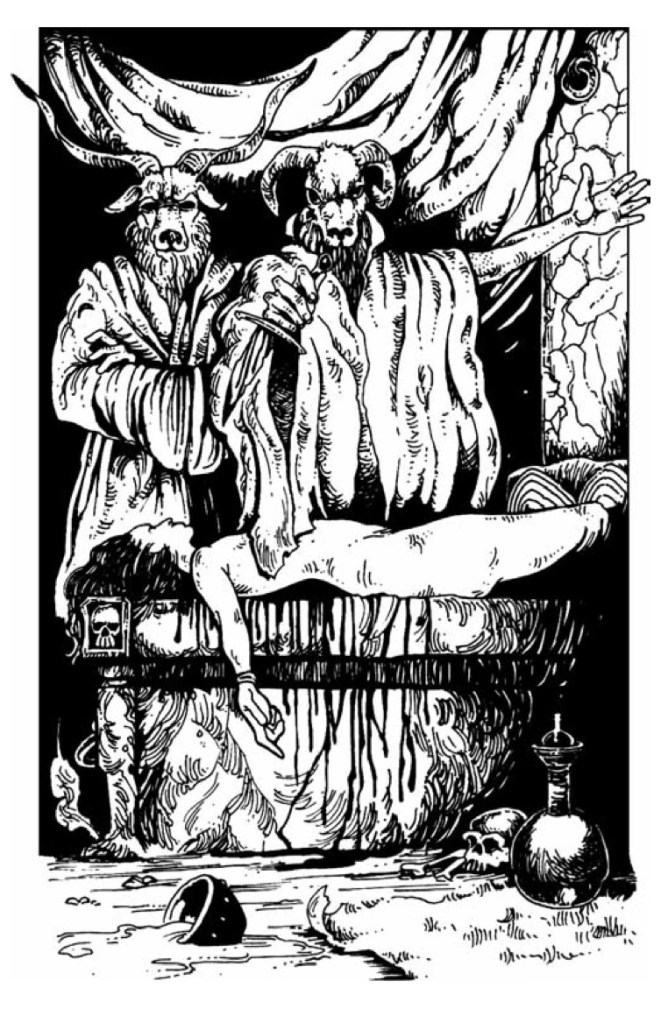



















 Audio, Video, Disco