• To celebrate International Women’s Day this post explores some of the women printers whose imprint can be found inside books in the Old Library.  They are present – sometimes only as initials, sometimes as “the widow of…”, on title pages and in colophons in books. Yet behind these traces lie the stories of women who managed printing houses, defended their economic and legal rights, and left a lasting imprint on scholarship, law, and the book trade.

    Early modern book production was collaborative and familial. Printing and bookselling businesses involved spouses, siblings, parents, and children working side by side.  Nearly all women who ran a printing business did so on becoming widows. Many were from printing families or had been involved in the business after marriage, which gave them the skills to successfully run a printing business.

    One of the most remarkable figures represented in our collections is Charlotte Guillard (c1485–1557). Often described as the first woman printer of Paris, she oversaw the publication of at least 165 works.  Charlotte is the first woman known to have printed a law book, a 1519 edition of Justinian’s Institutes. The Old Library holds several of her legal and theological imprints including a very rare book of Roman law in Greek: Novellae constitutions (Paris, 1542).

    Charlotte Guillard became a printer after marrying Berthold Rembolt, a prominent Parisian printer. When Rembolt died in 1518, she took control of the Soleil d’Or press on the rue Saint‑Jacques. Following the death of her second husband Claude Chevallon in 1537, she ran the business independently for nearly two decades.

    Guild rules in Paris allowed widows to inherit their husband’s printing business. The widow could register the right to print books, hire apprentices, print under law patents, and generally continue running things as their husband had. These rules allowed women a pathway into a skilled profession that was typically closed to them.

    As shown below Charlotte Guillard used her own name in imprints — unusual for women at this time, who were typically credited only as “the widow of…”

    Imprint of Charlotte Guillard in Novellae constitutions (Paris, 1542)

    One of the earliest female printers managing a 16th century printing press in London is Jane Yetsweirt (died 1597), who inherited her husband Charles’ patent in 1595, granting her exclusive rights to print English common law, overseen by the powerful Stationer’s Company, London’s printing guild.

    Yetsweirt soon found herself defending her rights before powerful figures, including the Earl of Oxford. Despite these pressures, she successfully printed at least a dozen works as Charles’  “executor, Administrator, and assigne”. These include our copy of Registrum Omnium Brevium (London, 1595), a compilation of legal writs printed in 1595, which is probably the earliest law book printed in English. Jane’s printing career ended within two years when she remarried, yet her brief tenure marked a key moment in England’s transition from oral to print‑based legal culture. The beautifully ornate woodcut border on the title page is shown below.

    The title page of Registrum Omnium Brevium (London, 1595) printed by ‘Ianae Yetsweirt relictae Caroli Yetsweirt’ [K*.1.24]

    Our collections also feature the work of Elizabeth Flesher (fl. 1636–71). She was the widow of James Flesher (died 1670), and the daughter of Cornelius Bee (fl. 1636-71), a prominent London bookseller. Elizabeth inherited her husband’s printing business and ran it until around 1680, printing several legal works. Shown below is the first major commentary on English statutes by Edward Coke. The imprint lists Elizabeth working with John Streater and Henry Twyford, indicating that large legal folios often required combined resources, labour, and capital.

    Coke, The second part of the Institutes of the Laws of England (1671) B*.3.16

    Perhaps the most formidable woman represented in our holdings is Elizabeth Nutt (c.1666–1746) who was a powerful force in the London book and newspaper trades in the 18th century. After the death in 1716 of her printer husband John Nutt, she became executrix of his estate and continued the business, later sharing the law‑printing patent with her son Richard from 1722. She was repeatedly jailed for printing material deemed seditious, often alongside fellow women printers Ann Dodd and Ann Smith.

    Her partnerships with leading women in the trade, especially Ann Dodd, produced more than 130 jointly issued titles and included participation in a female bookselling syndicate. This 1727 edition of John Cowell’s A Law Dictionary: Or The Interpreter lists ‘E. and R. Nutt’, referring to Elizabeth and her son Richard rather than giving her full name. Cowell, a master of Trinity Hall, found himself in hot water after the publication in 1607 of the first edition of this ‘seditious’ dictionary, which was banned by James I. Printers of both the first, and the later expurgated editions faced no consequences for printing the dictionary. Elizabeth continued to appear as a printer on imprints until 1741.

    Cowell, John. A Law Dictionary: Or The Interpreter (London: printed by E. and R. Nutt, and R. Gosling, assigns of E. Sayer, Esq [etc.], 1727. [J*.1.25]

    Not all women printers are easy to trace. Hannah Sawbridge, active between her husband’s death in 1681 and her own in 1686, never appears by her full name – every imprint reads simply “H. Sawbridge.” Five of her books survive in Trinity Hall’s collection, but without careful attention to initials we might never recognise her presence.

    Similarly, the “R. Bonwicke” listed in our 1717 edition of Pufendorf’s Of the Law of Nature and Nations refers not to a “Mr.” Bonwicke, as one source incorrectly assumed, but to Rebecca Bonwicke, a bookseller known for her business skill and involvement in women‑run printing syndicates.

    Their stories remind us that countless women contributed to early book production in ways that remain partially hidden.

    Jenni Lecky-Thompson

    Further reading

    No comments on Women Behind the Law Books in Trinity Hall’s Old Library

  • Richard III by an unknown artist; oil on panel, late 16th century. NPG148 © National Portrait Gallery, London, together with his coat of arms

    Trinity Hall’s Old Library contains an armorial manuscript which provides a window into England’s past: ‘Arms of the sovereigns and leading nobles of England’ (MS 73). Created in the 16th century and recently digitised, it contains over 450 carefully hand-drawn coats of arms of English royalty and nobility—each paired with a written description known as a blazon.

    Unlike many armorials that focus on a single family or region, MS 73 offers a Who’s Who of English nobility — from mythical founders like Brutus of Troy to Henry VII (1457–1509), the first Tudor monarch. Their coats of arms weren’t merely decorative: they served as records of legal and hereditary claims and were tools for tracing noble ancestry.

    The author of this manuscript records the short lineage of each person with a brief account of their life.  The order and selection of the coats of arms is very similar to two other manuscripts from the late 16th century – one held in the Walters Art Museum (W.847), the other in the British Library (Stowe MS 693). All three likely drew on a shared source for the heraldic information, but there are key differences.

    While the Walters and British Library manuscripts are illustrated with colourful heraldic designs, MS 73 relies on written blazons instead. This choice suggests its compiler may have been a heraldic professional, or at least, someone with a scholarly interest in the subject. More interestingly, MS 73 stands out for its vivid and sometimes scandalous anecdotes—particularly when discussing two of England’s most controversial monarchs: King John (1166-1216) and Richard III (1452-1485).

    Detail of the poisoning of King John from Fox’s Book of Martyrs

    Take King John (reigned 1199–1216), the famously villainous monarch of Robin Hood legend. The manuscript bluntly notes: “He died at Newark castle ye 19th October 1219 being poisoned by a monke of Swinsted abbey”* (p. 61). This dramatic tale—popularised in contemporary chronicles, Shakespeare’s King John, and even Foxe’s Book of Martyrs—attributes the King’s death to a monk from Swineshead Abbey who fatally spiked John’s drink with venom from a toad, then took a swig himself to avoid suspicion. Both died soon afterwards.  Modern historians generally agree that John died of dysentery, but this manuscript shows that the poisoned-cup story had powerful staying power.

    Entry describing the poisoning of King John

    Richard III, meanwhile, gets an even harsher treatment. His entry is the only one in the manuscript to include a physical description—and it’s far from flattering:

    “… a man of low statue crockbacked, ye left shoulder much higher than ye right and of a very crab[b]ed and sower counternance, his mother could not be delivered of him; he was borne toothed and w[i]th his foot forwards contrary to ye co[u]rse of nature.” (p. 143)

    This vivid portrait closely follows the account given by Sir Thomas More in The History of Richard III (posthumously published in 1557) and was widely influential by the time MS 73 was compiled:

    “…little of stature, ill featured of limbs, crooked-backed, his left shoulder much higher than his right, hard-favored in appearance… He was malicious, wrathful, envious, and from before his birth, ever perverse. It is for truth reported that the Duchess his mother had so much ado in her travail to birth him that she could not be delivered of him uncut, and he came into the world with the feet forward… also not untoothed” (Sir Thomas More’s Works, London, 1557, xvii).

    More’s version of Richard—deformed in body and twisted in mind—was echoed by Tudor historians like Edward Hall and Raphael Holinshed, and immortalised by Shakespeare.

    The manuscript goes further, accusing Richard of causing the deaths, first of King Henry VI, whom he “shamefully murthered” (p. 123), then of his own nephews, the “Princes in the Tower”.  We learn under the entry for Edward V, that he was “deprived of both his life and kingdome by his uncle ye D[uke] of Glouc[ester] who cawsed him and his brother Richard Duke of York to be murthered in ye Tower of London by smothering them between two ffether beds.” (p. 141).

    Entry on Richard III on page 143

    The fate of the two princes – suffocation using their own beds and blankets on the order of Richard III, was a common version of events in the 16th century, repeated in the popular chronicles by Hall and Hollinshed, as well as More’s The History of Richard III (1557, 105-6). These accounts were written down at least twenty-five years after the events concerned. However, they became the established truth and were cemented in the public imagination by Shakespeare’s play The Tragedy of Richard III, which was probably written around 1592–1594. Whether or not it’s true, MS 73, completed in 1599, reflects just how deeply these stories had embedded themselves in the Tudor imagination.

    The manuscript also has an interesting history of its own. It may have once belonged to the 17th-century antiquarian Christopher Towneley (1604-1674). His library was sold at Sotheby’s in 1883, and the manuscript passed through several collectors and booksellers before reaching George Edward Larman (1895-1961), who purchased it from bookseller Thomas Godfrey of York. Larman had an interest in heraldry, and MS 73 was part of a wider collection of books on this topic which were given to Trinity Hall (his former College) in the 1990s.
    Lambe, Philip; George Edward Larman (1895-1961); Trinity Hall, University of Cambridge

    Curious to see it for yourself? Thanks to digitisation, you can now explore this remarkable manuscript on the Cambridge Digital Library.

    Note

    * Although the manuscript gives King John’s year of death as 1219, the correct year was 1216, although the exact date is disputed.

    Jenni Lecky-Thompson

    Bibliography

    1 comment on Poisoned Kings and Crook Backs: A Look Inside Trinity Hall’s 16th-Century Armorial Manuscript

  • A Century of the Sports Pavilion

    1920s proposed plan for the Pavilion

    We don’t know the exact birthday of the Sports Pavilion, but it was most likely completed around this time 100 years ago. The College has owned land off Huntingdon Road since 1674, but the story of the Pavilion begins in earnest in 1892, when the College began renting 10 acres of land off Madingley Road from St John’s College in order to create a playing field for the Cricket Club. In 1923 the College made the decision to purchase 7 acres of the land from St John’s and an additional 2 acres of adjoining land on Storey’s Way. The purchase was completed by June 1924, and construction on the new playing fields and sports pavilion began soon afterwards. By June 12th 1925, construction of the ground and pavilion was nearly complete. Excluding the purchase of the land, the building work cost £3,768 (£195,129 today). An additional £100 (£5,179) was given to the Groundsman, Ernest Coote, in recognition of his hard work in constructing the ground.

    1930s proposed plan for concrete practice cricket pitch

    The original pavilion appears to have only consisted of a club room, changing room, restroom, and serving room. In the 1930’s the squash courts were added as well as a spectator’s gallery and shower block. By the 1960s it was in a state of disrepair. Major structural changes were made internally, and an extension was added.  The extension included an additional changing room, a restroom for visitors, more showers, and better kitchen. It was remodelled one last time in the early 2000s by Freeland Rees Roberts, turning it into the Sports Pavilion we know today. The most significant additions this time being a new entrance and the gym extension. 

    1960s redevelopment plans

    Regrettably, the Archive does not have any photos of the Sports Pavilion, so these plans are the best indications of what it has looked like through it’s various stages of life.

    2003 redevelopment plan

    No comments on A Century of the Sports Pavilion

  • As I write, the world awaits the moment when white smoke rises from the chimney of the Sistine Chapel— a centuries-old signal that a new pope has been elected. The papal conclave remains one of the most secretive and ritualised processes in the modern world, and recent popular portrayals, such as the film The Conclave, based on Robert Harris’ bestselling novel, have renewed public fascination with how the College of Cardinals chooses the next leader of the Catholic Church.

    The history of conclaves is steeped in intrigue, political manoeuvring, and the occasional scandal. One remarkable account from our collection at Trinity Hall may be found in The Life of Pope Sixtus the Fifth by the Italian historian Gregorio Leti (1630–1701).[1]  First published in Lausanne in 1669, and translated into English by Ellis Farneworth in 1754, the book recounts the dramatic events of the 1585 conclave that swiftly elevated Cardinal Felice Peretti—later Sixtus V—to the papacy.

    Pope Sixtus V Pietro Fachetti
    Pope Sixtus V

    Our copy of the book was owned by Herbert Conyers Surtees, Member of Parliament for Gateshead from 1918 to 1922. His library was sold upon his death in 1933 and several books were purchased by Trinity Hall alumnus George Edward Larman (1895-1961) who bequeathed them to the College.

    Title page from Leti, The Life of Pope Sixtus the Fifth (1754)

    Leti’s biography of “one of the most remarkable and entertaining lives that is to be met with in ancient or modern history”, was a sensation in its time. It paints a vivid portrait of a man who rose from humble beginnings to becoming the supreme head of the Catholic Church. His account reveals the complex, often shadowy politics of the Vatican.

    Following the death of Pope Gregory XIII, the 1585 conclave began on April 21 with only 39 cardinals present (compared to 133 today). Peretti (known as Cardinal Montalto) seemed an unpromising candidate. Leti describes how others : “seeing him bent down with disease and old age, did not in the least dream of his ever being elected.” [2]. Further, he did not seem interested in the job: “His proceedings were dark and secret; he alone, if we may use the expression, lay at anchor, when all the other Candidates were under full sail.” [3]

     Almost immediately, rival factions in the conclave emerged—one led by Cardinal Ferdinando de’ Medici, the other by Luigi d’Este, grandson of King Louis XII of France. Early voting favoured Cardinals Pier Donato Cesi and Guglielmo Sirleto, but both quickly lost ground. Behind closed doors, negotiations intensified with “great heat and animosity”. Medici and d’Este eventually forged a compromise, and with the backing of Spanish and Imperial interests, Cardinal Montalto emerged victorious. He was elected in a matter of days.

    As pope, Sixtus V became known for his iron-fisted reforms. Determined to restore order to both Church and Rome, he launched ambitious building projects and restructured the papal administration. However, Leti doesn’t shy away from the darker aspects of his rule. Sixtus’s efforts to clean up Rome included the destruction of ancient monuments and a brutal crackdown on criminal gangs—perhaps resulting in the execution of more than 27,000 people, their heads displayed on stakes across the city [4]. His pontificate ended with his death on August 27, 1590, and no pope has taken the name Sixtus since, although I do think that Sixtus the Sixth has a nice ring to it.

    Today’s conclaves may be more regulated, but the essence of the process endures: a secretive, solemn, and deeply political search for spiritual leadership. As we wait to watch the white smoke rise once more, Leti’s account of the 1585 conclave reminds us that the drama behind the chimney can be as enduring as the ritual itself.

    Jenni Lecky-Thompson

    References

    [1] Leti, Gregorio. The Life of Pope Sixtus the Fifth : (One of the Most Remarkable and Entertaining Lives That Is to Be Met with in Ancient or Modern History.) In Which Is Included the State of England, France, Spain, Italy, the Swiss Cantons, Germany, Poland, Russia, Sweden, and the Low Countries, at That Time. With an Account of St. Peter’s, the Conclave, and Manner of Chusing a Pope; the Vatican Library, the Many Grand Obelisks, Aqueducts, Bridges, Hospitals, Palaces, Streets, Towns, and Other Noble Edifices, Begun or Finish’d by Him. The Whole Interspers’d with Several Curious Incidents and Anecdotes, Not to Be Met with in Any Other Author. London: printed by W. Bowyer, and sold by C. Bathurst at the Cross-Keys against St. Dunstan’s Church, Fleetstreet, 1754.

    [2] ibid, p127

    [3] ibid p. 127

    [4] Ruggiero, Guido (2006). A Companion to the Worlds of the Renaissance. Wiley-Blackwell. p. 143.

    Further reading

     ‘1585 papal conclave’, Wikipedia, <https://en.wikipedia.org/w/index.php?title=1585_papal_conclave&oldid=1287947440> [Accessed 1 May 2025]

    No comments on Behind the Smoke: A Glimpse into a Papal Election from the Past

  • Let’s face it, Christmas sneaks up on the best of us. If you’re still hunting for the perfect present, why not go for a book? They’re a dream to wrap (no awkward shapes here!) and always make you look thoughtful. Plus, there’s something special about giving a book.

    Among the treasures in our special collections are the Cambridge Christmas Books—a series of finely crafted short publications produced as gifts for “friends in printing and publishing”. The tradition was started in 1930, by Walter Lewis (1878–1960), printer to the University of Cambridge. These annual keepsakes were designed to show off the skill and artistry of the Press, giving each book the format and typography which best suited its contents.

    Though paused during World War II, the tradition was revived in 1947 by Lewis’ successor, Brooke Crutchley (1907–2003). Crutchley studied Classics and English at Trinity Hall from 1926 to 1929. He then started out at the Press in 1930 as Assistant to Walter Lewis. In 1946, following Lewis’s retirement, Crutchley was appointed University Printer.  He remained in this role for 28 years, retiring in 1973. Unusually, despite not being an academic, he was made a Fellow of his former College in 1951. He was later appointed as its Vice Master from 1966 until 1970.

    Crutchley’s official Fellow photographic portrait

    Despite their festive timing, the Christmas books weren’t about snowmen or Santa Claus. Instead, they covered a variety of topics, frequently related to printing and publishing. Produced with meticulous attention to detail, prominent artists including Edward Ardizzone, David Gentleman, and Lynton Lamb added their artistic flair.

    Among the most notable editions (at least for printing nerds) was A Tally of Types (1953) [1], authored by Stanley Morison at Crutchley’s request. This book chronicled the development of the Monotype typesetting system, showcasing the Press’s pivotal role in advancing printing technology.

    Some books were prompted by current events. The story of how Baskerville’s punches was uncovered and acquired by type historian John Dreyfus after nearly 180 years in France, is celebrated in the 1949 Christmas book The Survival of Baskerville’s Punches. [2]

    Baskerville type

    The 1961 book Bridges on the Backs, [3] illustrated by David Gentleman, marked the building of two shiny new Cambridge bridges – one on Silver Street (1959) and the other on Garrett Hostel Lane (1960). It includes interactive “lift-the-flap” illustrations that reveal the changes in these structures over time.

    Binding of Bridges on the Backs, with a drawing of Garrett Hostel Bridge

    Another book with a Cambridge focus is the 1955 book: The Town of Cambridge as it ought to be Reformed. [4] This discusses the architect Nicholas Hawksmoor’s (c1661-1736) plans to re-envision the City, which he probably produced for fun.  We particularly like how he turned Cambridge streets into Italian-style piazzas. The red blob in the marbled cover paper (shown below) was created by stopping the marbling with the innovative use of a drop of ox-blood.

    Hawksmoor’s design turns a Cambridge Street into a piazza
    Cover of The Town of Cambridge as it ought to be Reformed (1955)

    The Cambridge Christmas Books were printed in limited editions, typically between 100 and 500 copies, and distributed as gifts rather than sold. At the time they must have delighted many of their lucky recipients, while today they are collector’s items. Crutchley himself, lamented their status as collectibles:

    “…it saddens me a little that now they are regarded (and collected) as a series rather than being valued on their individual merits.” (To Be a Printer, p. 127). [5]

    Trinity Hall is lucky to have all of the Christmas books printed by Crutchley, many of which bear his personal bookplate. Ten of these books were personally selected by him to give to the College when he retired. The remaining volumes in the series were generously bequeathed by Trinity Hall alumnus Lawrence Strangman (1907-1998), which completed our collection.

    The gifting of Cambridge Christmas books sadly came to an end with Crutchley’s retirement in 1973. His successor, Euan Phillips, cited the challenges of continuing such an endeavour in a competitive era:

    “It had become increasingly difficult … to justify the expenditure of the time, skill and resources.” (Tributes to Brooke Crutchley, 1974).[6]

    So, as Christmas rolls around, take a moment to appreciate the timeless charm of books. Whether it’s a beautifully crafted keepsake or a well-loved novel, there’s no better way to spread a little festive cheer.

    Wishing you a Merry Christmas and a very happy New Year!

    Jenni Lecky-Thompson

    A selection of beautiful Cambridge Christmas book covers

    References

    [1] Morison, Stanley. A Tally of Types : Cut for Machine Composition and Introduced at the University Press, Cambridge, 1922-1932. Cambridge: Privately printed, 1953. Strangman Collection   686.2 MOR (LV)  

    [2] Dreyfus, John. The Survival of Baskerville’s Punches. 1949. Cambridge: Privately Printed by the University Printer for Friends in Printing & Publishing, 1949. TH.C.4.4  

    [3] Gentleman, David. Bridges on the Backs : A Series of Drawings. Cambridge: B. Crutchley, 1961.  TH.C.4.15

    [4] Roberts, David. The Town of Cambridge as it ought to be Reformed : the Plan of Nicholas Hawksmoor Interpreted in an Essay. Privately Printed at the University Press, Cambridge. 1955. TH.C.4.10

    [5] Crutchley, Brooke. To Be a Printer. London: Bodley Head, 1980.

    [6] Phillips, Euan. Tributes to Brooke Crutchley on His Retirement as University Printer. Cambridge: University Printing House, 1975.

    1 comment on Cambridge Christmas Books: A gift for the printer who has everything

  • The witching hour is almost upon us so what better time than to look at some witchcraft books in our collection.

    The Old Library contains several chilling treatises about witchcraft, which could be used as manuals to identify and prosecute witches. In some ways this is unsurprising. Trinity Hall was founded and maintained a strong tradition in training lawyers, and witch-hunting was primarily a judicial process to uncover sufficient evidence to prove someone’s guilt or innocence of witchcraft. The stakes were high for the accused – in England the Witchcraft Act of 1562 meant that practicing magic was a crime punishable by death.

    The witchcraft books in our collection grapple with issues concerning proof of wrong-doing, and the use of torture in extracting confessions. The earliest book on witchcraft in our collection is De La Demonomanie Des Sorciers (Paris, 1581), which can be translated as On the Demon-Mania of Witches. [1] It was written by the French lawyer and philosopher Jean Bodin (1529/30-1596) and first published in 1580. The treatise contains one of the earliest attempts at a legal definition of a witch: “One who knowing God’s law tries to bring about some act through an agreement with the devil” (p. 1).

    Bodin discusses the essential problem of witchcraft as an offence: how to discover and prove it. You would need evidence that a crime had been committed, but allegations of witchcraft frequently blamed the accused for naturally-occurring events – such as the illness or death of people or livestock. It was rather difficult to ‘prove’ that this was the fault of a witch rather than just random misfortune.

    Physical evidence of witchcraft was often sought in the form of “witches’ marks” on the body—such as moles, scars, extra nipples, or insensitive patches of skin. These marks were thought to be left by “familiars,” animal-like spirits that supposedly fed on the witch’s blood, leaving these tell-tale signs. Bodin describes a witch named Marie de P who claimed that her familiar was a black cat:

    “She confessed that she had a familiar spirit, which took the form of a cat, that she had nourished with her blood, and that this spirit would come to her at night, instructing her in her wickedness and serving her in all her malicious designs.”
    Book II, Chapter 3.

    Confession was also an important part of the criminal trial. In 1589 Peter Binsfeld, Bishop of Trier and fanatical witch-hunter, published his De Confessionibus Maleficorum et Sagarum (“Treatise on Confessions by Evildoers and Witches”).

    Binsfeld supported the use of torture to secure a confession and he was the main force behind the witch trials of more than 300 people in Trier. His work compiled many of the confessions of witches taken down by him, including chilling admissions of them making pacts with the Devil. Anna Müller confessed:

    Binsfeld’s De Confessionibus Maleficorum et Sagarum

    “I have made a pact with the Devil. On the night of the full moon, I went into the forest where I met a dark figure cloaked in shadows. He offered me powers beyond mortal understanding, and in exchange, I pledged my soul to him. I have flown through the night on the back of a broomstick, casting spells to harm those who have wronged me.”

    Anna was most likely driven to confess under duress as few would willingly admit to being a witch. The Library holds an edition from 1596 to which he had added additional confessions.[2]

    One of the most influential witchcraft compendium of its time was the six-volume Disquisitionum magicarum (Investigations into Magic), authored by Jesuit scholar Martín Del Rio (1551-1608) between 1599 and 1600. This work provided practical advice for judges and confessors to combat what was viewed as a grave spiritual threat. It was extraordinarily popular, with the last edition printed in Cologne in 1755, more than 150 years after its first publication. We have the 1612 edition which had been expanded and revised after Del Rio’s death.

     Amid the anti-witch fervour of these publications lies a lone voice of reason in Jesuit priest Friedrich Spee, whose Cautio Criminalis (Precautions for Prosecutors) was first published anonymously in 1631. Our copy is the second edition, published a year later with some corrections and minor additions. Spee argued for the fair representation of the accused, highlighting the impossibility of proving innocence under torture—a system “often contrary to both law and reason”, designed to elicit false confessions and implicate others, creating endless cycles of accusation.

    By the late 16th century, a significant number of witchcraft publications had emerged across Europe. These texts contributed to a cultural climate where fear of witchcraft justified brutal trials and executions. Our collection shows no annotations suggesting they were used in legal practice, though they capture the anxieties of the period and the ruthless legal measures that followed. The exact number of Cambridge’s own witch trials remains uncertain due to sparse records, but it was likely small compared to other regions of England.

    If you enjoyed this post find out more about our bewitching books on the supernatural.

    Jenni Lecky-Thompson

    References

    [1] Bodin. De La Demonomanie Des Sorciers. … Paris: Chez Iacques Du Puys, Libraire Iuré, a La Samaritaine, 1581. Old Library   H*.6.18.

    [2] Binsfeld, Peter, Tractatus De confessionibus maleficorum et sagarum … (Trier: Henry Bock, 1596). Old Library   P*.3.33  

    [3] Del Rio, Martin Antoine, Disquisitionum magicarum libri sex. (Moguntiæ: Apud Johannem Albinum., 1612) Old Library   E*.6.16  

    [4] Spee, Friedrich Von. Cautio Criminalis, Seu, De Processibus Contra Sagas Liber. Editio Secunda. ed. Francofurti: Sumptibus Ioannis Gronaei Austrij, 1632. Old Library   J*.9.52  

    Further reading

    Goodare, Julian, Rita Voltmer, and Liv Helene Willumsen (eds). Demonology and Witch-Hunting in Early Modern Europe. London: Routledge, 2020.

    Levack, Brian. The Witch-hunt in Early Modern Europe. 3rd ed. Harlow: Pearson, 2006.

    No comments on Trials, Torture, and Treatises: Witch-Hunting Books in the Old Library

  • Trinity Hall Olympians

    To mark the beginning of the Paris 2024 Summer Olympic Games, we’ve delved into the archival collections of Trinity Hall to find out more about the College’s own Olympians.

    Trinity Hall boasts an impressive record at the modern Olympic Games: 27 medals (14 gold, 6 silver and 7 bronze) have been won by 17 athletes. If Trinity Hall represented a country in the 1900 Olympics, the College would have placed 7th overall in the Olympic medal table. This blog post will focus on the stories of four of these Olympians.


    William Faulder Smith

    Smith pictured in the centre wearing the stripped shirt.

    The College Archives hold a small piece of Olympic history: the papers and memorabilia of field hockey player William Faulder Smith, who won Gold at the 1920 Olympic Games in Antwerp. The collection includes a commemoration medal for the 1908 London Games, a British Olympic Team passenger ticket to Antwerp, correspondence from the Hockey Association, and a photograph album which documents Smith’s time at Trinity Hall between 1905 and 1908.

    Another interesting item in the collection is a dinner menu from the Antwerp Olympic Games. Beef, consommé and salad were on offer to athletes in 1920, as well as fruit and patisseries for dessert. Smith’s personal copy of the menu is signed by members of the 1920 British Olympic Hockey team.

    Smith – who was known by his friends as ‘Jerry’ – led a student life abundant in social and athletic activities. He was a member of the Trinity Hall Cricket Club, Hockey Club and Football Club, as well as president of the Trinity Hall Magpies, a debating club.  His photograph album provides an insight into Edwardian student life at Trinity Hall which, for Smith, was certainly not lacking in dinner parties.

    In later life William Faulder Smith took over the family business, and became director of the textile manufacturers, Stapley & Smith, and the insurance brokers, Smith & Burns.


    John Wodehouse, 3rd Earl of Kimberely

    John Wodehouse was an Olympic Polo player who won gold at the 1920 Antwerp Olympics and silver at the 1908 London Olympics. He was a distant cousin of P.G Wodehouse and was quite likely the inspiration for Bertie Wooster in ‘Jeeves and Wooster’, although this connection was never stated explicitly by P.G Wodehouse. 

    by Bassano, whole-plate glass negative, 18 February 1920

    Wodehouse matriculated in 1902 and studied Law, but he left without taking a degree. However, in other areas of university life he demonstrated considerable dedication, such as his attendance at the University Pitt Club where he was a committed member, serving as auditor in 1904 to 1905.

    Wodehouse played two out of the five times in which Polo was contested at the Olympic Games. Polo was last played at the Olympics in 1936 and is no longer considered an official Olympic sport alongside tug-of-war and lacrosse. 

    Wodehouse was awarded the Military Cross, the Croix de Guerre and the Italian War Cross in the First World War. He became a Liberal MP at the age of 22 and worked for a time as assistant private secretary to Winston Churchill.  He died during an air raid in London in 1941.

    Wodehouse’s entry from ‘Notes on Students’

    Sidney ‘Cygnet’ Swann

    Sidney Swann was an Olympic rower and clergyman who won gold at the 1912 Olympics in Stockholm and silver at the 1920 Antwerp Olympics.

    Swann pictured in the Silver Crescent Magazine

    Athletic prowess was part of the Swann family tradition. His father, Rev. Sidney Swann (matriculated1881) was described by Henry Bond as ‘the greatest all-round athlete of whom there is any memory in the Hall’. Rev. Swann was eccentric character with a penchant for new challenges: he broke the record for rowing across the Channel (3 hr 50 min), cycled around Syria, built several flying machines, cycled from Land’s End to John o’ Groats in record time, and served as a missionary in Japan.

    His son, Sidney – who was known as ‘Cygnet’ -matriculated in 1909 and studied History as an undergraduate. He won the first of his four Blues in 1911 and served as president of the Trinity Hall Boat Club, the Cambridge University Boat Club and the Trinity Hall Owls Club. In 1920, he returned to Trinity Hall as College Chaplain and coach of the Boat Club.

    Swann later became Archdeacon in Nairobi, Chaplain to King George VI, and Principal of the RAF Chaplain School at Magdalene College Cambridge during the Second World War.


    Billy Fiske

    Fiske in the 1928 matriculation photo

    William Mead Lindsley Fiske III, known as Billy Fiske, was a two-time Olympic gold medal winner in Bobsleigh. At the age of 16 he led the bobsleigh team for the USA and won gold at the 1928 Winter Olympics in St Moritz. Later the same year, he started his undergraduate degree at Trinity Hall where he read Economics and History. As a student he served as secretary of the Trinity Hall Golf Club and became a well-known figure in Cambridge for driving to the golf course at high speed in his 4 ½ litre open Bentley.

    In 1932, Billy Fiske carried the flag for the United States at the opening ceremony of the Winter Olympics at Lake Placid where he won gold in bobsleigh for a second time. In September 1939 he joined the RAF, by passing himself off as a Canadian citizen, and was assigned to a Hurricane fighter squadron. He was killed in an aerial combat at the age of 29 and was the first American in British Service to lose his life in action in the Second World War.

    Fiske’s entry in the College’s WWII War Memorial Book.

    Written by Sophie Stewart, Archives and Records Assistant

    No comments on Trinity Hall Olympians

  • Recently the MCR held a Bridgerton themed dinner, which got me thinking, what were they eating in College in the early 19th century? For those of you unfamiliar with Bridgerton, it is a historical romance book series set in Regency London, which took the world by storm in 2021 when it was adapted into a tv series by Netflix.

    A fortunate and rare survival of receipts covering 1724 to 1894 provided a wealth of information about the food being served here. The diet in college in the 1720’s and 30’s was predominantly meat based with little by way of fruits and vegetables. By the early 19th century, the lists of dishes become longer and more complex including some more vegetable side dishes, but still almost entirely meat. Many of the things they were eating seem quite normal by today’s standards like roast beef, ham, potatoes, broccoli, and apple pie. However, there were other dishes that might give some people today pause, such as pig’s face, tongue, and turtle soup.

    It was customary to start with soup and fish. Pease soup (pea soup) and the aforementioned turtle soup were the most common in the receipts. By all accounts, turtles and tortoises were delicious. They became a staple food for sailors, because they could live on ships and guarantee fresh meat on long voyages. The HMS Beagle took about 40 tortoises from the Galapagos mostly for food and some as scientific specimens. It was a comment made by the Vice-Governor of the Galapagos, Nicholas Lawson, that he could tell which island a tortoise came from just by looking at its shell that proved fundamental to Darwin developing his theory of Evolution.

    Eating turtles in the “West Indian way” became haute cuisine by the mid-18th century, and the English spread their love of turtle throughout their empire. As it became more accessible to the middle classes, the trend spread to North American and Continental Europe. By the late 1860s green turtles were being canned for mass consumption. Turtles were still being eaten in Florida as recently as 50 years ago.

    Fish was cheap and plentiful in this period, and oysters were enjoyed by all, rich and poor alike. At Trinity Hall, they ate a good variety of fish, such as salmon, pike, sole, eels, and especially oysters. The oysters were eaten raw or made into a sauce most commonly served with boiled turkey. The 18th and 19th centuries were considered the “golden age of oysters,” but overharvesting dramatically reduced natural oyster stocks by the mid-20th century.

    The second course would have been a selection of meat and vegetable dishes. Until 1815, meals would have been served à la francaise, which is serving all the dishes on the table at the same time. After 1815, the transition to service à la russe (bringing dishes out one by one) began. The most popular meat dishes at Trinity Hall were haunch mutton with jelly, veal, ham, roast beef, and various fowl such as duck, partridge, pheasant, and turkey. Venison, which would have been the height of luxury at the time, was not found in the surviving receipts. Alongside the meat was broccoli, greens (most likely some form of bean), potatoes, carrots, and occasionally turnips.

    The last, and possibly most important course in this period, was dessert. The variety of desserts served at Trinity Hall is impressive. They had lemon cheesecake, custards, lemon and apricot tarts, apple pie, plum pudding, mince pies, jellies, blancmange, chestnut pudding, college pudding, and bread pudding. Although the slave trade was abolished in the British Empire in 1807, slavery continued to flourish and was fuelled in large part by Britian’s sweet tooth. In 1704 Britain’s consumption of sugar per capita was 1.8kgs, by 1800 it was up to 8kgs, and by 1901 it was 40.8kgs, which is about what it is today.

    Their sugar consumption was not just down to their love of dessert, but also the ever-increasing popularity of black tea.  Tea was exceedingly expensive when it first arrived from China in the mid-17th century and could only be afforded by the aristocracy. Tea overtook coffee as the caffeinated beverage of choice in the late 18th century as it became more affordable. The British found tea too bitter, so they sweetened it with sugar. The more tea they drank, the more sugar they consumed.

    At Trinity Hall they drank both tea and coffee in this period, although it does not appear to be in large quantities. By far their favourite drink was ale. The College paid regular bills to its brewer (who was a woman at this time), purchasing barrels of ale at a time. Other favourites were port, tent wine (a red wine from Spain), madeira, and at Christmas, milk punch (a sort of eggnog).

    It is easy to romanticise this era, in large parts thanks to the abundance of historical romance books and movies set in this period, but it is important not to ignore the horrible human and natural cost paid to afford such a lifestyle. Britian’s growing love of sweets and tea enabled the slave trade to thrive even after it had been abolished. What’s more, in this period we can see the underpinnings of many of our modern problems from the endangerment of animals due to unsustainable practices to deforestation and loss of biodiversity due to the growth of cash crops such as sugar, tea and coffee.  

    No comments on More Turtle Soup, Please!: Regency Cuisine at Trinity Hall

  • Earlier this year, the College received an intriguing little book in the post. An accompanying letter explained that it had been found among the possessions of the sender’s relative after their death. They believed it may have been acquired by accident or misadventure during an ancestor’s time at Cambridge, and so they were returning it to Trinity Hall. There is, sure enough, an ownership inscription on the title page which says ‘W. Territt Trinity Hall’, however it was never part of the College library collection!

    The book belonged to William Territt (c1768-1836) who matriculated at Trinity Hall in 1786, obtaining a Bachelor in Law in 1792, followed by LLD in 1797. He embarked on a legal career and was to become Judge of the Court of Vice Admiralty in Bermuda between 1802 and 1815. He later returned to England to his family seat at Chilton Hall, Suffolk , and died aged 67 in 1836 [1].

    Besides Territt, there are traces of one other former owner, Richard Belward(?) who has written his name (none too legibly) on the sides of the frontispiece. His initials ‘R.B’ are also stamped on the cover.

    The book is the Chronological Tables of Europe. From the Nativity of our Saviour to the year 1703. [2] The engraved title page identifies ‘Colonel Parsons’ as the author, although, in fact, it is a translation and slight modification of Guillaume Marcel’s Tablettes Chronologiques, first printed in Paris in 1682.

    Spotting a money-making opportunity, William Parsons (1658–c1725) a former English army officer, simplified Marcel’s complex layout and symbolic scheme, and reduced its size so that it was easily portable. His new format was a commercial success, and many editions followed, selling 4,000 copies in about a decade.

    Each page of this remarkable pocket-sized book represents a century (1st to 17th), meticulously detailing the names and dates of monarchs and rulers. But what sets Parsons’ work apart are the mysterious symbols adorning its pages, offering insights into the character and fate of these historical figures. A fold-out chart provides the key so the reader can understand the symbols given in the tables.

    Among the symbols, the sun, or sol, reigns supreme. Representing the most glorious of all characters, it signifies a ruler endowed with the greatest perfections—a monarch esteemed as a most accomplished ruler by historians; one example is Elizabeth I.

    In contrast, the symbol for Saturn, resembling an ‘h’ shape, paints a grim picture. It denotes a cruel and bloody monarch. This has been applied to Elizabeth’s sister Mary I. Mary’s entry also has the dart and luna symbols (crescent moon) which signify misfortune, marked by adversity and hardship.

    The symbol for Mars—a circle with an arrow—signifies a prince of good courage and a warrior who leaves a mark on the annals of history with their bravery. Suleiman the Magnificent is in this category.

    The symbols provide an ingenious means to save space. Compact and lightweight, the book was designed for portability—a ready companion for the avid scholar or curious student. Its ingenious layout, paired with symbols for quick reference, made it a practical tool for navigating the complexities of European history. As it says on the title page:

    “…digested into so very easie and exact a method, that any one may immediately find out either pope, emperour, or king, and thereby know in what time & kingdom he reign’d, who were his predecessours, contemp[ou]rs, & success[ou]rs, to what virtues or vices he was most inclinable, the good or ill success of his fortune, the manner & time of his death.”

    This humble chronology serves as a reminder of our connection to the past. Through its pages, we not only uncover the stories of long-forgotten rulers, but can also trace the previous owners, bound together by a shared quest for knowledge. More than two hundred years after the book was purchased in Cambridge by a student at Trinity Hall, it has once again ‘returned’ to the College.

    Jenni Lecky-Thompson

    References

    [1] Venn, J., Alumni Cantabrigienses, Cambridge, 1922.

    [2] Marcel, Guillaume. Chronological Tables of Europe…. The VIth. Impression. London: printed for B. Barker at the White-Hart and C. King at the Judges Head in Westminster Hall, 1707.

    No comments on The circles of time: A chronology and its connection to Trinity hall

  • As it’s nearly Halloween let’s take a look at some of our spooky early modern books which describe encounters with the supernatural. One of the seminal works on paranormal happenings to found on the shelves is Saducismus Triumphatus or, A Full and Plain Evidence, Concerning Witches and Apparitions , which was first published posthumously in 1681. Trinity Hall has the fourth edition published in 1726 [1]. It was written by a clergyman named Joseph Glanvil (1636-1680) who was a member of the Royal Society.

    Glanvil believed in the existence of witchcraft and the supernatural (like many others in the 17th century) and he set out to provide “full and plain evidence concerning witches and apparitions”. He thought that without the threat of demons and witches, people would see no reason for religion – and worse – that a lack of belief in the supernatural was akin to atheism. The small book was hugely popular and is considered to have influenced Cotton Mather, a New England preacher who stirred up hysteria about witchcraft during the notorious Salem witch trials (1692-93).

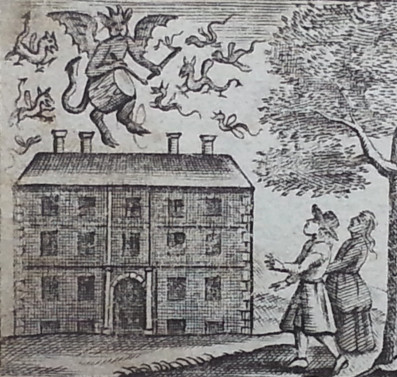
    Among the book’s numerous tales of ghosts, witches and demons, it includes one of the first descriptions of poltergeist manifestation in ‘The Drummer of Tedworth’. In Glanvil’s version of the story a landowner from Tedworth (now Tidworth) named John Mompesson brought a case against a vagrant drummer for begging with a forged permit. After he had won the suit and confiscated the drum, Mompesson’s house was plagued by inexplicable drumming, eerie lights, scratching noises and unpleasant sulphurous smells. Over several months in 1663, his children’s beds would shake and levitate into the air by themselves, and objects were thrown violently around the room by unseen hands. The drummer was in prison on a charge of theft for part of this time so could be exonerated as the cause of the disturbances.

    Two figures watch a devil beating a drum above a house
    Detail of the frontispiece of Saducismus triumphatus showing the Drummer of Tedworth. Wikimedia

    The case became well-known, and many people visited Mompesson’s house to witness the strange occurrences for themselves. Glanvil himself visited the family to investigate the disturbances in January 1663, and he describes how he heard a strange noise from the children’s bedroom:

    “It was as loud a scratching, as one with long Nails could make upon a Bolster. There were two little modest Girls in the Bed, between Seven and Eleven years old as I guessed. I saw their hands out over the Clothes, and they could not contribute to the noise that was behind their heads.”.

    Thinking the children too innocent to be the responsible for the noise and finding no “dog or other creature” in the room, he was persuaded that it was made by “some Dæmon or Spirit.” Despite this, he does not appear to have been unduly afraid.

    Later the same year, the drummer was convicted of theft and transported to the colonies never to return, and his drum destroyed. After this, peace returned to the Mompesson household. The general verdict now is that the poltergeist activity was a deception by either the children or the Drummer’s mates. Although the family swore at the time that it was not a fraud.

    Another noisy spirit can be found in a book first published in 1705 entitled An Historical, Physiological and Theological Treatise of Spirits, Apparitions, Witchcrafts, and Other Magical Practices [2], which was written by John Beaumont (c.1650–1731), a physician (and geologist). In his book he describes his frequent encounters with genii (spirits) who appeared to him, announcing their presence by ringing a little bell in his ear. He writes:

    I ask’d one Spirit which came for some Nights together… what his Name was, who answer’d Ariel… the two that constantly attended my self, appear’d both in Womens Habit, they being of a Brown Complexion, and about Three Foot in Stature; they had both black, loose Network Gowns, tyed with a black Sash about their Middles, and within the Network appear’d a Gown of a Golden Colour, with somewhat of a Light striking thro’ it; their Heads were not drest with Topknots, but they had white Linnen Caps on, with Lace on them, about three Fingers breadth, and over it they had a Black loose Network Hood. (p. 92)

    First edition of this early account of the supernatural, with wonderful engraved frontispiece of an “Evil Genius,” “Good Genii” and “Jews Going Out in the Moonshine” by Michael van der Gucht.

    First edition of this early account of the supernatural, with wonderful engraved frontispiece of an “Evil Genius,” “Good Genii” and “Jews Going Out in the Moonshine” by Michael van der Gucht.

    Beaumont was a firm believer in the occult and one of his main aims in writing his book was to refute Balthasar Bekker’s 1695 work The World Bewitch’d, which debunked the supernatural. Beaumont collected together many accounts of paranormal experiences from respectable narrators such as clergyman and aristocrats as evidence to support his views. He takes his own visitations from these fashionable ghosts in his stride and notes that the spirits would “disswade me from drinking too freely” (p. 394).  It is possible that these genii (as he called spirits) may well have come out of the bottle.

    Whatever the truth, many of our books do contain the ghosts of former owners in the form of their inscriptions or other notes in their books. Our copy of Beaumont’s text has an ink inscription on the title page: Char: Tollet, 1780″. He can be identified as Charles Tollet (died 1796), a landed gentleman who was appointed High Sheriff for Staffordshire in 1782. The book was donated to the College by Lawrence Strangman (1908-1980) who records in pencil at the front of the books that he purchased it in 1927. Strangman collected a wide range of books which he donated to Trinity Hall, which include several on witchcraft and the supernatural. Some of these are currently on display in the Jerwood library reading room if you dare to look.

    Jenni Lecky-Thompson

    References

    1. Glanvill, Joseph, Sadducismus Triumphatus : or, A Full and Plain Evidence, Concerning Witches and Apparitions : in Two Parts. The First Treating of Their Possibility. The Second of Their Real Existence, The fourth edition, with additions.. (London:: printed for A. Bettesworth, and J. Batley, in Pater-noster-Row; W. Meares, and J. Hooke, near Temple-Bar, in Fleet-street, 1726) Old Library J*.7.50
    2. Beaumont, John. An Historical, Physiological and Theological Treatise of Spirits, Apparitions, Witchcrafts, and Other Magical Practices. London: Printed for D. Browne, at the Black Swan without Temple-Bar; J. Taylor, at the Ship in St. Paul’s Church-Yard; R. Smith, at the Angel without Temple-Bar; F. Coggan, in the Inner-Temple Lane; and T. Browne without Temple-Bar, 1705. Strangman Collection 133 BEA

    Further reading

    Burns, William E. “Glanvill [Glanville], Joseph (1636–1680), Church of England clergyman.” Oxford Dictionary of National Biography.  January 03, 2008. Oxford University Press. Date of access 18 Oct. 2023, https://www.oxforddnb.com/view/10.1093/ref:odnb/9780198614128.001.0001/odnb-9780198614128-e-10790

    Mandelbrote, Scott. “Beaumont, John (c. 1640–1731), natural philosopher and collector of geological specimens.” Oxford Dictionary of National Biography.  September 28, 2006. Oxford University Press. Date of access 18 Oct. 2023, https://www.oxforddnb.com/view/10.1093/ref:odnb/9780198614128.001.0001/odnb-9780198614128-e-1876/version/1

    Prior, M. E. (1932). Joseph Glanvill, Witchcraft, and Seventeenth-Century Science. Modern Philology, 30(2), 167–193. http://www.jstor.org/stable/434078

    No comments on Bewitching books on the supernatural

Design a site like this with WordPress.com
Get started