Showing posts with label National Parks. Show all posts

Saturday, October 30, 2021

Travelog 2021, part 1: Cuyahoga Valley and a president

 18 days, 8 states, 3010 miles.  Our October trip -- the farthest I've been away from home since February, 2020, and even longer for Stevens -- was a memorable success.  We accomplished three goals and did so much more.  The travelog will be presented in multiple parts.

We left home Friday morning, October 9, headed for Richfield, OH, just south of Cleveland.  

 Saturday morning:   All aboard! Cuyahoga Valley Scenic Railroad tour to start our day. 

From the website:  CVSR is  a tourist excursion railway and private sector, nonprofit 501(c)3 organization operating in partnership with Cuyahoga Valley National Park. CVSR is dedicated and committed to preserving and renovating historic railcars so that they may be enjoyed by future generations. In addition to providing event excursions year-round, we also offer a membership program and have a volunteer base of more than 1,000.


The round trip took about 2-1/2 hours and provided a great overview of the Cuyahoga Valley National Park. 


Saturday afternoon we explored Cuyahoga National Park.  Beautiful fall scenery and two waterfalls.   (This one is Brandywine.) 


The weather was so mild that we dined outside at a Ukrainian restaurant near our hotel.  The food was delicious. 


Sunday morning: a final stop in Cuyahoga Valley National Park.  The Gleason Store (upper left) had displays with the story of the Ohio and Erie Canal. The shortest distance would have been from Cleveland to Marietta but to get taxpayer buy-in they routed the canal southwest to Columbus and further southwest to Cincinnati.  Lower left photo shows one of the canal locks.  Boston Mill is now the park headquarters/retail store. 

It was nice to find the Mentor Public Library open Sunday morning when we had ninety minutes before the next scheduled event. I wandered around while Stevens read the Sunday Plain Dealer.  The local quilt guild had an exhibit in the lobby display case. 


Sunday afternoon: James Garfield National Historic Site.  A Civil War general and a college president, Garfield bought Lawnfield in 1876. He added on to the nine-room farmhouse to accommodate his large family—wife Lucretia, five children, and his mother. He was the first presidential candidate to campaign in person, greeting some 17000 people from the front porch. He was shot in July, 1881, and died in September. Lucretia was determined to keep his memory alive, that he would not be forgotten after only 6 months in office.   An appeal for memorial funds raised enough for her to add onto the house including a library and archive. She saved every piece of paper he had—a boon to historians. The house stayed in the family, became a local historical museum, and was eventually deeded to National Parks.   


Left: the famous front porch. Right:  the wire-mesh bed where Garfield lay. (They used electric fans blowing over ice to keep hi cool.)  Bottom:  the Garfield children drew on ceramic tiles that were overglazed and set into the fireplace surround.  

Period quilts at Lawnfield.  A needlepoint footstool.  Stained glass and the Garfield children's cradle.
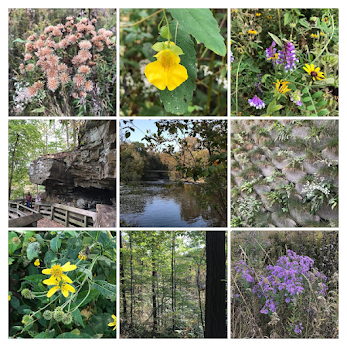


Wildflowers, woods, and waters at Cuyahoga Valley National Park.


...... next:  Chautauqua......

Friday, October 25, 2019

Vacation, 2019, part 1: Getting there

We left Thursday, October 10, and returned Sunday, October 20 -- a round trip journey of 2,284 miles.  The only mishap was that I left my eyeglasses in the hotel in Terre Haute after the first night.  I cannot see without corrective lenses and  not having eyeglasses at night and early morning was hard. Furthermore, my husband isn't able to drive long distances so I needed to be able to see!  The hotel shipped them to me at the motel in Crisfield and they arrived Monday. [I have worn eyeglasses for 60 years and contacts for 53 years and I have never, ever left my glasses behind. Until now.] 

Thursday, 10/10:   We planned our visit to the Swope Art Museum after reading a Chicago Tribune article about Terre Haute artist Gilbert Brown Wilson. It turned out only two pieces from their Wilson collection were on display but there were works by many other artists -- Grant Wood, Edward Hopper, Reginald Marsh, Gilbert Stuart, Peter Hurd among them. (All are American.)


 A learning trail and a literary sculpture at the Vigo County Public Library in downtown Terre Haute.


Friday, 10/11:  The day began with rain so rather than explore the countryside we drove directly (281 miles) fom Terre Haute to Lancaster, Ohio.    
We had lunch at Tim Hortons -- yes, it's a Canadian chain, but it was bought by Wendy's (headquartered in Columbus) and is now owned by Burger King. 
Our destination was the Decorative Arts Center of Ohio  in Lancaster. The current special exhibit is about the eight U.S. presidents from Ohio.    (To refresh your memory, they were: William Henry Harrison, Ulysses S. Grant, Rutherford B. Hayes, James A. Garfield, Benjamin Harrison, William McKinley, William Howard Taft, and Warren G. Harding.)


The museum is in an elegant early 19th-century mansion.  The spiral staircase was impressive. Fortunately we could use the modern elevator to get to the second floor.


Some of the "surprising facts" about the presidents.


 Modern t-shirt promoting a candidate have nothing on this dress made out of a James Garfield print.  To the right: Warren G. Harding's silk pajamas.


Quilt from Garfield's 1884 campaign


More campaign-related textiles


We spent Friday night in Lancaster. (That was when I found out I'd left my eyeglasses in Terre Haute.)


We left Lancaster after breakfast Saturday. We reached Harpers Ferry, West Virginia, mid-afternoon.  

Harpers Ferry is a whole town with a lot to see.  Visitors take a shuttle bus from the entrance/parking lot to the village. Stevens rode the shuttle bus several circuits while I did a whirlwind walk in the old town.  The shops are furnished in mid-19th-century style.  


The sewing machines are both Wilcox & Gibbs, circa 1845. 


The community of Bolivar is down the road from the national park entrance.  It was home to Storer College, founded in 1867 as a normal school to train black teachers. It operated until 1955. The building (shown here) is now the park headquarters.  The Appalachian Trail Conservancy office is also in Bolivar.   (The AT goes through Harper's Ferry.) 


One more stop: one of the locks on the C&O Canal.  
(The entire canal route is a national park but we did not search for the headquarters. You can read  more here .)

We crossed the Chesapeake Bay Bridge mid-Sunday afternoon -- destination: Crisfield on Maryland's eastern shore.  

Stay tuned! 


Sunday, June 30, 2019

#alaac19 post-conference: Manassas

On Tuesday, June 25, I went to visit Pat at the hospital. I returned to the hotel, checked out, and went to the airport to pick up a rental. car.  Destination:   Manassas Battlefield National Park.  GPS kept routing me on I-66 but that is EZ Pass only and I did not have EZ Pass in the rental car. I know that every interstate highway has a parallel U.S. highway--in this case, US 29. It took a few mis-turns to get there, but I did.

I was in time to see the orientation film and to take a ranger-led walking tour.  I didn't take time to visit the site of Second Manassas (1862) which was a mile down the road. [It turned out I had plenty of time, but I didn't know that.]


Two wounded soldiers carved their names into the floor at the Stone House.


General Stonewall Jackson and me.


Detail of the Stone House.   


Saturday, August 4, 2018

Summer vacation, part 3: "New England's Gem" with Road Scholar

 Our 2,982-mile trip took us through nine states. We left July 17 and returned August 1.  The weather was sunny and hot most days.   We saw a lot, learned a lot, saw long-time friends and met new people, ate well, and returned home with great memories.


Monday morning
"New England's Gem: Mount Desert Island and Acadia National Park" (July 22-26) was our 38th full-length Road Scholar program.  (Click here to see the entire list.)  Stevens went to college and seminary in Maine. We lived in Maine. I'd been to Bar Harbor for library meetings.. But we had never been to Acadia National Park!  

Road Scholar was the ideal way to get the most out of our visit. 3.5 million people visited Acadia in 2017 and there will be more this year.  Our program was organized by Glenn Tucker, who's been a Road Scholar provider for more than 20 years.    There were 23 people in our group, the maximum size for the small tour bus. Participants were mostly from the east coast.  (A woman from Wisconsin and we were the farthest west.) 

Humans have lived on Mt. Desert for 5,000 years. In 1604 Samuel de Champlain was the first European to document MDI. The French and British disputed ownership (they wanted the rich fishing grounds).  English colonists established a permanent settlement in 1761.  The town of Eden, later called Bar Harbor, was created in 1796.  

The rise of tourism and "re-creation" in the mid-19th century brought artists and wealthy city dwellers from Boston, New York, and Philadelphia. The "rusticators" stayed in huge hotels or built elaborate summer "cottages."   Land preservation began in 1901 when summer residents Charles Eliot (president of Harvard),   George Dorr (heir to a Boston textile fortune), and John D. Rockefeller Jr. acquired (by donation) 5,000+ acres. They presented it to the federal government -- the only national park that was given, not purchased.  


View from Cadillac Mountain

We began with a after-dinner walking tour of Victorian Bar Harbor. In 1946 a tremendous fire devastated the town and most of the island so much that's downtown is relatively new. 

Monday:  into the national park, where we saw the remnants of George Dorr's family home, Old Farm.At the YWCA we learned about the flora and fauna of Mt. Desert from Ruth Grierson, who's *only* 90 (and sharp!).  Historian Tim Garrity told us about historical fiction and fact on MDI. After lunch we drove into the park along Ocean Drive where we saw Thunder Hole fill and spray, fill and spray. We went up Cadillac Mountain, the highest elevation on the eastern seaboard.  


We learned about lobsters.  Maine lobstermen (who are women, too) are in the forefront of conservation with strict rules about what they can keep and what they can release. Consider: 200 years ago lobstering was for old men and young boys who could just walk out along the beach and harvest all the lobster they could eat (and prisoners at the York Co. jail protested because all they got was lobster),  

We went to the Maine Granite Industry Museum. Founder Steve Haynes has amassed tools, papers, books, and oral histories about all the quarries on the island and inland. Maine granite was used in buildings as far west as Omaha.  

This is why we enjoy Road Scholar -- we would not have found this museum ourselves. 

We also had a hand in splitting a rock. It happened to be my turn when the rock split, right along the line created by the wedges. 

It was foggy for our three-hour (really!) bay tour. The boat docked at Little Cranberry Island for an hour so we could walk around.  

The ospreys live in Apt. 2A 


And, yes, there's a quilt shop in Bar Harbor. I paid a visit to Fabricate and chatted with the owner.  Nessa is a Bowdoin alumna. In conversation, it turned out that she is one of my husband's fraternity brothers!  (Bowdoin made all the fraternities go co-educational.  All members are "brothers," regardless of gender.  In 2000 the college closed the entire system.)  I went back to the hotel to fetch Stevens. He said he'd never kissed an AD brother.  

Fabricate has a great selection, including a lot of Maine-themed novelties such as six different blueberry prints, lots of lobsters, gulls, and puffins.  My favorite (yes, I bought some) is a print with beach glass. 


Road Scholar concluded at lunchtime on Thursday.  
Here's our group in front of the tour bus.  


Here are a few more photos. 


It is legal to pick blueberries in the national park. There is a limit of one pint per person per year. (No explanation of how that's monitored.)
Somesville 


bunchberry 


no beach glass but lots of mussel shells

Jordan Pond


There is a bald eagle in the middle of the photo.


Three maple species: striped, red, sugar.
The size of the striped maple leave led to the name "poor man's toilet paper."


Carriage road gatehouse. Looks like a structure in a Thomas Kinkade painting.


All that is left of George Dorr's Old Farm "cottage." The woods reclaimed the site long ago.