

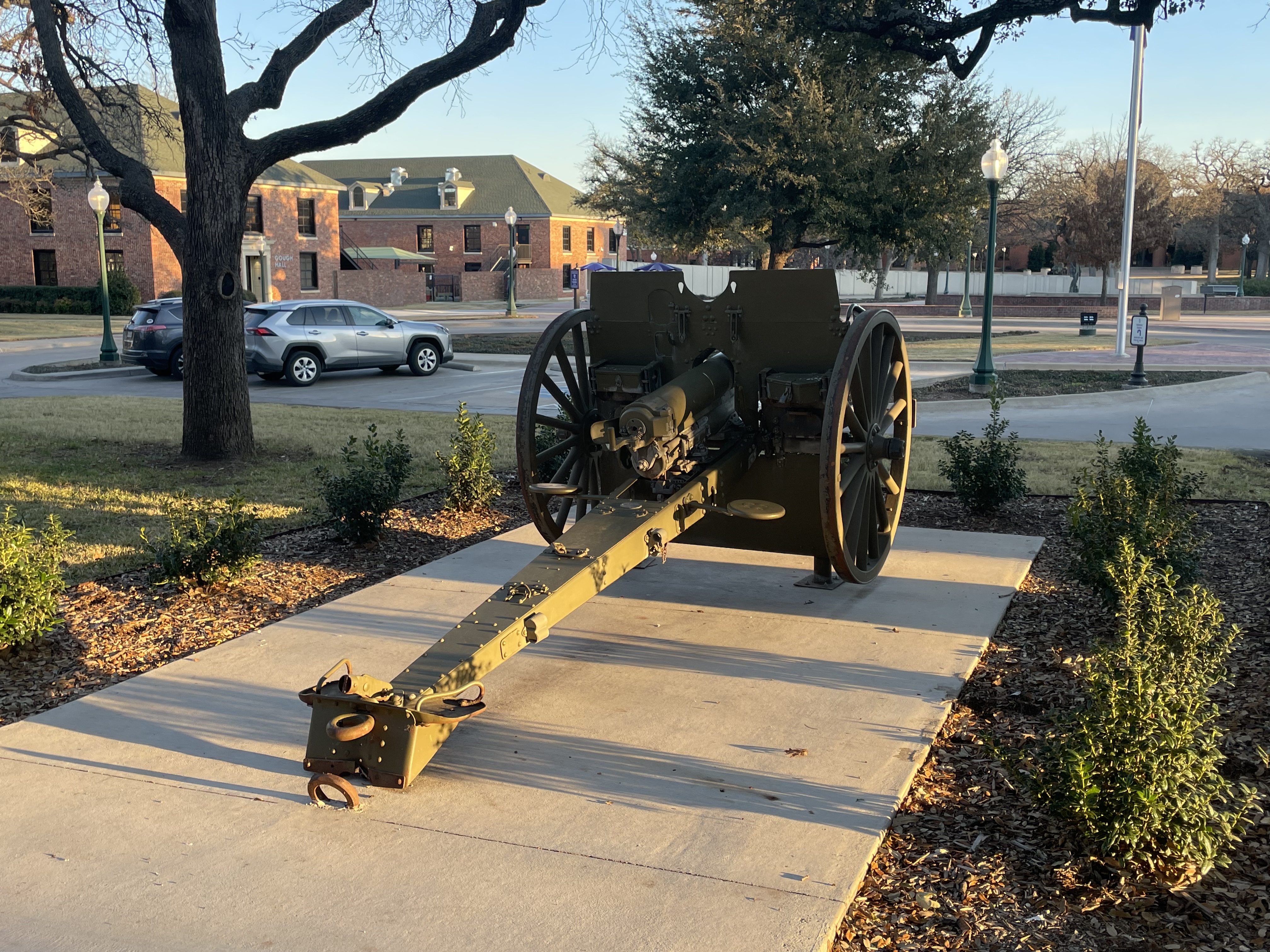
You’ve probably passed this landmark hundreds of times while walking through central campus and may have even thought to yourself, “Why is there a cannon in the middle of campus?”. The answer is a bit… complicated. It involves Tarleton’s military history, theft, and… chickens?
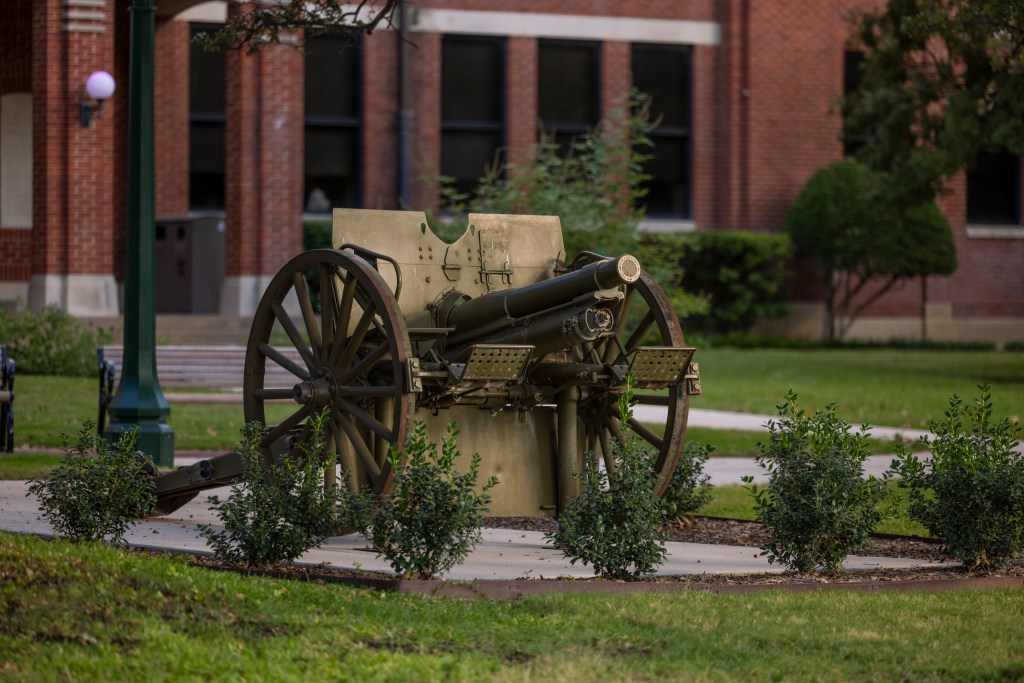
The cannon is a Model 1902 3-inch Field Artillery Gun. It weighs 2,500 pounds and was able to fire a 15-pound projectile to a maximum distance of 4.5 miles. It’s not clear if this cannon was used in World War I, but many believe it was not since most of those cannons stayed in Europe. It was likely used for men to train on before shipping over to Europe.

The cannon was donated to Tarleton’s ROTC by the US Army in 1922. Tarleton has always had a strong military tradition. All male students were required to be members of the Tarleton Corps of Cadets, wear a uniform, and take part in daily training. During their first year, they were also members of the ROTC program. At the end of their first year, they could choose to remain in ROTC and earn a commission in the US Army. If they opted out of it, they stayed in the Corps of Cadets.
During the lead-up to World War II, Tarleton became one of 220 schools that offered pilot training, created more programs in automotive, diesel, and airplane engine mechanics, and expanded classes into the summer to graduate students as quickly as possible so they could take part in the national defense. At one point, Tarleton was even a training location for the Army’s Specialized Training Program (ASTP). The ASTP consisted of 500 soldiers given military training and college coursework by Tarleton instructors. The program lasted from the summer of 1943 to the spring of 1944. Among these members were actor George Kennedy (who won an Oscar for Cool Hand Luke) and Dr. Norman Shumway, a pioneer of heart surgery and the first doctor to perform an adult human-to-human heart transplant in the United States.
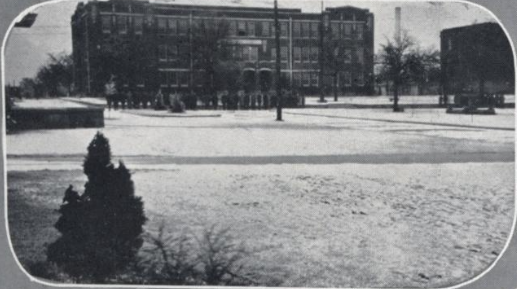
The cannon was used in training by ROTC cadets as can be seen up top. It was also featured during Parent’s Day and other campus events. One of these events was the weekly lowering of the flag in front of the current day Education Building. After drill on Thursday afternoons, the flag was lowered, “taps” was played, and the cannon was fired. The cannon was fired using blank shells for a number of years until the 1940s, when President Davis called for the cannon to be welded shut.

There is some debate behind the reasoning for the silencing of the cannon. Some believe that as the country was gearing up for WWII, ammunition became harder to find, and thus the decision was made to silence the cannon. Another reason had to do with… chickens. Starting in the 1920s, Tarleton had a sizeable chicken farm near the present-day site of Bender Hall (across from McDonalds). For years, it hosted an international egg-laying contest where people from around the country would compete to see whose hen laid the most eggs in a certain time frame. Unfortunately, for some reason, the firing of the cannon had a negative effect on that day’s egg production. Many cite this as the TRUE reason why the cannon was silenced.

The cannon also had a part to play in our heated football rivalry with North Texas Agricultural College (now the University of Texas at Arlington). A decade before their infamous air raid on Tarleton, NTAC students would invade campus the week of the annual football game to try and paint “NTAC” on the cannon and their school colors.
However, in 1928, painting the cannon wasn’t enough for NTAC… they decided to steal it. According to beloved professor “Doc” Blanchard, NTAC students hauled the cannon off campus around 5AM a few days before the big game, dragging it behind a truck. Unfortunately, the students had difficulties with transporting the cannon and dumped it in the Bosque River, just north of Stephenville. Blanchard and a few other volunteers fished the cannon out of the river. By the time they got it back to campus, it was in rough shape with many of the wooden spokes on the wheels broken. Restoration began at once, with Doc Blanchard making the new spokes by hand. The cannon was placed in its current spot sometime in the early 1930s, the wheels cemented to the ground so it could never again be stolen.


The cannon has kept silent vigil over the campus for almost 100 years. Throughout that time, it has been repainted, sometimes silver and sometimes purple. However, during the early 90s, and thanks largely to a fundraising effort by alumni of that era, it underwent a much-needed restoration. Part of this restoration included returning it to its original olive-drab color.
Today the cannon continues its watch. As Major William Brown put in his article in the 1993 Alumni JTAC, “While on the surface a weapon of war, it now stands as a symbol of peace gained through sacrifice and in many ways, endurance, for this cannon is indeed a survivor. We would all do well to protect and cherish Tarleton’s silent sentinel as an integral part of what Tarleton was, is and can be.”
For more information about the history of Tarleton, check out Chris Guthrie’s John Tarleton and His Legacy: The History of Tarleton State University, 1899-1999.
All images come from material in the Tarleton’s Archives and the Tarleton website. To search through digitized versions of the JTAC and Grassburr, visit the Portal to Texas History.

















 tarletonlibraries.wordpress.com