Do You Judge a Book by Its Cover?

Be honest. When you walk through the doors of the Dick Smith Library, what’s the first thing that catches your eyes? Is it the cool artwork up the stairwell or archival display case of Mr. Dick Smith himself? Is it the amazing book displays with carefully chosen titles, or perhaps you gravitate to that one author you already love? We all have our bias in picking up books, and making judgment calls based on appearances when those split-second decisions happen.

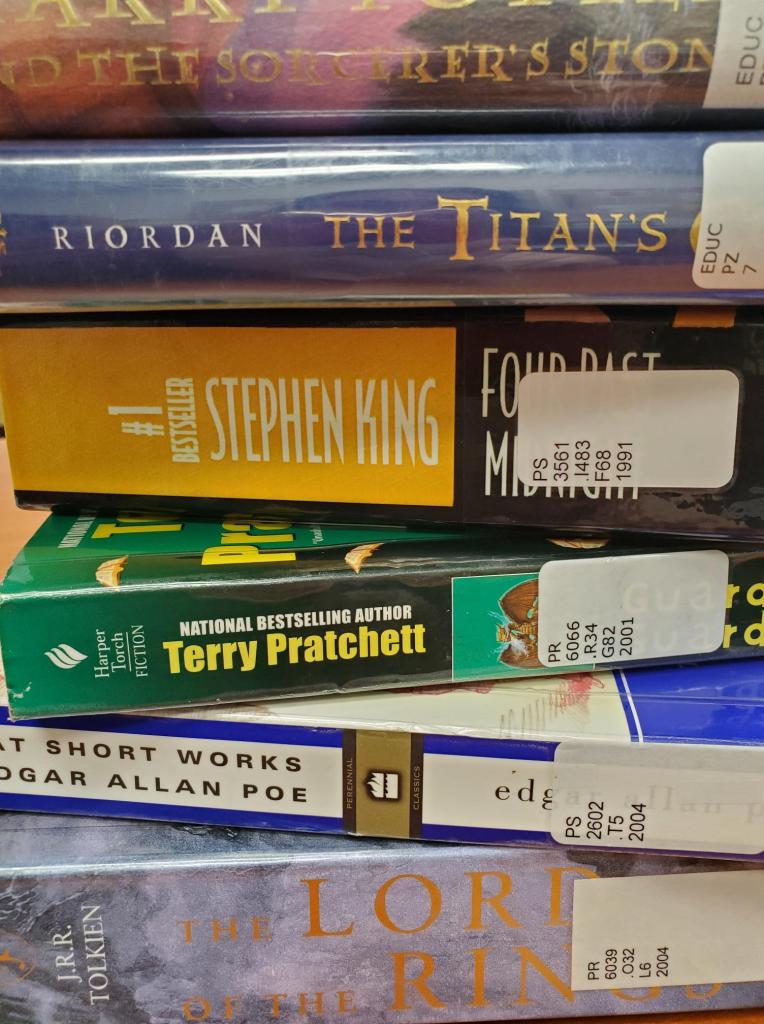
Image of library Cart with Books wrapped in plan paper to hide the covers.

Here at the Dick Smith Library, we challenged that habit during Library Lovers Week in February with a fun and creative event: “Blind Date with a Book.” This was actually our fourth time running this event, and it has quickly become a favorite for students and staff alike!

It’s Okay, Bias Is Hard to Beat

Think of it like scrolling through a streaming service. You probably skip over movies with posters you don’t like, in spite of an amazing plot line. I am here to tel you that the same thing happens with books too. Sometimes that weird cover of a sword or a plain text title in funky lettering is just not enough to make you even consider taking it off the shelf.

This natural tendency to prefer things that look familiar is a tough habit to break, and it can keep us from discovering great new things.

So We Hid Them So You Can Pick Blindly

Our solution? We played matchmaker! Instead of just wrapping the books, we created fun “dating profiles” for them. The covers and titles were completely hidden, so you could only judge them by their personality.

There was a real buzz of excitement near our front desk as students browsed the profiles, trying to choose their perfect match. On the front of each wrapped book, we only wrote a few intriguing clues about the story inside, just like other libraries do for this event. For example:

Two Book Profiles, one with a Heart and heart emoting couple, the other with vampire fangs. Both have an about me section, and "interests" tags.
Image created by the Tarleton State University Library for our “Blind Date with a Book” event. 2026

Each profile gave just enough information to get you curious. For example, Book #15 was described as a “slice-of-life story following a cute couple” from Tokyo, with interests in Manga and Romance.

Meanwhile, Book #23 was a bit more mysterious: a paranormal romance from Chicago looking for a roommate. Its profile cheekily warned, “Just try not to leave bags of blood in the shared fridge, okay?” with interests including Slow Burn Romance and Forced-Proximity.

The challenge was simple: pick a “date” based only on its profile. No cover art or popular author names to sway your decision. It was all about trusting your curiosity.

The Big Reveal

And it was successful as several books were borrowed by students! I hope that students were excited while choosing their mystery books and unwrapped them to see what they got. It was all about the fun of discovery and the surprise of finding a hidden gem.

“‘Blind Date with a Book’ gives readers a great way to try something they never would have chosen otherwise, and that’s exactly where the fun is in the event,” said Megan Gilpin, an outreach coordinator at Penn State University, in an article for Penn State News.

Library Lovers Week was a great reminder that some of the best stories are found when we step outside our comfort zone. So the next time you’re looking for something to read, we challenge you to try it. Pick up a book you’d normally ignore. Read the first page, and don’t judge a book by its cover.

Tarleton Author Talk – Homicide in the Hood

Tarleton’s scholarly community is rich with unique perspectives and vibrant stories. The Friends of the Dick Smith Library are excited to host the Tarleton Author Talk series, which is an excellent opportunity for published authors to present their research and interact with Tarleton students and faculty about their book.

The next featured author is Kelli Martin, discussing her book, Homicide in the hood: Murders that Haunt a Small Town Girl. Kelli is a Tarleton alumnus and has taught at several Texas higher educational institutions. A string of murders in her hometown of Granbury in Hood County inspired Kelli to enter the field of criminal justice, and writing her book was a great effort towards finding important answers to long-unsolved crimes.

From the Amazon book description, “Growing up in this quaint, picturesque town was not what people might think. Women in the 1980s were being murdered in the hood and no one was being arrested. People were scared and began locking their doors. A convicted rapist was running loose, peeping in the author’s window, and stalking her. These events in childhood and the murder of a friend and co-worker in 1990 had a profound impact on Martin and her choice to enter the field of criminal justice. All these years later she wrote this book Homicide in the Hood: Murders that Haunt a Small Town Girl, in hopes of these cases finally being solved. The unsolved cases covered is this book are now being worked by law enforcement.”

All events in the Tarleton Author Talk series are free and open to the public, held in the Dick Smith Library. Kelli Martin will be speaking about her book on Tuesday, February 10th at 1:00pm in the library’s Multipurpose Room. With no reservation necessary, show up and learn more about some fascinating crime stories that can hit close to home, and how the criminal justice field works to solve them!

The Easiest Book Club You’ll Ever Be Part Of

Just a few of the 60+ works brought up during the No-Stress Book Club’s Fall 2025 meetings

Do you love reading? Have you ever thought about joining a book club but then didn’t for whatever reason? Or maybe you did join, but you found you just couldn’t keep up with it. You couldn’t find the time to finish the selected books, or the group kept choosing books that didn’t appeal to you. Instead of being fun, reading a book for the next meeting started to feel like a chore.

The Dick Smith Library’s No-Stress Book Club might just be for you, then. Led by librarians Melissa Cookson, Kim Gragg, and Heather O’Donnell, the group had its first meeting on September 16, 2025.

Unlike many other book clubs that choose a particular work for the whole group to read, the No-Stress Book Club picks a genre (or, in the future, possibly a topic or something else). Group discussion is then based primarily around works that attendees read, in full or in part, that somehow fit the genre being focused on.

What was the book about? Why did you choose it? What did you like or dislike about it? Your fellow attendees might decide they’d like to read it too, and you might find yourself intrigued by whatever they read. No worries on that account, because all attendees who are interested can sign up to receive emails with lists of the works mentioned at the meetings.

Above all, though, the most important things about this book club are that attendees 1) enjoy reading and 2) aren’t stressing about what to read. If you’re a newcomer to that month’s selected genre and can’t decide what to pick, we have a guide with various suggestions. You can also email librarians directly for help choosing something that might best fit your tastes.

Or, if you really can’t decide, just pick something off your pile of books you’ve been intending to read and don’t worry about whether it fits the month’s focus – we’ll all still be happy to hear about whatever it is you read. Format doesn’t matter either – feel free to listen to your pick in audiobook format during your daily commute, or bypass novels entirely and choose a graphic novel. Just have fun and come to the meetings to get to know other Tarleton readers!

Wading Through History: The Tarleton State University Archives

This past semester, we have had the opportunity to have an intern working in our archives, digitizing one of our most used collections, the University Photo Collection. Join her as she explains the mission of the archives and the process she followed in digitizing some of the collection. All of the images in this blog are ones that she digitized during this process.

The Dick Smith Library at Tarleton State University houses a multitude of items. The most notable items are the books, periodicals, and digital resources available, but it also houses the Tarleton Libraries’ Archives and Special Collections. The goal of the archives is to curate and preserve materials relating to the history of Tarleton, Erath County, and the Cross Timbers region. These materials are photographs, manuscripts, rare books, serials, and the permanent historic records of Tarleton. While curating a collection is one topic to discuss and conservation another, the one that most people are curious about is the preservation of a collection.

Preservation comes in many forms. There is the preservation of physical items in climate-controlled environments, which necessitates the use of archival materials such as acid-free boxes, papers, and folders to separate items from one another. This keeps harmful acids and chemicals that leach over time from items and stops them from touching other items. These acids and chemicals damage and age items, and protecting them from this added harm keeps items intact for many more years than letting them sit stacked beside each other without acid-free barriers would. However, the most modern method of preservation is digital preservation.

Digital preservation will vary depending on the type of item being preserved. While digital-born items are the most common things created today, think photographs and emails, many older physical items can also be preserved digitally. This process is largely completed by scanning the item. The Texas State Library and Archives Commission (TSLAC) shares guidelines for best practices for the digitization of items. These standards allow for best practices and best care for the items and their digital records. TSLAC’s recommendation is for images to be at 600 or better dots per inch (DPI) and for documents to be at 400 or better DPI. This is only one portion of the standards necessary for digital preservation. The other is metadata, or the information about the item. While a picture is worth a thousand words, a picture still has a title, a description, a creator, a date created, and so on and so forth. The DACS or Describing Archives: A Content Standard sets a set of rules for describing collections and allows for standardization across multiple materials.

The only thing left after establishing what is necessary to collect is to begin. Starting with the earliest images that exist about Tarleton in the University Archives Box 1 Folder 1, we took down the information about the item, identifier – the name of the item in the system, title -the name of the item, creator, date, folder, and so on, and then scanned each item from there. For the majority of the items in the collection, a flatbed scanner was adequate to digitize the majority of the images. For the items that are too large to fit on a standard scanner, a high-resolution camera and a well-lit room will suffice. This process, while simple, is labor-intensive and time-consuming, and when it is complete, there is a digital copy of these items that will potentially outlast the physical, so long as the preservation of the digital copy succeeds; however, digital preservation for digital items is a different topic to discuss.

Classic Movies and Copyright

What Happened? 

The Tarleton State University Dick Smith Library is hosting two Classic Movie Nights on October 30th and November 6th! We will enjoy two timeless films and plenty of popcorn. But before the popping started, we had to make sure we were not breaking any copyright laws. 

What is Copyright? 

Copyright is a law that protects creators—like filmmakers, musicians, and authors—from having their work used without permission. Once an original work is fixed in a tangible form (like a film), it gains copyright protection under the laws of the country where it was created. 

Owning a DVD or having access to a streaming service does not give you the right to show a movie to a public audience. Public screenings need a license because they count as a public performance. To keep things simple and legal, we decided to show films that are in the public domain: works which are no longer protected by copyright. Public domain films can be shared, remixed, or screened without paying fees or asking permission, and they often inspire new creative works. 

Night of the Living Dead (1968) 

We chose Night of the Living Dead by George A. Romero as one of our films. It entered the public domain because the copyright notice was accidentally removed during post-production. That means we can confidently show the original version without worrying about licenses or fees. 

Yet even public domain films require that we take caution. Here is what we checked: 

  • Public Domain Status: Confirm that the version being screened is truly public domain. Some remastered or colorized editions are copyrighted as derivative works. The original 1968 version of the film is widely considered public domain due to a copyright notice being omitted during release. 
  • Trademark: Titles, logos, or even characters can still be protected under trademark law. We are only using content from the original film. 
  • Music Rights: Original scores may have separate copyright protections. The soundtrack used stock music, which was generally in the public domain. 
  • Attribution: Even if a work is in the public domain, it is good practice to credit the original creators. Many thanks to Gorge A. Romero! 

Not every website labels movies correctly, so we verified our sources using trusted platforms like the Internet Archive and the Library of Congress to double check the film we selected. 

Why It Matters   

Libraries are all about sharing knowledge and entertainment, but we also must respect the rights of creators. By choosing Public Domain films, we can host a fun event. Additionally, we can teach people a little about copyright, and our patrons can learn about the protection that copyright offers.  

While Copyright sounds complicated, it is about doing the right thing for the creators. If you are planning a movie night at school or in your community, consider Public Domain films. They are free, legal, and often have interesting stories of origin.   

Do you want to learn more about copyright? Go check out Copyright.gov! 

Otherwise come join us for popcorn and watch some classic films that have shaped cinema history! 

Welcome Home Texans!

The library is excited to welcome you all to the start of the Fall 2025 semester.

Looking for a fun way to kick off the semester and explore everything the library has to offer? The Dick Smith Library invites you to take part in Clash of the Colleges, happening August 20–22 during regular library hours. This exciting event is part scavenger hunt, part competition, and all about showing off your college pride while learning more about the resources and spaces available to you.

Bring your friends and set out on an adventure through the library as you complete challenges, discover new study areas, and unlock hidden gems you may not have noticed before. Along the way, you’ll earn points for your college. The more tasks you complete, the more points your college racks up and at the end of the week, one college will claim the ultimate prize: bragging rights for the entire year!

But that’s not all: once you finish your quest, you’ll even get the chance to design your own button as a keepsake of the event. Whether you’re a first-year student just starting out or a returning student who thinks you know the library inside and out, Clash of the Colleges is the perfect way to test your knowledge, bond with your peers, and have a little fun along the way. Don’t miss out on the chance to represent your college and be part of the competition!

Story Time at the Stephenville Public Library

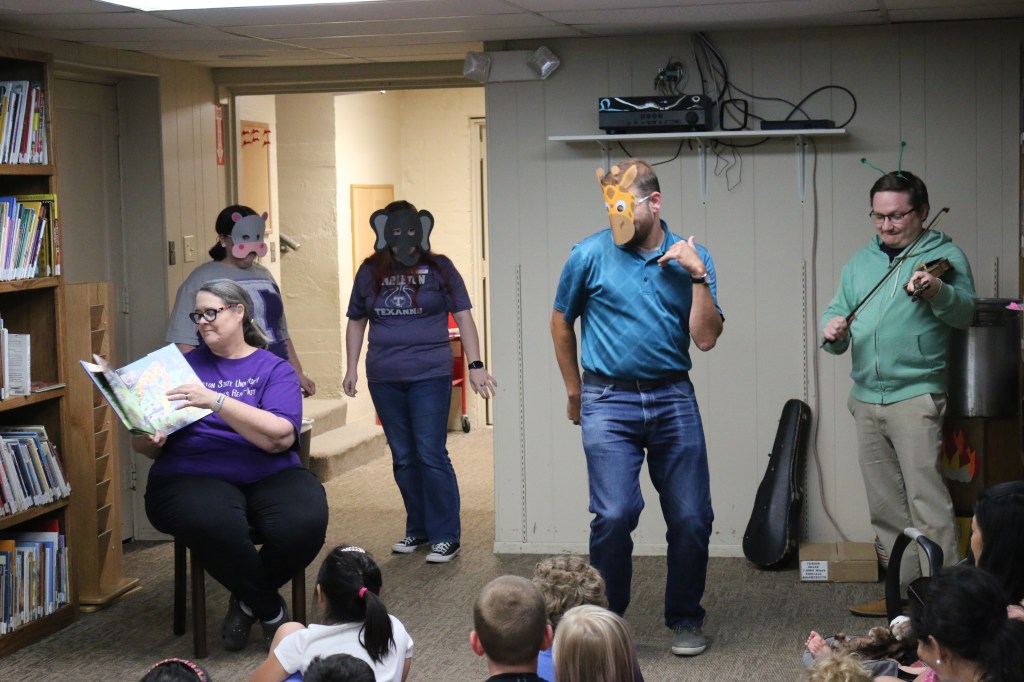
Every summer for the past 9 years staff members from Tarleton’s Dick Smith Library have performed story time events at the Stephenville Public Library.

We call our troupe the Dick Smith Players.

What makes these events unique is we don’t just narrate stories, we act them out as well. For weeks before the event, we create costumes, props, memorize lines, figure out entrances/exits and other character movements.

It’s a lot of fun and we all get a lot of enjoyment from it. However, we aren’t just there to have fun. We also do it to share our love of reading with the children of the community.

Dragons Love Tacos by Adam Rubin in 2017
Rhyming Dust Bunnies by Jan Thomas in 2019
Giraffes Can’t Dance by Guy Parker-Rees in 2023

You can find more photos of our Story Time events, as well as much more, on our Flickr page: https://www.flickr.com/photos/tarleton_libraries/.

Tarleton State University’s 125 Years of Excellence: A Reflection

As we’ve celebrated Tarleton State University’s 125 Years of Excellence this past year, we’ve combed through the archives and told stories from the history of TSU. We looked at the history of the Dick Smith Library and its namesake, the defense of the bonfire with Risinger, the history of our silent sentinel, and more.

As I jumped into research and delved into the stories of Tarleton State, I started to see the campus a bit differently.  I’ve looked through so many pictures of TSU’s past, it’s hard not to see “ghosts” on campus…

Every time I walk by the cannon, I see the cadets from the 1920s firing it in practice.

When I walk by the admin building and see the people celebrating the construction of the south gate in the 1930s.

I see generations of students taking their senior photos near the Tarleton gates.

Those who represented Tarleton State on the field and on the court.

The students who struggled and succeeded in various classrooms over the past century.

 The rich history of the fine arts department.

The sacrifice and service of Tarleton students and alumni.

And more.

These glimpses of the past make one stop and reflect on the impact we have on the future history of Tarleton State University. What are we doing now that will be remembered years from now? Will we continue to have stories such as Coach Wisdom and “The Streak”? The service and legacy of Doc Blanchard and his red fire truck? Or the legend of our namesake, John Tarleton?

The only known photo of John Tarleton… allegedly taken after he was drugged and robbed by bandits.

The future is bright as word is out about the “best kept secret in Texas”. Tarleton State University is making waves in both athletics and academics, highlighting the amazing work being done by our community. Our enrollment is surging, with each incoming class higher than the last. And new programs, such as physical and occupational therapies, are constantly being added.

It will be exciting to see what history, stories, and traditions are formed as we strive ever forward.

If you would like to know more about the history of Tarleton State, check out:

Christopher Guthrie’s John Tarleton and His Legacy: The History of Tarleton State University, 1899-1999

Richard C. King’s The John Tarleton College Story: Golden Days of Purple and White.

The Tarleton Collection Narratives

The Grassburr (both in print and online)

The J-TAC

The Cross Timbers Historical Image Project

Vaquero: Genesis of the Texas Cowboy

A black and white portrait of a cowboy standing confidently outdoors, wearing a wide-brimmed hat and denim clothing.
Photograph by Bill Wittliff, 1971 from Humanities Texas.

For the past few months, the Dick Smith Library has proudly hosted the exhibit Vaquero: Genesis of the Texas Cowboy. This captivating exhibition features the stunning photography of Bill Wittliff, a renowned Texan screenwriter and photographer. Wittliff is celebrated for his work on over a dozen films and TV series, including Legends of the FallThe Perfect Storm, and Lonesome Dove.

In the 1970s, Mr. Wittliff had the unique opportunity to visit a ranch in northern Mexico that still operated in the traditional ways of the vaquero. This tradition, which originates from the Spanish conquistadors of the 16th century, serves as the foundation for the cowboy culture we know today. Wittliff followed the vaqueros as they went about their daily work, capturing their timeless practices through his lens.

Bill Wittliff, 1971 from Humanities Texas.

The exhibit combines Wittliff’s evocative photographs with bilingual narrative text, offering a vivid portrayal of the muscle, sweat, and drama that define the life of a vaquero.

We invite you to join us at the Dick Smith Library on Thursday, April 17th, at 2:30 PM for a special reception to celebrate the closing of this remarkable exhibit.

Vaquero: Genesis of the Texas Cowboy is an exhibition produced by the Wittliff Collections at Texas State University, presented in partnership with Humanities Texas, the state affiliate for the National Endowment for the Humanities.

We hope to see you there!

Tarleton’s 125 Years of Excellence: Dr. Dick Smith

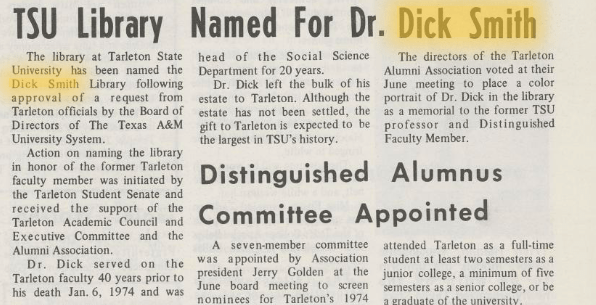
1967 Grassburr

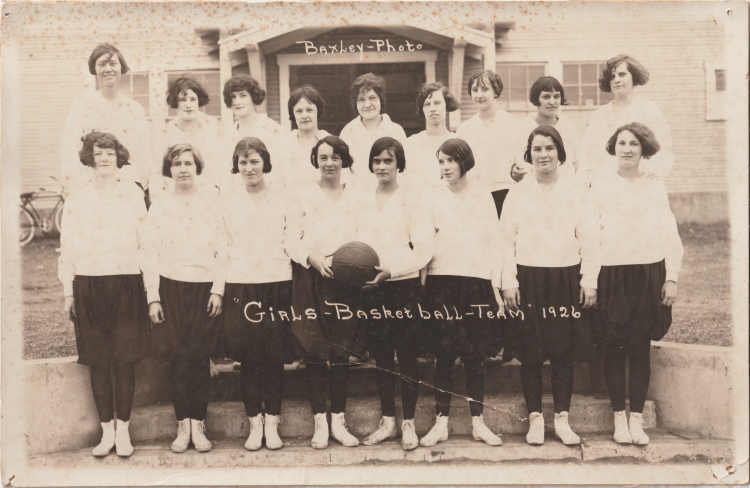
Dr. Dick Smith was a professor of government at Tarleton for almost 40 years, from 1934 to 1973. Born in Milford, Texas in 1908 to a county judge and high school teacher, politics and education were in his blood. Smith briefly attended Tarleton in 1926 before completing his undergraduate degree and receiving his master’s from the University of Texas.

1926 Student Photo, Grassburr

A gifted student, Smith then began his doctoral studies at Harvard University. Unfortunately, Smith’s mother became ill in 1932 after his first year in Boston, and he returned home to take care of her and to sub in her classroom at Breckenridge High School. Smith was hired by Dean J. Thomas Davis to fill in as assistant registrar and instructor of history in 1933. By 1934, he was promoted to associate professor of history and government.

1934. First Staff Photo, Grassburr

Before settling into his role permanently, Dr. Smith took a two-year leave of absence in 1935 and returned to Harvard to finish his doctoral degree, completing his dissertation after his return to teaching at Tarleton in 1937. Smith received his doctoral degree in 1939, at the time becoming the second professor at Tarleton with a Ph. D. As well as some extended teaching engagements at a variety of universities in Texas, the only other time he left Tarleton was during the 1940s when he served as a field artillery corporal in WWII.

1950 Grassburr
1946 Grassburr. Dr. Smith served as advisor for the Grassburr for many years.

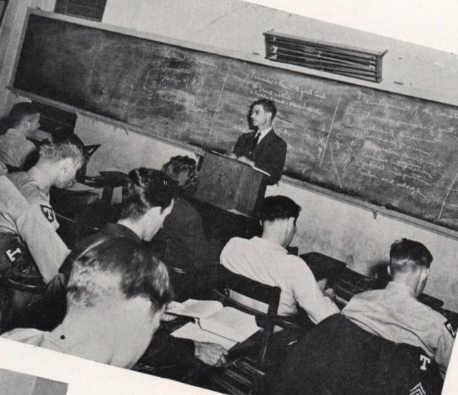
Smith was known as a tough and demanding professor, who believed that Tarleton students were as capable as students from any other institution. Smith’s style of instruction was purely lecture-based and described as a “true learning experience–an exhaustive and exciting excursion into the subject”. Dr. Smith was constantly updating his notes, sometimes getting information about pending legislation directly from the state capital in Austin before turning around and lecturing about the new developments to a class of students. The high standard to which Dr. Smith held himself was also reflected in how he treated the students at Tarleton. Smith’s tests were notoriously difficult and struck fear into many students… but a sense of immense pride for the student who passed. As former student Richard Cruz stated, “People said they were government majors with pride… The grades were tough to make… but it was something that people were proud of.”

1964 Grassburr

Dr. Smith was a renowned expert on Texas government, becoming one of the most active scholars in Tarleton’s history. In the 1940s, he co-authored two highly successful textbooks on Texas government, which were updated through several editions and widely used across the state for decades. Additionally, he penned numerous articles and two well-known booklets on the subject. Dr. Smith served as department head for the Department of Social Sciences from 1947 to 1967, when he requested to step down to return to full-time teaching.

During the presentation of the Distinguished Faculty Member Award to Dr. Smith in 1972, Alumnus Joe R. Long had this to say:

“…in an era obsessed with technology, and with the acquisition of material wealth where higher education generally reflects that era by attempting to equip students with a marketable skill, he has continued to believe that ideas, their interrelationship, their development, and ultimately their application to human affairs is a legitimate and necessary purpose of the educational process. In an era which has dehumanized men and largely robbed them of their individuality, he continues to sponsor classical liberal thought, believing in the inherent worth and dignity of the individual.”

After his retirement in 1973, Smith earned the honorary title of professor emeritus. Unfortunately, Smith passed away a few months later on January 6, 1974. At his request, a major portion of his estate ($525,000, which today would be almost $4,000,000) was given to Tarleton in his will to establish the Dick Smith Scholarship for students from the College of Arts and Sciences, a scholarship that still exists to this day. In addition to donating his private library to the Tarleton Library, he left instructions that at his death mourners donate funds to the university library.

Tarleton Library was renamed the Dick Smith Library in his memory after a push by the student senate. Dr. Smith’s legacy continues to inspire students and faculty alike, reminding them of the profound impact one dedicated educator can have on an institution and its community.

6/26/1974 Alumni J-TAC
1974 Grassburr

Join us later this month as we honor the namesake of our library by hosting an exhibit showcasing the life and achievements of Dr. Dick Smith.

Design a site like this with WordPress.com
Get started