

1-on-1 Special Operations Selection Coaching
This is structured, data-driven preparation built specifically for high-attrition military and law enforcement selection.
If you want to understand the philosophy behind this model, read the About SOFPrepCoach page first. Below is how the coaching process actually works.
Strengths & Weaknesses Analysis
I start you with a set of assessments to determine your strengths and weaknesses
Structured Weekly, Personalized Programming
Based on your performance and feedback, I create and adjust training at least weekly
Performance Monitoring
You have my personal number to message, so I can optimize your training at any moment
How Does 1-on-1 Coaching Work
Step 1: Assessments and Initial Data
I always start with data.
I will ask you to fill out a form with details on your training history, injury history, training equipment, availability, and more. You’ll get setup on TrainingPeaks, an app which allows me to collect and monitor performance data including HR. Then, based on your timeline and unique history, I’ll share initial workouts to determine your strengths and weaknesses.
Our initial workouts and information collected will tell me:
- How strong you are
- How developed your aerobic base is
- How you tolerate volume
- Where you’re most likely to break down
- What to prioritize immediately
This is a snapshot of a few baseline strength workouts for an athlete who was recovering from a lower-leg injury. You can see, training is adjusted to his needs.

Step 2: Working Backwards from Your Selection Date
Once I understand your current level of fitness, I build a tentative, periodized plan by working backwards from your selection or ship date.
Keep in mind, this is NOT a program I’m writing out with individual workouts 8, 10, or 12 weeks in advance.
I’m simply writing out a rough outline of milestones the athlete needs to hit and phases to accomplish them.
For instance, I like to have a 10 – 12 week peaking protocol ahead of selection. If someone comes to me 16-weeks out from selection, this outline may look like
- 1-week to identify strengths and weaknesses
- 3 – 5 weeks focused on weaknesses
- 10–12 weeks of peaking, split into two personalized blocks
Each training block will train all energy systems concurrently, but each will have an emphasis:
- Building aerobic capacity
- Max strength
- Load carriage
- Ramping volume
- Selection-specific metcons
In some cases, I may believe your timeline to ship or go to selection is aggressive or unrealistic. If that’s the case, I will tell you immediately. I would love for you to beat the odds, but it’s also my responsibility to be realistic and give you the best chance of being selected. Sometimes it’s safer to adjust your timeline.
On the other hand, I’ve also had athletes who were too conservative. There have been several cases, after reviewing week 1 data, I’ve told athletes to sign up for the next available SFRE or move up their ship date. That happens as well.
Step 3: Building a Foundation of Strength and Endurance
The first deficiencies I’m looking for are in strength and endurance. These are non-negotiable.
Because think about it: If an athlete shows up to selection with a deficit in either, it will be immediately apparent. Collapsing during carries or struggling to keep up on runs or rucks is not where you want to be.
Too many athletes skip this phase of training and jump into fast, long rucks or selection-specific metcons and wonder why they can’t keep up. The simple reality is that there is no way you will hit 12-minute miles with 65lbs on your back if you can’t run a 40-minute 5 mile.
That’s why, before I layer in high-volume rucking, long carries, or high volumes of selection-style conditioning, we build the base that enables it.
This phase focuses on:
- Aerobic development
- Full-body strength
- Limited metabolic conditioning work
- Gradual increases in total training volume
Step 4: Selection-Specific Training
Once your base is solid, training becomes a lot more fun and progressively more specific.
This is not to say step 3 isn’t fun. You’ll be consistently hitting PRs in the gym and PRs on the track. But it’s during step 4 that you’ll be rucking more and doing more selection-specific circuits.
That includes:
- Ruck progressions
- Pre-fatigue runs and rucks
- Selection-style conditioning
- Longer training days where appropriate
Frankly, many athletes can achieve competitive or near-competitive scores in strength and endurance with self-coaching. But learning how to achieve peak fitness in both and implement selection-specific can be a lot to juggle.
Step 5: Peak at the Right Time
One of the most underrated aspects of preparation is peaking. No one cares how fit and healthy you were 4-months prior to selection. If you show up with shin splints, you’re in trouble.
Peaking is about:
- Selection-specific preparation
- Ramping volume while managing fatigue
- Avoiding injury
- Arriving physically confident and structurally intact
By the time we start peaking, you’re already fast, strong, and physically competitive. On paper, you’re already fantastic.
Peaking allows us to ramp the volume to simulate the demands of selection.
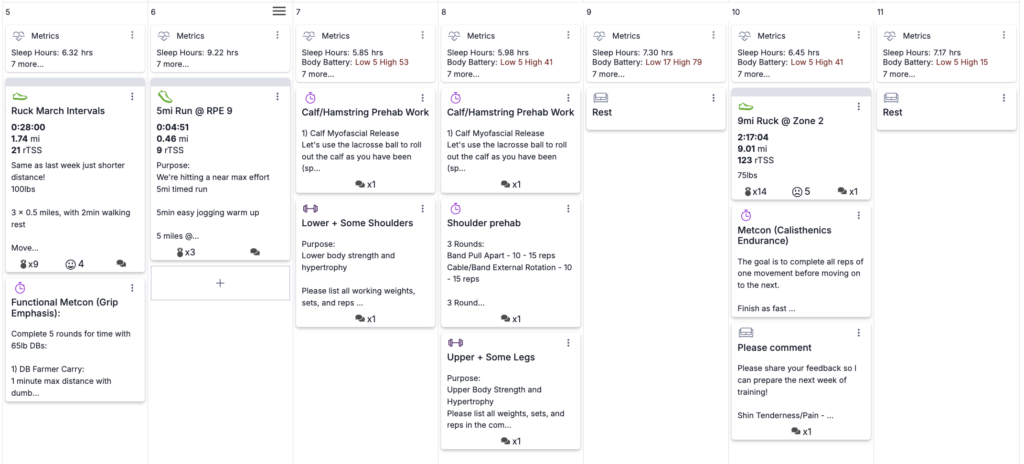
So, instead of training for a fresh 5-mile performance. We’re hitting overhead, grip, and leg-focused metcons with a ruck on and transitioning directly into hard 5-mile runs. Earlier phases are focused on fresh performance, whereas now, we’re fully focused on selection.
Here’s a sample training week for an athlete leading up to selection. You’ll notice he has some focused prehab work as well.
Step 6: Ongoing Adjustments
Throughout the entirety of training together and after, I am in your corner.
I will do everything in my power to ensure you’re physically overprepared. Day 1 of selection, physical preparedness should be the least of your concerns. There should be zero doubt that you have what it takes to succeed. The only thing you should be focused on is execution.
Sadly, many candidates arrive on day 1 stressed about timed runs and rucks, which they knew about ahead of time! How does that make any sense? Thinking charitably, there could be many reasons… But I will make sure you are not in that position.
I will rely on the data in TrainingPeaks and directly from you to ensure we’re on track.
This includes:
- Heart rate data
- Workout feedback
- Scheduling changes
- Missed sessions
- Emerging aches or pain
- Life stress
When something changes or I see something off, I’ll message you.
And since TrainingPeaks can’t tell me about life stressors or schedulling changes ahead of time, anytime you would like an adjustment, I’m always here.

Does Coaching Make Sense For You?
You have a unique training history and set of strengths and weaknesses. Your training for special operations selection should reflect that.
At the same time, coaching is not right for everyone, all the time.
If you’re unsure, read Do You Need a Special Operations Coach? for a detailed breakdown.
Apply for Coaching
Coaching is $269/mo. Apply below if you’re ready to commit.
Hear from My Former Athletes:


(In Training)
Common Questions
Hear from My Athletes:


This is very well thought out with a lot of science and purpose behind it. You can tell just by watching the videos on this, even better that it is personalized. Feedback is taken very seriously and the program is fluid to change with what works and to get closer to your goals. I am leaving for MARSOC A&S in a week and I am not stressing the physical aspects. The level of my training will reflect that!

Honestly I can’t think of how you could improve as a coach, you’re personal with the workouts I can tell they’re catered to my weaknesses and you’re attentive to my needs as a client
Good explanation and workouts, always answering the questions I have with fairly quick responses, willing to adapt my workouts to my situation. You’re my first coaching program I have ever done, I was a big skeptical at first due to being my first coaching program but I have nothing but good things to say about it.

Great coach who puts forth immense effort and gives reasoning behind workouts. Having him for the two months got me stronger and faster.
Man I’m loving it honestly I’ve improved on a lot of things in the short amount of time we’ve started working together I can’t wait to see what 2 months from now is like or even the month before I go to selection
Everything has been very precise and informative the training is well written and easy to understand very thankful to have this coaching