
If you read the newspapers or online news websites, or watch the news on TV, you would have noticed that pollution is a chronic problem affecting our natural environment, especially since plastic was invented.
Plastics everywhere
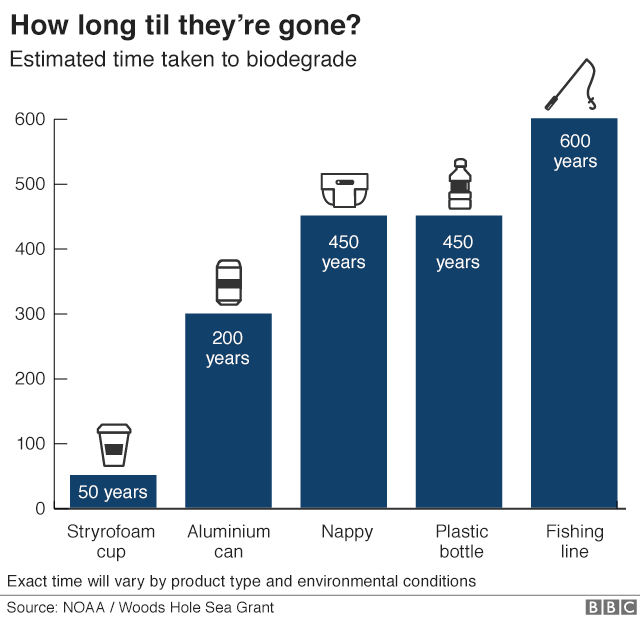
Plastic has been around for the last 60-70 years, but it has revolutionised our urban existence. Because plastic is so flexible and created to last such a long time, it has been an ingredient added into everything from clothing, cooking and catering equipment, to engineering and retailing materials. The problem is that nearly all plastic that has ever been created still exists today in some form, as they take a very long time to degrade. The chart below from BBC’s ‘Seven Charts That Explain the Pollution Problem’ illustrates clearly the lifespan of plastic.
Due to consumerism, our lifestyles have largely become unsustainable, and we generate too much trash every day, to the extent that landfills are filling up way too fast.
Making Choices
So, what can we do as ordinary people to be more sustainable in our daily lives? Well, it’s all about choices. Yesterday, I participated in a beach clean-up at Bagan Lalang in Sepang, and after the activity, some of us were very thirsty, so we bought some drinks from a drink stall nearby. A friend thought out loud, “We just picked up all the trash on this beach. After that, are we going to generate more trash?” She was referring to the plastic cups. I said I was not going to throw the cup away, but bring it home, wash it, and reuse it. Reusing stuff is a very important part of a more sustainable lifestyle.


Reusing Plastic Items
Plastic cups, plates, bowls, cutlery, etc. all can be taken home, washed, stored neatly and reused, at least for a few times. I like to keep them for outings, barbecues and parties. Once they are damaged, broken, change colour or warp in some way, then it is time to put them in the recycling bin.

Reusable Cutlery, Straws & Containers
It is handy to bring your own set of reusable cutlery along with you to work or outings. In that way, you do not need to get the disposable type. These are very common now – they are made of extra sturdy plastic or metal, and come in their own containers or pouches. If the food seller offers disposable food containers and cutlery to you, you can politely decline them.


Similarly, bamboo and stainless steel straws are becoming more popular and more widely sold now. So, if you are the type that likes to sip your iced drinks through straws, it is a good idea to get yourself one.
Plan ahead. If you like to buy food on the way to work or on the way back home, it is good to have a few reusable food containers in the car or in your bag. For those who go out during lunchtime to buy food back to the office, having a reusable container in your office drawer, plus reusable cutlery, is a good idea.

If you like to buy coffee or drinks on-the-go, then it will be good to have a thermos or tumbler in the car or in your bag, so that you can do away with paper or plastic cups. Do you know that paper drink cups are not recyclable? The plastic waterproof lining of many paper cups makes them unrecyclable. If they are collected with paper and cardboard, they may actually contaminate the whole load because they are also dirty/stained – this will cause the lot to be sent to landfill.
For those who travel frequently, or like to have garden parties or picnics, a set of reusable lightweight crockery and cutlery would be ideal to have. I got this 46-piece blue picnic set at carrefour many years ago, and they have served me well.


Recycling Plastic Items That Can’t Be Used Anymore
Once your reusable plastic items cannot be reused anymore, it is time to put them in the recycling bin. I sort my recyclables the low-tech way in my yard – one bag for plastics, one bag for paper, one bag for metal items, and another bag for glass items. It takes me a few months to fill up a bag. When a bag is full, I will take it to a recycling bin.

Remember that you have to clean your plastic containers, glass bottles and metal tins before you put them in your recycling bin. You do not want to contaminate the whole bin. Also, please take note that soiled/dirty paper cannot be recycled. Dirty paper (especially those stained with food) will contaminate all the paper pulp during recycling.
So, if you haven’t thought about living more sustainably, it is never too late to start. If you are already doing all the necessary steps for living a more sustainable life, then congratulations! Keep up the good work.

 Project Prose