
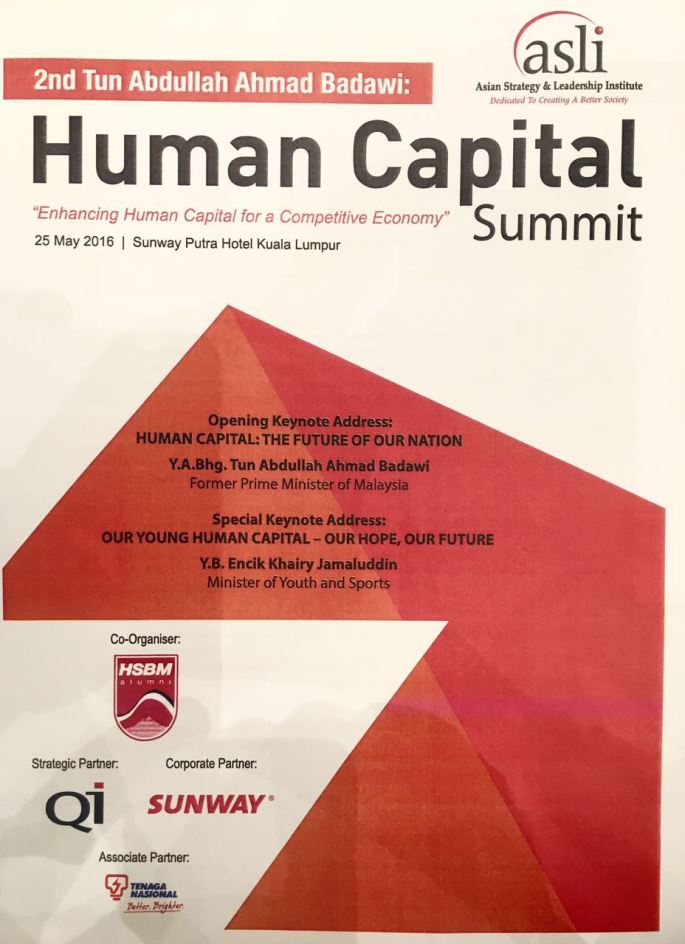
The 2nd Tun Abdullah Ahmad Badawi Human Capital Summit was organised to bring together senior representatives from the government, business sector, academia and training providers to discuss the key issues facing human capital development in Malaysia, with the intention of charting the way forward for the nation.
I was fortunate to be able to attend the summit on 25 May 2016 at Sunway Putra Hotel Kuala Lumpur. It was an interesting and eye-opening experience for me, and it provided valuable insights into the state of human capital and the mismatch between human capital demand and the supply provided by the institutions of higher learning.
Supply vs. Demand
As the day progressed and respected speakers took to the stage one by one to share their knowledge and observations, a marked trend emerged. Firstly, parents, teachers and school counsellors all prioritised professional qualifications such as medical and engineering degrees, and pushed students and their own children towards achieving success in professions which they thought were superior, until there is now a surplus of degree holders, but a significant shortage in skilled and technical specialisations. So, what sort of human capital do we actually need?
“Annually, 100,000 youth do not enrol in any tertiary programme after SPM. Not even certificate courses,” said Associate Professor Elajsolan Mohan, President of the National Association of Private Educational Institutions (NAPEI) during the CEO panel discussion. “To compound the issue, career counsellors in schools are not updated about the prime areas of human capital demand.”
He added, “The top area of demand is currently the manufacturing sector. There is a real and growing demand for Technical and Vocational Education (TVET) graduates.”
The graduate unemployment statistics he presented drove the point home. Among fresh graduates (with degrees), 31% are now unemployed, of which 43% are from the Arts and Social Sciences. Meanwhile, 25% were from Technical, 20% from Science, 4% from Education, and 8% from ICT.
Top 15 job sectors that are most sought after by applicants in Malaysia since 2011
|
RANKING BY YEAR |
|||
|
SECTOR |
2011 |
2012 |
2013 |
| Government/NGO |
1 |
1 |
1 |
| Oil & Gas |
3 |
2 |
2 |
| Engineering/Industrial Services |
4 |
4 |
3 |
| Financial & Banking |
2 |
3 |
4 |
| Agriculture/Aquaculture |
6 |
6 |
5 |
| FMCG |
5 |
5 |
6 |
| Education |
7 |
8 |
7 |
| Call Centre/BPO |
8 |
7 |
8 |
| Logistics |
9 |
9 |
9 |
| Manufacturing – SemiCon |
14 |
10 |
10 |
| Manufacturing – E&E |
15 |
12 |
11 |
| Others |
12 |
13 |
12 |
| Biotech/Healthcare |
10 |
11 |
13 |
| Manufacturing – Production |
13 |
14 |
14 |
| Construction |
11 |
15 |
15 |
(Source: Associate Professor Elajsolan Mohan’s slides)
Top 15 job sectors in Malaysia since 2011
|
RANKING |
SECTOR |
|
1 |
Manufacturing – Production |
|
2 |
Construction |
|
3 |
ICT |
|
4 |
Financial & Banking |
|
5 |
Wholesale & Retail |
|
6 |
Hospitality |
|
7 |
Consulting |
|
8 |
Biotech/Healthcare |
|
9 |
Manufacturing – E&E |
|
10 |
Others |
|
11 |
Human Resources/RF |
|
12 |
Oil & Gas |
|
13 |
Education |
|
14 |
Printing/Arts |
|
15 |
FMCG |
(Source: Associate Professor Elajsolan Mohan’s slides)
Mohan also shared with us what employers are saying about graduates these days:
- 68% of graduates are asking for unrealistic salaries
- With 30% asking for a whopping starting salary of RM6,500 (no wonder they are unemployed!)
- 59% exhibit poor attitude or character
- 64% do not have a good level of English
- 60% lacked communication skills
“Employers also felt that fresh graduates lacked adaptability, multitasking ability and decision-making skills,” he added. So, university students and fresh graduates have to take note to improve on these important areas to raise their level of employability.
What can be done?
“The universities are not supposed to produce 100% employable graduates,” said Mr. Tay Kay Luan, Chief Executive of the Asian Institute of Chartered Bankers, who provided a realistic viewpoint.
“A workable approach is the 70:20:10 rule, which is 70% effective learning on the job, 20% coaching and mentoring, and 10% training and certification,” Mr. Tay explained. Created by three researchers and authors working with the Centre for Creative Leadership in the 1980s, the 70:20:10 model for learning and development is a common proven formula within the training profession.
Daniel Bernbeck, the Executive Director of the Malaysian-German Chamber of Commerce and Industry, was invited to provide some advice because Germany was well-respected as a developed nation where industries flourished.
“Originally, what is Germany today was a collection of small kingdoms, and they all did things differently. Even until today, 80% of Germany still consists of Small and Medium Enterprises (SMEs),” said Bernbeck, providing some historical information. “To standardise everything, guilds and chambers of industry were set up. They, in turn, set the standards, and ensured the commitment to the standards was upheld.”
Bernbeck further elaborated, “The onus is on private companies in industries, and TVET training is provided by the companies themselves. Students spend two days in classes and three days working as apprentices in the company every week. They are fruitfully employed, are paid for work done, and have a three-year apprenticeship contract. Now, the latest trend is to move the classroom into the company itself, because education cannot keep up with the developments in industry fast enough.”
However, when asked how Malaysia can emulate the successful free education of Germany, Bernbeck gave a candid response. “Germany’s free education is funded by taxes. High income earners can pay up to as much as 53% in taxes.” Gasps of surprise were heard from the audience.
The future of tertiary education
The way forwarded in education was summarised well by Prof. Dr. Ahmad Rafi Mohamed Eshaq, President of Multimedia University, in the final panel discussion, which consisted of representatives from institutions of higher learning. He shared the drivers of change (university of the future) published by Ernst & Young:
- Digital technologies is the way forward – blended learning, with a mixture of traditional and digital tools
- Integration with industry
- Global mobility
- Contestability of markets and funding
- Democratisation of knowledge and access
Finally, Prof. Wahid Razally, Deputy Vice-Chancellor of University Tun Hussein Onn Malaysia, highlighted that TVET instructors as well as graduates needed to be provided ample avenues for their continual growth and development in institutions of higher learning.
“TVET graduates can work in a company for 20 years and remain exactly the same. Universities should provide higher TVET courses to offer the chance for them to upgrade and develop themselves further, even to Master or PhD level,” said Prof. Wahid Razally.
It was a thought-provoking day, and it was hoped that participants took back new knowledge and fresh insights to their companies and organisations, to better inform them of the actual trends in the nation’s human capital developments, and how to address the significant mismatch between demand and supply.
Note:
A shorter version of this article was published in Lakeviews Issue #48. Lakeviews is the bulletin of the Rotary Club of Lake Gardens, District 3300.
Citation: Khor Hui Min (2016). Revving up the nation’s driving force. Lakeviews Issue #48. Kuala Lumpur: Rotary Club of Lake Gardens (District 3300).
 Project Prose