This is not a review. This is pretty much a diatribe and a warning to anyone vaguely titillated by the premise of
Eight Perfect Murders (2020) by Peter Swanson. I have never read any of Swanson's other books. I was only interested in this because it is yet another contemporary crime novel that is paying homage to classic mystery novels -- or rather books (and one play, later a screenplay) that feature murder. The ostensibly "perfect murders" are found in eight different crime fiction works, only three of them genuine detective novels, spanning seventy years from
The Red House Mystery by A. A. Milne published in 1922 to 1992's
The Secret History by Donna Tartt.
Interesting that last title. Admittedly as far removed from crime fiction as one can get, Tartt's book is an overhyped 'literary novel' that features murder. It's not really a mystery as I define the genre nor is it anything remotely resembling a detective novel. However, the list in which these books appear is not really concerned with genre of any type even if it was composed by Malcolm Kershaw, a mystery bookstore owner and narrator of Swanson's novel. The list plays with the idea of a supposedly perfectly executed murder on paper that could have allowed the culprit to escape justice. In the novel this list appears to be the inspiration for a serial killer who is copying the murder methods from each book on the list. The killer's murders are similarly made to look like accidents or natural deaths and each victim is someone who deserves death for unpunished crimes.
|
 |
| #1 on the list |
|
 |
| #2 on the list |
|
My problem with
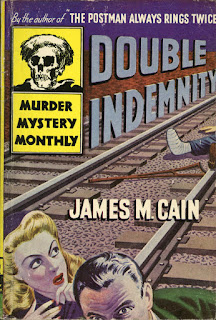
Eight Perfect Murders is that Peter Swanson blatantly disregards one of the tacit rules of paying homage to any work of fiction, but especially a mystery novel. He ruins every one of the eight books by divulging in great detail the endings. He reveals not only the method of each "perfect murder" but the motivations and the identity of each murderer. Essentially, scattered throughout his own story Swanson has written a Cliff Notes of classic crime works.
 |
| #3 on the list |
|
 |
| #4 on the list |
|
It was not necessary to explain the entire plot of every book, it was quite easy to discuss the murder method without revealing who the killer was. Not only does he spoil these books once – he does so repeatedly. I got the feeling I was reading a old time serial there was so much repetition. The only thing missing was "Previously on..." or "In our last episode..." He tells us the plot of
Malice Aforethought about three separate times. He mentions the ending of
The Drowner by John D. MacDonald just as many.
[Aside: Where are the editors, BTW? Asleep at the wheel as usual. This is my eternal woeful complaint about contemporary publishing houses for the past 20+ years.]
 |
| #5 on the list |
|
 |
| #6 on the list |
|
That Swanson chose not to be circumspect in discussing the various killers' identities makes me think that the writer supposedly paying homage to works of the past is contemptuous of, or at least envious of, those writers and their capacity for ingenuity and originality. Who at Morrow and HarperCollins thought this was a cool idea to give away the endings of all these books? I was beyond disappointed with Swanson I was furious with him. Luckily, I was familiar with all of the old books mentioned, even less well known titles like
The Drowner and
The Burnt Orange Heresy by Charles Willeford, the latter mentioned only in passing towards the end of the book. [Both of those titles, BTW, are reviewed on my blog.] However, the vast majority of readers will not be familiar with even half of these books. More likely most people will be familiar with the movie and TV versions of five of them.
 |
| #7 on the list |
|
 |
| #8 on the list |
|
As for Swanson's novel itself? Extremely limited in originality from what is on display here. Since so much of the book is based on the works of more skilled, more interesting, and more imaginative writers Swanson had to surpass all of them in my estimation in order to succeed. He failed. His ideas are pedestrian or derivative of movies and TV shows. The overarching plot and the slow reveal of Malcolm’s true personality is a retread of every damn "unreliable narrator" book (a subgenre I am beginning to grow weary of) published in the past ten years. He even alludes to
Gone Girl as a "clue" that Malcolm is just as unreliable as the narrator in that book. And makes it seem like Gillian Flynn invented the concept.
Nothing was surprising at all. The movie-of-the-week style motivations of the protagonist and the horrible secrets of the victims “who deserved to die” (another reprehensible conceit cropping up in modern crime fiction these days) were neither creepy nor spine-chilling. It was all just banal.
Finally, the biggest insult of all. In Malcolm Kershaw the writer has created a bookseller who doesn't read the books he sells, who pretends to have read them when having conversations with his customers and employees. He confesses that he just can't read crime fiction anymore even though this is his chosen profession. Swanson gives an entirely lame reason for Malcolm’s decision to stop reading crime fiction, one that is entirely in conflict with his the bookseller's personality, but tied to his deep, dark secrets in the past. Most readers will figure it all out.
Ultimately, all the twists are mechanical and cliched. Drawing from past writers' plots makes this book nothing more than rehash. As a result the story lacks suspense and the genuinely unexpected events that should be the hallmark of all crime fiction. That most of the rave reviews dismiss the blatant spoilers, Swanson's ballsy borrowing, and focus on what they think is original shows that very few people care about classic crime novels anymore. It's all up for grabs now. It's just a matter of who has the nerve to get there first.


.jpg)