PAXsims

Conflict simulation, peacebuilding, and development

Tag Archives: Dstl

Dstl trip report 2024

The following trip report has been cleared for publication by Dstl.


In late July/early August I had an opportunity to spend several days with colleagues from the Dstl Defence Wargaming Centre at Portsdown West, as well as a day at UK Strategic Command Defence Experimentation and Wargaming Hub at Southwick Park. This was my fifth such wargaming visit to Portsmouth in recent years, and like the earlier ones (in 201620172018, and 2023) it was very productive and stimulating indeed.

A number of topics were addressed.

The first of these was the use and abuse of psychological influence in wargame design and execution. The ways in which we present and run games can have a powerful subconscious effect on players. In some cases, this might be intended—for example, to encourage narrative engagement, or to manage the “flow-state” of players to maximize learning, or to generate emotional or cognitive states in the service of game objectives. In other cases, however, we might be adversely distorting the outcome and findings of a game by placing a “psychological finger on the scale.” Moreover, it can be very difficult to determine how powerful these effects are—especially when the players themselves may be unaware of the extent to which their behaviour was influenced.

A second topic was “making the intangible tangible.” How does one get players to engage with issues that are not physically represented in the game, or which are vague, imprecise, contextual, and/or long-term? How does one embed decision-making in a realistic setting? Underpinning this discussion was Dstl’s efforts to develop strategic gaming systems (like Contested) that are simple and flexible enough to be widely used, yet rigorous enough to be useful. 

A third topic was wargaming military deception, a topic on which I previously spoke at Connections North. Deception was also the focus of a Connections US working group earlier this year, at will be discussed in a panel at the forthcoming Connections UK conference, where there will also be some games covering elements of deception in the games fair. Some of my comments explored significant historical examples of deception, raising the question of whether or how we might wargame these. Other parts of my presentation focused on game methods and techniques for both “modelled” deception (where deception is an evident game mechanic) and “executed deception” (where players must actively deceive other players).

There were extensive discussions wargaming influence and information operations. I also came away with a copy of Dstl’s PoP! (Powers of Persuasion) card game, intended as an introduction to some of the principles of military Information Operations while encouraging discussion and debate. I plan to play it with my conflict simulation students later this academic year to get their impressions.

Other sessions during the week addressed modern urban combat, supporting diversity and inclusion in professional wargaming, and the potential utility of “track two” wargaming (that is, with non-official, external partners to wargame sensitive political issues). 

I came away from it all not only with some free games (thanks!), but also very impressed with the work of Dstl, DWC and the new DEWH. It is remarkable to see the progress they have made over the years.  I think the UK is uniquely positioned to support wargaming development in medium and smaller NATO countries that lack the resources and experience of the large American wargaming enterprise. I was equally impressed by the working environment. They are simply a very lovely group of very smart people with whom to discuss serious games and defence analysis.

Because of a few sensitive topics I won’t be sharing my slides via PAXsims this time around, but official UK folk could contact Dstl’s Defence Wargaming Centre for a copy.

Return to Portsdown West

The following post has been cleared for release by the Defence Science and Technology Laboratory.

AI (DALL-E2) interpretation of my return to Dstl Portsdown West.

In early May I was fortunate to spend four days at the Defence Wargaming Centre of the UK Defence Science Technology Laboratory (Dstl), at Portsdown West near Portsmouth. I had been on similar visits before (in 2016, 2017, and 2018) but this had been followed by a hiatus due to COVID and other factors. It was good to be back, and I’m very grateful to everyone at Dstl who organized and supported the visit.

On the Tuesday and Wednesday I offered a series of lectures on “Mishaps and Minefields in Professional Wargaming,” which examined common mistakes we make and why we make them. These were primarily intended for newer analysts, although several more experienced wargamers participated and contributed to our wide-ranging discussion.

  • Mishaps and Minefields I: So You Think You Need a Wargame?
  • Mishaps and Minefields II: Game Development
  • Mishaps and Minefields III: Participants and Resources
  • Mishaps and Minefields IV: Game Control, Adjudication, and Facilitation
  • Mishaps and Minefields V: Data Collection and Analysis
  • Mishaps and Minefields: Mea Culpa

The final session involved me recounting decisions I now regret and mistakes I’ve made personally while designing and running serious games. Critical reflection is important, after all!

The slides for all of these sessions are below. Like the image at the top of this report, most of the artwork for the slides was generated by AI (and some of it is quite amusing).

The Thursday and Friday of my visit involved more informal discussions of key topics, such as adjudication and end-to-end analysis. There were also playtest sessions of two games being developed as part of Dstl’s EAD (Explore, Anticipate, and Develop) Project. The first was a full-featured modular grand strategic game system that can be adapted to a variety of questions and scenarios.

The second was a much simpler “strategic game in a box” (Contested) to introduce the possibilities of strategic gaming (in much the same way that the Dstl-sponsored Matrix Game Construction Kit was designed to help jump-start matrix gaming in organizations). Both are very promising, and the latter in particular benefits from a very intutive game system that presents few barrier to adoption and play.

On a related note, in 2021 Dstl published a lengthy (165 page) paper on How Can Dstl Expand Our National Security Gaming Toolset To Generate More Meaningful And Reliable Insights? (DSTL/PUB131779 1.4) which provides some really thoughtful discussion of the methodological challenges in strategic gaming. Dstl has now cleared this report for public release, so I’ve just shared it as a separate post on PAXsims.

We also had a session on the design of We Are Coming, Nineveh!, followed by three simultaneous games. The latter went very well, with everyone quickly learning the game system. Daesh seemed to have the best of it in all three wargames, perhaps because the ISF was overly cautiously a little slow to find and fix the enemy—who, after all, were playing for time before they inevitably lost control of West Mosul. I was pleased to learn that the game is to be used in the Defence Academy of the UK to teach about modern urban warfare

Friday afternoon involved a lengthy (but highly enjoyable) drive up to Liverpool, where the Western Approaches HQ Museum hosted Dstl, Royal Navy, and other personnel for a convoy wargame based on the work of the famed Western Approaches Tactical Unit during World War Two. Kit Barry, who organized the event, has already written about the game preparations and the outcome. As captain of fictional Type-VII U-boat U2, I was quite pleased with my result: three merchantmen sunk, followed by a stealthy exit (despite one corvette doggedly trying to find me with ASDIC).

Overall, I had a terrific time—it was both professionally rewarding and very fun. There has been quite a few changes since my earlier visits: the establishment of the DWC, more facilities, and a very substantial growth in the number of Dstl analysts now supporting defence wargaming acriss the UK Ministry of Defence. The United States, of course, remains the preeminent wargaming “superpower” in NATO. Indeed, the budget for the new US Marine wargaming center alone likely exceeds the wargaming resources of most other NATO members combined. However, the UK has clearly consolidated its position as a leader in the field, as evidenced not only by Dstl’s expanding activities but also by the 2017 publication by the Development, Concepts and Doctrine Centre of the Defence Wargaming Handbook as well as the forthcoming Wargaming Influence Handbook. It has developed this capacity, moreover, from a position of greater resource scarcity relative to the US. In that sense I think it is sometimes better attuned to the challenges faced by small and medium-sized NATO militaries. It is also geographically closer to most of them, and the annual Connections UK wargaming conference always has strong representation from other European countries.

I hope that Dstl and others across the UK Ministry of Defence will continue to leverage these strengths to play a leading role in mentoring, supporting, and partnering with wargaming initiatives by allies and partners. They have a a great deal to contribute.

It should also be added that Dstl has been an early and avid supporter of the Derby House Principles on diversity and inclusion in professional wargaming. The effects of this can be increasingly seen in their team of analysts, how they approach their work, and the powerful synergies that arise from harnessing multiple experiences and perspectives. Here too, others have much to learn from their example.

Dstl: Expanding national security gaming to generate more meaningful and reliable insights

The following report has been cleared for release by the Defence Science and Technology Laboratory .


In May 2021, the UK Defence Science and Technology Laboratory published a lengthy (165pp) report entitled How Can Dstl Expand Our National Security Gaming Toolset To Generate More Meaningful And Reliable Insights? This addresses a broad range of related issues, including the experiential value of games, identifying genuine insights (as opposed to artifacts of the game design), and post-game analysis.

  • Section 1 – Introduction
  • Section 2 – How Is An ‘Analytical Game’ Defined?
  • Section 3 – How Can We Develop Creating Knowledge Games That Are More Analytical?
  • Section 4 – How Can We Conduct More Analytical Games Within TheConstraints Of Engaging Very Senior Players?
  • Section 5 – How Can We Encourage More Representative Red Cell ResponsesTo Blue Cell Actions?
  • Section 6 – Proof of Concept Escalation Dynamics Game and Concept of Analysis
  • Section 7 – Conclusions and Recommendations
  • Section 8 – Closing Summary

This report has now been approved for general public release, and can be found in its entirety below (DSTL/PUB131779 1.4).

Sally Davis wins UK MoD award for work on diversity and inclusion in professional wargaming

Everyone at PAXsims is extremely pleased to report that Sally Davis has won yet another award for her work in promoting diversity and inclusion within the UK Defence Science and Technology Laboratory (Dstl) and professional wargaming more broadly, this time from the Chief Scientific Adviser of the UK Ministry of Defence.

We’re reliably informed, too, that Derby House Principles pins were in evidence in MoD Main Building during the event!

Dstl: Diversity on the virtual battlefield

Dstl has highlighted their commitment to diversity and inclusion in professional wargaming with a new video and accompanying article.

Dstl Head of the Defence Wargaming Centre (DWC) Mike said:

The first step is to recognise the issue and to commit to do something about it.

The Derby House Principles were co-created by a Dstl wargamer and Dstl – all of Dstl, not just the wargaming centre – was an early signatory.

We are committed to ensuring the Defence Wargaming Centre is an inclusive environment. We display the Derby House Principles prominently in the DWC and brief them to players at our games in order to make clear that we are an inclusive environment. We include diversity and inclusion in our training and development.

He went on to say they were looking at the barriers to diversity and inclusion in how we design our games and are seeking to address them. And we encourage our partners to value diversity and inclusion – including encouraging them to update their software to represent more diverse armed forces.

Slitherine Software adopted the Derby House Principles in September.

Dstl is looking for a wargaming analyst

The Defence Science and Technology Laboratory (Dstl) is looking for a wargaming analyst:

A wargame is a process of adversarial challenge and creativity, delivered in a structured format and usually umpired or adjudicated. Wargames immerse participants in an environment with the required level of realism to improve their decision-making skills and/or the real decisions they make. Wargaming is a powerful tool, used within the Ministry of Defence to explore issues ranging from national strategic (such as current geopolitical decision-making) to the tactical (such as how to effectively use generation-after-next concepts on a future battlefield). 

The Wargaming capability you would be joining uses wargaming as a structured analytical technique to understand conflict in order to provide advice to the Ministry of Defence and wider UK Government. Wargaming draws on people with a range of skills; quantitative and qualitative operational analysis techniques; communication; and player interaction in order to model adversarial scenarios to understand factors that can influence the outcome. 

In order to build a better wargaming capability, we need a team of people with a range of different skills and experiences to challenge established assumptions. Analysts brought in to the Defence Wargaming Centre will be developed using our Wargaming Development Framework to give a broad range of opportunities to develop the breadth of skills needed to be a professional wargamer. As well as building a broad range of skills, you will also be given opportunities to specialise in areas of wargaming which should align with your own passions/interests. 

Dstl wargamers are founder signatories of the Derby House Principles, showing our commitment to leading the opposition of sexism, racism, homophobia, and other forms of discrimination across the board, as well as in wargaming. If you want to find out more, please read this.

The job description for the position is as follows:

In this role you will: 
For Level 4:

• Work as part of a multidisciplinary team in the provision of timely, impartial, evidence-based advice to inform decisions on future defence and security capabilities, policies and strategies. 
• Work with customers and the military to understand their needs & challenges and shape their requirements for advice. 
• Lead on the delivery of small work packages, being responsible for your own research and analysis. 
• Provide technical advice and direction to industrial and academic partners and suppliers. 
• Prepare and deliver technical reports and presentations to a range of technical and non-technical audiences. 
• Develop an awareness of defence and security challenges and issues. 
• Develop your awareness of advances in science and technology 
• Explore and visualise data to present its story in a meaningful way to technical and non-technical audience 
• Develop your technical skills in wargaming in line with the Wargaming Development Framework. 

Additionally for Level 5 you will 
• Lead strands of work, including the work of others to maintain a focus on output and technical quality. 
• Provide technical partnering to work done by Industry and Academia to ensure that the tasks remain on track, are of high quality and maximise the benefit of external expertise 

Additionally for Level 6 you will
• Engage with senior stakeholders across MOD and wider Government to offer advice and capture/identify future wargaming requirements 
• Lead on deep technical or professional specialisation 
• Manage the resources of people, materials, money and information to achieve a balanced set of results within a project framework 
• Consistently seek broader application and exploitation of your wargaming outputs 

Finally, the security stuff and other details:

Our work in defence, security and intelligence requires our employees to be British Citizens who are able to gain a high level of security clearance to understand the work you will undertake to protect us from any security threats. For this reason, we regret that only UK Nationals will be able to apply for this role. If you are an international or dual-national candidate, and you think you have the skills we need, please consider applying to any of our government, security or defence partners. 

This role will require full UK security clearance and you should have resided in the UK for the past 5 years. For some roles Developed Vetting will also be required, in this case you should have resided in the UK for the past 10 years. 

If you are a current Dstl employee, you are encouraged to inform your line manager of your application as they can support you through the process and should you be successful it will help in negotiating a release date. 

Work location
Dstl is strongly encouraging blended and flexible working either at one of our sites or from home or both. We want to empower you to undertake your duties at the most appropriate location for the task, however you will be allocated a Dstl site as a base. You may be required to travel to other Dstl and MoD sites as required.  

We particularly welcome female and ethnic minority applicants and those from the LGBTQI community, as they are under-represented within Dstl at these levels.

Full details and a link to the application process can be found here. The deadline for application is 18 October 2021.

Sally Davis shortlisted for UK Civil Service Award

I am extremely pleased to report that PAXsim’s very own Sally Davis has been shortlisted for a UK Civil Service 2020 Diversity and Inclusion Award for her work on promoting diversity and inclusion in professional wargaming.

In addition to her work on the Derby House Principles, Sally has been tireless in highlighting the historical and ongoing contributions of women, visible minorities, LGBTQ persons, and others in the defence and national security. She has also encouraged an organization-wide discussion of how to make Dstl more inclusive, welcoming, and effective.

The winners of the 2020 UK Civil Service D&I Awards will be announced on December 4.

Operation POMPEY WiiDOM

The following was contributed to PAXsims by Sally Davis.


After 5 days in quarantine I found a way to get out of the house without spreading the plague to my building-full-of-elderly-neighbours. It turns out you can connect Wii hardware to a PC by Bluetooth. I’m using the WiiBuddy API to get hold of the input in Unity:

  • The balance board returns a Vector4 with the load on each of the four load sensors (top left, top right, bottom left, bottom right). A quick bit of maths identifies individual steps, and while the player is stepping, the character walks forward.
  • The wiimote returns a Vector3 for roll pitch and yaw. I’m using pitch to rotate the character left/right, to copy the Wii Fit cycling game where you hold the wiimote sideways like bike handles.

Then I’m using MapBox‘s Unity SDK, which lets me stream in outstandingly optimised OpenMaps data within the bounds of the camera view. I’ve got a really basic setup going at the moment, using flat terrain and satellite imagery. It’s extruding buildings where the data exists—turns out that’s not many in Portsmouth (and, hilariously, Spinnaker Tower is rendered as a generic towerblock), but major cities are pretty well modelled.

At the moment it doesn’t care where you walk, so I can set out across the ocean, and walk through buildings. It’s awfully tempting to turn this into a Godzilla Simulator. As a 1-day “can I escape Wii Fit Island and go for a walk somewhere new?” experiment, I’m declaring operation POMPEY WiiDOM a success as-is.

I’m going to tidy things up, replace the somewhat inappropriate character artwork (I happened to have characters for a wargame lying around), and add some game mechanics like counting distance travelled and flags to collect. Then I’ll see about releasing an copy for the Good of Humanity in these strange times.


Dstl wargaming “show and tell”

Dstl is being sent to Coventry!

20191004-Influencing_the_future_wargaming_v1_0.jpg

To be more specific, the Defence Science and Technology Laboratory (Dstl) is seeking potential new suppliers to help influence future wargame development. A free “Show and Tell” event is planned with their partners at The Manufacturing Technology Centre in Coventry on 7 November .

Wargames can be used to explore tactical, operational and strategic issues across the business, security, emergency services, humanitarian and military sectors. Wargames encourage players to: think innovatively and creatively in a safe to fail environment; identify emerging issues; test hypotheses; assess alternate options and highlight the potential consequences of choices.

Under its Searchlight initiative, Dstl is looking for industry partners, especially Small and Medium Enterprises (SMEs) to help develop innovative wargaming tools, techniques, technologies and analysis. Companies need not have any experience in the defence sector. Opportunities exist across all aspects of wargame design and analysis, especially in the field of data capture, analysis and visualisation.

Dstl will also offer the opportunity to access its expertise and peer review of the potential utility of innovative approaches and subsequently to test the best of these live in Dstl’s Defence Wargaming Centre.

The 7 November event will outline Dstl’s aims and give participants the chance to network with potential new collaborators. The dual focus will be on closed pitches from SMEs to the Dstl team of specific offers that may improve wargaming outcomes and on an open event where there will be the chance to present ‘Lightning Briefs’ to a broader audience and network informally with other participants and exhibitors.

The event is being hosted by The Manufacturing Technology Centre and supported by KTN; the UK’s Innovation Network; ADS, The Federation of Small Businesses; Team Defence Information and techUK. Dstl will also provide more information on its role in encouraging SME innovation and growth as partners in Venturefest South.

To secure a place at the event, register online at Team Defence Information.

Dstl needs you!

kitchener_Dstl1.jpg

…well, they do if you’re a UK national with expertise in wargaming.

The UK MOD’s Defence Science and Technology Laboratory is looking for five people to join their wargaming team:

  1. 1614750 Wargame & Computer Simulation Analyst(x2)
  2. 1614762 Senior Wargaming Analyst(x1)
  3. 1614765 Wargaming Analyst(x1)
  4. 1614740 Principal Historical Analyst(x1)

These job opportunities are open to UK nationals onlyand are not open to candidates who hold a dual nationality. The closing date for applications is Sunday, January 20.

Details at the links above. For more on what the Dstl wargaming team does, see this and this and this and this and this. You may even get a Dstl Portsdown West wargaming mug out of it!

IMG_2059.JPG

WATU wargame report

41277989_10155785980468977_7247479715378757632_o.jpg

On September 8, volunteers from the Defence Science and Technology Laboratory, the Royal Navy, the Royal Canadian Navy, and PAXsims paid homage to what may have been the most consequential wargaming of World War Two: the work of the Western Approaches Tactical Unit. WATU contributed greatly the development of anti-submarine tactics, and also taught more than five thousand British and allied escort officers during the war. Most of those wargamers were women too.

The event was hosted by the Western Approaches war museum and held in the map room of the wartime headquarters of Western Approaches Command: an underground bunker beneath the Exchange Building (Derby House) in Liverpool. During the war, WATU had operated from an upper floor.

IMG_0263

Setting up the plotting map. The screens on the right prevent the escort commanders from seeing the map, except when permitted to peek through small visors. Red filters in these prevent them from seeing the U-boat tracks.

41473155_10155785956653977_3089331926897524736_o.jpg

The plot viewed through the visor. U-boat tracks are not visible.

IMG_0271.jpg

The screen from above, with the tables for the escort commanders beyond.

IMG_0265.jpg

Nefarious U-boat commander Tom Mouat (Defence Academy of the UK/PAXsims).

IMG_0262 2.jpg

Some of our lovely simulated Wrens.

IMG_0269 2.jpg

IMG_0272 2.jpg

Pre-game briefing.

DmkHcJUXgAA8ka5.jpg

IMG_0275.jpg

The WATU wargame underway. The convoy, escort, and U-boat positions are being plotted on the floor, while escort commanders plan their next moves beyond the screens.

The game started with U-305 (U1 on the plotting floor, commanded by your scribe) having penetrated the escort screen on the surface at night, and attacking from within the convoy. One ship went down, and I ordered my vessel to submerge to periscope depth and to turn slightly to run under the convoy.

Meanwhile, U-501 (U2) approached on the surface from outside the screen, hoping to attack while the escorts were distracted.

IMG_0277.jpg

The U-boat commanders smile as they celebrate their first sinking of a merchantman.

Alas—or fortunately, depending on your perspective—it wasn’t to be so. As soon as the first ship was hit, HMCS Ottawa (L3) made a high-speed dash into the convoy and ran straight into the still-submerging U1, which it had not yet spotted. The damage was enough to force U1 to the surface. I ordered my submarine to run close alongside the Canadian destroyer, hoping her guns would not be able to depress sufficiently to engage my much smaller vessel. My own 88mm deck gun fired into the escort at close range and I also fired a spread of my remaining bow torpedos at the damaged HMS Starling (L1) as she approached to assist. However, soon U1 began to sink. I ordered the Enigma machine and codebooks thrown overboard and we abandoned ship.

A-27818.jpg

Image of a WWII WATU wargame in progress. Note the plotting of the convoy, escorts, and submarines on the floor, as well as the screens.

large_000000-1.jpg

WWII WATU wargame in progress. Wrens point out ships and current situation for officers viewing through screen.

41452257_10155787004413977_1475635425853833216_n.jpg

41398881_10155784888393977_1666033641072885760_o.jpg

Meanwhile, U2 fired a spread of torpedos into the convoy, sinking one freighter. Its lookouts failed to notice a Royal Navy destroyer (O1) bearing down her through the dark night until it was almost too late, however. Fregattenkapitän Mouat ordered a crash dive, which was soon followed by the thunderous explosions of depth charges overhead. With a drive shaft damaged, the wily Moaut ordered that oil be vented and rubbish discharged through the torpedo tubes to suggest his vessel had been destroyed. HMS Vanquisher was having none of that, however, and continued to drop depth charges. U2 would eventually be sunk with all hands.

41390536_10155785956843977_8702770821749276672_o.jpg

U1 sunk, U2 under attack.

As this was ongoing, U3 (Brynen) approached from the front of the convoy submerged, while U4 (Mouat) proceeded on the surface well ahead of the convoy to report its location to Kriegsmarine headquarters back in Germany. These transmissions were picked up by HF/DF (High Frequency Direction Finding), and minutes later U4 itself was spotted on radar by HMCS Orillia (P1). Mouat turned slowly, and then proceeded south at top speed, hoping thereby to draw off escorts before eventually submerging and doubling back.

U3 continued to creep forward, until it was within 1500 yards of the convoy. It then fired two pairs of torpedoes from its forward tubes. A short while later hydrophones reported more explosions as two merchantmen were hit. The wolfpack had now sunk four ships in the convoy, and damaged two escorts.

IMG_0285.jpg

The plot. U4 (bottom) has just begun its dash south with escorts in pursuit. The white markers indicate the depth charges dropped by O1 on U2, while U3 is nearby, having just fired torpedoes and turned.

…and there we had to finish as the day came to an end.

We all had a terrific time, and the 130 visitors who passed through the museum while the wargame was underway seemed to find it all very interesting too. It was particularly gratifying to meet with the daughter and granddaughter of wartime wargaming WATU Wren officer Laura Janet Howes.

41290288_10155785025523977_1051092271014871040_o.jpg

The daughter (right) of WRNS officer Laura Janet Howes poses with a card summarizing her mother’s wartime career.

IMG_0289.jpg

The commander of HMS Vanquisher points to the last resting place of U2.

Enormous thanks are due to the Dstl team that made this all happen, and especially Sally Davis and Paul Strong. Emma Stringfellow (Big Heritage) and the rest of the Western Approaches museum staff were terrific hosts, happily putting up with twenty or so of us moving things around, talking loudly, and even playing ASDIC noises and dive alarms. The screens produced by Alfred Chow (Maker of Things) were perfect for the task. Steve Cowan recreated the HMS Tactician/WATU crest, which was emblazoned on the shirts of many of the wargaming crew, and on commemorative mugs available in the Western Approaches gift shop.

WATU colour.jpeg

I would like to personally thank Cmdr Jeffrey McRae (Royal Canadian Navy) for joining with the Royal Navy to mark the occasion, taking on the role of an escort commander (HMCS St Croix). Some five hundred Canadian naval officers were among those trained by WATU during WWII, and a similar tactical training unit (modelled on WATU) was established in Halifax in 1943.IMG_0297 copy.jpg

The WATU wargame is an excellent tool for teaching about wargaming, operations, research, the Battle of the Atlantic, and the contribution of women during WWII. Visitor after visitor expressed how interesting it was, and how analysis, gaming, and outthinking an opponent all converged in the kind of work WATU did. I certainly hope this becomes at annual event at the museum, and the Dstl and RN volunteers who made it happen are able to organize similar events elsewhere in the UK.

41402980_10155787011508977_3799445150850088960_o.jpg

The Dstl/RN/RCN/Defence Academy/PAXsims crew, including nefarious U-boat captains Mouat and Brynen.

Finally, if you are in or visiting the Liverpool area, go and see the Western Approaches museum (where, for a limited time, you can get your very own HMS Tactician/WATU mug). They’ve done a terrific job rennovating the facility, and it is well worth a trip.

IMG_0295.jpg

RN officers demonstrate appropriate protocol for carrying a simulated Wren.

https://twitter.com/WestApproaches/status/1038686842403606528

The STRIKE! Battlegroup Tactical Wargame

STRIKE is a wargame developed at the UK Defence Science and Technology Laboratory for the British Army, to enable them to examine novel tactical concepts to use with the UK’s new Strike brigade. The following piece was shared with PAXsims by STRIKE’s chief developer, Mike Young.


The British Army is being equipped with a new generation of fighting vehicles that will provide the core combat elements within the new Strike Brigades.  The vehicles are an 8 wheeled infantry transport platform known as the Mechanised Infantry Vehicle (“MIV”) and a family of vehicles based around the AJAX platform.  The British Army was keen to understand how the Strike Brigade would perform on the battlefield so commissioned a series of manual wargames to examine their operational effectiveness.  I facilitated at these wargames and produced the STRIKE! wargame as a result.

strike1.png

STRIKE! is a detailed tactical level game, based around one inch square counters each representing a platoon of 3 or 4 vehicles. There are counters to represent all the fighting elements of the Strike Brigade as well as an Armoured Infantry Brigade on the Blue side, and a full mechanised brigade and an airborne battalion on the Red side.  The game also represents helicopter and engineering assets and, if required, has an alternative Red ORBAT with less sophisticated equipment.  Three large hex maps of different terrain types have been produced to go with the game along with a scenario booklet, enabling many different tactical situations to be examined.  The hexes on the map represent an area 500 metres across, and each game turn represents half an hour of real time.

The counters display a unit ID, movement, firepower and protection details.  A detailed set of rules is provided, although after a PowerPoint brief  the players were able play the game using a single A4 quick reference sheet to calculate combat results.

The reaction to the game was extremely positive and enthusiastic, with all six copies of the game being eagerly received by the customer.

As the customer said:

It is absolutely AWESOME. I am so pleased. They had it manufactured professionally and have written fantastically clear rules, crib cards, notes, ORBAT sheets etc. They have missed nothing. Thank you very much indeed for organising the project. This is going to be hugely helpful for the Brigade and I hope that we will be able to spread the word across the Armoured Infantry Brigades too.

Capt H J B Jordan LG | SO3 Experimentation | STRIKE Experimentation Group

We expect the British Army to make great use of this new analytical game that Dstl has developed, and look forward to designing and facilitating many more wargames with them in the future.

strike2.png

Distilling wargaming wisdom at Dstl

The following report has been cleared for release by the Defence Science and Technology Laboratory (public release identifier DSTL/PUB110424).


IMG_0106.jpg

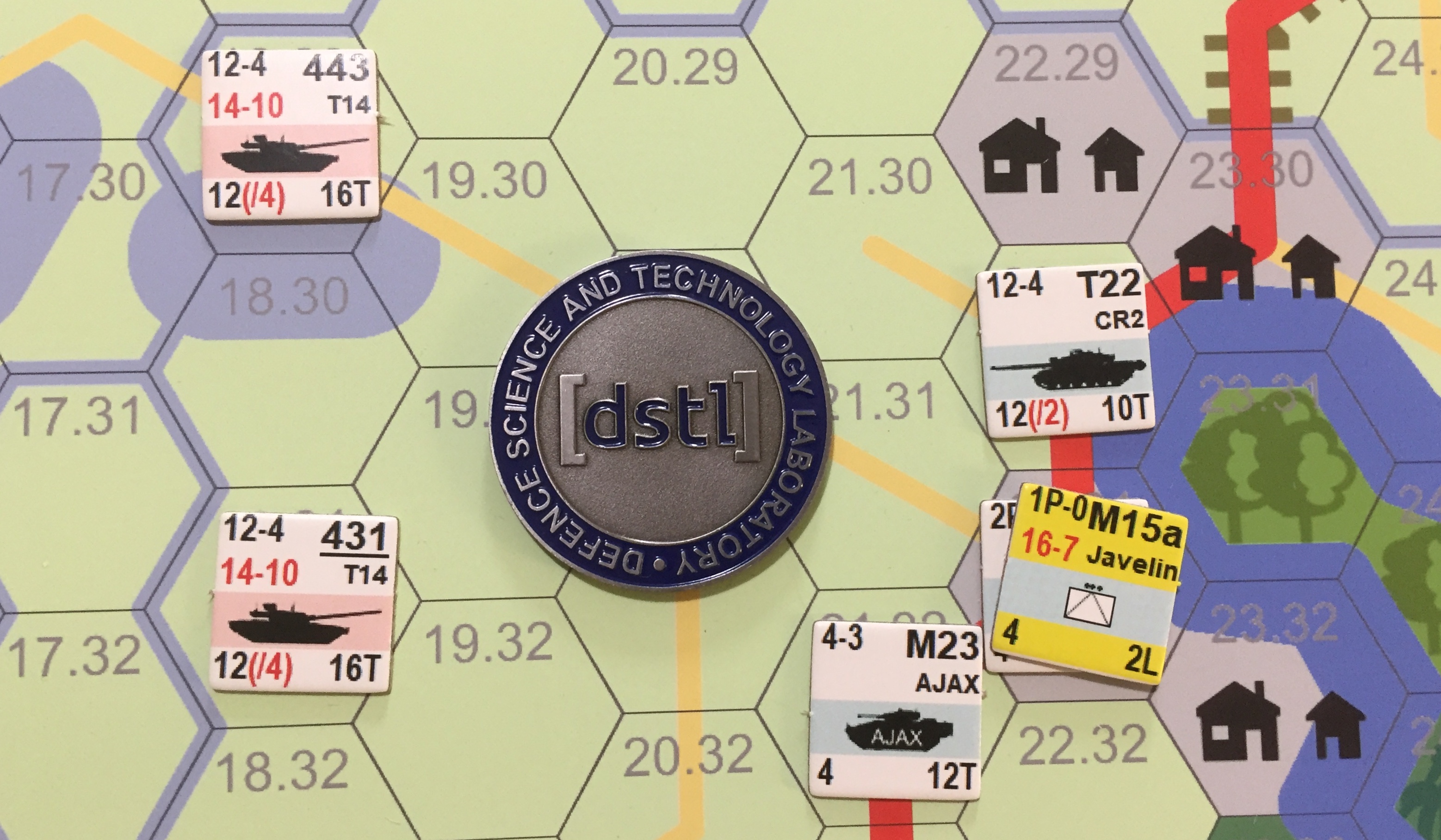
The legendary Dstl coin holds off RED forces on the outskirts of a small village.

At the end of June I spent a very pleasant week at the Defence Science and Technology Laboratory in Portsdown West (Portsmouth), discussing various topics with members of the wargaming team there and others. I made similar visits in 2016 and 2017, and—as with the earlier occasions—this trip was very stimulating, productive, and enjoyable.

Monday

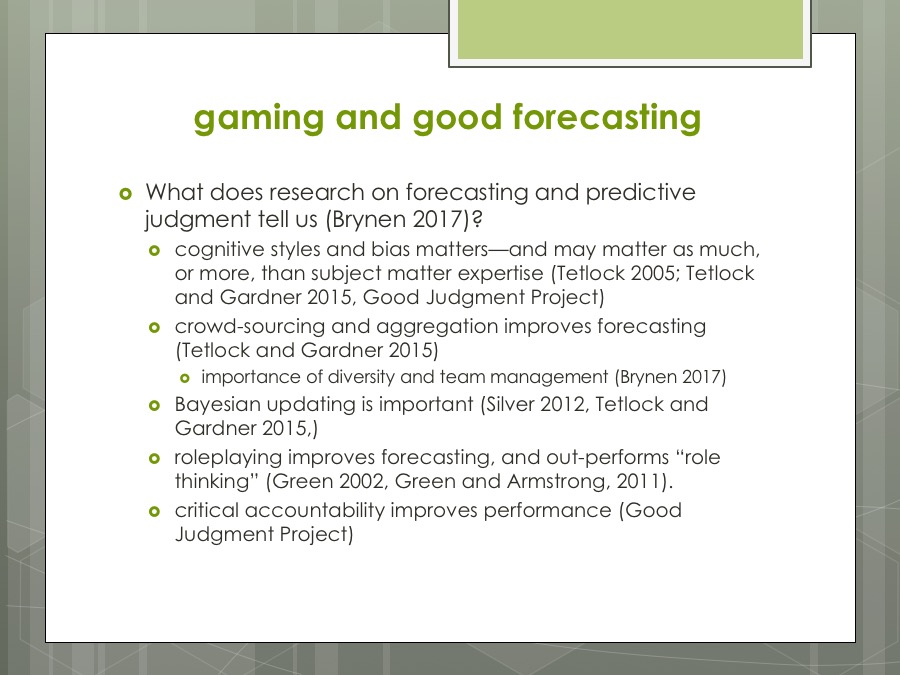
Day 1 of my visit started with a presentation on wargaming and forecasting (slides/pdf). Wargamers often intone that “wargamers are not predictions,” largely so that clients and participants will not hold games to an unreasonable standard of predictive accuracy. However, while wargames do not generate detailed findings about the future, they do contain an element of prediction in that they are usually intended to explore plausible futures. Assessing that a future scenario is plausible is, after all, an act of forecasting in itself.
Dstl Forecasting

Given this, the literature on political forecasting offers some guidance as to how games might be better configured to increase foresight. I also suggested that wargames were best used as an adjunct to other forecasting methods (helping us to identify key junctures, challenge assumptions, and encourage discussion) rather than a method in and of themselves.

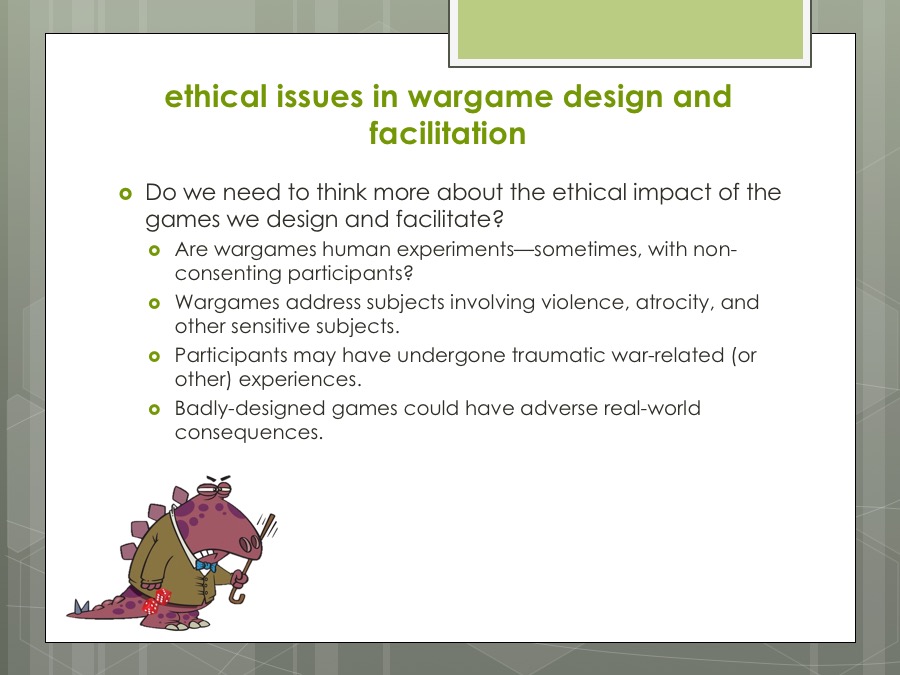
This was followed by a second presentation on ethical challenges in wargaming (slides/pdf). Here I addressed three major themes:

  • The use of serious games to teach about ethical decision-making, the laws of armed conflict, and similar topics.
  • The use of games to explore the dynamics of mass atrocity and human rights abuses, so that we might develop appropriate policy responses.
  • Finally, I discussed some of the ethical issues that might arise in game design and facilitation.

I was especially pleased with this presentation, since it raised issues that have not been discussed much within the professional community. How should games address sensitive issues such as religion and ethnicity? How can a game explore topics like torture, mass atrocity, or sexual and gender-based violence without having adverse effects on participants who may have had personal traumatic experience of such things? What is our ethical obligation to produce high quality games, given the implications of our work for policy or war-fighting? What is our obligation to produce games that have positive moral effects—and what should we do if we believe a game design might be put to unethical purposes? Interestingly, I was not the only one in attendance who had refused work from a client because we were uncomfortable with who might be using a game and what it might be used it for. (This is, of course, a rather more difficult choice if working on wargame design as a government employee.)
Dstl Ethical.jpg

Much of the latter part of the session involved case studies to which members of the audience were invited to respond. How does one deal with player humour that might be seen as insensitive or offensive by some, given the game scenario? How does one incorporate issues of (countering) sexual exploitation and violence in wargames given the possible effects on players who have experienced the same in their personal or professional lives?

Next, came a session devoted to gaming indirect social media and cyber effects (slides/pdf). I started off by warning that not everything is new under the sun, and that communities and combatants alike have always leveraged new information and communication technologies to enhance their influence and effect. Certainly, the digital age had made it easier to do this, and to reach more people faster than ever before. However, the magnitude of this change might sometimes be exaggerated.

Dstl Social Media Cyber

Maj. Tom Mouat (Defence Academy of the UK) and I then moved on to discussing a variety of interesting games and game mechanics that might be adapted to explore such issues. These included:


Hostage.png

Demonstrating influence dynamics in Hostage Negotiator.

Tuesday

The second day of my visit largely involved me participating in, and commenting on, other people’s wargames, which is always an enjoyable task. In the morning, our focus was matrix gaming. I made a quick presentation on the status of the Matrix Game Construction Kit, then Tom facilitated a session of the High North matrix game. This went very well, with Russia, the US and Canada all using environmental concerns to project their regulatory influence well beyond their established Exclusive Economic Zones. Chinese efforts to meddle in a Greenland independence referendum went badly wrong, while “the spirit of capitalism” pursued a variety of economic opportunities as the polar ice cap slowly receded due to global climate change. The session provided ample opportunities to discuss both matrix game design and game facilitation.

High North.png

Gaming the “High North.”

After lunch, we discussed support for RAF wargaming. As part of this, Flt. Lt. Colin Bell (RAF) demonstrated three educational games he has developed for training cadets. I particularly enjoyed his air logistics games (in which players must move personnel and supplies using a variety of air assets to various locations, in response to randomly-drawn mission cards), and a game that explored mission planning and execution for offensive and defensive air operations. Playing a few turns of the latter, we lost a few Typhoons in our fighter sweep ahead of our main force but came out slightly ahead in air-to-air engagement. A heavy concentration of radar targets suggested an impending inbound enemy attack on our air defence command centre, so we ordered two other fighter groups to reposition themselves to respond. Meanwhile, we had two strike packages headed towards our target—an enemy destroyer, docked in port—when the game had to be brought to an early end.

RAF logs.png

RAF wargaming—teaching about air logistics.

RAF air power.png

More RAF wargaming. Strike package inbound!

Wednesday

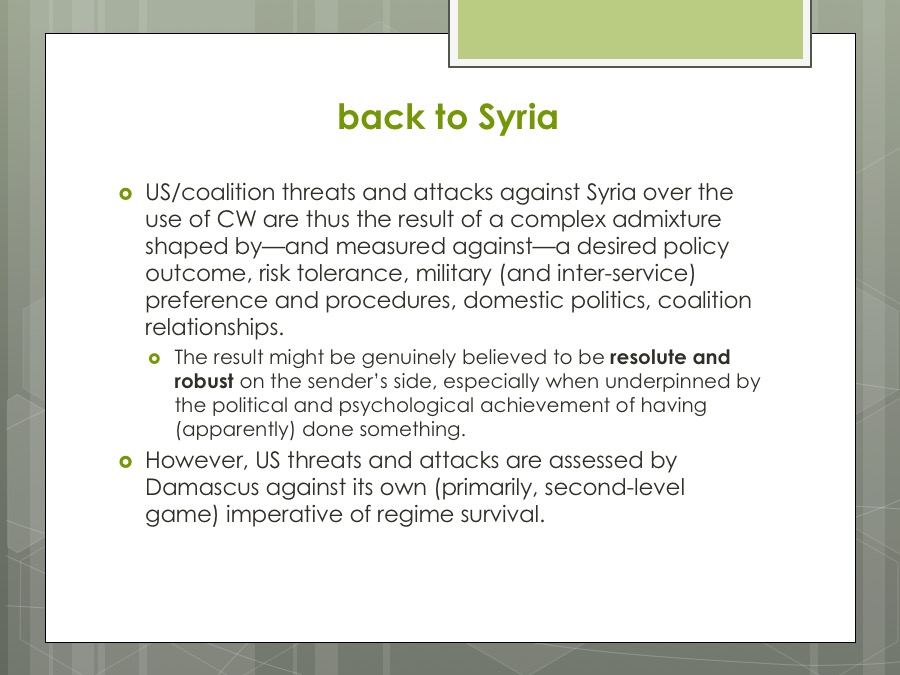
Day three of my visit involved a morning spent at Dstl’s annual historical analysis symposium. My own paper explored strategic communications, signaling, and deterrence in the specific context of Syrian use of chemical weapons (slides/pdf). Here I drew upon both the scholarly literature on deterrence and the findings of wargames to suggest how it is that what one side regards as a robust signal of capability and credible commitment might be seen rather differently by the recipient—in part because each side operates in a very different organizational and political context.
Dstl Communications

Wednesday evening was spent at the mess of HMS Excellent, the Royal Navy “stone frigate” (shore establishment) on Whale Island, Portsmouth. After dinner, not surprisingly, we all turned our attention to some less serious gaming. While some of the group plotted to assassinate Hitler in Black Orchestra, the rest of us played Bloc by Bloc. I’m happy to report that fascism had a bad day: Hitler went down in the former game, while in the latter a progressive revolutionary coalition of workers, students, anarcho-neighbours, and prisoners brought down the repressive state system.

Thursday

The fourth day of my trip was wholly devoted to a day-long workshop on wargame adjudication (slides/pdf). In the morning, Tom and I started with a presentation on the topic, drawing upon our own experience. Adjudication runs along a spectrum from rigid (rules-based) to free kriegsspiel, with matrix games and hybrid approaches somewhere in between. Adjudication also varies depending on whether game play is turn-based, continuous, or a mix of these.

I suggested that wargame facilitators and adjudicators stand astride two essential mandates, sometimes complementary, but also sometimes in tension: that of the technician (committed to attaining the technical goals of the game) and the theatre director (responsible for bringing alive the imaginary world of the game narrative).

After lunch, we collectively discussed two recent Dstl games and the adjudication challenges each had presented. We then broke into smaller groups, and discussed how we might address a number of game adjudication vignettes:

  • Dealing with an adjudication error in combat resolution. Do you rewind the game, admit the error but press ahead regardless, or hide the mistake from the players?
  • What sort of adjudication would be most appropriate for a game intended to examine security planning for a forthcoming high-profile diplomatic visit, and why?
  • How should one deal with a (more senior, male) SME who is persistently pestering a (junior, female) player with criticisms of the game system?
  • How might adjudication approaches be configured to better withstand sponsor pressure to reach predetermined conclusions?

Interestingly, almost all of the participants felt that an adjudicator should cover up a minor error during a game if the mistake had no major game-changing effects and if informing players would “break the bubble” of narrative engagement—only disclosing the glitch after the game was over, depending on the participants and client. I concur and have done it myself, but I know others who don’t and wouldn’t. The issue was one that was further debated at the Connections US wargaming conference a few weeks later, during a session on in-stride adjudication.

Friday

The last day of my visit involved a trip to the Maritime Warfare School at HMS Collingwoodfor a playtest of the Western Approaches Tactical Unit naval escort game. PAXsims has extensively covered the work that Paul Strong and Sally David have done on WATU and its impressive contribution to World War Two naval tactics and training, and it was an absolute delight to see how it all worked.

WATU4.png

Playtesting the WATU wargame.

During the playtest, I commanded one of the Type-VII U-boats attacking a convoy headed from Liverpool to Halifax. I did well, using the darkness to maneuver within the convoy formation and torpedoing three merchantmen before ordering a deep dive and hard turn to port to evade the now-alerted escorts. Initial depth charges fell well wide of their mark, but a couple of escorts did manage to ping my boat with ASDIC and had turned course towards us.

Just then, explosions at the far side of the convoy signaled that another German submarine had found its prey—hopefully distracting them while I dived even deeper and headed to the rear of the convoy. My intention was to surface once the action had passed me by, and then use my deck gun to finish off any damaged ships that were straggling behind the main formation.

We had to bring the game to an end at this point, but I must say it went well for an initial playtest. I think all of us who were there were very proud to be recreating a great moment in wargaming history. Sally Davis has also written up a brief account, which I have also posted to PAXsims.

The WATU wargame will be demonstrated at King’s College London in September, during the Connections UK wargaming conference, and shortly after that in a special session at the Western Approaches Museum in Liverpool. I am especially looking forward to the latter—an opportunity to conduct a WATU game in the very rooms used to command the North Atlantic convoys during WWII.
IMG_0107.jpg

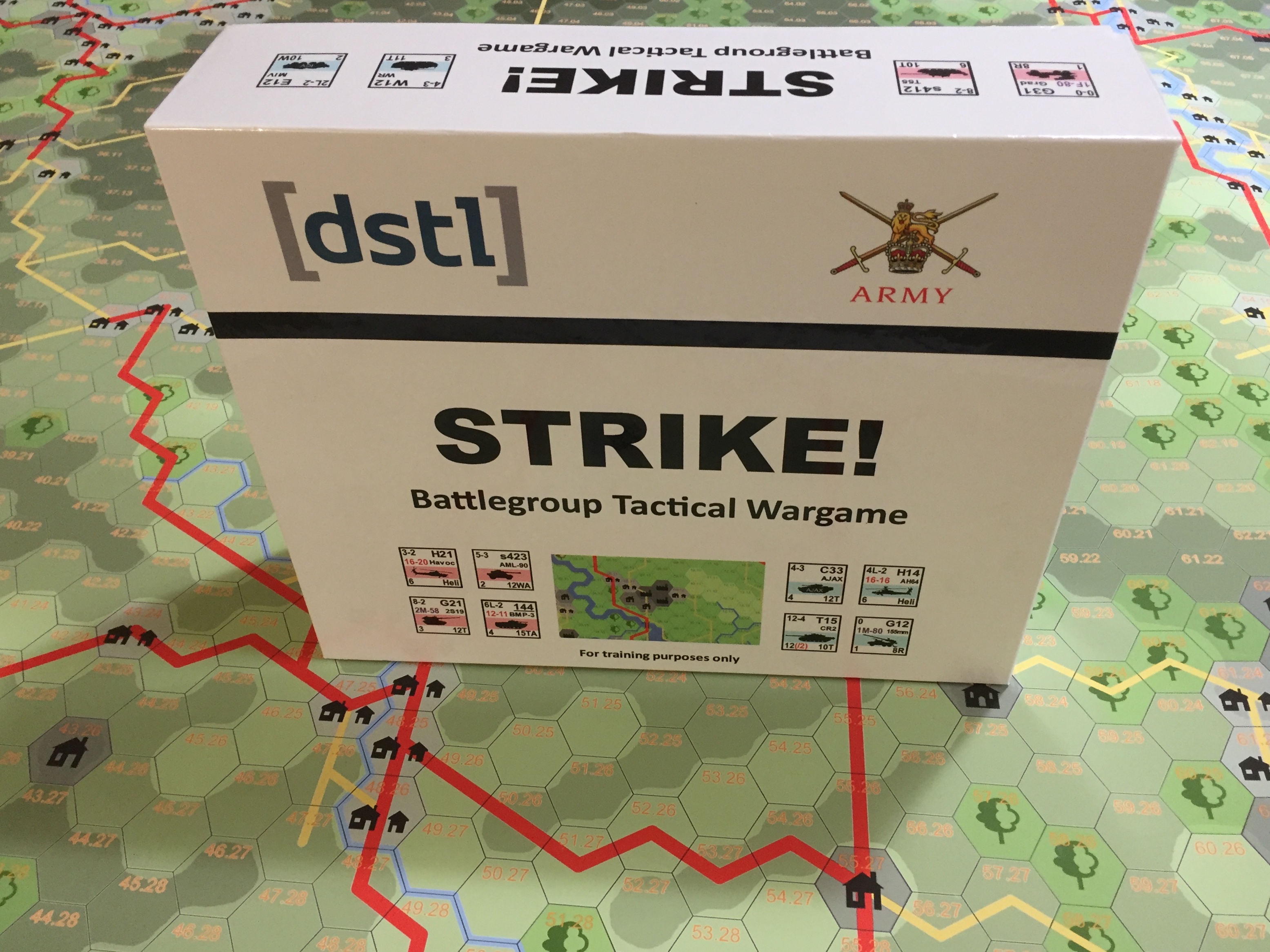
Before I left, Dstl presented me with both one of their rare challenge coins (see picture at top) and a copy of  their STRIKE! Battlegroup Tactical Wargame. Dstl has developed this manual wargame for the British Army to help it examine how the Strike Brigade would perform on the battlefield—we will be providing more detail on the game in a future PAXsims article. At McGill University I intend to use STRIKE in my conflict simulation course next year to illustrate fundamental elements of basic wargame design (such terrain and capability modelling), so you may see some after action reports here too.


Wargaming Wrens redux

The following report was prepared for PAXsims by Sally Davis and has been cleared for release by the Defence Science and Technology Laboratory (public release identifier DSTL/PUB110424). All photos are © IWM or © Crown Copyright.


In late June, a small invasion force landed at HMS Collingwood to test-play a recreation of ‘the game‘ used to teach convoy escort tactics at the Western Approaches Tactical Unit during 1942-45.

It was rather good fun! Rex Brynen and Tom Mouat played the dastardly U-Boat captains, sank a handful of convoy ships and were on the verge of a depth-chargey-comeuppance when we ran out of time. Here’s the after-action debrief.

wrens1

Left, above: The RCN tactical table at HMCS Stadacona, Halifax (which adopted the WATU game for Canadian naval training).

Right, above: The Dstl tactical table at HMS Warspite, early on in the game.

wrens2

Left, above: WATU 2nd Officer Wren Jean Laidlaw tells Lt Cdr Tooley-Hawkins, “You’re here, sir, and Jerry just sank your battleship!”

Right, above: The Dstl peeping experiment: our escort commander player (centre, between the screens) is looking at the map through a red filter, rendering the U-Boat tracks invisible. We don’t think WATU used red filters, but their screens and peep-holes achieved a similar effect.

wrens3

Left, above: The convoy has just altered course to port. Rex’s U-Boat is right in the middle of the convoy, the white markers are where our gallant escorts depth-charged him, but he went deep and evaded damage. The red straight-line in from the bottom right is Tom’s U-Boat creeping in on the surface, hoping to take advantage of a poor look-out at the other end of the action!

Right, above: A few more turns and we’d have something similar to the original game.

WATU4

The Dstl “Wrens.”

Next stop(s): the Connections UK professional wargaming conference (London) on the 5th September, and the Western Approaches Museum (Liverpool) on the 8th September. A huge shout out to everyone who played, helped with the pre-play-test-testing, or has expressed an interested in the Liverpool event!

WATU wargame at Western Approaches war museum, September 8

IMG_8941.JPG

On Saturday,  8 September 2018, volunteers from the Defence Science and Technology Laboratory, the Royal Navy Maritime Warfare Centre, and PAXsims will be at the Western Approaches museum in Liverpool to recreate a WWII convoy escort wargame, of the sort conducted by the Western Approaches Tactical Unit.

This will be a unique opportunity to see the gaming techniques that helped turn the tide of the Battle of the Atlantic—and to honour the work of Captain Gilbert Roberts and the women and men of WATU. Hope to see you there!

2018 WATU WAM Poster 2.1