Theater Review: Black Swan at American Repertory Theater


Black Swan

Book by Jen Silverman
Music, Lyrics, & Orchestrations by Dave Molloy
Based on the Searchlight Pictures Film Black Swan, story by Andres Heinz

June 27, 2026: Loeb Drama Center at American Repertory Theater, Cambridge, Massachusetts

Cast

Alex Aquilino – Swing
Kyle Brown – Ajay/Ensemble
Cameron Burke – Swing
Jada Simone Clark – Lily
Mia Deweese – Swing
Karli Dinardo – Glory/Ensemble
Mehry Eslaminia – Barbara (understudy for Kate Jennings Grant)
Gabriel Hyman – Ensemble
Amber Iman – LeRoy
Charizma Lawrence – Ensemble
Adrian Lee – Ensemble
Caleb Marshall – Dylan/Ensemble
Johanna Moise – Swing
Melanie Moore – Nina
Ava Noble – Ensemble
Martell Ruffin – Ensemble
Ida Saki – Doppel
Anthony Santos – Ensemble
Thom Sesma – Jacques/Rothbart
Sarah Sigman – Morgan/Ensemble
Chelsea Thedinga – Ensemble
Tory Trowbride – Beth
Valeria Yamin – Ensemble


I assumed that a musical adaptation of the psychological horror film Black Swan scored by Dave Molloy (Natasha, Pierre, and the Great Comet of 1812) would be absolutely bonkers.  And it is, … in a good way.

Aspiring dancer Nina lands the lead role in Swan Lake in an experimental  adaptation by the demanding renegade choreographer Margaux LeRoy.  The pressures of the production paired with her overbearing mother Barbara, and the breakdown of Beth, the prima ballerina she replaced, drive Nina to the edge of her sanity.  She sees fellow dancer and understudy Lily as her rival, although admiring Lily’s freedom of movement and grows romantically attracted to her.

Some differences from the film include more humor, especially in Act I.  Margaux LeRoy replaces a sexually abusive male character in the film and is portrayed as more sympathetic although still unaware of the effect she’s having on Nina’s mental health (she also has an awesome singing voice).  By necessity, the cast of the musical are all experienced dancers and the show’s choreography stands out.  Indeed, it’s oddly meta to use choreography to explore the experience of dance. The show makes use of mirrors, lighting, and visual effects to explore Nina’s deteriorating psyche.  I’m a simple man, but a short blackout that’s followed by a reveal of characters in entirely different positions on stage always impresses me.

Black Swan continues at American Repertory Theater through July 12, 2026.


Movie Review: Project Hail Mary (2026)


Title: Project Hail Mary
Release Date: March 20, 2026
Director: Phil Lord, Christopher Miller
Production Company: Metro-Goldwyn-Mayer | Lord Miller Productions | Pascal Pictures | Open Invite Entertainment | Waypoint Entertainment
Main Cast:

  • Ryan Gosling as Ryland Grace
  • Sandra Hüller as Eva Stratt
  • James Ortiz as Rocky
  • Lionel Boyce as Carl,
  • Ken Leung as Yao Li-Jie
  • Milana Vayntrub as Olesya Ilyukhina
  • Priya Kansara as the voice of Mary
  • Malachi Kirby as Martin Dubois
  • Liz Kingsman as Annie Shapiro
  • Mia Soteriou as Dr. Browne
  • Orion Lee as Dr. Li
  • Michelle Greenidge as Chimamanda

Synopsis (via Letterboxd):

Science teacher Ryland Grace wakes up on a spaceship light years from home with no recollection of who he is or how he got there. As his memory returns, he begins to uncover his mission: solve the riddle of the mysterious substance causing the sun to die out. He must call on his scientific knowledge and unorthodox ideas to save everything on Earth from extinction… but an unexpected friendship means he may not have to do it alone.

My Thoughts:

An astronaut awakes on a ship in deep space with amnesia and discovers that the other two crew members are dead. In a flashback we learn that an organism called an astrophage is consuming the Sun and other stars in the galaxy.  Ryland Grace is part of a “hail Mary” mission to the one star that is unaffected by the astrophage. As he attempts to complete the mission, Grace encounters another spaceship and meets it’s occupant, a five-legged rock-like creature he calls “Rocky,” the only survivor of his planet’s mission to the same star.  Grace and Rocky share knowledge and technology and work together to find a solution to the astrophage forming a deep bond in the process.

Project Hail Mary has a lot of antecedents: the grandeur of 2001: A Space Odyssey, the heartwarming aspects of Spielberg/Amblin films of the 70s & 80s, and the expert must find solutions to avert a global catastrophe plot of Interstellar and Arrival.  For all that it feels refreshingly original and hopeful. The movie benefits from the extensive use of practical effects for the spaceship and puppetry for Rocky.  The one aspect I didn’t like is that Grace is an outsider in the scientific community due to his unorthodox views and thus works as a middle school science teacher before being recruited for the Hail Mary program.  This feeds into the tired maverick renegade knows best trope, when Grace’s would’ve had enough challenges even as a trained astronaut. It also adds a lot to the run time in extensive flashback scenes.

Apart from that, Project Hail Mary is a delight and is well on the way to becoming a classic of the genre.

Rating: ****

Songshare: “All My Friends Are So Depressed” by Joyce Manor


I have been delinquent in creating Songshare posts, so here’s a newish track from California rock band Joyce Manor. Channeling The Smiths, “All My Friends Are So Depressed” has a peppy tune that belies it’s lyrics.

Theater Review: Les Misérables at Boston Opera House


Les Misérables

Produced by Cameron Mackintosh

Based on the novel by Victor Hugo
Music by Claude-Michel Schönberg
Lyrics by Herbert Kretzmer
Original French Text by Alain Boublil and Jean-Marc Natel
Additional material by James Fenton
Adaptation by Trevor Nun and John Caird

Directed by Laurence Connor and James Powell

June 21, 2026, 6:30pm: Boston Opera House, Boston, Massachusetts

Cast (click for complete cast)

Jean Valjean – Nick Cartell
Javert – Hayden Tee
The Bishop of Digne – Randy Jeter
Fantine – Lindsay Heather Pierce
Little Cosettte – Lillian Castner, Kayla Scola-Giampa
Madame Thénardier – Victoria Huston-Elem
Thénardier – Matt Crowle
Gavroche – Cree-Silver Corley, Rocco Van Auken
Éponine – Jaedynn Latter
Cosette – Alexa Lopez
Enjolras – Daniel Gerard Bittner
Marius – Peter Neureuther

I celebrated Father’s Day with my daughter by attending a performance of the current North American touring production of Les Misérables. For some reason the advertisements claim this is the LAST time the show will visit Boston.  But even though the show originated in the 1980s (1980 in France, 1985 in the West End, and 1987 on Broadway), I can’t imagine it not being revived again in the foreseeable future. I previously saw Les Misérables in August 1990 at the National Theatre in Washington, DC. with a group of students from the Georgetown University summer program for high school students.  The passage of time and my nostalgia for that summer in Georgetown will affect my memory of that show, but there were some notable differences.  The current production doesn’t use a rotating stage which is something that impressed me greatly as a 16-year-old.  As a result the scenery changes don’t feel as fluid.  This production does use projection technology in addition to physical sets that is based on Victor Hugo’s art works. It’s particularly effective for the special effect that makes it appear that Javert is falling into the Seine.

While everything looked good from my seat in the balcony, the experience was unfortunately marred by dozens of theatergoers arriving late for the show.  Up to 25 minutes after curtain people were still noisily making their way to their seats.  It was thus difficult to appreciate Lindsay Heater Pearce sing “I Dreamed a Dream” when people were walking in front of me with their smartphone flashlights on.  The sound quality also was not the best, at least in the balcony, where the vocals were often overpowered by the orchestra.  This seemed to affect Nick Cartell as Jean Valjean the most.

While this was annoying, I was still able to put it aside and enjoy an excellent performance.  Jaedynn Latter is terrific as Éponine, who deserves better.  And the children playing young Cosette and Gavroche although I don’t know which actors were in this particular performance.  And the classic ensemble pieces “Do You Hear the People Sing?” and “One Day More” are as rousing as ever. Back in 1990, I was so obsessed with Les Miz that I decided to read Victor Hugo’s novel.  As a teenager with a hyperfocus and a lot of free time in the summer, I finished the tome in 12 days!  I don’t think I will have time to read it again, at least not this summer.

Some things I noticed that I didn’t recall from the first time I saw the show:

  • Javert is the only police officer in all of France.  Like, I remember him being obsessed with chasing down Valjean, but he also has at least 4 different positions that happen to be in the same place as Valjean.
  • It’s also amazingly coincidental that in all of France the same six people (Valjean, Cosette, Monsiuer and Madame Thénardier, Éponine, and Javert) keep meeting.  It’s odder that I never noticed it before.
  • I didn’t know until I read the book that Éponine and Gavroche are the Thénardiers’ children.  Seeing the show again, their family relationships are never made clear in the musical, especially for Gavroche.
  • “to love another person is to see the face of God” is a beautiful line.

Les Misérables continues at Boston Opera House until June 28.

100 Years of Movie Musicals: Romance on the High Seas (1948)


Next year marks the 100th anniversary of the movie musical, and to celebrate I’m embarking on a two-year project to watch 100 movie musicals from 1927 to the present!

Title: Romance on the High Seas
Release Date: June 26, 1948
Director: Michael Curtiz, Busby Berkeley
Production Company: Michael Curtiz Productions
Main Cast:

    • Jack Carson as Peter Virgil
    • Janis Paige as Elvira Kent
    • Don DeFore as Michael Kent
    • Doris Day as Georgia Garrett
    • Oscar Levant as Oscar Farrar
    • S. Z. Sakall as Uncle Lazlo
    • Fortunio Bonanova as Plinio
  • Eric Blore as Ship’s Doctor
  • Franklin Pangborn as Rio Hotel Clerk
  • Leslie Brooks as Miss Medwick
  • William Bakewell as Travel Agent
  • John Berkes as The Drunk (as Johnny Berkes)
  • Specialty Players
    The Samba Kings
    Avon Long
    The Page Cavanaugh Trio
    Sir Lancelot

Synopsis (via Letterboxd):

Georgia Garrett is sent by jealous wife Elvira Kent on an ocean cruise to masquerade as herself while she secretly stays home to catch her husband cheating. Meanwhile equally suspicious husband Michael Kent has sent a private eye on the same cruise to catch his wife cheating. Love and confusion ensues along with plenty of musical numbers.

My Thoughts:

Elvira and Michael Kent are a three-years married couple, each suspicious that the other is cheating.  When Michael once again has to cancel their anniversary trip due to an important business deal, Elvira pretends to go on the cruise on her own.  Instead she remains behind to spy on Michael, sending nightclub singer Georgia Garrett in her place.  Meanwhile, Michael hires private detective Peter Virgil to tail “Elvira” on the cruise ship. Naturally, Peter and Georgia fall in love.  To further complicate matters, Georgia’s night club manager and wannabe suitor also arrives on the ship to pursue Georgia.

The humor is an earlier version of Three’s Company-style mistaken identity with everyone making the worst assumption.  It’s hit or miss, but charming enough.  Despite her billing, Doris Day is the star of this movie.  I read somewhere that Day is underrated and they think they’re on to something.  Her comic timing reminds my of Ginger Rogers, and she has a lovely singing voice.  That being said, whenever she sang “It’s Magic,” I couldn’t help but think “Oh, carrots are divine…You get a dozen for a dime. It’s magic!

Rating: ***

Theater Review: Eureka Day at The Huntington Theatre


Eureka Day

Written by Jonathan Spector
Directed by Margot Bordelon

June 18, 2026: The Huntington Theatre, Boston, Massachusetts

Cast

 Nancy Lemenager – Suzanne
Ken Cheeseman – Don
Japhet Balaban – Eli
Sasha Diamond – Meiko
Eunice Woods – Carina
Ebonie Marie – Winter

This sharp, satirical comedy is set at Eureka Day, a private independent elementary school in Berkley, California.  The small cast represent the school’s executive board who meet in a classroom and use social justice terms in their dialogue as they attempt to reach consensus.  Carina, in her first year on the board representing first-year parents, looks as befuddled and skeptical as the audience listening to the arcane language of her fellow board members. It quickly becomes evident that these people who keep claiming to want to hear other voices are going to talk over one another and hold to their biases.

Things reach a crisis point when the school is forced to close due to an outbreak of the mumps leading to conflict between parents who favor and oppose vaccination.  One of the funniest scenes is when the board attempts to livestream a community meeting with the parents’ tangential and increasingly insulting chat messages, relatable to anyone who has ever been in an online parent community.  The audience laughter was so loud that it was impossible to hear the cast’s dialogue on stage, which I think was the point at showing how quickly they lost control of the situation.

The central conflict is between Suzanne, an older white woman who helped found the school and opposes vaccinations, and Carina, a Black woman who delicately attempts to respond to Suzanne’s microaggressions.  Ken Cheeseman deftly plays Ken, and older white male teacher who so even-evenhandedly moderates the meetings that I had no idea what side he was on until a unexpected twist near the end of the play.  The cast overall is terrific although I felt the characters of Eli, a secretly very rich stay-at-home dad, and single mother Meiko were underwritten. There’s a subplot about their relationship and that Eli has overstated the nature of his open marriage with his never-seen wife that just doesn’t go anywhere.

The play is set during the 2018-2019 school year and despite the fact it so clearly channels the experience of living through the COVID-19 pandemic, it actually premiered in 2018.  It is obvious however that the hilarious final lines of dialogue were re-written post-pandemic. There are so wonderful touches in the set that add detail the story without being commented on (look to the bookcase on the left in the final scene!).  Eureka Day continues at The Huntington Theatre through June 28, 2026.

Movie Review: Chimes at Midnight (1965)


Title: Chimes at Midnight
Release Date: December 22, 1965
Director: Orson Welles
Production Company: Internacional Films Española | Alpine Productions
Main Cast:

  • Orson Welles as Sir John Falstaff
  • Keith Baxter as Prince Hal
  • John Gielgud as King Henry IV
  • Margaret Rutherford as Mistress Quickly
  • Jeanne Moreau as Doll Tearshee
  • Alan Webb as Justice Shallow
  • Walter Chiari as Justice Silence
  • Michael Aldridge as Pistol
  • Tony Beckley as Ned Poins
  • Charles Farrell as Bardolph
  • Patrick Bedford as Nym
  • José Nieto as Earl of Northumberland
  • Keith Pyott as the Lord Chief Justice
  • Fernando Rey as Earl of Worcester
  • Norman Rodway as Henry Percy
  • Marina Vlady as Kate Percy
  • Andrew Faulds as Earl of Westmorland
  • Jeremy Rowe as Prince John
  • Beatrice Welles and Bruno Yasoni as Falstaff’s Page (Yasoni took over the role when Beatrice could not finish filming)
  • Ralph Richardson as the voice of the narrator
  • Ingrid Pitt as a courtesan

Synopsis (via Letterboxd):

Henry IV usurps the English throne, sets in motion the factious War of the Roses and now faces a rebellion led by Northumberland scion Hotspur. Henry’s heir, Prince Hal, is a ne’er-do-well carouser who drinks and causes mischief with his low-class friends, especially his rotund father figure, John Falstaff. To redeem his title, Hal may have to choose between allegiance to his real father and loyalty to his friend.

My Thoughts:

The Henry IV plays are not my favorites, but there’s a big difference between reading a play and seeing an adaptation.  Chimes at Midnight wisely condenses the two plays into one and centers it on Falstaff.  I can’t imagine any human who can embody Falstaff more than Orson Welles.  Not only does he look the part but he portrays Falstaff as a liar, carouser, and swindler who is nonetheless empathetic.  All the acting is wonderful with Keith Baxter showing Prince Hal’s sense of betrayal overhearing  Falstaff speak ill of him, paired with Falstaff’s heartbreak when the now King Henry V turns his back on him at the end. And this movie is just beautiful, with a crisp black & white film that highlights the shadow and light.  I wonder if Welles was influenced at all by Akira Kurosawa, especially during the battle scene which is magnificent.  So there we have it: a couple of Shakespeare plays I found to be so-so become one of my all-time favorite movies.

Rating: ****1/2

Book Review: Henry IV, Part 2 by William Shakespeare


Author: William Shakespeare
Title: Henry IV, Part 2
Publication Info: New York : Washington Square Press, 2006. [written circa 1596-1599]
Summary/Review:

The second party of Henry IV is the story of growing up (Prince Hal) and losing your friend (Falstaff). With the king dying, Prince Hal needs to face up to taking on greater responsibilities.  Meanwhile, Falstaff is still up to his old tricks and dealing with his own mortality.  Thematically it offers a lot of parallels to Part 1, but unfortunately it also feels like repetition.  There are a lot of great moments and humor here, but maybe it  didn’t need to be two plays.

Rating: ***


I’m reading every Shakespeare play, one per month, in chronological order.  Here’s my progress thus far:

  1. The Two Gentlemen of Verona
  2. The Taming of the Shrew
  3. Henry VI, Part 1
  4. Henry VI, Part 2
  5. Henry VI, Part 3
  6. Titus Andronicus
  7. Richard III
  8. The Comedy of Errors
  9. Love’s Labours’ Lost
  10. Richard II
  11. Romeo and Juliet
  12. A Midsummer’s Night’s Dream
  13. The Life and Death of King John
  14. The Merchant of Venice
  15. The History of Henry IV, Part 1
  16. The Merry Wives of Windsor

Book Review: The Zorg by Siddharth Kara


Author: Siddharth Kara
Title: The Zorg: A Tale of Greed and Murder That Inspired the Abolition of Slavery
Narrator: Dion Graham
Publication Info: MacMillan Audio, 2025
Summary/Review:

The Zorg is the name of a ship acquired by a Liverpool-backed syndicate involved in the transatlantic slave trade in 1781.  This book details the horrific journey in which the Zorg set off from Accra across the Middle Passage with 442 enslaved Africans on board.  Despite knowing the cruelty and deprivations of slave ships, Kara’s visceral description of the conditions for the enslaved people is shocking. This journey is even worse due to the gross incompetence of the understaffed crew.  The ship’s captain was actually a surgeon with no sailing experience, and his illness plus navigational errors lead to a total breakdown of command on the ship.

When the ship’s supply of water was close to exhaustion, the ship’s crew threw 130 of the enslaved people overboard to die.  We know the details of this atrocity because the ship’s owners made an insurance claim on the dead Africans, which lead to a series of court cases.  Olaudah Equiano, a free Black abolitionist, brought news of the massacre to the attention of prominent white abolitionist Granville Sharp.  With publicity from Sharp, the Zorg massacre became a cause célèbre in Britain and drew more people into the abolition movement.

I was not familiar with the history of the Zorg before I read this book.  It is an unsettling book to read but I think an important work.  Additionally, has done a lot of research that offers new insights in details of what happened on the ship, and the anonymous sources in the case.

Recommended books:

Rating: ****

Book Review: John Quincy Adams: Militant Spirit by James Traub


Author: James Traub
Title: John Quincy Adams: Militant Spirit
Publication Info: New York : Basic Books, a member of the Perseus Books Group, [2016]
Summary/Review:
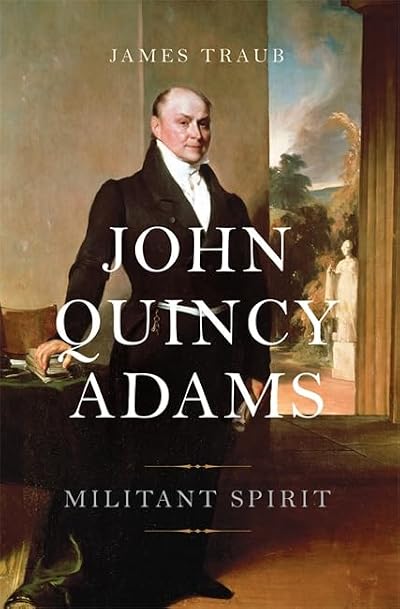
John Quincy Adams is a man of contrasts.  Born during the revolutionary era he’s essentially the first post-colonial American politician.  Yet he’s oddly old fashioned, formal, and clings to the idea of a government without parties that only George Washington could make work.  He’s flinty and economical in a way that reflects his home state of Massachusetts, but he actually lives much of his life abroad and in Washington.

From the age of 11 he was accompanying his father on diplomatic missions to Europe, and at 14 was working as an ambassadorial secretary and translator.  He was elected to the Senate as a Federalist but his determination to following his own conscience earned him the enmity of his own party in New England.  He was more successful as a diplomat with positions in Prussia, Russia, and the United Kingdom.  He negotiated the Treaty of Ghent ending the War of 1812. President Monroe appoints him Secretary of State from 1817 to 1825. The Monroe Doctrine, despite his name, is largely Adams’ idea.

All of this sets him up for the presidency. Not able to accomplish anything easily Adams is elected in a multi-candidate race that is decided by the House of Representatives and some notorious vote trading.  Despite his efforts to rise above party politics, Adams’ single term is consumed by it, with partisan attacks by the Jackson faction preventing any major accomplishments.  After losing in the Election of 1828, Adams doesn’t fade away into retirement but instead is elected to the House of Representatives.

It’s this last 16 years of his life where Adams flourishes.  While opposed to slavery, Adams was not an abolitionist.  But he leads the opposition to the gag rule preventing the reading of petitions against slavery on the grounds of free speech.  As a result he becomes a hero to nascent abolition movement befriending leaders of the movement, and adopting their views, although believing that slavery would only be ended through war.  In 1841 he defended the enslaved people in the Amistad case before the Supreme Court.  Adams kept working and fighting to the end, suffering a massive stroke on the floor of the House in 1848, preceding his death.

The book is also interesting in detailing Adams’ obsessions and interests. Traub writes: ” Adams took up hobbies to the point of mania.” During his career Adams tried to introduce the metric system, a national university, and a system of astronomical observatories, with little success.  He was more successful in directing the James Smitshon gift toward a museum and research institute.  He also loved swimming in the Potomac each morning, on one occasion during his presidency coming close to drowning with only one assistant as a witness.  He was also fascinated by the railroad, becoming an early adopter, even after surviving a deadly derailment in New Jersey.

This is a fascinating book in that if provides an insight into a period of American history I’m less familiar with.  In fact it’s basically a history of the first 75 year of U.S. politics.  Adams is a complex and often unlikable man.  His family relationships are strained, with his wife Louisa seeming to be miserable most of the time from having to conform to the stern Adams way of life.  Adams’ brothers and sons are also troubled by depression and alcoholism resulting from the overbearing expectations of the family’s ideals.

Favorite Passages:

In the years to come, Adams would discover that the solution to his life lay in politics. He had a gift not for avoiding the storms of partisanship, but for weathering them. – Chapter 9

Adams regarded the Bible not as infallible text but as a human narrative inspired by revelation—the greatest of all works of literature. He knew all the debates and did not wish to be distracted by them from the central message. He told George that it was unknowable, and unnecessary to know, whether Jesus was “a manifestation of almighty God” or simply his only son. – Chapter 14

(On the Monroe Doctrine) It is striking that so self-consciously moral and Christian a figure as Adams was prepared to excuse bellicose behavior in the name of national self-aggrandizement. For Adams, American destiny had a moral force of its own – Chapter 16

Tom’s slow downward spiral, and his ultimate humiliation, offers a pointed reminder of how very hard it was to be an Adams. The family lacked the wealth that served as a safety net for the less lucky or gifted or driven members of other prominent families. At the same time, a merely ordinary disposition, much less a tender one, could not survive the pressure of family expectations. John Quincy had been forged in the fires and emerged whole and hard; neither Charles nor Tom had proved so fortunate. John Quincy Adams had put his own children through the same thresher, and that generation, too, would see a terrible winnowing. – Chapter 17

THE MOST IMPORTANT JOBS JOHN QUINCY ADAMS HAD EVER held were ones to which he had been appointed by a president—minister to the Netherlands, Prussia, Russia, and England; chief negotiator at Ghent; secretary of state. Of course he had sought electoral positions, but he had not shown much of a gift for attracting voters. He had lost his very first contest, for state assemblyman, and had been recalled as a US senator by a state legislature outraged at his stubborn independence. He did not like appealing to voters, did not believe he should have to, and was not good at it. And now he was living with the consequences. – Chapter 22

As the first president to have gone back to work after his tenure, Adams had given himself the opportunity, as none of his predecessors had, to benefit from a “sober second thought.” He had changed the meanings Americans attached to him. No longer the dynastic New Englander who represented an archaic Federalist America, Adams had become the dauntless standard-bearer of the very modern cause of abolitionism. At the same time, his rootedness in the republican principles of the founders also placed him on a pedestal in the national pantheon. Indeed, the very fact that he had not changed, that he had stood for principles when they were despised and lived to see them vindicated, offered the most powerful evidence of his greatness of character. – Chapter 36

Recommended books:

  • John Adams by David McCullough
  • Passionate Sage: The Character and Legacy of John Adams by Joseph J. Ellis
  • The Great Abolitionist by Stephen Puleo

Rating: ****