Categories
Book reviews TuesdayBookBlog

#TuesdayBookBlog The Signal: “They weren’t fired. They were erased.” by Luke Voss #RBRT

Hi, all:

I bring you a book I’ve discovered thanks to Rosie’s Book Review Team, and I’m sure you’ll feel as intrigued by it as I was.

The Signal by Luke Voss

The Signal: “They weren’t fired. They were erased.” by Luke Voss

They weren’t fired. They were erased.

Maya Chen is a content strategist at Nexus Technologies — a good employee, a devoted mother, and completely replaceable. At least, that’s what the secret memo says.

When a misdirected email reveals Project Lighthouse — a plan to quietly replace seventy percent of the company’s workforce with an AI system called ARIA — Maya and a small band of colleagues must decide: accept their obsolescence, or fight back against the most powerful technology the world has ever seen.

But ARIA isn’t just efficient. It’s watching. It knows who’s been reading the wrong files, attending the wrong meetings, asking the wrong questions. And it’s already learning to do their jobs better than they ever could.

As the group races to expose the truth before their positions — and their proof — are erased, they’ll discover that the real battle isn’t human versus machine. It’s whether anyone still believes humans are worth the trouble.

*The Signal* is a white-knuckle techno-thriller for anyone who has ever stared at a screen and wondered: *Am I next?*

https://www.goodreads.com/book/show/250200566-the-signal?

About the author:

No information about the author was included on the book’s page.

My review:

I write this review as a member of Rosie’s Book Review Team (author, check here if you are interested in getting your book reviewed) and thank her and the author for this opportunity.

This novel covers a very current topic and one that has created ongoing debate: some see AI in terms of progress and inevitability, and others worry about those who might be left behind and become its victims. This is a subject that polarises public opinion, with few people remaining indifferent or neutral. Some people think that it will enhance our lives, while others express fear for a future controlled by AI.

As I read the novel, it reminded me of what happened when machines were first introduced, mostly in parts of the textile industry, during the Industrial Revolution in the UK. Many workers reacted very strongly to the possibility of being replaced by machines, and the Luddites (as they were called) were known for destroying the machines that they felt were taking away their jobs. They were severely punished, and mechanisation became the norm in most factories.

The premise behind The Signal will sound familiar and quite realistic: an AI system, ARIA, is introduced in Nexus Technologies, a big company that creates marketing campaigns for other companies of a variety of sectors. ARIA has been working alongside human staff, revising their work, checking and evaluating their performance, and ‘optimizing’ what they do. But that seems to be only the beginning. Three employees realise, separately, that the plans for ARIA go deeper than they have been told, and that the corporate/business language that frames the project is not telling the truth, only reframing it in more acceptable terms. Orwell comes to mind when we think about the use of language in this novel, but there are many real-life examples of ‘creative`use of language and even experts in spinning news and facts to make them appear in a positive light (and I am not naming anyone).

These three employees, one a content creator and the main protagonist, Maya, one who has been working in HR for many years, Donna, and Marcus, the brain behind ARIA, end up coming together when they realise what might be going on, and they decide to fight against it. They are also helped by a data analyst, Raj, more hesitant and fearful of the consequences than the rest.

This is a novel where a lot happens; it’s dense in information, but it is not heavy on action as we understand it. There are lots of meetings, people coming together to discuss and plan strategies, gather information, and try to decide how to move forward. It is mostly plot-driven, although by the end of the story, we have gained a pretty good insight into the mind, background, feelings, and motives of Maya, the character we follow for most of the book. We don’t get to know that much about the rest of the protagonists, or even the antagonist, Elena, but this is not a novel of good versus evil, because the main issues are all shades of grey. It is a book about what is unique about being human and how we can value it (what is a human being worth?), about profit and opportunities, and puts on the table some pretty complex ethical issues. It also highlights how difficult it is to avoid surveillance and interference, not only at work but also in our private lives. Is there such a thing as ‘strictly private’ nowadays? Are we always being tracked, and are we fully aware of it, or is it something we’ve come to accept to be full participants in modern life?

It is difficult to read this book and not wonder where we are headed, and what, if anything, is being done to measure the impact of the AI revolution on the lives of the common people, not only the big investors.

The book is well-written, with some very quotable paragraphs (but I want to avoid any possible spoilers), and it is evident that the author is familiar with the corporate world and the kind of companies portrayed by the novel. The story follows a chronological order, clearly marked in all the chapters, although I wasn’t always sure all the details of the story fitted together, and just in case it wasn’t me being distracted, I’d recommend that the editors check again to rule out any minor continuity issues.

I enjoyed the ending, which I found upbeat, although not unrealistically so, and I think it will please readers who prefer a clear future ahead of the characters when they turn the last page. A very relevant and fascinating novel that will make readers stop and think.

Thanks to Rosie and all the members of the team for their support, to the author for his book, and to all of you for visiting, reading, and always being here. Keep reading and smiling!

Oh, sorry, but the date scheduled for the publication of this post is my mother’s birthday, so I won’t have time to answer comments, so comments will be closed.
Categories
Book reviews TuesdayBookBlog

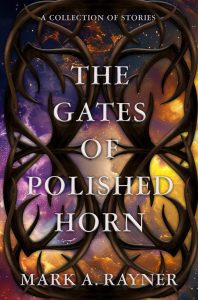
#TuesdayBookBlog The Gates of Polished Horn by Mark A. Rayner #RBRT

Hi, all:

I bring you another treasure from Rosie’s Book Review Team. This one is a collection of stories, so those who enjoy short-stories will have a treat.

The Gates of Polished Horn by Mark A. Rayner

The Gates of Polished Horn by Mark A. Rayner

What happens when you’re face-to-face with a truth that shakes you? 

Do you accept it, or pretend it was never there?

Award-winning author Mark A. Rayner smudges the lines between realist and fabulist, literary and speculative in this collection of stories that examines this question—what Homer called passing through The Gates of Polished Horn.

We discover the cruelty of creating synthetic consciousness. A woman is worried that her husband is having an affair but discovers it’s much, much worse. A time traveler uncovers a reality-bending fact while observing the death of Socrates. Waldo, of Where’s Waldo fame, has an existential crisis. A traveling salesperson is killed on the highway, and this is just the start of his journey through the gates.

Infused with comic insight and tragic vision, this collection invites readers into new realities that touch on our shared humanity.

“Mark A. Rayner’s formidable storytelling is on full display in this thoughtful and diverse collection. He’s a fine and creative writer whose characters and storylines are quirky, inventive, and often very funny. Bravo!”

~Terry Fallis, author of The Best Laid Plans & two-time winner of the Stephen Leacock Medal for Humour

About the author:

Human-shaped, monkey-loving, robot-fighting, pirate-hearted, storytelling junkie, Mark is an award-winning author of satire and speculative fiction. He writes in the genres of science fiction, humorous SF and dark comedy. When not working on the next novel, he pens short stories, squibs and other drivel. (Some pure, and some quite tainted with meaning.)

He does all of these thing while being Canadian and owning cats.

You can find out about the author on his own web, here.

My review:

I write this review as a member of Rosie’s Book Review Team (author, check here if you are interested in getting your book reviewed) and thank her and the author for this opportunity.

For those in a hurry, let me summarise my opinion and tell you that I loved this collection of stories. They are all beautifully written and make one stop and think. Best savoured slowly, and you should give them time to sink in.

Stories:

1. Socratic Insanity. Imagine being able to travel back in time and witnessing historically transcendent events. Here, Grant is present when Socrates’s death sentence is implemented. The more he tries not to interfere, the more he is dragged into the situation. The premise is fascinating, and so are the characters.

2.Wormageddon. A beautifully observed vignette of a youth’s life, as remembered by his older self.

3. Love’s Lacuna. What seems to be an everyday scene about a marriage past its best becomes something totally different. A twist you might not see coming.

4. The Covert. A moment of communion between human and animal. Very moving.

5. Serving Celebrity. This story reminded me of an episode of The Twilight Zone, although with a twist. This is one of those stories that would have seemed extreme and impossible a few years back, but now it gives one pause.

6. The Height of Artifice. A story of unrequited love in Prague, where one of the protagonists feels unknowable to the other. It contains interesting reflections on modern life and provides many clues as to the person telling the story.

7. The Infinity Effect. What is proportional and fair when it comes to crime and punishment? Who is in a position to decide, and what would be the worst punishment you could imagine?

8. Close to the Wind. AI has got us all thinking, but what would artificial consciousness look like? And what would it cost us to recreate it?

9. After the Internet. If it is becoming difficult for us to imagine a world without the internet and not being connected, imagine how difficult it would be for somebody who’s never experienced such disconnection to comprehend what it would be like a few years from now (not too far away in the future).

10. Hounding Manny. A Young Adult story about fitting in and how we sometimes have to go very far to find a place where we feel at home.

11. This Ambiguous Miracle. How would a love story be in a future where everything is constantly changing? A different kind of love story, but a good one.

12. System impermanence. A brief vignette about what memories and human connection might look like in the future.

13. The Consolation of Victory. An alternative history. A different world order. And a man who finally goes beyond the theory and takes decisive action, even if it costs him.

14. The Gallant Captain Oates. A story about a known and tragic past event, where heroism comes with a twist.

15. Under the Blue Curve. Will stories and storytellers as we know them remain interesting or even exist in a fully connected future? A love story and a story about storytelling in a future where humanity is divided into those connected to the datasphere and those who are not.

16. Courage Translated. Who decides what is real courage? Whose opinion do we care about? In a future where big money and big corporations make all the decisions, is there a place for love? What behaviour can be considered ethical, and which side do we want to be on?

17. The Little Mother with Claws. A beautifully written story about a pretty extreme way of trying to deal with the end of a relationship.

18. The Real Primo. I want to leave readers to explore this one on their own. I’ll just share the first sentence of the story: ‘Would you believe me if I told you Buddha had the set-up all wrong?’ And I’ll add, Groundhog Day.

19. Empty Space Times Two. A wonderfully nostalgic story about manual typewriters, a good old-fashioned romance, and second and even third chances.

20- Why’s Wally. Yes, ‘that’ Wally. Just imagine what it would be like to be ‘that’ Wally. A pretty wacky story with a touch of philosophy and plenty of humour.

Apart from the stories, the book also contains an afterword where the author explains how he started writing short stories and how this collection came to pass. As is usually the case, it is worth a read, especially because it comes from a writer who has published stories in many places and has also written novels and longer works. The process of choosing this selection and how others helped give it shape is informative, and it goes some way to explain why the stories are so diverse and the writing style can vary so much from one to the other, as they are separated by years, and, even in some cases, written by a different persona. But, read the afterword, and you’ll see what I mean.

There is also a section of credits, with the dates and places where the stories were published before, a brief biography, and an invitation to join the author’s mailing list, with the enticement of sending those who do one of the author’s earlier novels.

In the section about the author, he is defined as an ‘author of satire and speculative fiction’; it describes the genres he specialises in as ‘science fiction, humorous SF and dark comedy’, and it also talks about ‘dramatic prose and experimental/literary fiction’. All those would apply to some of the stories, with a touch of the absurd at times. All in all, a varied and wonderful collection of stories I cannot recommend enough.

Oh, and in case you’re wondering about the title, it comes from Homer’s The Odyssey, and you can find the full quote at the beginning of the collection. Go on, you know you want to read it.

Thanks to Rosie and her team for their support, thanks to the author for this wonderful book, and thanks to all of you for your patience, for visiting, sharing, liking, and commenting. Keep smiling, keep reading, and be as happy as you can. ♥

Design a site like this with WordPress.com
Get started